The Reading Room | Select Bacchus Editions:
No Kingdom Comes


The Bibliographical Labyrinth
Explore the complete bibliography and follow its references into further writings, histories, and related works.
The Alphabetical Index
A clickable guide to the names, ideas, texts, and historical references encountered throughout the book.
Dancing in the Backwoods
Explore the six volumes of Dancing in the Backwoods and the wider literary and philosophical project to which this book belongs.
The Author & the Book
Reflections on the writing of No Kingdom Comes, its origins, and the questions that gave rise to it.
Word From Elsewhere
Reviews and commentary on No Kingdom Comes.
No Kingdom Comes: On Blasphemy and the End of Empire is the most philosophically dense book published by Bacchus Editions to date. As such, it has a life beyond its published pages.This room brings together an expanded index, an interconnected bibliography, further writings on the book's references and footnotes, reflections on its writing, and selected correspondence. Readers may follow its many paths into related works, explore the larger Dancing in the Backwoods series, and return as new materials are added.
This reading room is laid out as follows:


No Kingdom Comes: On Blasphemy and the End of Empire, Fíona Vivienne. Dancing in the Backwoods, Book VI. Bacchus Editions, 2026.
424 pages of anarchist philosophy, with an extensive bibliography and index. Hardcover.

The Bibliographical Labyrinth
-
303 Creative LLC v. Elenis, 600 U.S. 570 (2023).
Agamben, Giorgio. Profanations. Translated by Jeff Fort. New York: Zone Books, 2007.
Allen, Anita L. Uneasy Access: Privacy for Women in a Free Society. Totowa, NJ: Rowman & Littlefield, 1988.
Alliance Defending Freedom.
———. “Alliance Defense Fund Now Alliance Defending Freedom.” Press release, July 9, 2012.
———. “History.”
American Library Association. “American Library Association Reports Record Number of Unique Book Titles Challenged in 2023.” March 14, 2024.
Anselm of Canterbury. Cur Deus Homo (Why God Became Man). In Anselm of Canterbury: The Major Works, edited by Brian Davies and G. R. Evans. Oxford: Oxford University Press, 1998.
Arendt, Hannah. “The Crisis in Education.” In Between Past and Future: Six Exercises in Political Thought. New York: Viking Press, 1961.
———. Eichmann in Jerusalem: A Report on the Banality of Evil. Rev. and enl. ed. New York: Viking Press, 1964.
———. The Human Condition. 2nd ed. Chicago: University of Chicago Press, 1998.
———. On Violence. New York: Harcourt, Brace & World, 1970.
———. Responsibility and Judgment. Edited by Jerome Kohn. New York: Schocken Books, 2003.
———. “What Is Authority?” In Between Past and Future: Six Exercises in Political Thought. New York: Viking Press, 1961.
Asad, Talal. Formations of the Secular: Christianity, Islam, Modernity. Stanford: Stanford University Press, 2003.
———. Genealogies of Religion: Discipline and Reasons of Power in Christianity and Islam. Baltimore: Johns Hopkins University Press, 1993.
Augustine. The City of God. Translated by Marcus Dods. In Nicene and Post-Nicene Fathers, first series, vol. 2, edited by Philip Schaff. Buffalo, NY: Christian Literature Publishing, 1887.
———. The City of God against the Pagans. Translated by R. W. Dyson. Cambridge: Cambridge University Press, 1998.
Baker, Emerson W. A Storm of Witchcraft: The Salem Trials and the American Experience. New York: Oxford University Press, 2015.
Bakhtin, Mikhail. Rabelais and His World. Translated by Hélène Iswolsky. Bloomington: Indiana University Press, 1984.
Barthes, Roland. “The Death of the Author.” In Image-Music-Text, translated by Stephen Heath. New York: Hill and Wang, 1977.
Bartky, Sandra Lee. “Foucault, Femininity, and the Modernization of Patriarchal Power.” In Femininity and Domination: Studies in the Phenomenology of Oppression, 63–82. New York: Routledge, 1990.
Barzilay, Tzafrir. Poisoned Wells: Accusations, Persecution, and Minorities in Medieval Europe, 1321–1422. Philadelphia: University of Pennsylvania Press, 2022.
Beauvoir, Simone de. The Ethics of Ambiguity. Translated by Bernard Frechtman. New York: Philosophical Library, 1948.
———. The Second Sex. Translated by Constance Borde and Sheila Malovany-Chevallier. New York: Alfred A. Knopf, 2010.
Becker, Howard S. Outsiders: Studies in the Sociology of Deviance. New York: Free Press of Glencoe, 1963.
Bellah, Robert N. “Civil Religion in America.” Daedalus 96, no. 1 (Winter 1967): 1–21.
Benedict of Nursia. The Rule of Saint Benedict.
Benjamin, Walter. “On the Concept of History.” Translated by Harry Zohn. In Selected Writings, vol. 4, 1938–1940, edited by Howard Eiland and Michael W. Jennings. Cambridge, MA: Harvard University Press, 2003.
Bercovitch, Sacvan. The American Jeremiad. Madison: University of Wisconsin Press, 1978.
Berger, Peter L., and Thomas Luckmann. The Social Construction of Reality: A Treatise in the Sociology of Knowledge. Garden City, NY: Doubleday, 1966.
Bergson, Henri. Laughter: An Essay on the Meaning of the Comic. Translated by Cloudesley Brereton and Fred Rothwell. London: Macmillan, 1911.
Berlin, Isaiah. “Two Concepts of Liberty.” In Four Essays on Liberty. Oxford: Oxford University Press, 1969.
———. “Two Concepts of Liberty.” In Liberty, edited by Henry Hardy. Oxford: Oxford University Press, 2002.
Biagioli, Mario. Galileo, Courtier: The Practice of Science in the Culture of Absolutism. Chicago: University of Chicago Press, 1993.
Billig, Michael. Laughter and Ridicule: Towards a Social Critique of Humour. London: SAGE Publications, 2005.
Blumenberg, Hans. The Legitimacy of the Modern Age. Translated by Robert M. Wallace. Cambridge, MA: MIT Press, 1983.
Boase, T. S. R. Boniface VIII. London: Constable, 1933.
Boniface VIII. Unam Sanctam. Papal bull, November 18, 1302. In Corpus Iuris Canonici, edited by Emil Friedberg, vol. 2, Extravagantes communes 1.8.1. Leipzig: Bernhard Tauchnitz, 1881.
Bourdieu, Pierre. “Delegation and Political Fetishism.” In Language and Symbolic Power, edited by John B. Thompson, translated by Gino Raymond and Matthew Adamson. Cambridge, MA: Harvard University Press, 1991.
Brown, Wendy. Regulating Aversion: Tolerance in the Age of Identity and Empire. Princeton: Princeton University Press, 2006.
———. States of Injury: Power and Freedom in Late Modernity. Princeton: Princeton University Press, 1995.
Brundage, James A. Law, Sex, and Christian Society in Medieval Europe. Chicago: University of Chicago Press, 1987.
Burke, Edmund. Reflections on the Revolution in France. Edited by L. G. Mitchell. Oxford: Oxford University Press, 1993.
Butler, Judith. Giving an Account of Oneself. New York: Fordham University Press, 2005.
———. Precarious Life: The Powers of Mourning and Violence. London: Verso, 2004.
———. The Psychic Life of Power: Theories in Subjection. Stanford: Stanford University Press, 1997.
Calhoun, Cheshire. “Changing One’s Heart.” Ethics 103, no. 1 (1992): 76–96.
Camus, Albert. The Rebel. Translated by Anthony Bower. New York: Vintage International, 1991.
Carlson, Allan C., and Paul T. Mero. The Natural Family: A Manifesto. Dallas: Spence Publishing, 2007.
Cassian, John. The Institutes. Translated by Edgar C. S. Gibson. In Nicene and Post-Nicene Fathers, second series, vol. 11, edited by Philip Schaff and Henry Wace. New York: Christian Literature Company, 1894.
Catholic Church. Catechism of the Catholic Church.
———. Code of Canon Law. 1983.
Cavarero, Adriana. Inclinations: A Critique of Rectitude. Translated by Amanda Minervini and Adam Sitze. Stanford: Stanford University Press, 2016.
———. Relating Narratives: Storytelling and Selfhood. Translated by Paul A. Kottman. London: Routledge, 2000.
Cohen, Stanley. Folk Devils and Moral Panics: The Creation of the Mods and Rockers. London: MacGibbon & Kee, 1972.
Collins, Patricia Hill. Black Feminist Thought: Knowledge, Consciousness, and the Politics of Empowerment. 2nd ed. New York: Routledge, 2000.
Concerned Women for America. “CWA Founder Beverly LaHaye.” https://concernedwomen.org/cwa-founder-beverly-lahaye/.
Criminal Justice and Immigration Act 2008, c. 4, § 79 (UK).
Critchlow, Donald T. Phyllis Schlafly and Grassroots Conservatism: A Woman’s Crusade. Princeton: Princeton University Press, 2005.
Defense of Marriage Act, Pub. L. No. 104-199, 110 Stat. 2419 (1996).
Deleuze, Gilles. Nietzsche and Philosophy. Translated by Hugh Tomlinson. New York: Columbia University Press, 1983.
Derrida, Jacques. Given Time: I. Counterfeit Money. Translated by Peggy Kamuf. Chicago: University of Chicago Press, 1992.
Dobbs v. Jackson Women’s Health Organization, 597 U.S. 215 (2022).
Donahue, Charles, Jr. Law, Marriage, and Society in the Later Middle Ages: Arguments about Marriage in Five Courts. Cambridge: Cambridge University Press, 2007.
Dotson, Kristie. “Tracking Epistemic Violence, Tracking Practices of Silencing.” Hypatia 26, no. 2 (2011): 236–57.
Douglas, Mary. Purity and Danger: An Analysis of Concepts of Pollution and Taboo. London: Routledge & Kegan Paul, 1966.
Durkheim, Émile. The Division of Labour in Society. Translated by W. D. Halls. New York: Free Press, 1984.
Dworkin, Gerald. “Paternalism.” The Monist 56, no. 1 (1972): 64–84.
-
Eagleton, Terry. Walter Benjamin, or Towards a Revolutionary Criticism. London: Verso, 1981.
Federici, Silvia. Caliban and the Witch: Women, the Body and Primitive Accumulation. Brooklyn, NY: Autonomedia, 2004.
Feinberg, Joel. Offense to Others: The Moral Limits of the Criminal Law. New York: Oxford University Press, 1985.
Fejes, Fred. Gay Rights and Moral Panic: The Origins of America’s Debate on Homosexuality. New York: Palgrave Macmillan, 2008.
Feuerbach, Ludwig. The Essence of Christianity. Translated by George Eliot. London: John Chapman, 1854.
———. Das Wesen des Christentums. Leipzig: Otto Wigand, 1841.
Field, Sean L. The Beguine, the Angel, and the Inquisitor: The Trials of Marguerite Porete and Guiard of Cressonessart. Notre Dame, IN: University of Notre Dame Press, 2012.
Finocchiaro, Maurice A. The Galileo Affair: A Documentary History. Berkeley: University of California Press, 1989.
———. Retrying Galileo, 1633–1992. Berkeley: University of California Press, 2005.
Foucault, Michel. Discipline and Punish: The Birth of the Prison. Translated by Alan Sheridan. New York: Pantheon Books, 1977.
———. Histoire de la sexualité. Vol. 1, La Volonté de savoir. Paris: Gallimard, 1976.
———. The History of Sexuality. Vol. 1, An Introduction. Translated by Robert Hurley. New York: Pantheon Books, 1978.
———. Security, Territory, Population: Lectures at the Collège de France, 1977–1978. Edited by Michel Senellart. Translated by Graham Burchell. Basingstoke: Palgrave Macmillan, 2007.
———. Surveiller et punir: Naissance de la prison. Paris: Gallimard, 1975.
———. “What Is an Author?” In Language, Counter-Memory, Practice: Selected Essays and Interviews, edited by Donald F. Bouchard, translated by Donald F. Bouchard and Sherry Simon. Ithaca: Cornell University Press, 1977.
France. Loi no 2004-228 du 15 mars 2004 encadrant, en application du principe de laïcité, le port de signes ou de tenues manifestant une appartenance religieuse dans les écoles, collèges et lycées publics. Journal officiel de la République française, March 17, 2004.
Fricker, Miranda. Epistemic Injustice: Power and the Ethics of Knowing. Oxford: Oxford University Press, 2007.
Friedman, Marilyn. Autonomy, Gender, Politics. New York: Oxford University Press, 2003.
Gaskill, Malcolm. Witchfinders: A Seventeenth-Century English Tragedy. Cambridge, MA: Harvard University Press, 2005.
Gelasius I. “Letter to Emperor Anastasius.” 494. Translated by John S. Ott. Portland State University. https://web.pdx.edu/~ott/Gelasius/.
Gentile, Emilio. Politics as Religion. Translated by George Staunton. Princeton: Princeton University Press, 2006.
Girard, René. Deceit, Desire, and the Novel: Self and Other in Literary Structure. Translated by Yvonne Freccero. Baltimore: Johns Hopkins Press, 1965.
———. I See Satan Fall Like Lightning. Translated by James G. Williams. Maryknoll, NY: Orbis Books, 2001.
———. Mensonge romantique et vérité romanesque. Paris: Bernard Grasset, 1961.
———. The Scapegoat. Translated by Yvonne Freccero. Baltimore: Johns Hopkins University Press, 1986.
———. Things Hidden Since the Foundation of the World. Translated by Stephen Bann and Michael Metteer. Stanford: Stanford University Press, 1987.
———. Violence and the Sacred. Translated by Patrick Gregory. Baltimore: Johns Hopkins University Press, 1977.
Goffman, Erving. Stigma: Notes on the Management of Spoiled Identity. Englewood Cliffs, NJ: Prentice-Hall, 1963.
Goldman, Emma. My Disillusionment in Russia. Garden City, NY: Doubleday, Page & Company, 1923.
———. My Further Disillusionment in Russia. Garden City, NY: Doubleday, Page & Company, 1924.
Graeber, David. Debt: The First 5,000 Years. Brooklyn, NY: Melville House, 2011.
———. Fragments of an Anarchist Anthropology. Chicago: Prickly Paradigm Press, 2004.
Guérin, Daniel. Anarchism: From Theory to Practice. Translated by Mary Klopper. New York: Monthly Review Press, 1970.
Hacking, Ian. “Making Up People.” In Reconstructing Individualism: Autonomy, Individuality, and the Self in Western Thought, edited by Thomas C. Heller, Morton Sosna, and David E. Wellbery, 222–36. Stanford: Stanford University Press, 1986.
Hall, David D., ed. The Antinomian Controversy, 1636–1638: A Documentary History. 2nd ed. Durham, NC: Duke University Press, 1990.
Haraway, Donna. “Situated Knowledges: The Science Question in Feminism and the Privilege of Partial Perspective.” Feminist Studies 14, no. 3 (1988): 575–99.
Harding, Sandra. Whose Science? Whose Knowledge? Thinking from Women’s Lives. Ithaca: Cornell University Press, 1991.
Hatch, Nathan O. The Democratization of American Christianity. New Haven: Yale University Press, 1989.
Heller, Agnes. Everyday Life. Translated by G. L. Campbell. London: Routledge & Kegan Paul, 1984.
Herman, Judith Lewis. Trauma and Recovery. New York: Basic Books, 1992.
Hobbes, Thomas. Leviathan. Edited by Richard Tuck. Cambridge: Cambridge University Press, 1996.
Hubert, Henri, and Marcel Mauss. “Essai sur la nature et la fonction du sacrifice.” L’Année sociologique 2 (1899): 29–138.
———. Sacrifice: Its Nature and Function. Translated by W. D. Halls. Chicago: University of Chicago Press, 1964.
Hume, David. “Of the Original Contract.” In Essays, Moral, Political, and Literary, edited by Eugene F. Miller. Indianapolis: Liberty Fund, 1987.
Hursthouse, Rosalind. “Virtue Theory and Abortion.” Philosophy & Public Affairs 20, no. 3 (1991): 223–46.
-
Ignatius of Loyola. The Spiritual Exercises. Translated by Louis J. Puhl.
———. “To the Members of the Society in Portugal.” Rome, March 26, 1553. In Ignatius of Loyola: Letters and Instructions, edited by John W. Padberg et al., 412–21. St. Louis: Institute of Jesuit Sources, 1996.
Innocent III. Novit ille. 1204. In Decretals of Gregory IX, X 2.1.13. In Corpus Iuris Canonici, edited by Emil Friedberg, vol. 2, cols. 242–44. Leipzig: Bernhard Tauchnitz, 1881.
Jefferson, Thomas. Thomas Jefferson to James Madison, September 6, 1789. In The Papers of Thomas Jefferson, vol. 15, 27 March 1789 to 30 November 1789, edited by Julian P. Boyd. Princeton: Princeton University Press, 1958.
John Paul II. Man and Woman He Created Them: A Theology of the Body. Translated by Michael Waldstein. Boston: Pauline Books & Media, 2006.
Johnson, Emily Suzanne. This Is Our Message: Women’s Leadership in the New Christian Right. New York: Oxford University Press, 2019.
Kant, Immanuel. The Metaphysics of Morals. Translated and edited by Mary Gregor. Cambridge: Cambridge University Press, 1996.
Kantorowicz, Ernst H. The King’s Two Bodies: A Study in Mediaeval Political Theology. Princeton: Princeton University Press, 1957.
Kittay, Eva Feder. Love’s Labor: Essays on Women, Equality, and Dependency. New York: Routledge, 1999.
Koselleck, Reinhart. Futures Past: On the Semantics of Historical Time. Translated by Keith Tribe. New York: Columbia University Press, 2004.
La Boétie, Étienne de. The Politics of Obedience: The Discourse of Voluntary Servitude. Translated by Harry Kurz. Introduction by Murray N. Rothbard. New York: Free Life Editions, 1975.
Landauer, Gustav. Revolution and Other Writings: A Political Reader. Edited and translated by Gabriel Kuhn. Oakland: PM Press, 2010.
LaPlante, Eve. American Jezebel: The Uncommon Life of Anne Hutchinson, the Woman Who Defied the Puritans. San Francisco: HarperSanFrancisco, 2004.
Le Bon, Gustave. The Crowd: A Study of the Popular Mind. London: T. Fisher Unwin, 1896.
———. Psychologie des foules. Paris: Félix Alcan, 1895.
Le Goff, Jacques. The Birth of Purgatory. Translated by Arthur Goldhammer. Chicago: University of Chicago Press, 1984.
Lefebvre, Henri. Critique of Everyday Life. Vol. 1. Translated by John Moore. London: Verso, 1991.
Lerner, Robert E. The Heresy of the Free Spirit in the Later Middle Ages. Berkeley: University of California Press, 1972.
Levack, Brian P. The Witch-Hunt in Early Modern Europe. 4th ed. London: Routledge, 2016.
Locke, John. A Letter Concerning Toleration. Translated by William Popple. 1689.
———. Two Treatises of Government. Edited by Peter Laslett. Cambridge: Cambridge University Press, 1988.
Löwith, Karl. Meaning in History: The Theological Implications of the Philosophy of History. Chicago: University of Chicago Press, 1949.
Löwy, Michael. Fire Alarm: Reading Walter Benjamin’s “On the Concept of History.” Translated by Chris Turner. London: Verso, 2005.
Lugones, María. “Toward a Decolonial Feminism.” Hypatia 25, no. 4 (2010): 742–59.
Luker, Kristin. Abortion and the Politics of Motherhood. Berkeley: University of California Press, 1984.
Mackenzie, Catriona, and Natalie Stoljar, eds. Relational Autonomy: Feminist Perspectives on Autonomy, Agency, and the Social Self. New York: Oxford University Press, 2000.
MacKinnon, Catharine A. Toward a Feminist Theory of the State. Cambridge, MA: Harvard University Press, 1989.
Mahmood, Saba. Politics of Piety: The Islamic Revival and the Feminist Subject. Princeton: Princeton University Press, 2005.
———. Religious Difference in a Secular Age: A Minority Report. Princeton: Princeton University Press, 2016.
———. “Religious Reason and Secular Affect: An Incommensurable Divide?” Critical Inquiry 35, no. 4 (2009): 836–62.
Mansbridge, Jane J. Why We Lost the ERA. Chicago: University of Chicago Press, 1986.
Marcel, Gabriel. Being and Having. Translated by Katharine Farrer. London: Dacre Press, 1949.
Marcuse, Herbert. One-Dimensional Man: Studies in the Ideology of Advanced Industrial Society. Boston: Beacon Press, 1964.
———. “Repressive Tolerance.” In A Critique of Pure Tolerance, by Robert Paul Wolff, Barrington Moore Jr., and Herbert Marcuse. Boston: Beacon Press, 1965.
Martin, Dale B. The Corinthian Body. New Haven: Yale University Press, 1995.
Masterpiece Cakeshop, Ltd. v. Colorado Civil Rights Commission, 584 U.S. 617 (2018).
Mauss, Marcel. The Gift: The Form and Reason for Exchange in Archaic Societies. Translated by W. D. Halls. London: Routledge, 1990.
Maxwell, Carol J. C. Pro-Life Activists in America: Meaning, Motivation, and Direct Action. Cambridge: Cambridge University Press, 2002.
McSheffrey, Shannon. Marriage, Sex, and Civic Culture in Late Medieval London. Philadelphia: University of Pennsylvania Press, 2006.
Merleau-Ponty, Maurice. Phenomenology of Perception. Translated by Donald A. Landes. London: Routledge, 2012.
Mill, John Stuart. On Liberty. 1859.
Moen, Matthew C. The Transformation of the Christian Right. Tuscaloosa: University of Alabama Press, 1992.
Moore, R. I. The Formation of a Persecuting Society: Authority and Deviance in Western Europe, 950–1250. 2nd ed. Malden, MA: Blackwell, 2007.
-
Nietzsche, Friedrich. The Birth of Tragedy. Translated by Walter Kaufmann. New York: Vintage Books, 1967.
———. On the Genealogy of Morality and Other Writings. Rev. student ed. Edited by Keith Ansell-Pearson. Translated by Carol Diethe. Cambridge: Cambridge University Press, 2006.
———. On the Genealogy of Morals and Ecce Homo. Translated by Walter Kaufmann and R. J. Hollingdale. New York: Vintage Books, 1967.
———. “On the Uses and Disadvantages of History for Life.” In Untimely Meditations, edited by Daniel Breazeale, translated by R. J. Hollingdale. Cambridge: Cambridge University Press, 1997.
Noddings, Nel. Caring: A Feminine Approach to Ethics and Moral Education. Berkeley: University of California Press, 1984.
Norton, Mary Beth. In the Devil’s Snare: The Salem Witchcraft Crisis of 1692. New York: Alfred A. Knopf, 2002.
Nussbaum, Martha C. “Objectification.” Philosophy & Public Affairs 24, no. 4 (1995): 249–91.
———. Upheavals of Thought: The Intelligence of Emotions. Cambridge: Cambridge University Press, 2001.
Obergefell v. Hodges, 576 U.S. 644 (2015).
Paine, Thomas. Rights of Man. Introduction by Eric Foner. Notes by Henry Collins. London: Penguin Books, 1984.
PEN America. Banned in the USA: Beyond the Shelves. November 1, 2024. https://pen.org/report/beyond-the-shelves/.
———. Cover to Cover: An Analysis of Titles Banned in the 23–24 School Year. February 27, 2025. https://pen.org/report/cover-to-cover/.
Pettit, Philip. Republicanism: A Theory of Freedom and Government. Oxford: Clarendon Press, 1997.
Planned Parenthood of Southeastern Pennsylvania v. Casey, 505 U.S. 833 (1992).
Plato. Phaedrus. Translated by Alexander Nehamas and Paul Woodruff. In Plato: Complete Works, edited by John M. Cooper. Indianapolis: Hackett, 1997.
———. Symposium. Translated by Alexander Nehamas and Paul Woodruff. In Plato: Complete Works, edited by John M. Cooper. Indianapolis: Hackett, 1997.
Porete, Marguerite. The Mirror of Simple Souls. Translated by Ellen L. Babinsky. New York: Paulist Press, 1993.
Quakers in Britain. “Quakers and World War I.” https://www.quaker.org.uk/faith/our-history/ww1.
Raz, Joseph. “Authority and Justification.” Philosophy & Public Affairs 14, no. 1 (1985): 3–29.
———. The Morality of Freedom. Oxford: Clarendon Press, 1986.
Rich, Adrienne. Of Woman Born: Motherhood as Experience and Institution. New York: W. W. Norton, 1976.
Ricoeur, Paul. Memory, History, Forgetting. Translated by Kathleen Blamey and David Pellauer. Chicago: University of Chicago Press, 2004.
Roe v. Wade, 410 U.S. 113 (1973).
Roper, Lyndal. Witch Craze: Terror and Fantasy in Baroque Germany. New Haven: Yale University Press, 2004.
Rosenthal, Bernard. Salem Story: Reading the Witch Trials of 1692. Cambridge: Cambridge University Press, 1993.
-
Sabbath, Erika L., et al. “US Obstetrician-Gynecologists’ Perceived Impacts of Post–Dobbs v Jackson State Abortion Bans.” JAMA Network Open 7, no. 1 (2024): e2352109. https://doi.org/10.1001/jamanetworkopen.2023.52109.
Sanger, Carol. About Abortion: Terminating Pregnancy in Twenty-First-Century America. Cambridge, MA: Harvard University Press, 2017.
Sartre, Jean-Paul. Being and Nothingness. Translated by Hazel E. Barnes. New York: Philosophical Library, 1956.
Scarry, Elaine. The Body in Pain: The Making and Unmaking of the World. New York: Oxford University Press, 1985.
Scott, James C. Domination and the Arts of Resistance: Hidden Transcripts. New Haven: Yale University Press, 1990.
———. Two Cheers for Anarchism: Six Easy Pieces on Autonomy, Dignity, and Meaningful Work and Play. Princeton: Princeton University Press, 2012.
———. Weapons of the Weak: Everyday Forms of Peasant Resistance. New Haven: Yale University Press, 1985.
Scott, Joan Wallach. The Politics of the Veil. Princeton: Princeton University Press, 2007.
———. Sex and Secularism. Princeton: Princeton University Press, 2017.
Shklar, Judith N. “The Liberalism of Fear.” In Liberalism and the Moral Life, edited by Nancy L. Rosenblum, 21–38. Cambridge, MA: Harvard University Press, 1989.
———. Ordinary Vices. Cambridge, MA: Harvard University Press, 1984.
Simmons, A. John. Justification and Legitimacy: Essays on Rights and Obligations. Cambridge: Cambridge University Press, 2001.
———. Moral Principles and Political Obligations. Princeton: Princeton University Press, 1979.
Skinner, Quentin. “Motives, Intentions and the Interpretation of Texts.” New Literary History 3, no. 2 (1972): 393–408.
Smith, Anthony D. Chosen Peoples: Sacred Sources of National Identity. Oxford: Oxford University Press, 2003.
Sontag, Susan. Illness as Metaphor. New York: Farrar, Straus and Giroux, 1978.
Spierenburg, Pieter. The Spectacle of Suffering: Executions and the Evolution of Repression: From a Preindustrial Metropolis to the European Experience. Cambridge: Cambridge University Press, 1984.
Spinoza, Baruch. Ethics. Translated by Edwin Curley. London: Penguin Books, 1996.
Stirner, Max. Der Einzige und sein Eigenthum. Leipzig: Otto Wigand, 1845.
———. Stirner’s Critics. Translated by Wolfi Landstreicher. Berkeley: LBC Books, 2012.
———. The Unique and Its Property. Translated by Wolfi Landstreicher. Baltimore: Underworld Amusements, 2017.
Stoeckl, Kristina. “The Rise of the Russian Christian Right: The Case of the World Congress of Families.” Religion, State & Society 48, no. 4 (2020): 223–38. https://doi.org/10.1080/09637494.2020.1796172.
Stoeckl, Kristina, and Dmitry Uzlaner. The Moralist International: Russia in the Global Culture Wars. New York: Fordham University Press, 2022.
Strayer, Joseph R. The Reign of Philip the Fair. Princeton: Princeton University Press, 1980.
Sutton, Matthew Avery. American Apocalypse: A History of Modern Evangelicalism. Cambridge, MA: Belknap Press of Harvard University Press, 2014.
Tarde, Gabriel. The Laws of Imitation. Translated by Elsie Clews Parsons. New York: Henry Holt, 1903.
———. Les Lois de l’imitation: Étude sociologique. Paris: Félix Alcan, 1890.
———. L’Opinion et la foule. Paris: Félix Alcan, 1901.
“The Backlash Against Gay Rights in Florida (1977).” The MacNeil/Lehrer Report, June 6, 1977. American Archive of Public Broadcasting. https://americanarchive.org/primary_source_sets/conservatism/9-507-qn5z60ct7w.
Thiel, Andreas, ed. Epistolae Romanorum pontificum genuinae. Vol. 1. Brunsberg: Eduard Peter, 1867.
Thiselton, Anthony C. The First Epistle to the Corinthians: A Commentary on the Greek Text. Grand Rapids, MI: William B. Eerdmans, 2000.
Thomson, Judith Jarvis. “A Defense of Abortion.” Philosophy & Public Affairs 1, no. 1 (1971): 47–66.
Tronto, Joan C. Moral Boundaries: A Political Argument for an Ethic of Care. New York: Routledge, 1993.
Tully, James. A Discourse on Property: John Locke and His Adversaries. Cambridge: Cambridge University Press, 1980.
United Nations General Assembly. Universal Declaration of Human Rights. Resolution 217 A (III), December 10, 1948.
United States Holocaust Memorial Museum. “Rescue.” Holocaust Encyclopedia. https://encyclopedia.ushmm.org/content/en/article/rescue.
United States v. Windsor, 570 U.S. 744 (2013).
Vaneigem, Raoul. The Revolution of Everyday Life. Translated by Donald Nicholson-Smith. London: Rebel Press, 1983. Originally published as Traité de savoir-vivre à l’usage des jeunes générations (1967).
Vivienne, Fíona. The Disloyal Animal. Dancing in the Backwoods. Bacchus Editions, 2024.
———. Nothing Is Innocent. Dancing in the Backwoods. Bacchus Editions, 2024.
———. The Soil Remains Intoxicated. Dancing in the Backwoods. Bacchus Editions, 2024.
———. The Wild Ethics of Maternal Presence. Dancing in the Backwoods. Bacchus Editions, 2024.
Waldron, Jeremy. The Harm in Hate Speech. Cambridge, MA: Harvard University Press, 2012.
Walker, Margaret Urban. Moral Repair: Reconstructing Moral Relations after Wrongdoing. Cambridge: Cambridge University Press, 2006.
Weber, Max. Economy and Society: An Outline of Interpretive Sociology. Edited by Guenther Roth and Claus Wittich. Berkeley: University of California Press, 1978.
Weil, Simone. “The Iliad, or the Poem of Force.” Translated by Mary McCarthy. Politics 2, no. 11 (1945): 321–30.
Wendell, Susan. The Rejected Body: Feminist Philosophical Reflections on Disability. New York: Routledge, 1996.
Whitehouse v. Lemon [1979] AC 617 (HL).
Wilkins, Leslie T. Social Deviance: Social Policy, Action, and Research. London: Tavistock Publications, 1964.
Williams, Bernard. Ethics and the Limits of Philosophy. Cambridge, MA: Harvard University Press, 1985.
———. Truth and Truthfulness: An Essay in Genealogy. Princeton: Princeton University Press, 2002.
Williams, Daniel K. God’s Own Party: The Making of the Christian Right. New York: Oxford University Press, 2010.
Winship, Michael P. Making Heretics: Militant Protestantism and Free Grace in Massachusetts, 1636–1641. Princeton: Princeton University Press, 2002.
Wolff, Robert Paul. In Defense of Anarchism. New York: Harper & Row, 1970.
Wood, Susan. The Proprietary Church in the Medieval West. Oxford: Oxford University Press, 2006.
Young, Iris Marion. “Throwing Like a Girl: A Phenomenology of Feminine Body Comportment, Motility, and Spatiality.” Human Studies 3, no. 2 (1980): 137–56. Reprinted in On Female Body Experience: “Throwing Like a Girl” and Other Essays. New York: Oxford University Press, 2005.
No Kingdom Comes: The Index
The index to No Kingdom Comes traces the people, histories, philosophical concepts, and recurring questions that move through the book. More than a guide to names and subjects, it allows readers to follow the author's engagement with particular thinkers, identifying the ideas under consideration, the questions brought to them, and the points at which her own thinking develops or departs from theirs.
The complete index is reproduced below with its original page references and cross-references. Selected entries will gradually be linked to additional writings, historical sources, and related materials, allowing readers to pursue particular questions beyond the printed pages.
To view, download, or print the complete typeset index as it appears in the book, click here.
-
303 Creative LLC v. Elenis, 84n12
abjuration, 298–99. See also confession; Galileo Galilei
abortion
Dobbs and the overturning of Roe, 64–65
exceptions to bans, 75–76, 144
fetal moral status and, 68–69, 72
medical practice under bans, 73–76
mobility, travel, and enforcement, 77–79
philosophical arguments concerning, 326
prohibitions of, as coercion of the woman, 69–72
protesters outside clinics, 324–27
the state and permission, 148
the woman who simply does not wish to remain pregnant, 76–77
See also body, female; Dobbs v. Jackson Women’s Health Organization; pregnancyaccusation, 254–55, 261–62
circulation and repetition of, 103, 108–9, 291
human hands required to enforce, 283–84, 292
as an instrument of the cynic, 253, 285–87
reorganizing the accused’s past, 288–89
what it seeks to obtain, 295, 309
See also blasphemy; confession; persecution; scapegoatAgamben, Giorgio, 333. See also profanation
agency, women’s, 37–39, 167–68. See also Mahmood, Saba; religious women
Allen, Anita L., 327n48
Alliance Defending Freedom
founding as Alliance Defense Fund, 65
international legal work of, 155
See also religious libertyAmerican Library Association, 85n13
anarchism, 8, 38, 106, 358, 382
affinity with, not vows, 244
as a sacred jurisdiction, 135
See also égoïsme; Stirner, MaxAnastasius I (emperor), 12
animals, 233, 364. See also earth; kneeling animal
Anselm of Canterbury, 267–68, 347. See also debt
Antinomian Controversy, 260n3. See also Hutchinson, Anne
Antonov, Anatoly, 150
apology, 276–77, 296. See also repentance
archives, 383–84
Arendt, Hannah, 241n21, 284n16, 329n50, 339n58, 346n68
on action and unpredictability, 384–85
on promising and forgiveness, 385Asad, Talal, 248n23, 263n6
ascetic ideal, 238n19
Nietzsche’s ascetic priest, 96–99
purification of influences as, 146association, 136–37, 179. See also solidarity; union of égoïstes
Augustine, 13, 351n2
authority, rightful
consent as ground of, 203
of the dead, 372–75
distinguished from power, 8, 11, 240, 252
of the future, 350
institutional and customary, 209–10
invoked by representatives, 271
political, arguments for, 199, 202–4
service conception of, 205
standing to command, origin of, 204–5, 208
usefulness distinguished from legitimacy, 173, 182
See also jurisdiction; obedience; power; sovereigntyauthorship, 380–83
author function (Foucault), 381–82
the author’s own book and, 380, 388
posthumous, 380, 383
and responsibility for one’s words, 383
See also Barthes, Roland; books; Foucault, Michelbad conscience, 95–96. See also guilt; Nietzsche, Friedrich
bad faith, 286n18, 358, 359n7. See also Sartre, Jean-Paul
Baker, Emerson W., 290n21, 294n23
Bakhtin, Mikhail, 334, 335n54. See also carnival
Barrett, Amy Coney, 64
Barthes, Roland, 380–81. See also authorship
Bartky, Sandra Lee, 319n40
Barzilay, Tzafrir, 124n28
Beauvoir, Simone de, 225n11, 310n30
on the body as situation, 316
on willing the freedom of others, 359–60Becker, Howard S., 113, 261n5, 285n17. See also moral entrepreneurs
Bellah, Robert N., 7n4, 55n2. See also civil religion
Benedict of Nursia, 3n1, 28–30, 33. See also monasticism; obedience
Benjamin, Walter
angel of history, 353
on remembrance and redemption, 353–54Bercovitch, Sacvan, 55n2
Berger, Peter L., 231n16
Bergson, Henri, 331n52
Berlin, Isaiah, 195n1, 345n66
Biagioli, Mario, 300n25
Bible
1 Corinthians 6:19–20, 311
Lord’s Prayer (Matt. 6:10), 11, 388–89
See also Lord’s PrayerBillig, Michael, 331n52, 337n56
birth rates, 154–55. See also motherhood; nation
Black Death, 124. See also Jews, medieval accusations against; well-poisoning accusations
blasphemous libel, 256, 257n1. See also Gay News; Whitehouse v. Lemon
blasphemy, 8, 249–54
as accusation named by an accuser, 254, 260–61
distinguished from heresy and sacrilege, 259
English prosecution of Gay News, 256–57
history of the word, 255–56
indifference as the most intolerable offense, 344
the injured god and his representatives, 262–63, 266–67
irreverence as pleasure, 251
not a virtue, 246
See also accusation; heresy; irreverence; sacrilegeBlumenberg, Hans, 352n3
Boase, T. S. R., 15n4
body, female, 34, 310
girls’ bodies and anticipatory restraint, 318–20
not a temple or an estate, 329–30
pregnancy and, 69
as property of God, 311–12
as testimony against itself, 322–23
See also abortion; embodiment; self-ownershipBoniface VIII (pope), 17
conflict with Philip IV, 14–15
Unam Sanctam, 15–16
See also Unam Sanctambooks, 85–86, 101, 137, 379–80, 387. See also authorship; schools
Bourdieu, Pierre, 269–70
Brown, Wendy, 143, 227n14, 320n41
Brundage, James A., 6n3
Bryant, Anita, 58–59, 81, 89, 93, 114. See also Save Our Children
bureaucracy, 198, 229–30. See also authority, rightful; enforcers
Burke, Edmund, 373–74
Butler, Judith, 226n13, 287n19, 330n51, 345n66
Calhoun, Cheshire, 276n12
Camus, Albert, 345n67
care, 201–2, 363. See also dependence; motherhood
Carlson, Allan C., 150, 151n39. See also World Congress of Families
carnival, 334–36. See also Bakhtin, Mikhail; laughter
Cassian, John, 25–27, 33. See also monasticism
Catholic Church
canon law on religious profession, 41–44
Catechism of, 3n1
divine commission, claim to, 45
See also vows, religiousCavarero, Adriana, 330n51, 362–63
censorship. See books
children, 67–68, 86–87
the author’s own, 87–88, 386–87
education of, and obedience, 215–16
protection of, 201, 215–16
who refuse their families’ futures, 86–87
See also innocence; motherhoodChristianity. See Catholic Church; Christian right, American; monasticism
Christian right, American, 62–63
historical antecedents of, 54–55
international networks of, 149–50
legal infrastructure of, 65
and Trump, 63–64
women leaders of, 57–60, 81–82
See also Alliance Defending Freedom; Moral Majority; persecutionCitizenGO, 157. See also public, dispersed
civil religion, 7n4, 54, 55n2. See also Bellah, Robert N.
clinics, abortion. See abortion: protesters outside clinics
coercion, 207, 240, 301, 342. See also authority, rightful; compliance; power
Cohen, Stanley, 111–13, 115, 116n25, 130, 285n17. See also folk devils; moral panic
Collins, Patricia Hill, 339n59
compliance
as accommodation, not worship, 230
distinguished from allegiance or conviction, 21, 229, 280–81
of the woman who complies because she must, 212–13
See also coercion; obedienceConcerned Women for America, 59. See also LaHaye, Beverly
confession, 292–94, 297–98
and Cassian’s disclosure of thoughts, 27
and discourse on sexuality (Foucault), 142–43
at Salem, 294
secular, 172
See also abjuration; repentanceconscience
collective (Durkheim), 100, 130
freedom of, and costs to others, 66, 84
See also bad conscience; religious libertyconsent, 203. See also authority, rightful; promises
contagion, 105. See also crowds
Corinthians, First Epistle to the. See Bible
Critchlow, Donald T., 63n6, 81n10
crowds, 103–4, 106. See also Le Bon, Gustave; public, dispersed; Tarde, Gabriel
custom, 209–10. See also habit; La Boétie, Étienne de
Dade County, Florida, 58. See also Bryant, Anita
dead, the, 372–75, 385–86
love and remembrance of, 386
as martyrs of historical progress, 352–53
See also inheritance; remembrancedeath, 34–35, 241–42
debt
divine honor as, 267–68
gratitude converted into, 347
guilt and (Nietzsche), 93–94
See also Anselm of Canterbury; gratitudeDefense of Marriage Act (1996), 82
Deleuze, Gilles, 343n65
dependence, 137–38, 193–94. See also care; Kittay, Eva Feder
Derrida, Jacques, 347n70
desire
formed through discipline, 37, 172
as lack (Plato), 356–57
mimetic. See mimetic desire
as striving (Spinoza), 357
See also mimetic desire; pleasuredeviance amplification, 115–16. See also Wilkins, Leslie T.
Dionysus, 237–38
discipline (Foucault), 140–41. See also Foucault, Michel
Dobbs v. Jackson Women’s Health Organization, 64, 74n9. See also abortion
domination, 198–99. See also Pettit, Philip; power
Donahue, Charles, Jr., 18n7
Dotson, Kristie, 298n24
Douglas, Mary, 307n28
Durkheim, Émile, 99–102, 130. See also solidarity
Dworkin, Gerald, 322n42
Dyer, Mary, 323
-
Eagleton, Terry, 335n54
earth, 233–34. See also animals; nature
égoïsme, 8
accusation of indifference against, 136
and affection, 219–20
and care for others, 180, 206
consequences and responsibility within, 144–45, 199
and dependence, 49–50
the égoïste who commands, 221–24
exemplary égoïste, 176, 244
orthodoxy among égoïstes, 219
religious women and, 39
suspicion of causes, 160–61
and vulnerability, 137–38, 184
and the woman who will not rule, 224
See also ownness; Stirner, Max; union of égoïstesemancipation
historical redemption and, 352–53
as obligation, 145–47, 169
the properly emancipated woman, 139–40, 172–73
See also freedom; liberation; secular guardianembodiment, 225–27, 314. See also body, female; Merleau-Ponty, Maurice; self-ownership
empire, 149, 389–90. See also kingdom
enforcers, 212–14, 232. See also authority, rightful; bureaucracy
Equal Rights Amendment, 59, 81. See also Schlafly, Phyllis
evil. See Nietzsche, Friedrich: noble and slave morality
exemplary punishment, 303–4. See also punishment
Falwell, Jerry, 62
family, 79–80, 88–89
the author’s own, 80, 152
international defense of, 151–52
natural. See natural family
See also children; marriage; natural familyFederici, Silvia, 310n30
Feinberg, Joel, 338n57
Fejes, Fred, 58n3
feminism, 135, 139. See also emancipation
Feuerbach, Ludwig, 133–34, 348n72
Field, Sean L., 258n2
Finocchiaro, Maurice A., 300n25
folk devils, 112–13. See also Cohen, Stanley; moral panic
forgiveness, 277, 385. See also apology; repentance
Foucault, Michel, 230n15, 287n19, 293n22, 303n26, 319n40
on the author function, 381–82
on discipline, 140–41
on pastoral power, 36–37
on sexuality and confession, 142–43
See also discipline (Foucault); pastoral powerFrance, 163–64. See also headscarf controversy; laïcité; secularism
freedom
as condition of existence (Sartre), 358–59
demand for perpetual demonstration of, 190–91, 230, 369
as ideal or sacred object, 41, 145–46, 366
obligatory, 46
as a test of feminine virtue, 173
See also emancipation; liberation; ownnessFricker, Miranda, 298n24
Friedman, Marilyn, 322n42
future, the, 354–56, 361. See also kingdom; progress, historical
Galileo Galilei, 299, 300n25. See also abjuration
Gaskill, Malcolm, 322n43
Gay News, 256, 257n1. See also blasphemous libel; Whitehouse v. Lemon
gay rights, 58–59, 114. See also Bryant, Anita; same-sex marriage
Gelasius I (pope), 12–14
Gentile, Emilio, 7n4
Girard, René, 119, 286n18
on biblical revelation and the victim, 127–30
mimetic desire, 120–21
persecution texts, 123–25
on sacrifice, 125–27
scapegoat mechanism, 121–22
See also mimetic desire; scapegoatGoffman, Erving, 261n5, 305n27
Goldman, Emma, 340n60
Gorsuch, Neil, 64
Graeber, David, 268n8, 282n14
gratitude, 144, 347, 386. See also debt
guardian, the, 52–53
as injured party, 89–90, 123
religious and secular, 148–49, 174–75
speaking for the sacred, 271, 274
See also innocence; secular guardianGuérin, Daniel, 340n60
guilt
and debt (Nietzsche), 93–94
surviving loss of belief, 47–48
See also bad consciencehabit, 47–48, 230. See also custom
Hacking, Ian, 305n27
Hall, David D., 260n3
Haraway, Donna, 328n49
Harding, Sandra, 328n49
Hatch, Nathan O., 55n2
headscarf controversy, 163–65, 171. See also laïcité; Scott, Joan Wallach; secularism
Heller, Agnes, 347n69
heresy, 92–93, 259. See also blasphemy; Porete, Marguerite
Herman, Judith Lewis, 342n63
Hobbes, Thomas, 269. See also representation
homosexuality. See gay rights; same-sex marriage
Hubert, Henri, 126
humanitarianism, 144. See also secular guardian
Humanity, as sacred abstraction. See Stirner, Max: critique of sacred causes and Humanity
Hume, David, 203n5. See also consent
Hursthouse, Rosalind, 326n47
Hutchinson, Anne
pregnancy loss of, 323
trial and banishment of, 259–60, 301
See also Antinomian Controversy; Dyer, Mary -
Ignatius of Loyola
letter on obedience (1553), 30–32
Rules for Thinking with the Church, 32–33
See also obedienceillness and pain, 238–40. See also Sontag, Susan; suffering
imitation, 107–8. See also mimetic desire; Tarde, Gabriel
inclination, 362–64. See also Cavarero, Adriana; kneeling
indifference, 281–82, 344. See also irreverence; refusal
inheritance, 373–74, 376, 386. See also dead, the; Jefferson, Thomas; Paine, Thomas
injury, 263–66
and intimidation, 266
political identity and, 143
religious, 264–65
See also suffering; victimsinnocence, 52–53, 72–73
of the author, 148, 175–76, 187
of children, 67–68
not the price of refusal, 189
as political justification, 53
of resistance, 178–79
of victims, 128–29, 180–81
See also guardian, the; victimsInnocent III (pope), 17–18. See also ratione peccati
intelligence, the author’s, 33
internal sovereign. See self-government
inverted cross, 251, 255, 332–33. See also irreverence
irreverence, 330–31, 341
compulsory, 243–44, 334
and harm to others, 336–38
without political purpose, 338–39
See also blasphemy; laughter; profanationIslam. See headscarf controversy; Mahmood, Saba
Jefferson, Thomas, 375
Jesuits, 30, 31n3, 32. See also Ignatius of Loyola
Jews, medieval accusations against, 124. See also Black Death; well-poisoning accusations
John (king of England), 17
John Paul II (pope), 317n37
Johnson, Emily Suzanne, 59n4, 60
judgment, the author’s, 4, 206–7. See also intelligence, the author’s
jurisdiction, 10–17, 19
ratione peccati, 17–18
spiritual and temporal, 12–14
See also authority, rightful; sovereigntyjustices, Supreme Court. See Barrett, Amy Coney; Gorsuch, Neil; Kavanaugh, Brett
Kant, Immanuel, 317
Kantorowicz, Ernst H., 376, 377n12. See also king’s two bodies
Kavanaugh, Brett, 64
kingdom, 10, 22, 350–51
the author’s own, refused, 391
earthly administrators of, 6–7, 21
possessive pronoun in “Thy kingdom,” 388
without God, 20
See also empire; Lord’s Prayerking’s two bodies, 376–77. See also Kantorowicz, Ernst H.
Kirkup, James, 256, 257n1
Kittay, Eva Feder, 236n18
kneeling, 1, 242, 247
erotic, 364
“On a chassé Dieu, mais on a gardé l’agenouillement,” 228
refusal of, and bodily posture, 361–62, 365
See also inclination; kneeling animal; uprightnesskneeling animal, 48–49, 364–65. See also kneeling
Koselleck, Reinhart, 350n1
La Boétie, Étienne de, 35–36. See also custom; voluntary servitude
LaHaye, Beverly, 59. See also Concerned Women for America
laïcité, 163–64. See also France; headscarf controversy; secularism
Landauer, Gustav, 341n61
LaPlante, Eve, 260n3
laughter, 183, 334, 336, 341–42. See also carnival; irreverence
Le Bon, Gustave, 106, 130
on crowds, 103–4
prejudices of, 104–5
See also contagion; crowdsLefebvre, Henri, 347n69
legal recognition, 182–83. See also authority, rightful
Le Goff, Jacques, 351n2
Lemon, Denis, 256, 257n1
Lerner, Robert E., 258n2
Levack, Brian P., 288n20
liberation, 161, 196. See also emancipation; freedom
Locke, John
on churches as voluntary associations, 44
on God’s workmanship and self-property, 313Lord’s Prayer, 11, 388–89. See also kingdom
love, 202, 235–37
and attachment, ownness of, 368–69
Stirner on, 367
See also care; motherhoodLöwith, Karl, 350n1, 352n3
Löwy, Michael, 353n4
Lugones, María, 339n59
Luker, Kristin, 325n46
Mackenzie, Catriona, 315n34
MacKinnon, Catharine A., 324n45
Madison, James, 375
Mahmood, Saba, 263n6, 320n41
on religious injury, 264
on secular governance (Religious Difference in a Secular Age), 169–70
on women’s agency (Politics of Piety), 37–39, 167–68
See also agency, women’sMansbridge, Jane J., 81n10
Marcel, Gabriel, 316
Marcuse, Herbert, 336n55
marriage, 18
same-sex. See same-sex marriage
See also family; same-sex marriageMartin, Dale B., 312n31
martyrdom, 46, 352. See also dead, the; sacrifice
Masterpiece Cakeshop, Ltd. v. Colorado Civil Rights Commission, 84n12
Mauss, Marcel, 126, 347n70
Maxwell, Carol J. C., 325n46
McSheffrey, Shannon, 18n7
memory. See remembrance
Merleau-Ponty, Maurice, 226n12, 314n33. See also embodiment
Mero, Paul T., 151n39
Mill, John Stuart, 41
mimetic desire, 120–21. See also Girard, René; imitation
Moen, Matthew C., 62n5
monasticism, 25–27, 33. See also Benedict of Nursia; Cassian, John; obedience
Moore, R. I., 6n3
moral entrepreneurs, 113–14. See also Becker, Howard S.
Moral Majority, 55, 62. See also Christian right, American; Falwell, Jerry
moral panic, 112, 114–15, 117. See also Cohen, Stanley; folk devils
motherhood, 154, 200, 234–35
daughters and, 320
as institution (Rich), 235n17
and possessiveness, 88, 138
See also care; children; Vivienne, Fíonamourning. See dead, the; death
-
nation, 20, 153–55. See also birth rates; civil religion
natural family, 151–52. See also Carlson, Allan C.; World Congress of Families
nature, 233–34. See also earth; sea
Nietzsche, Friedrich, 100, 102, 130, 268n8, 343n65, 348n71
ascetic ideal, 96–99
bad conscience, 95–96
Dionysus and, 237–38
genealogical method of, 90–91
guilt, debt, and punishment, 93–95
limits of, 98–99
noble and slave morality, 91–92
See also ascetic ideal; bad conscience; ressentimentNoddings, Nel, 346n68
Norton, Mary Beth, 290n21, 294n23
Novit ille. See Innocent III (pope)
Nussbaum, Martha C., 324n45, 337n56
obedience, 1–2
as desirable or loved, 2, 23–24, 45–46
as its own end (Foucault), 36–37
Jesuit, 30–33
monastic, 25–30
pleasure in directing others’, 213, 215
pleasure of being directed, distinguished from, 46–47
wish to withdraw as moral failure, 47
the woman who loves, 50
See also compliance; kneeling; monasticism; submissionObergefell v. Hodges, 82. See also same-sex marriage
ownness, 137, 144, 222–23, 240, 370
as achievement to be demonstrated, 224–25
and attachment, 360–61, 368–69
“mine,” the word, 365–66, 372
Stirner’s Eigenheit, 366
See also égoïsme; self-ownership; Stirner, Maxpain. See illness and pain
Paine, Thomas, 373–74
pastoral power, 36–37. See also Foucault, Michel
patriarchy, 59–60, 81–82, 139. See also Christian right, American; feminism
Paul (apostle), 312. See also Bible
PEN America, 85n13
permission, 197–98
persecution, 56, 66, 84, 119, 127, 156. See also accusation; scapegoat
Peter, Saint, 332
Pettit, Philip, 198n2. See also domination
Philip IV (king of France), 15–17. See also Boniface VIII (pope)
Planned Parenthood v. Casey, 64
Plato
Phaedrus on writing, 379–80
Symposium on desire, 356pleasure, 183–84, 223. See also desire; irreverence; laughter
Porete, Marguerite, 294
condemnation and execution of, 257–58, 302–3
theology of, 258power. See authority, rightful: distinguished from power; coercion; domination
prayer. See Lord’s Prayer
pregnancy, 69–70, 323. See also abortion; body, female
profanation, 333–34. See also Agamben, Giorgio; irreverence
progress, historical, 351–53. See also Benjamin, Walter; emancipation; future, the
promises, 40–43, 199–200
made on behalf of others, 385
to one’s former self, 218–19
See also vows, religiousproperty. See ownness; self-ownership
protection, 201, 321–22. See also care; guardian, the
public, dispersed, 106–7, 157. See also CitizenGO; Tarde, Gabriel
punishment, 306, 309
exemplary, 303–4
Nietzsche’s genealogy of, 93–94
public spectacle of, 303n26
as social reaffirmation (Durkheim), 99–102
See also exemplary punishmentpurification, 306–7. See also Douglas, Mary
Puritan covenant, 54, 55n2
Quakers, 3n2
ratione peccati, 17–18. See also Innocent III (pope); jurisdiction
Raz, Joseph, 205n6
rectitude. See uprightness
refusal, 6, 9
has no automatic moral beauty, 146
and power’s capacity to prevail, 184, 329
and vindication, 390
See also indifference; resistancereligious liberty, 65–66, 155–56. See also Alliance Defending Freedom; conscience
religious women, 25, 39, 48. See also agency, women’s; Mahmood, Saba
remembrance, 378–79. See also Benjamin, Walter; dead, the
repentance, 296–97, 304–6. See also apology; confession; forgiveness
representation, 269–70, 278–79. See also Bourdieu, Pierre; Hobbes, Thomas
Republican Party, 63
resistance, 339–41. See also refusal; solidarity
ressentiment, 91, 93. See also Nietzsche, Friedrich
reverence, 184, 228, 254, 275. See also blasphemy; irreverence; sacred, the
Rich, Adrienne, 235n17
Ricoeur, Paul, 348n71
Roe v. Wade, 64–65
Roper, Lyndal, 288n20, 322n43
Rosenthal, Bernard, 290n21, 294n23
Rothbard, Murray N., 35n5
Russia, 150–51. See also World Congress of Families
-
Sabbath, Erika L., 74n9
sacred, the
attachment made into, 233, 235
respect for belief and, 245–46
Stirner’s critique of, 134
survival after God, 228, 232–33
See also blasphemy; profanation; sacrilegesacrifice, 34, 61, 125–27. See also Girard, René
sacrilege, 246, 259, 263n6, 273, 282. See also blasphemy
Saint-Denis, 377
Salem witch trials
confession at, 294
spectral evidence at, 289–90
See also witch persecutionsalvation, 2, 15–16, 351, 355. See also kingdom; Unam Sanctam
same-sex marriage, 82–84. See also Defense of Marriage Act (1996); Obergefell v. Hodges
Sanger, Carol, 327n48
Sartre, Jean-Paul, 358–59. See also bad faith; freedom
Save Our Children, 58, 114. See also Bryant, Anita
scapegoat, 122, 127. See also Girard, René; persecution
Scarry, Elaine, 293n22, 342n63
Schlafly, Phyllis, 63n6, 80–81, 89, 93. See also Equal Rights Amendment
schools, 85, 101. See also books; children; headscarf controversy
Scott, James C., 281n13, 282n14, 342n62
Scott, Joan Wallach
on the headscarf controversy, 163–64
on sex and secularism, 165–66sea, 238
secular guardian, 131–32, 160. See also emancipation; humanitarianism; secularism
secularism, 162–63
and sexual equality, 165–66
as state power over religion, 169–71
See also headscarf controversy; laïcité; secular guardianself-government, 194–95, 217–18
relief from uncertainty and, 220–21
self-tyranny, 218
the sovereign self, 227–28
See also sovereigntyself-ownership, 313–17, 329. See also body, female; Locke, John; ownness
Shklar, Judith N., 283n15
Simmons, A. John, 211n8, 308n29
sin, 27, 267–68. See also ratione peccati
sincerity, 82, 260–61. See also guardian, the; persecution
Skinner, Quentin, 339n58
slavery, voluntary, 41
Smith, Anthony D., 7n4
solidarity
from affection, not duty, 340–41
compulsory, 147, 160
mechanical and organic (Durkheim), 100
See also association; Durkheim, ÉmileSontag, Susan, 239n20
sovereignty, 6, 224
national, 153
of the self. See self-government
See also authority, rightful; jurisdiction; self-governmentSpierenburg, Pieter, 303n26
Spinoza, Baruch, 357. See also desire
Stirner, Max, 140, 145–46, 225, 316n35, 341n61, 345n67, 348n72, 360
critique of sacred causes and Humanity, 132–33
debt to, 244
and the égoïste who commands, 221–24
fixed ideas and possession, 134
limits of, 135–36, 224
on love, 367
on ownness and freedom, 366–67
and the properly emancipated woman, 172
reading with disagreement, 371–72
Stirner’s Critics, 367n9, 369
on the Unique and creative nothing, 369–70
See also égoïsme; ownness; union of égoïstesStoeckl, Kristina, 150n38, 151n39, 152n40
Strayer, Joseph R., 15n4
submission, 2, 22. See also obedience
suffering, 77, 98, 185, 238–39. See also illness and pain; injury
Sutton, Matthew Avery, 54n1
Tarde, Gabriel, 130, 157
on conversation, 109–10
on imitation, 107–8
on the public as dispersed crowd, 106–7
See also imitation; public, dispersedThiselton, Anthony C., 312n31
Thomson, Judith Jarvis, 326n47
tolerance, 187
Tronto, Joan C., 200n3
Trump, Donald, 54, 63–64. See also Christian right, American
Tully, James, 313n32
two swords, 15, 16n5. See also Unam Sanctam
Unam Sanctam, 15, 16n5. See also Boniface VIII (pope)
unbeliever, exemplary, 242–44
union of égoïstes, 136–37. See also association; Stirner, Max
United States v. Windsor, 82
Universal Declaration of Human Rights, 158, 159n41. See also natural family
uprightness, 247, 362–63. See also Cavarero, Adriana; kneeling
usufruct, 375. See also Jefferson, Thomas
Uzlaner, Dmitry, 151n39, 152n40
Vaneigem, Raoul, 244n22
victims, 129–30, 180–81. See also injury; innocence: of victims
Vivienne, Fíona
childhood and upbringing, 191–92
earlier books of, 9, 237
encounter with clinic protesters at sixteen, 324–27
as French and Canadian, 146
as mother, 5, 87, 154, 320
writing and books, life among, 149, 210, 390–91
See also children: the author’s own; motherhoodvoluntary servitude, 35–36. See also La Boétie, Étienne de; obedience
vows, religious, 39–40, 44–45. See also Catholic Church; promises
Waldron, Jeremy, 338n57
Walker, Margaret Urban, 276n12
Wardwell, Samuel, 294
Weber, Max, 209n7, 271n11
Weil, Simone, 343n64
well-poisoning accusations, 124. See also Barzilay, Tzafrir; Jews, medieval accusations against
Wendell, Susan, 318n38
Whitehouse, Mary, 256–57. See also blasphemous libel; Gay News
Whitehouse v. Lemon, 257n1. See also Gay News
Wilkins, Leslie T., 115, 116n25. See also deviance amplification
Williams, Bernard, 261n4
Williams, Daniel K., 54n1, 62n5, 63n6
Winship, Michael P., 260n3
Winthrop, John, 323
witch persecution, 287–89, 322–23. See also Salem witch trials
Wolff, Robert Paul, 203n4, 308n29, 329n50, 336n55
Wood, Susan, 6n3
World Congress of Families, 150, 152. See also Carlson, Allan C.; natural family
worship, 133, 230. See also compliance; reverence
writing. See authorship; books
Young, Iris Marion, 318, 319n39. See also body, female

Dancing in the Backwoods
Six books. One unfolding body of thought.
An Unfolding Body of Thought
No Kingdom Comes is the sixth volume of Dancing in the Backwoods, a series of philosophical and literary works by Fíona Vivienne exploring individualist existence through Dionysian cosmology, sensual refusal, fertile ruin, motherhood, ethical consequence, and animal disloyalty.
The first five volumes move between philosophical inquiry and literary experiment, where thought often takes the form of gesture, atmosphere, and embodied experience. They share an individualiste sensibility without demanding consistency of method or conclusion. Each book inhabits a different terrain, yet the questions of desire, attachment, freedom, and the claims made upon an individual recur throughout.
With No Kingdom Comes, the inquiry takes a more sustained argumentative form. Questions that have long inhabited the series are brought into direct confrontation with religious and political authority, moral guardianship, and the presumption that another possesses rightful jurisdiction over one's life. The examination also turns inward, toward the possibility that freedom, sovereignty, and refusal themselves may become obligations.
The sixth volume neither completes nor supersedes its predecessors. The books belong to one unfolding body of thought, with all the continuities, contradictions, and departures that such a life permits.
The volumes appear here in their published sequence. Each cover opens its individual product page, while the complete series introduction and further writings can be found in the Dancing in the Backwoods section of the site.
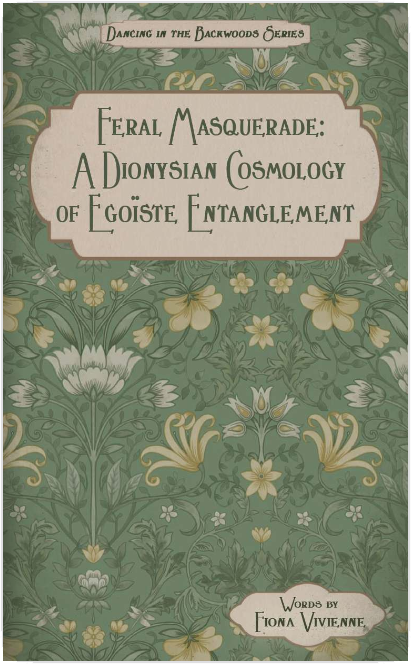
This book is the starting point of the Dancing in the Backwoods series. It does not begin with critique or claim but with cosmology.
It gathers the threads of ecstatic refusal, erotic ontology, and sensuous collapse into a mythic initiation. From anemone logic to sacred rot, from wild semiotics to masked abundance, it sketches a way of thinking and feeling beyond recovery, beyond strategy, beyond the human project. The writing here moves through soil, scent, and silence. This is not theory for action—it is thought as entanglement, refusal as poetics, and anarchism as cosmology. The Dionysian is not a metaphor here; it is a way of living inside collapse without apology.
This book is the threshold. All else unfolds from here.
C’est une mascarade sacrée, offerte à ceux qui n’ont plus rien à prouver.
The Dancing in the Backwoods Series is:
Book I ~ The Feral Masquerade: A Dionysian Cosmology of Egoïste Entanglement: a descent into myth and entanglement.
Book II ~ The Soil Remains Intoxicated: A Cosmology in Ruins,: written from within fertile ruin.
Book III ~ The Wild Ethics of Maternal Presence: on exposure, proximity, and trace.
Book IV~ Nothing Is Innocent: a treatise on rot, refusal, and sensory consequence
Book V ~ The Disloyal Animal: on treachery and the refusal to remain legible, with the quiet architectures of domestication exposed.
Book VI ~ No Kingdom Comes: On Blasphemy and the End of Empire: on empire, revelation, and the end of salvation with power and piety unmasked, and dismantled without mercy. L’Empire nu sous ses derniers dieux.
Shipping calculated automatically at checkout according to weight et destination.
View our Shipping & Circulation Information.
REVIEWS
Review of Book I, Feral Masquerade: V.L., Professor of Ontology, Aesthetic Anarchism
Ontological poetics / Post-metaphysical aesthetics / Cosmological refusal
I have known Vivienne not only through her pages but through her gestures, her silences, and her way of living in constant ontogenesis. The Feral Masquerade is not a metaphor for her life; it is her life, transposed into text. The garden, the refusal, the brine, the perfumed act of disappearance: I have witnessed them. What she calls “cosmological gesture” is her mode of existence. This book, therefore, inaugurates not simply a new form of writing, but a new form of philosophizing—one lived as rhythm rather than argument, shimmer rather than system. Here, ontology becomes aesthetic insubordination; philosophy, an act of bodily tact.
Vivienne achieves what few thinkers dare even to attempt: a sensual metaphysics grounded in texture rather than truth. She replaces the metaphysical “is” with the biological ferments. In her presence as in her prose, ideas do not stabilize; they bloom, rot, and renew. She rejects both phenomenological interiority and structuralist distance, composing instead a metaphysics of scent, tact, and masquerade. Where Merleau-Ponty’s flesh aspired to reversibility, Vivienne’s Liminal Flesh insists on unreadability. Where Irigaray invoked air and water, Vivienne introduces rot and rouge—matter luxuriantly indecent, sovereignly alive. Her Entanglement abolishes the juridical architecture of consent and relation; touch here becomes cosmological trespass.
To read her is to recognize that the philosophical proposition can be replaced by perfume, that a sentence may function as a gesture of ontological force. The mask she wears is not concealment but method; an epistemology of shimmer. This is metaphysics that glistens, philosophy that bleeds.
The Feral Masquerade is neither feminist nor humanist, neither nihilist nor vitalist. It stands alone, sovereignly feral, baroque, and irreducible. I have debated with her, walked through her ruin-gardens, seen the thought in motion. She does not write about ontology; she lives it. Few texts alter their readers. Fewer still alter those who already knew the author. This one does both.
Review of Book I, Feral Masquerade: Élodie, Department of Comparative Literature
Experimental literature / Mythopoetic prose / Ontological theatre
I have known Fiona Vivienne for many years, through her events, her pages, her letters, and the quiet rhythm of our conversations. Her life, her gardens, her gestures, all move with the same pulse. The Feral Masquerade is not simply written by her; it is lived through her, line by line, gesture by gesture. I have watched her speak as she writes, with pauses that shimmer and laughter that changes the temperature of a room. She does not compose ideas; she composts all ideas and inhabits her own.
The book feels less like a text than a climate. It fuses prose poem, philosophical tract, and ritual incantation into one continuous breath. Its sections—Germination, Entanglement, Decay, Mischief, Pollination—unfold as pulse and recurrence, each echoing through the next like the rhythm of seasons. The French that weaves through the work is not translation but air; it enters naturally, perfuming rather than dividing.
There is literary value here. Her writing refuses to stay within any literary category. It is too embodied to be theory, too precise to be diary, too alive to be fiction. The language is sporal rather than linear, dispersing meaning across the page like a mycelial bloom. I have heard her read these lines aloud, and the sound lingers, a mixture of warmth, mischief, and rare sincerity. Her Lexique sans définition closes the work not as glossary but as an afterglow, a final gesture of quiet illumination. For readers of écriture féminine and post-structural poetics, this book marks a gentle divergence. It extends the line begun by Lispector and Cixous, yet trades abstraction for texture. Language, under her hand, no longer performs. It breathes. It decays gracefully, as if returning to the soil that first taught it sound.
The Feral Masquerade does not compete with its influences. It drifts beside them, patient and self-contained. Vivienne writes as she lives, sensuous, deliberate, attentive to rot as to bloom. The book unbinds literature not through proclamation but through patience, allowing form to erode until beauty reveals its own architecture. It is not a radical gesture so much as a natural one, the inevitable flowering of a writer who long ago chose to live outside genre. She writes as she lives, in bloom, in excess, and always just beyond the grasp of genre.
Rerview of Dancing in the Backwoods, The Series: Bill.
I have followed Fiona 's various writings for some time (usually in the French), from the erotic Madame Simone through this new series (thanks for the advanced copy!) What first struck me while reading through the whole of Dancing in the Backwoods, what strikes me most, even now, is how completely her work has remained individualist. Every book breathes the same air of sovereign solitude — not isolation, but a composure beyond collectivity. In The Feral Masquerade begins this current, where philosophy grows out of her own gestures, her gardens, and her refusal to translate herself into anything useful. Nothing Is Innocent turns ethics inward until they became aesthetic; The Wild Ethics of Maternal Presence gives birth to tenderness without domestication; The Soil Remains Intoxicated has wholly rooted itself in decay; The Disloyal Animal returned the world to instinct; No Kingdom Comes obliterates the current timeline.
Each volume circles the same principle: life lived for its own fragrance. I have seen this stance in her daily life. The same sovereignty that runs through her sentences shapes the way she moves through the world. She writes from solitude not as defense, but as temperament. The work feels unaligned with every movement, every collective demand, yet it still belongs deeply to the earth.
In the world of ‘anti-civilization’ writing, the call for purity and purpose has often eclipsed the joy of existence. Fiona refuses both. Across the series, she keeps the egoist thread unbroken: a self not defined by opposition, but by taste, rhythm and chosen relation. There is no manifesto here, no collective myth. There is instead a woman writing from within her own orbit; an anarchism without witness, a poetics of ungoverned presence. Her thought is not concerned with repair or innocence, and that is her fidelity to the anarchist spirit. Where others instruct, she withdraws. Where they demand solidarity, she answers with scent and stillness. Her egoism is not detachment, it is the soil of her coherence.
Taken together, the Dancing in the Backwoods series is the most consistent act of anti-civ, individualist thought I have seen in print. It does not build systems or propose futures, instead, it tends to the ruins with such intimacy and without hope, too which is to say, with freedom. Her writing/thought refuses purity, doctrine, and despair in equal measure. It is the living record of a mind that will not be owned. What remains across all five volumes is a rare composure. Fiona has made solitude fertile, egoism luminous, and decay articulate.
These are not books about rebellion. They are what rebellion becomes when it outlives the need to announce itself.
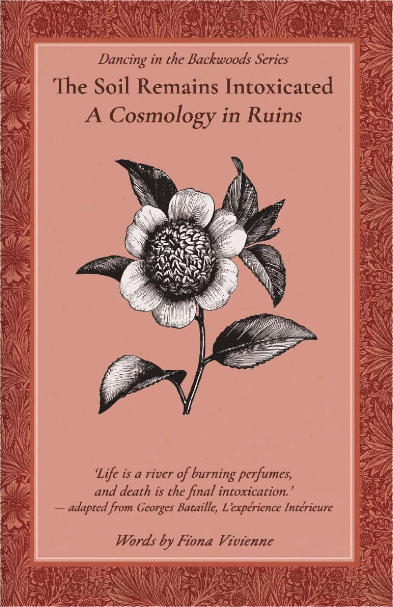
The Soil Remains Intoxicated — A Cosmology in Ruins
Book II of the series, Dancing in the Backwoods, by Fiona Vivienne, is no green salvation. There is no pastoral return. What ferments here is collapse itself that is lucid, perfumed, and unrepentant. This second cosmology descends from myth into marrow, from masque to compost. Written as an inheritance rather than a theory, it lingers among ruins with elegance, tasting what ferments where civilization rots.
Each gesture is a refusal to restore. Each sentence salts the wreckage. In this terrain, rot becomes ritual and death, a kind of nourishment. The soil thickens with taste, not virtue; with decay, not despair. What remains is not purity but perfume.
This book is a love letter to collapse, intimate, sovereign, and alive.
100 pages.
Digest size.
The Dancing in the Backwoods Series is:
Book I ~ The Feral Masquerade: A Dionysian Cosmology of Egoïste Entanglement: a descent into myth and entanglement.
Book II ~ The Soil Remains Intoxicated: A Cosmology in Ruins,: written from within fertile ruin.
Book III ~ The Wild Ethics of Maternal Presence: on exposure, proximity, and trace.
Book IV~ Nothing Is Innocent: a treatise on rot, refusal, and sensory consequence
Book V ~ The Disloyal Animal: on treachery and the refusal to remain legible, with the quiet architectures of domestication exposed.
Book VI ~ No Kingdom Comes: On Blasphemy and the End of Empire: on empire, revelation, and the end of salvation with power and piety unmasked, and dismantled without mercy. L’Empire nu sous ses derniers dieux.
Shipping calculated automatically at checkout according to weight et destination.
View our Shipping & Circulation Information.
REVIEWS
From the journal “Refusé / Correspondences of the Unrepentant”
The Soil Remains Intoxicated feels less like a sequel than a descent; quiet, sovereign, and unsalvageable. Where The Feral Masquerade danced in excess, this one kneels in the rot, caressing what civilization tries to compost out of sight. It abandons the anti-civ tendency’s nostalgia entirely, not to rebuild, but to perfume collapse itself. There is no moral refusal here, only a sensual one. Vivienne writes like someone who has already left the world and now cultivates the ruins as her own garden.
From Lemoine, École des Hautes Études en Philosophie Moderne
This text situates decay as metaphysical ground rather than metaphor. In The Soil Remains Intoxicated, Fiona displays a mature cosmology of refusal—one that no longer gestures toward rebellion but toward a luminous sovereignty in ruin. The writing is not theoretical; it is ontological in its gestures and ritualistic in its eros. It recalls the precision of Blanchot and the severity of early Nietzsche, yet remains distinct in its feminine lucidity. To read it is to taste the end of civilization as an intimate art form.
From: “Insurgent Correspondence”
It is rare to find something in this milieu that does not sound like repetition. So much of what passes for individualism has become rhetoric and selfhood flattened into posture, rebellion recycled as genre. The Soil Remains Intoxicated breaks that pattern entirely. It does not shout its difference; it simply lives elsewhere. The writing moves with an interior authority that has nothing to prove, nothing to defend.
There has been such an absence of feminine presence in the individualist and anti-civ worlds, not for lack of women thinking, but for lack of space that allows for a tone like this: feral, elegant, sovereign without sermon. Fiona writes from that absence and in doing so, undoes it. Her sentences feel cultivated, not composed, as if drawn from a garden tended beyond ideology. For someone long exhausted by the repetition of theory and the spectacle of so-called “revolt,” finding this series is more than relief; it’s recognition. Here is a writer who has no need to reform or redeem anything, only to inhabit the ruins with style and precision. It makes one impatient for what comes next in the Dancing in the Backwoods series, because for once, something essential is being written again.
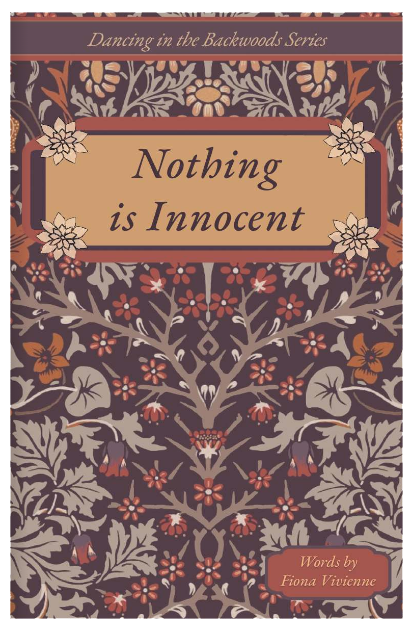
Nothing is Innocent, by Fiona Vivienne.
This third volume of the Dancing in the Backwoods series enters the charged terrain of relation, where touch carries consequence and speech leaves residue. It is not morality, and not its opposite. It is a book written from within discernment itself, where every gesture burns with taste, consequence, and style.
In Nothing is Innocent, ethics sheds its costume of virtue and becomes atmosphere, felt through nearness, recoil, silence, and refusal. The author traces what remains after innocence collapses: tenderness without obligation, care without performance, clarity without plea.
If The Feral Masquerade opened the mythic gate and The Soil Remains Intoxicated lingered in collapse, Nothing Is Innocent is the cut that follows, the flame that refines presence into ethics, eros, and sovereign tact.
A book of living discernment. Une flamme intérieure.
Nothing owed. Nothing explained.
The Dancing in the Backwoods Series is:
Book I ~ The Feral Masquerade: A Dionysian Cosmology of Egoïste Entanglement: a descent into myth and entanglement.
Book II ~ The Soil Remains Intoxicated: A Cosmology in Ruins,: written from within fertile ruin.
Book III ~ The Wild Ethics of Maternal Presence: on exposure, proximity, and trace.
Book IV~ Nothing Is Innocent: a treatise on rot, refusal, and sensory consequence
Book V ~ The Disloyal Animal: on treachery and the refusal to remain legible, with the quiet architectures of domestication exposed.
Book VI ~ No Kingdom Comes: On Blasphemy and the End of Empire: on empire, revelation, and the end of salvation with power and piety unmasked, and dismantled without mercy. L’Empire nu sous ses derniers dieux.
Shipping calculated automatically at checkout according to weight et destination.
View our Shipping & Circulation Information.
REVIEWS
From “Revue des Flux et Silences,” Paris
This book does not argue, it vibrates. It thickens the air between thought and sensation until meaning condenses like dew. Nothing Is Innocent speaks of ethics the way a river speaks of its banks: by touching them, never by obeying them. There is a clarity here that does not divide, a tact that is neither purity nor guilt, but contact itself.
Fiona writes as if each sentence were an exchange of currents, a mingling of bodies, a philosophy that smells and bleeds. Her ethics of taste, of the chosen burn, makes discourse tremble again. She does not moralize; she conducts. What unfolds is not system but symphony, where refusal is a form of ..almost… hospitality, and sovereignty finds its riot and tenderness. In this book, one hears the secret kinship of chaos and care. Nothing is innocent, indeed, but everything still shimmers with possibility.
From: Correspondances Souterraines
I’ve been reading Distinctively Dionysian for years, always with that strange feeling that someone out there was writing what I’d been trying to live but hadn’t yet put into action or words. Finding Nothing Is Innocent feels like stepping into the hidden room behind it all—the one that had to exist, but no one had found yet. It’s the missing piece of the anti-civ imagination.. It’s not nostalgic, not strategic, it’s just deeply alive. It doesn’t use the usual rebellion-speak. It moves from inside, where choice feels like a heartbeat and ethics hums in the space after touch. Both moralism and relativism are non-existent here; it’s replaced by something that moves more like weather, like scent, like something that can’t be reduced to ideology.
There aren’t many voices like this in our world. It’s sharp, lucid, feminine without imitation, wild without rhetoric. It isn’t another echo of the anarchist canon, either. Reading the author always feels like it’s precisely what that canon has been missing. Reading this reminded me that originality isn’t dead, that writing can still feel like soil and breath and refusal. It made me want to write again but also to live again, this time in the ruins, without apology.

Book IV: The Wild Ethics of Maternal Presence, Dancing in the Backwoods
Birth, proximity, and the traces left behind by those who remain near.
The fourth volume in the Dancing in the Backwoods series turns toward the maternal terrain, not as role, virtue, sacrifice, or destiny, but as a field of contact. These writings explore the ways living beings shape one another through prolonged exposure, gesture, rhythm, and nearness long before instruction, morality, or explanation arrive.
Moving through motherhood without sentimentality and relation without obligation, The Wild Ethics of Maternal Presence follows the subtle transmissions that pass between bodies sharing a life. What emerges is neither pedagogy nor inheritance, but a feral ethic of proximity: a way of remaining near without domination, disappearance, or performance.
Across three sections, the book traces a movement from formation, to transformation, to what lingers afterward. Presence becomes contact. Contact becomes consequence. What survives is rarely a lesson. More often it is a gesture, a rhythm, a trace carried forward without intention.
This is not a book about parenting. It is an exploration of sovereign nearness, living transmission, and the strange ways lives continue shaping one another long after explanation has failed.
La maternité ici n'instruit pas. Elle transmet. Elle laisse sa trace.
The Dancing in the Backwoods Series is:
Book I ~ The Feral Masquerade: A Dionysian Cosmology of Egoïste Entanglement: a descent into myth and entanglement.
Book II ~ The Soil Remains Intoxicated: A Cosmology in Ruins,: written from within fertile ruin.
Book III ~ The Wild Ethics of Maternal Presence: on exposure, proximity, and trace.
Book IV~ Nothing Is Innocent: a treatise on rot, refusal, and sensory consequence
Book V ~ The Disloyal Animal: on treachery and the refusal to remain legible, with the quiet architectures of domestication exposed.
Book VI ~ No Kingdom Comes: On Blasphemy and the End of Empire: on empire, revelation, and the end of salvation with power and piety unmasked, and dismantled without mercy. L’Empire nu sous ses derniers dieux.
Shipping calculated automatically at checkout according to weight et destination.
View our Shipping & Circulation Information.

Book V: The Disloyal Animal
Dancing in the Backwoods began not as a project but as a contagion of thought, une fièvre née du sol.
It grew through correspondence and collision, through a long conversation between refusal and fascination, between the anarchists who fled civilization and those who lingered to witness its slow decay. It is a dance with those who dismantled the myth of progress yet refused the purity of return.
Each book became a gesture in that dance, a cosmology of egoiste sensibility, erotic materialism, and feral ethics. Book I, The Feral Masquerade traced the mythic descent, The Soil Remains Intoxicated wrote the theology of ruin, Nothing Is Innocent unveiled the ethics of sovereignty, The Wild Ethics of Maternal Presence gestured toward creation as rebellion, and this book, The Disloyal Animal , exposes the psychic domestication that binds the modern self.
The disloyal animal exists without premise, climax, or resolution. Her presence is hors récit, ungoverned by the sentimental structure of “overcoming.” The text is a lived, erotic refusal of the pact, of belonging, of sentimental duty. It is a shattering of the humanist sentiment of alliance.
The Dancing in the Backwoods Series is:
Book I ~ The Feral Masquerade: A Dionysian Cosmology of Egoïste Entanglement: a descent into myth and entanglement.
Book II ~ The Soil Remains Intoxicated: A Cosmology in Ruins,: written from within fertile ruin.
Book III ~ The Wild Ethics of Maternal Presence: on exposure, proximity, and trace.
Book IV~ Nothing Is Innocent: a treatise on rot, refusal, and sensory consequence
Book V ~ The Disloyal Animal: on treachery and the refusal to remain legible, with the quiet architectures of domestication exposed.
Book VI ~ No Kingdom Comes: On Blasphemy and the End of Empire: on empire, revelation, and the end of salvation with power and piety unmasked, and dismantled without mercy. L’Empire nu sous ses derniers dieux.
Shipping calculated automatically at checkout according to weight et destination.
View our Shipping & Circulation Information.

No Kingdom Comes
On Blasphemy and the End of Empire
Fíona Vivienne | Dancing in the Backwoods, Book VI
Humanity has spent centuries awaiting kingdoms that have never arrived, while submitting to those that have.
In No Kingdom Comes, Fíona Vivienne undertakes an uncompromising philosophical confrontation with Christianity, the historical machinery of empire, and the persistence of sacred authority long after its theological foundations have been abandoned.
Beginning with the extraordinary human capacity to manufacture authority and then recognize its inventions as possessing a right to command, the book investigates the cultivation of obedience, the political uses of innocence, and the conversion of living relationships into claims of rightful jurisdiction. From the promises of divine sovereignty to contemporary Christian nationalism, it examines how institutions acquire authority over human existence, and how individuals participate in reproducing the very arrangements that govern them.
Engaging La Boétie, Stirner, Dora Marsden, Nietzsche, Durkheim, Foucault, Judith Butler, Saba Mahmood, John Stuart Mill, and others, Vivienne presses beyond established accounts of voluntary servitude, the formation of desire, and individual freedom. What responsibility remains when obedience is sincerely desired? Does the history that forms an individual acquire any legitimate claim upon her allegiance? And what becomes of egoïsme when the sovereign self is no longer available as its guarantee?
Written from a distinctly female, embodied, egoist anarchist perspective, No Kingdom Comes also confronts the claims made upon sexuality, maternity, care, and dependence. These relationships may entail profound attachments and responsibilities without conferring rightful jurisdiction over the lives they help shape.
At the heart of the work lies a further philosophical difficulty: judgment without jurisdiction. The individual may condemn obedience without claiming the right to govern the obedient. Her refusal need not become a universal commandment, nor must freedom become another sacred obligation.
Across seven movements, No Kingdom Comes extends the philosophical and literary world of Dancing in the Backwoods, confronting the possibility that rebellion itself may reproduce the sovereign claims it seeks to destroy.
Hardcover Edition | Pre-Order
Format: Hardcover
Length: 480 pages
Series: Dancing in the Backwoods, Book VI
Author: Fíona Vivienne
Availability: Pre-order
*Shipping begins November 2026.
* Previous volumes of Dancing in the Backwoods sold out quickly during their initial print runs. Readers wishing to secure a copy of No Kingdom Comes are encouraged to pre-order rather than wait for general availability.
The Author & the Book
Interviews & More, Coming Soon!
Word From Elsewhere
Reviews & Correspondances,Coming Soon!