BACKWOODS JOURNAL
A Journal of Anarchy & Wortcunning
ABOUT BACKWOODS
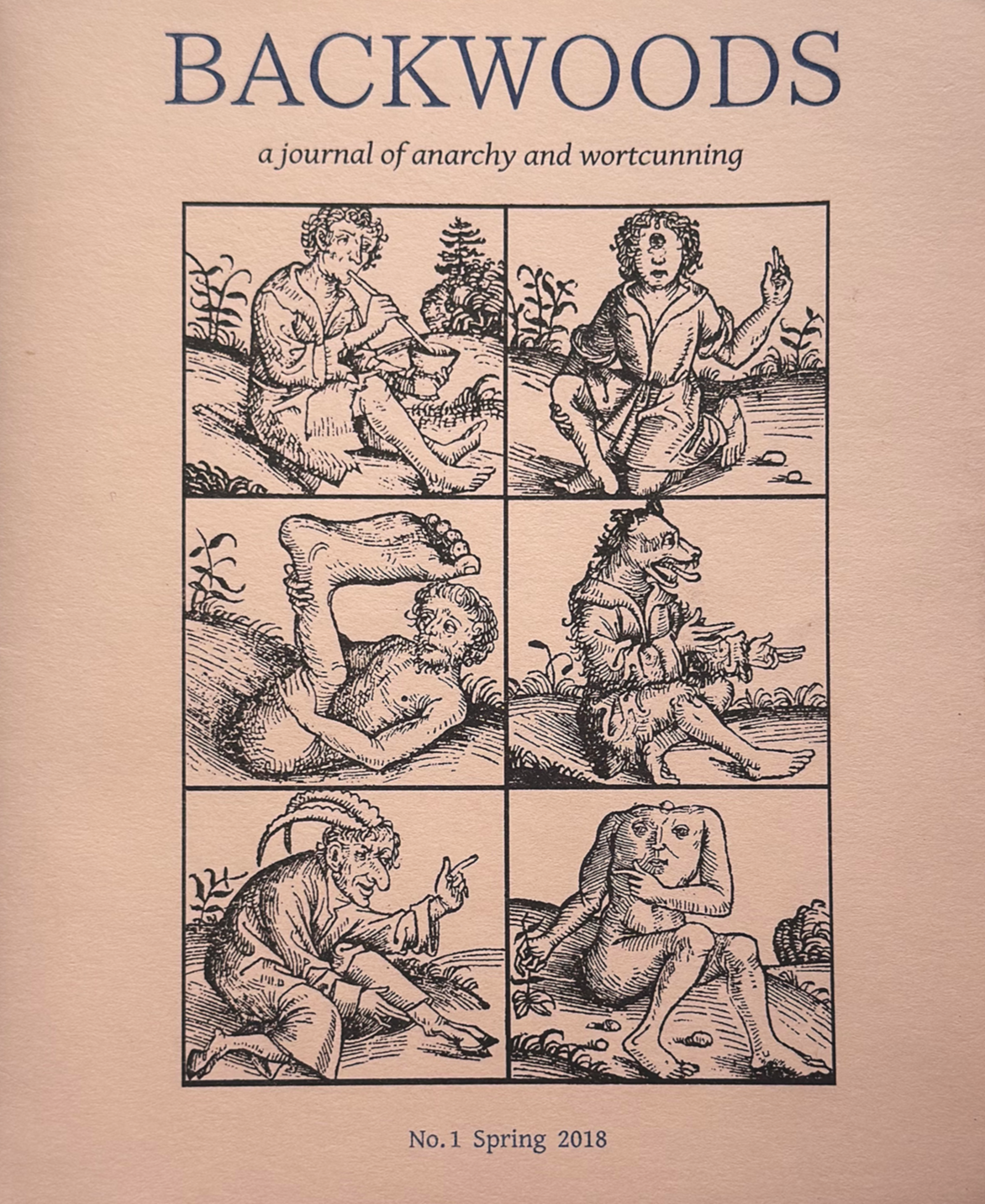
Backwoods: A Journal of Anarchy & Wortcunning began in 2018 with an unusual proposition. Its editors described the journal as “a kind of suture in journal form,” made to bring into communication two radical tendencies that too often travelled separately: the anarchist and permaculture milieux.
From its beginning, Backwoods has occupied the place where anarchist critique meets the material question of how one might actually live. Its editors describe anarchism as critique, vision and social ethics, while permaculture offers design, ecological ethics and ways of transforming one's relationship with subsistence, habitat and the living world. The interest of Backwoods lies in bringing these things together.
The journal emerges from an explicitly anti-civilization anarchist perspective. Civilization, in the analysis developed through its earliest pages, is bound to the State, domination, ecological destruction, technological dependence and the progressive loss of people's ability to furnish their own lives outside the dominant economy. Against this dependency, Backwoods develops a practical language of desertion, autarky and reinhabitation.
Desertion, in the journal's sense, means moving toward the abandonment of civilization materially and psychically. Autarky concerns recovering the ability to furnish one's needs directly through one's habitat, individually or through voluntary cooperation and free association. Reinhabitation carries this movement into an intimate relationship with a particular landbase, developing knowledge of the place and relationships with the human and nonhuman beings who inhabit it.
This is the terrain of its wonderfully strange subtitle, A Journal of Anarchy & Wortcunning. Across its pages, theoretical work on civilization, domination, autonomy, technology and voluntary servitude lives beside forest gardening, foraging, subsistence, ecological knowledge and the recovery of practical skills. Backwoods advocates modes of subsistence including foraging, hunting, fishing and forest gardening, alongside a Neo-Luddism concerned with refusing toxic and stupefying technologies and recovering the broad capacities necessary for furnishing a life.
Permaculture occupies a particular place in this project. The editors see it as a means of meeting one's own needs and therefore as a form of direct action capable of enlarging the autonomy fundamental to anarchism. Ecological harmony, decentralization, hyperlocal life and cultivated relationships with plants and wider ecologies belong to the political question itself. Yet Backwoods has been equally critical of a permaculture stripped of radical social critique, particularly where ecological practice is recuperated into the dominant economy and offered back as another means of sustaining the civilization it ostensibly seeks to transform.
The journal exists in part to keep these encounters and tensions alive. Its founding editors envisioned a platform for dialogue, critique and inspiration, seeking greater communication between people whose practical and theoretical knowledge might otherwise remain separated. Theory therefore appears alongside praxis throughout Backwoods: essays and interviews beside forest gardening and subsistence; ecological knowledge beside political philosophy; reviews, correspondence and criticism beside accounts of possibilities for living differently.
From its first issue, its editors explicitly invite dialogue, feedback, contributions and criticism.
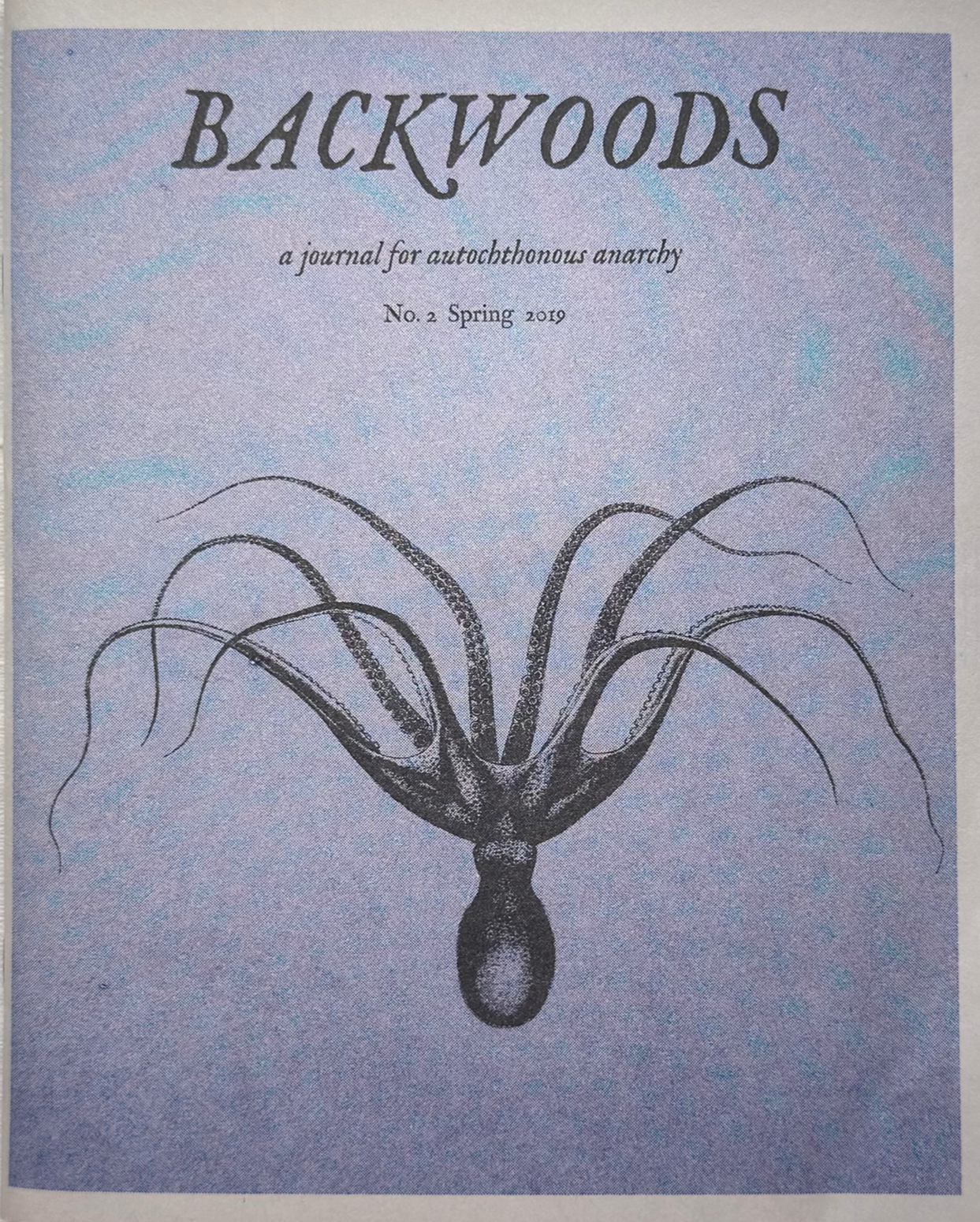
After its first two issues, changes in the original editorial group brought another stage of the project. The renewed editorial group chose to make Backwoods larger and slower: substantial volumes of roughly 150 to 250 pages, issued irregularly when the editors had assembled material with which they were satisfied. This is still the case. The journal also moved toward thematic volumes while continuing to consider work from across the broader Backwoods terrain.
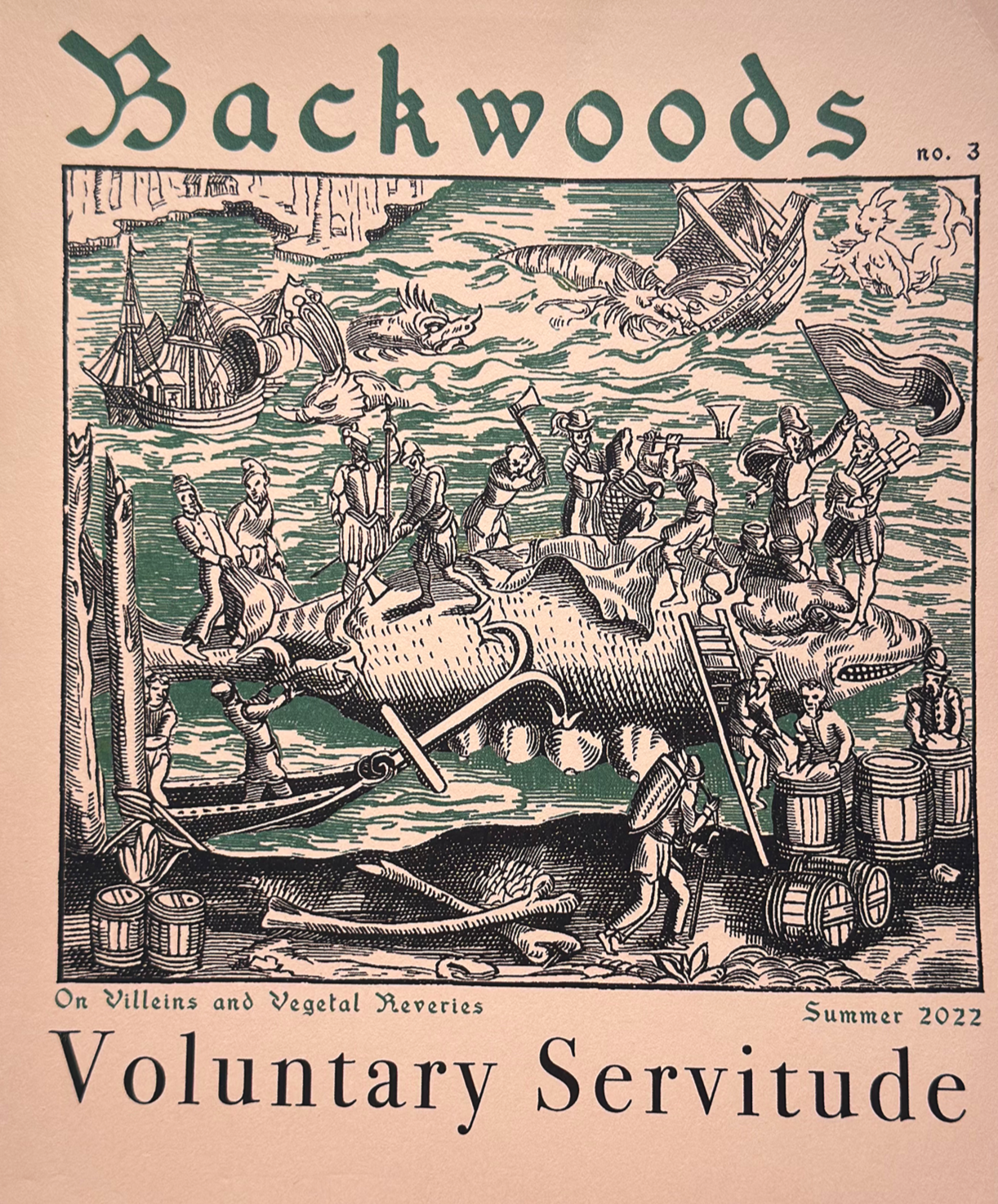
Issue No. 3 turned toward the problem of voluntary servitude: why people participate in and reproduce the conditions of their own domination, how the state-building project has severed relationships with ecology and place that might foster autonomy, and whether recovering practical self-reliance can provide a route away from that condition.
Through these changes, the animating concern remains recognizable…
Backwoods Journal is interested in anarchy as a way of living: in withdrawing one's participation from civilization where possible, recovering capacities surrendered to it, developing direct relationships with the sources of subsistence, and cultivating forms of human and nonhuman relationship grounded in freedom, mutuality and an intimate knowledge of place.
Backwoods Journal & Bacchus Editions
The relationship between Bacchus Editions and Backwoods Journal does not begin with publishing.
The Bacchus Editions crew has been reading Backwoods since it first appeared, following its editors and contributors through the journal’s developing conversations, arguments, experiments and changes. It has long been one of those publications that circulates around our press because people here actually read it, return to it, disagree with it, talk about it and wait to see where it wanders next.
For Bacchus Editions creator Fíona Vivienne, that relationship takes a particular form. Her six-book series, Dancing in the Backwoods, grows from years spent thinking alongside Backwoods Journal and inhabiting some of the same questions, though often in a very different atmosphere. The title is deliberate: the series is a dance with Backwoods, an approach to certain shared terrain from another angle, sometimes moving alongside it, sometimes pressing against it, sometimes wandering rather far into the trees.
The books share terrain with anti-civilization thought, green anarchism, ferality and the long critique of domestication, yet Dancing in the Backwoods breathes in rather different air. It is written from the terrain of an individualiste life: Dionysian cosmology, sensual refusal, forested life, death, motherhood, collapse, egoïste desertion, taste, discernment, intimacy, distance, sovereignty, embodiment, gesture and disappearance. The questions sometimes meet those found in Backwoods, but the emphasis, instincts and textures are Fíona’s own. The six books approach these territories through the particularity of a lived life, concerned with what happens when such questions enter a body, a forest, a household, a love affair, a death, a refusal, a mother’s life. They become a personal cosmology: reverberations more than arguments, gestes more than manifestos. Une chorégraphie de solitude partagée.
What Bacchus admires about Backwoods is the seriousness with which its editors refuse to separate anarchist thought from the substance of a life.
There is an enormous difference between writing about autonomy and asking what capacities autonomy actually requires; between criticizing civilization and examining the dependencies that fasten everyday life to it; between imagining another relation to the living world and learning how to inhabit one.
Backwoods is willing to stay inside those difficulties.
Its editors also make something increasingly rare: a journal with an identifiable mind…
Backwoods never feels assembled merely because enough material arrives to fill an issue. Its essays speak to one another. Its practical pieces complicate its theoretical ones. Questions recur, mutate, and return carrying different consequences. Even disagreement belongs to the life of the journal. There is editorial intelligence behind it, and a willingness to let an inquiry remain alive rather than forcing it toward doctrine.
For Bacchus Editions, affection for a journal becomes something more interesting than agreement. One returns to a publication because it continues to provoke thought, because its editors have cultivated a territory large enough to wander around inside, and because even where one parts company with it, there is something worth parting company from. That has long been our relationship with Backwoods Journal.
When the editors of Backwoods approached Bacchus and asked us to take on the publishing life of the journal, there was something particularly meaningful in being entrusted with a publication we had already spent so many years reading, thinking beside and admiring. Absolutely, was our answer…
We already know these woods.