THEAnarchist Death Project
Welcome.
THE ANARCHIST DEATH PROJECT IS BROUGHT TO LIFE BY YOUR GRAVEYARD ACCOMPLICES & KEEPERS OF THE DEAD:
Fíona Vivienne & High Noon Hills Natural Burial Grounds & Conservation Cemeteries.
Published & hosted by Bacchus Editions
INSIDE THE ANARCHIST DEATH PROJECT:
THE PARALLEL DEATHCARE LIBRARY ↙↙↙
Field guides for caring for the dead, burial, law, autonomy, refusal, and practical deathcare. Read online, download, print & distro.
END-OF-LIFE FORMS ↙↙↙
All the paperwork you need to protect yourself, your wishes, your body, your identity and your people ~ before, and after death.
✦ · · · 🪦 · ✦ · 🪦 · ✦ · 🪦 · · · ✦ · · · 🪦 · ✦ · 🪦 · ✦ · 🪦 · · · ✦ · · · 🪦 · ✦ · 🪦 · ✦ · 🪦 · · · ✦ · · · 🪦 · ✦ · 🪦 · ✦ · 🪦 · · · ✦
PARALLEL DEATHCARE LIBRARY

The Parallel Deathcare Library is the working heart of the Anarchist Death Project: these are your field guides for caring for the dead, burying our people, protecting your wishes, understanding the law & its limits, refusing unnecessary authority, and making deathcare your own.
The most recently pressed field guides are shown below. The complete Parallel Deathcare Library can be found using the pulldown menu, where every available guide is gathered in one place.
The Library is a growing project. New field guides will be added as they are made. Read them online, download them, print them into zines, make copies, pass them around. Keep what you need somewhere you can find it when death arrives.
Note: full-color Bacchus Editions print magazines live in the bookshop, and the most recently pressed editions are gathered here for easy access.
Read · Download · Print · Distro
Every field guide in the Parallel Deathcare Library can be read online, downloaded, or printed for distro.
The Print Zine files are already imposed and ready to print. Print at Actual Size, double-sided, flipping on the short edge. Stack the sheets as printed, fold in half & staple through the fold. Do not select Booklet or Multiple in your printer settings.
Each field guide is also available as a Bacchus Editions print edition, printed on our Heidelberg presses on Mohawk Superfine Silk and Wire-O bound to open completely flat and stay open in use. Substantial, durable working editions made for handling. The PDFs are made to circulate. The Bacchus editions are made to last.
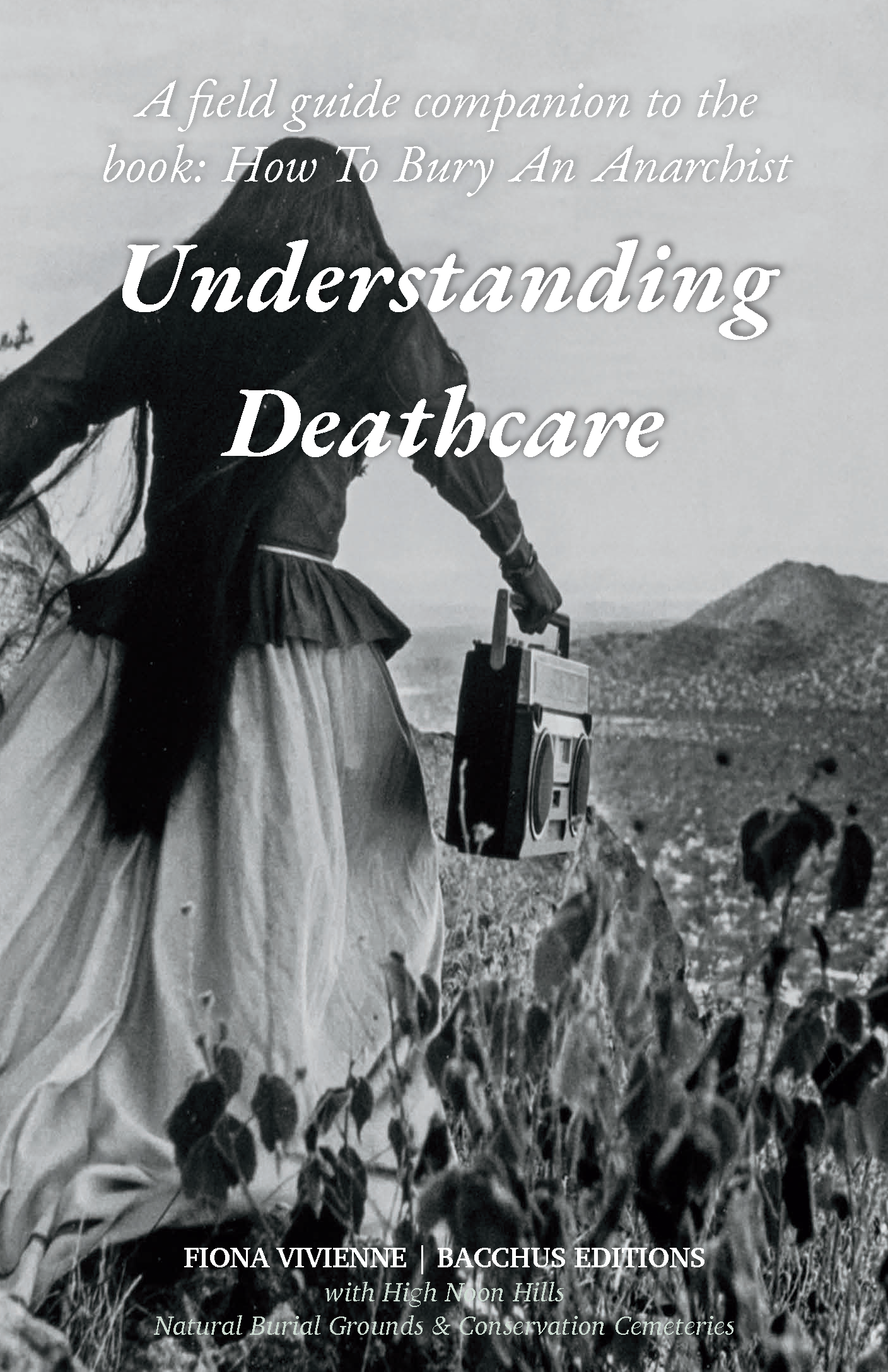
Understanding Deathcare, A Field Guide Companion to How To Bury An Anarchist. Full Color, Print Magazine, Book No. 1.

Start Here
READ / DOWNLOAD · PRINT A ZINE

Clandestine Burial: Law, Risk & Autonomy
READ / DOWNLOAD · PRINT A ZINE
Private-Land Burial; Burying The Dead Outside The Cemetery
READ / DOWNLOAD · PRINT A ZINE
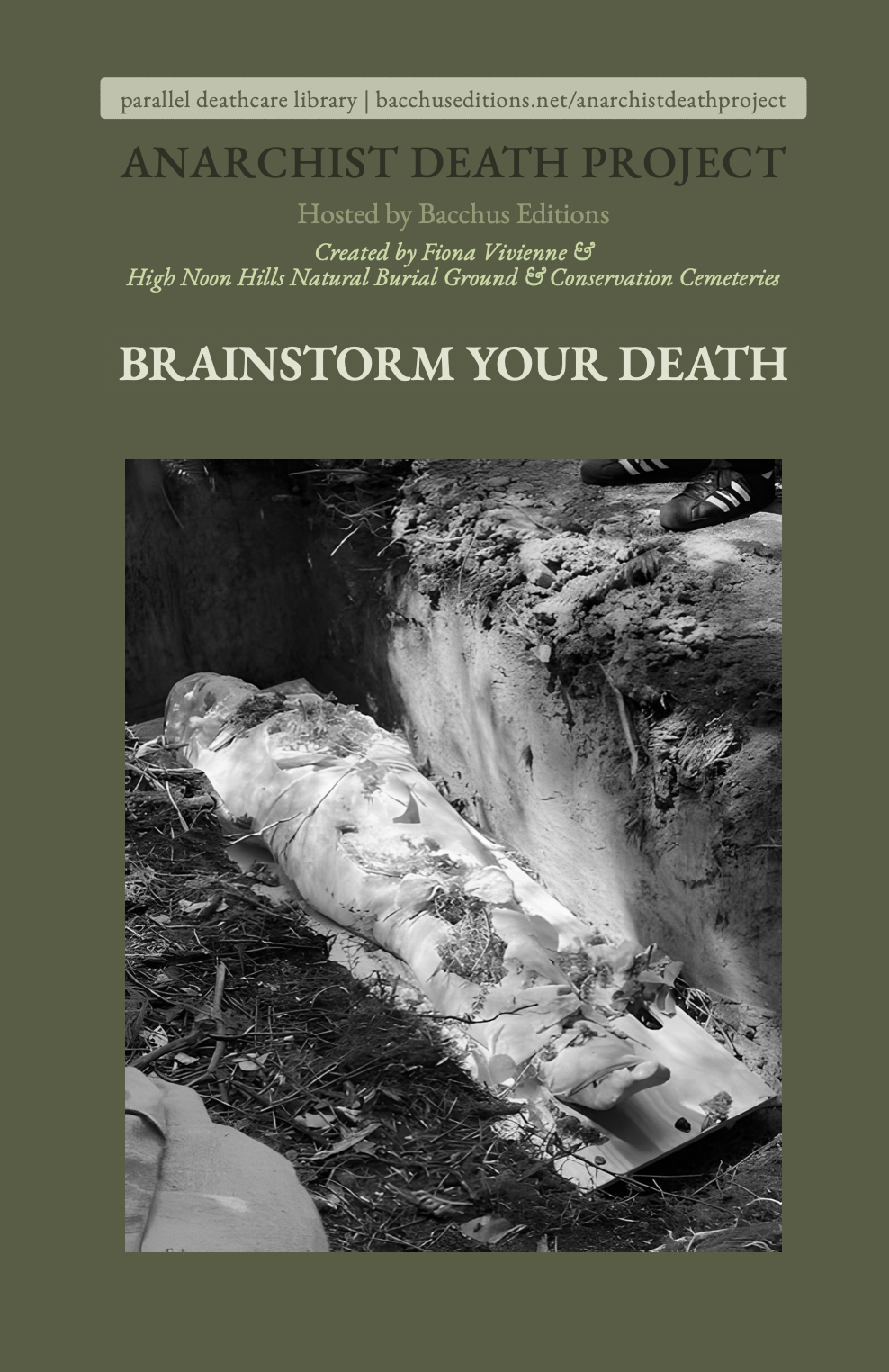
Brainstorm Your Death
READ / DOWNLOAD · PRINT A ZINE

Identity After Death & Chosen Family: A Planning Workbook
✦ · · · 🪦 · ✦ · 🪦 · ✦ · 🪦 · · · ✦ · · · 🪦 · ✦ · 🪦 · ✦ · 🪦 · · · ✦ · · · 🪦 · ✦ · 🪦 · ✦ · 🪦 · · · ✦ · · · 🪦 · ✦ · 🪦 · ✦ · 🪦 · · · ✦
END-OF-LIFE FORMS.
The paperwork of dying. Use it to protect yourself.
These are the forms for protecting your decisions, your body, your identity, and the people you choose to act for you. What you need depends on where you live. Choose your country below, then follow the steps. We’ll show you which forms you need, where to get them, and what to do with them.
The forms library begins with the United States, Canada and Europe, where your graveyard accomplices & keepers of the dead have the deepest practical and working knowledge of deathcare, burial, and the systems surrounding the dead. The work will travel outward from there. If your country is not yet showing here, it has not been forgotten. The End-of-Life forms area is ongoing, just like the Anarchist Death Project. New jurisdictions, forms and resources will be added as the project continues.
Use what you need. Fill it out. Sign what needs signing. Put it in the hands of your people.
Do not leave an opening for an outside authority to decide what happens to you.

CANADA
START HERE
Your end-of-life paperwork is divided between resources that work across Canada and documents governed by the province or territory where you live.
Start here, then open your province or territory. Each section is organized around what you are trying to protect: your medical decisions, authority over your body, your identity after death, funeral and body care, burial and disposition, property and practical affairs, and your digital life.
You do not need every form listed. Each entry will tell you who needs it, what it protects, how to complete it, and what is required to make it legally valid.
Where one legal document protects several things, we will tell you that rather than send you through duplicate paperwork. ADP planning PDFs help you decide and record what you want; where a separate legal form is needed to protect those wishes, it will be listed and linked in the relevant section.
Keep completed legal documents where your people can actually get to them. Give copies to anyone who may need to use them.
BRAINSTORM YOUR DEATH
Before jurisdiction enters the room, imagine your death. Begin with what you actually want: your dying, your people, your body, what becomes of you, what becomes of the life you leave behind, and what you discover is yours to protect.
ALBERTA
MEDICAL CARE & INCAPACITY
PERSONAL DIRECTIVE
What it does: Alberta’s Personal Directive lets you name one or more agents to make personal decisions for you if you lose capacity. Those decisions may include health care, where and with whom you live, and other non-financial personal matters. You may also put your own instructions directly into the document.
Who needs it: Anyone who wants to choose who will make personal and health-care decisions rather than leave that choice to Alberta’s default decision-making system. This is especially important when the person you trust is a partner, friend or chosen family member who might not otherwise be the person approached.
To make it valid: The directive must be in writing and dated. You sign it in the presence of an adult witness, who also signs in your presence. Alberta restricts certain people from acting as the witness, including your agent and specified close relations. Notarization is not required.
Do this: Name your agent and any alternate you want, record the instructions you want followed, execute the document correctly, and give copies to the people who may need it. Alberta also maintains an optional Personal Directive Registry. The registry records information about the directive and contacts rather than storing the directive itself.
AUTHORITY OVER YOUR BODY
WHO CONTROLS YOUR FUNERAL & BODY AFTER DEATH?
Your Personal Directive does not answer this question. It is an incapacity document. Authority after death is governed separately.
Alberta gives first priority to the personal representative named in the will. If that person cannot or will not act, authority passes through the statutory hierarchy, beginning with the deceased’s spouse or adult interdependent partner and then through specified family relationships and, farther down the hierarchy, other people and public authorities.
Chosen family: Do not assume that being the person who knows someone best automatically gives you control of their body. If this matters to you, the choice of the person who will administer your estate deserves particular attention.
IDENTITY AFTER DEATH
IDENTITY, CHOSEN FAMILY & HOW YOU ARE PRESENTED
Your name. Pronouns. Gender. Clothing. Hair. Photographs. Relationships. Who may see or care for your body. Who should be kept away. What appears in an obituary, gathering, grave marker or other memorial.
Identity After Death & Chosen Family records these wishes in one place.
Important in Alberta: This planning document does not replace the legal authority governing your body after death. Give it to the person who will actually have authority, and make sure your estate planning does not leave control in hands you deliberately meant to avoid.
Want to go deeper?
If you want a much deeper 46-page workbook for thinking through identity, chosen family, bodily boundaries, privacy & posthumous identity, Fíona & High Noon Hills made one.
FUNERAL & BODY CARE
YOU DO NOT HAVE TO HIRE A FUNERAL HOME TO ARRANGE THE DISPOSITION
Alberta expressly allows family or friends to arrange a burial or cremation themselves. Hiring a licensed funeral arranger is not a prerequisite to making the arrangements.
For a family-directed death, the original Medical Certificate of Death and Registration of Death can be taken through the provincial process described by Alberta. Once the requirements are satisfied, a Burial / Disposition Permit can be issued.
A Burial / Disposition Permit must be obtained before the body is buried, cremated or otherwise disposed of.
This leaves considerable room for people who want to participate directly in caring for their dead rather than automatically handing the entire process to a funeral business.
FAMILY-DIRECTED BURIAL / CREMATION + PERMIT INSTRUCTIONS →
AFTER-DEATH WISHES & BODY CARE
Use the universal ADP planning document to record who you want involved, washing and dressing, clothing or shrouding, viewing, vigil, religious or nonreligious practices, privacy, funeral or no funeral, and your instructions for the time between death and disposition.
ADP PLANNING DOCUMENT · UNIVERSAL
BURIAL & DISPOSITION
BURIAL
Burial is a recognized form of disposition in Alberta, including traditional, natural and green burial. A Burial / Disposition Permit is required before burial.
PRIVATE-LAND / HOME BURIAL
Ordinary burial on unregistered private property is not Alberta’s legal route.
Alberta regulates the land itself. A new cemetery can be established only through the provincial cemetery process and only by the kinds of organizations Alberta permits to establish one: a religious organization, religious auxiliary or municipality.
Establishment requires an actual cemetery-registration process involving land and site documentation, subdivision approval and a health-authority recommendation. A provisional approval does not authorize burial. The required final approval must be obtained before burials begin.
Owning acreage does not by itself create a lawful family burial ground.
ALBERTA CEMETERY REGISTRATION & LICENSING →
CREMATION
LEGAL. Alberta recognizes cremation as a disposition method. The required Burial / Disposition Permit must be obtained before cremation. Family or friends may arrange the cremation themselves rather than hiring a funeral arranger, although the cremation itself takes place through a crematorium.
ALBERTA DISPOSITION PERMIT INFORMATION →
AQUAMATION / ALKALINE HYDROLYSIS
UNVERIFIED AFTER RESEARCH. The current Alberta sources reviewed for this Portal did not establish affirmative authorization for alkaline hydrolysis as a human disposition method. This does not mean the Portal is declaring it illegal.
NATURAL ORGANIC REDUCTION
UNVERIFIED AFTER RESEARCH. No affirmative current authorization was established during the verification pass. The Portal therefore does not infer either permission or prohibition from silence.
ORGAN & TISSUE DONATION
Alberta maintains an official Organ and Tissue Donation Registry. Record your donation decision through the provincial system and make sure the people likely to be involved after your death know what you want.
PROPERTY, MONEY & PEOPLE
ENDURING POWER OF ATTORNEY
A Personal Directive does not authorize your agent to manage your finances or property.
Alberta uses an Enduring Power of Attorney for financial and property authority that can continue during incapacity.
Alberta does not provide a regulated fillable EPA form comparable to its Personal Directive form. Because an EPA can give another person substantial authority over property and money, the Anarchist Death Project is not supplying an invented substitute legal form.
ALBERTA ENDURING POWER OF ATTORNEY →
YOUR WILL
A will governs matters after death rather than incapacity. In Alberta it carries another consequence worth noticing here: the personal representative named in the will occupies the first position in the legal hierarchy for control of funeral arrangements and the body.
DIGITAL LIFE
ACCOUNTS, FILES, DEVICES & DIGITAL WORK
Record what exists, who should know about it, what should be preserved or destroyed, and where the information needed to deal with your accounts and devices can be found.
Do not put passwords into a public-facing will.
The Portal does not claim a special Alberta statutory digital-access mechanism where this research has not established one. Coordinate digital planning with the authority created by your incapacity and estate documents and with the access rules of the individual services involved.
ADP PLANNING DOCUMENT · UNIVERSAL
LAW & RESOURCES CHECKED: SEPTEMBER 2026
Provincial law and official Alberta resources can change. Follow the linked provincial
sources before relying on a procedure or form.
BRITISH COLUMBIA
MEDICAL CARE & INCAPACITY
REPRESENTATION AGREEMENT
British Columbia allows you to make a Representation Agreement appointing another person to make specified decisions for you. Depending on the type of agreement, this may include health care and personal-care decisions.
A Representation Agreement must satisfy BC’s signing, witnessing and certificate requirements. BC provides optional forms, but there is no single mandatory government form that must be used for every Representation Agreement.
BC ADVANCE CARE PLANNING GUIDE + REPRESENTATION AGREEMENT FORMS →
REPRESENTATION AGREEMENT ACT →
ADVANCE DIRECTIVE
An Advance Directive is different from appointing a representative. It allows you to give or refuse consent in advance to health care described in the directive for circumstances in which you later become incapable of making the decision yourself.
The provincial My Voice guide contains BC’s advance-care-planning material and forms. Read the execution instructions carefully before signing.
AUTHORITY OVER YOUR BODY
WHO CONTROLS YOUR BODY AFTER DEATH?
Your Representation Agreement and Advance Directive are incapacity and health-care instruments. They do not simply continue as authority over your body after death.
British Columbia has a separate statutory hierarchy. First priority belongs to the personal representative named in your will. After that come your spouse, adult child, adult grandchild, a guardian in the specified circumstances, parent, adult sibling, adult nephew or niece, next of kin, specified public authorities, and finally an adult having a personal or kinship relationship with you.
If the person with priority is unavailable or unwilling to act, authority passes to the next person in the hierarchy.
Chosen family: BC does eventually recognize an adult with a personal relationship to the deceased, but that person sits below a long statutory hierarchy. Do not rely on the existence of that final category if you deliberately want a particular person to control what happens to your body.
BC CONTROL OF DISPOSITION LAW →
YOUR WRITTEN DISPOSITION WISHES
BC gives particular legal force to certain written disposition wishes.
A written preference concerning disposition is binding on the person who controls your remains when the preference is stated in your will or a preneed cemetery or funeral services contract, provided the other statutory conditions are satisfied.
This is important: an ordinary worksheet, note or ADP planning document should not be treated as though it has the same statutory force.
IDENTITY AFTER DEATH
IDENTITY, CHOSEN FAMILY & HOW YOU ARE PRESENTED
Your name. Pronouns. Gender. Clothing. Hair. Photographs. Relationships. Who may see or care for your body. Who should be kept away. What appears in an obituary, gathering, grave marker or other memorial.
Identity After Death & Chosen Family records these wishes in one place.
Important in British Columbia: planning instructions do not themselves move someone to the top of BC’s statutory disposition hierarchy. Give your instructions to the person who will actually control disposition.
If a particular disposition preference needs the binding effect provided by section 6 of the Cremation, Interment and Funeral Services Act, put that preference into the legally recognized instrument rather than relying on this worksheet alone.
Want to go deeper?
If you want a much deeper 46-page workbook for thinking through identity, chosen family, bodily boundaries, privacy & posthumous identity, Fíona & High Noon Hills made one.
FUNERAL & BODY CARE
WHO AUTHORIZES FUNERAL SERVICES & DISPOSITION?
A funeral provider must receive authorization from the person who legally controls disposition. An operator of a cemetery, mausoleum or crematorium likewise needs the authorization required by BC law before disposition, together with the authorization required under the Vital Statistics Act.
BC law regulates commercial funeral and cemetery services. Do not turn the existence of a regulated funeral industry into the broader claim that every intimate act around the dead belongs exclusively to that industry.
BC AUTHORIZATION REQUIREMENTS →
AFTER-DEATH WISHES & BODY CARE
Use the universal ADP planning document to record who you want involved, washing and dressing, clothing or shrouding, viewing, vigil, religious or nonreligious practices, privacy, funeral or no funeral, and other instructions for the time between death and disposition.
This is a planning document. It does not replace the legal authority of the person who controls disposition under BC law.
ADP PLANNING DOCUMENT · UNIVERSAL
BURIAL & DISPOSITION
BURIAL
British Columbia regulates where human remains may legally be disposed of. Ordinary burial takes place within the province’s authorized place-of-interment structure.
A place of interment includes a cemetery, mausoleum or columbarium. BC law generally permits disposition by interment on land carrying the required certificate of public interest, by cremation in a crematorium, or by interment on Crown land reserved for that purpose.
BC LEGAL PLACES OF DISPOSITION →
PRIVATE-LAND / HOME BURIAL
Ordinary burial on unregistered private land is not British Columbia’s legal home-burial route.
Owning land does not by itself authorize burial there. BC’s statutory structure attaches legal requirements to the place of interment itself.
There is a narrow exception for death in a remote location. With the director’s approval, remains may be disposed of at the place of death when removing them to a cemetery, mausoleum or crematorium is impossible or very impracticable. The regulation also requires evidence of the landowner’s consent, or the applicable Crown-land status.
This is an emergency/remoteness exception. It is not an ordinary private-land burial pathway.
BC REMOTE-LOCATION DISPOSITION EXCEPTION →
CREMATION
LEGAL. Cremation is expressly recognized under BC law and takes place through a crematorium. The crematorium must have the authorization required under the Vital Statistics Act and authorization from the person legally entitled to control disposition, unless the statutory public-health route applies.
BC CREMATION, INTERMENT & FUNERAL SERVICES ACT →
AQUAMATION / ALKALINE HYDROLYSIS
UNVERIFIED AFTER RESEARCH. The current BC legislation and official material reviewed for this Portal did not establish affirmative authorization for alkaline hydrolysis as a human disposition method.
This does not mean the Portal is declaring it illegal. No permission or prohibition is being invented from statutory silence.
NATURAL ORGANIC REDUCTION
UNVERIFIED AFTER RESEARCH. The current material reviewed did not establish affirmative authorization for natural organic reduction as a human disposition method in British Columbia.
ORGAN & TISSUE DONATION
British Columbia maintains an official Organ Donor Registry. Your registration records your decision concerning organ donation and is not tied to your driver’s licence.
PROPERTY, MONEY & PEOPLE
POWER OF ATTORNEY
A Representation Agreement concerns the personal and health-care authority granted under that agreement. Financial and property authority belongs to a different legal instrument: a Power of Attorney.
Keep those roles separate when planning. The person you want making health-care decisions does not automatically acquire authority over your finances simply because you named them in a Representation Agreement.
YOUR WILL
Your will matters here for more than property.
Under BC’s disposition hierarchy, the personal representative named in your will has first priority to control disposition of your body. A disposition preference stated in your will can also be binding under section 6 of the Cremation, Interment and Funeral Services Act when the statutory conditions are satisfied.
For anyone concerned about chosen family, estranged relatives, identity after death, burial or cremation wishes, this makes the will part of the deathcare architecture, not merely an inventory of who receives possessions.
DIGITAL LIFE
ACCOUNTS, FILES, DEVICES & DIGITAL WORK
Record what exists, who should know about it, what should be preserved or destroyed, and where the information needed to deal with your accounts and devices can be found.
Do not put passwords into a public-facing will.
The Portal does not claim a special BC digital-access mechanism where this research has not established one. Coordinate digital planning with your estate documents, incapacity planning, and the access or legacy tools offered by the individual services you use.
ADP PLANNING DOCUMENT · UNIVERSAL
LAW & RESOURCES CHECKED: SEPTEMBER 2026
Provincial law, regulations and government resources can change. Follow the linked
BC sources before relying on a procedure or form.
MANITOBA
MEDICAL CARE & INCAPACITY
HEALTH CARE DIRECTIVE
Manitoba’s Health Care Directive lets you record medical treatment instructions, appoint one or more people as your health care proxy, or do both.
Your proxy makes medical decisions for you when you lack the capacity to make those decisions yourself. If you name more than one proxy, Manitoba’s form lets you specify whether they act consecutively or jointly.
To make it valid: sign and date the directive. If you are able to sign it yourself, no witness is required. If another person signs for you, additional witness requirements apply. Your proxy or your proxy’s spouse cannot act as the substitute signer or witness.
Manitoba provides an official form. The statutory scheme does not require you to use that particular form, but there is no reason for the Portal to recreate something the province already provides clearly.
AUTHORITY OVER YOUR BODY
HEALTH-CARE AUTHORITY ENDS WHERE AFTER-DEATH AUTHORITY BEGINS
A Health Care Directive protects decisions about medical treatment while you are alive. Naming someone as your health care proxy does not automatically make that person the legal controller of your body, funeral or disposition after death.
Treat those as separate planning problems. If the person you trust is chosen family, a partner whose legal status may not place them first, or anyone who could face opposition from relatives, do not assume the Health Care Directive settles the after-death question.
IDENTITY AFTER DEATH
IDENTITY, CHOSEN FAMILY & HOW YOU ARE PRESENTED
Your name. Pronouns. Gender. Clothing. Hair. Photographs. Relationships. Who may see or care for your body. Who should be kept away. What appears in an obituary, gathering, grave marker or other memorial.
Identity After Death & Chosen Family records these wishes in one place.
Important in Manitoba: this is a planning document. It does not create legal authority over your body merely by naming the person you want involved. Give your instructions to the people who will actually be in a position to carry them out and coordinate them with your estate and after-death planning.
Want to go deeper?
If you want a much deeper 46-page workbook for thinking through identity, chosen family, bodily boundaries, privacy & posthumous identity, Fíona & High Noon Hills made one.
FUNERAL & BODY CARE
FUNERAL-DIRECTING RULES DO NOT MAKE EVERY ACT A PROFESSIONAL ACT
Manitoba regulates funeral directors, embalmers and commercial funeral activity. Embalming is a regulated professional act.
Keep that rule as narrow as the law makes it. The existence of licensed funeral professionals does not by itself establish that every act of sitting with, washing, dressing, shrouding or keeping vigil with a dead person belongs exclusively to a funeral business.
Manitoba’s death-registration system also expressly contemplates paperwork reaching the place of burial through a funeral director, a lay funeral director, or the person officiating at the burial. Do not silently turn professional regulation into a broader monopoly than the law actually creates.
AFTER-DEATH WISHES & BODY CARE
Use the universal ADP planning document to record who you want involved, washing and dressing, clothing or shrouding, viewing, vigil, religious or nonreligious practices, privacy, funeral or no funeral, and other instructions for the time between death and disposition.
ADP PLANNING DOCUMENT · UNIVERSAL
SPECIAL PUBLIC-HEALTH RULES
Manitoba has additional handling and timing rules for bodies when particular communicable diseases are involved. Those are conditional public-health rules. They are not the ordinary rule for every death.
BURIAL & DISPOSITION
BURIAL
Manitoba regulates burial through its vital-statistics, cemetery and related legal machinery. Required death registration and burial paperwork must be completed before treating burial as merely a choice of physical location.
PRIVATE-LAND / HOME BURIAL
Manitoba requires more care than a simple “legal / illegal” answer.
The Cemeteries Act defines a cemetery as land that is set apart or used as a place for burial, or land in which dead human bodies or other human remains have been buried.
That means the legal character of the land itself can be implicated by burial. A private grave cannot safely be treated as an ordinary use of private property simply because the owner consents to it.
Before planning a burial on private land, investigate the cemetery consequences, municipal and land-use rules, required death and burial paperwork, title implications, and any other requirements applying to that particular parcel.
The Portal therefore does not reduce Manitoba private-land burial to an unsupported YES or NO.
CREMATION
LEGAL. Manitoba recognizes and regulates cremation and crematories. Required death-registration and disposition paperwork must be completed before cremation occurs.
MANITOBA CEMETERY & CREMATORY LAW →
AQUAMATION / ALKALINE HYDROLYSIS
UNVERIFIED AFTER RESEARCH. The current Manitoba legislation and official material reviewed for this Portal did not establish affirmative authorization for alkaline hydrolysis as a human disposition method.
This is not a declaration that it is illegal. The Portal does not manufacture a prohibition from silence.
NATURAL ORGANIC REDUCTION
UNVERIFIED AFTER RESEARCH. The current material reviewed did not establish affirmative authorization for natural organic reduction as a human disposition method in Manitoba.
ORGAN & TISSUE DONATION
Manitoba maintains a provincial organ and tissue donation system. Record your intentions through the current provincial route and tell the people likely to be involved after your death what you want.
PROPERTY, MONEY & PEOPLE
ENDURING POWER OF ATTORNEY
Your Health Care Directive concerns medical treatment. It does not give your health care proxy authority over your money and property.
Manitoba uses an Enduring Power of Attorney for financial and property authority intended to continue despite later mental incapacity.
There is no required standard Manitoba EPA form. The document must satisfy the requirements of the Powers of Attorney Act, including the statutory execution and witnessing rules.
Because this instrument can transfer substantial authority over another person’s financial affairs, the Anarchist Death Project is not supplying a generic substitute legal form.
DIGITAL LIFE
ACCOUNTS, FILES, DEVICES & DIGITAL WORK
Record what exists, who should know about it, what should be preserved or destroyed, and where the information needed to deal with your accounts and devices can be found.
Do not put passwords into a public-facing will.
The Portal does not claim a special Manitoba fiduciary digital-access mechanism where the verification research has not established one. Coordinate digital planning with your estate documents, financial authority, and the access or legacy tools offered by the individual services you use.
ADP PLANNING DOCUMENT · UNIVERSAL
LAW & RESOURCES CHECKED: SEPTEMBER 2026
Provincial law, regulations and government resources can change. Follow the linked
Manitoba sources before relying on a procedure or form.
NEW BRUNSWICK
MEDICAL CARE & INCAPACITY
ENDURING POWER OF ATTORNEY FOR PERSONAL CARE
New Brunswick now uses the Enduring Powers of Attorney Act for this planning. Older references to the province’s former Advance Health Care Directives Act should not be relied upon as though that were still the current legal system.
An Enduring Power of Attorney can appoint an attorney for personal care. Personal care includes decisions concerning health care, shelter, clothing, nutrition, hygiene, safety and other personal matters.
You may give your attorney authority to make personal-care decisions and include directions or restrictions governing how that authority is exercised.
Personal-care-only EPA: the document must satisfy the Act’s execution requirements, including the required qualified witnesses.
If the same EPA also gives authority over property and financial affairs, additional formalities apply, including the statutory lawyer involvement and statement. Do not treat a personal-care EPA and a combined personal-care/property EPA as though their execution requirements are identical.
AUTHORITY OVER YOUR BODY
YOUR PERSONAL-CARE ATTORNEY DOES NOT KEEP THAT AUTHORITY AFTER YOU DIE
An Enduring Power of Attorney protects authority while you are alive. The authority granted by the EPA terminates when you die.
That means choosing the person who will make health-care and personal-care decisions during incapacity does not by itself choose who will control your funeral, body and disposition after death.
Treat incapacity planning and after-death authority as separate pieces of the same planning architecture.
IDENTITY AFTER DEATH
IDENTITY, CHOSEN FAMILY & HOW YOU ARE PRESENTED
Your name. Pronouns. Gender. Clothing. Hair. Photographs. Relationships. Who may see or care for your body. Who should be kept away. What appears in an obituary, gathering, grave marker or other memorial.
Identity After Death & Chosen Family records these wishes in one place.
Important in New Brunswick: your personal-care attorney’s authority ends at death. This planning document likewise does not create after-death legal authority merely by naming someone you trust.
Give these instructions to the people who will actually be in a position to carry them out, and coordinate them with your will and other after-death planning.
Want to go deeper?
If you want a much deeper 46-page workbook for thinking through identity, chosen family, bodily boundaries, privacy & posthumous identity, Fíona & High Noon Hills made one.
FUNERAL & BODY CARE
DEATH REGISTRATION & THE DISPOSITION PERMIT
New Brunswick’s Vital Statistics Act requires the legal death-registration process before burial, cremation, removal or another disposition proceeds.
The required permit for burial, cremation or other disposition must be issued after the cause of death has been satisfactorily determined.
Do not confuse this required public paperwork with ownership of the surrounding funeral. A permit answers the state’s registration and disposition requirements. It does not decide the texture of the vigil, clothing, gathering, memorial or other intimate acts surrounding the dead.
NEW BRUNSWICK VITAL STATISTICS ACT →
AFTER-DEATH WISHES & BODY CARE
Use the universal ADP planning document to record who you want involved, washing and dressing, clothing or shrouding, viewing, vigil, religious or nonreligious practices, privacy, funeral or no funeral, and other instructions for the time between death and disposition.
ADP PLANNING DOCUMENT · UNIVERSAL
BURIAL & DISPOSITION
PRIVATE-LAND / FAMILY BURIAL
New Brunswick has a genuine legal family-cemetery pathway.
Provincial law recognizes a family cemetery. This does not mean that owning land gives you automatic permission to bury family members wherever you choose. The cemetery itself must go through the legal approval process.
An application to establish a family cemetery requires substantial information about the land and proposed cemetery, including ownership and boundary information, soil conditions, groundwater or rock depth, and a scale plan showing the site and surrounding features.
The application must also include the required health approval and other supporting material. If the property is smaller than the threshold specified by regulation, a subdivision plan is required.
Approval involves the provincial government. The regulations also prohibit establishment on land subject to flooding and impose minimum separation from groundwater and bedrock.
So the answer here is YES, through the approved family-cemetery route. It is not casual private-property burial.
NEW BRUNSWICK CEMETERY COMPANIES ACT →
FAMILY CEMETERY REGULATION + APPLICATION REQUIREMENTS →
CREMATION
LEGAL. Cremation is expressly recognized and regulated in New Brunswick. The required disposition paperwork must be completed before cremation.
New Brunswick also retains a statutory timing rule governing cremation after death, subject to the exceptions provided by law.
AQUAMATION / ALKALINE HYDROLYSIS
UNVERIFIED AFTER RESEARCH. The current New Brunswick legislation and official material reviewed for this Portal did not establish affirmative authorization for alkaline hydrolysis as a human disposition method.
This is not being converted into a declaration that aquamation is illegal.
NATURAL ORGANIC REDUCTION
UNVERIFIED AFTER RESEARCH. The current material reviewed did not establish affirmative authorization for natural organic reduction as a human disposition method in New Brunswick.
ORGAN & TISSUE DONATION
New Brunswick’s current statutory framework is the Human Organ and Tissue Donation Act. The province also maintains current public information about organ and tissue donation.
Record your intentions through the current provincial system and make sure the people likely to be involved after death know what you want.
PROPERTY, MONEY & PEOPLE
ENDURING POWER OF ATTORNEY FOR PROPERTY
New Brunswick’s Enduring Powers of Attorney Act allows an EPA to grant authority over property and financial affairs, personal care, or both.
The execution requirements become especially important when property authority is included. The Act requires the prescribed lawyer involvement and lawyer statement for an EPA containing property authority.
Because this instrument can transfer substantial legal authority over money and property, the Anarchist Death Project is not supplying an invented generic EPA form.
DIGITAL LIFE
ACCOUNTS, FILES, DEVICES & DIGITAL WORK
New Brunswick gives this planning unusually clear statutory support.
The Fiduciaries Access to Digital Assets Act governs access to digital assets by fiduciaries. The Act recognizes directions left by the account holder and expressly interacts with authority created through instruments such as a will or enduring power of attorney.
This makes digital planning worth doing with precision. Record what exists, what should be preserved or destroyed, and who should deal with it. Then coordinate those wishes with the legal instruments through which the person will actually acquire authority.
Do not put passwords into a public-facing will. Keep access information somewhere secure and tell the appropriate person how to find it.
NEW BRUNSWICK FIDUCIARIES ACCESS TO DIGITAL ASSETS ACT →
DIGITAL LIFE PLANNING DOCUMENT
Use the universal ADP Digital Life document to inventory accounts, devices, files, archives, domains, social media, subscriptions and other digital property, and to record what you want done with them.
ADP PLANNING DOCUMENT · UNIVERSAL
LAW & RESOURCES CHECKED: SEPTEMBER 2026
Provincial law, regulations and government resources can change. Follow the linked
New Brunswick sources before relying on a procedure or form.
NEWFOUNDLAND & LABRADOR
MEDICAL CARE & INCAPACITY
ADVANCE HEALTH CARE DIRECTIVE
Newfoundland & Labrador’s Advance Health Care Directive lets you record instructions about future health care, appoint a substitute decision maker to make health-care decisions if you become unable to make them yourself, or do both.
Your substitute decision maker must be at least 19 years old and must accept the appointment in writing. You may also name alternate substitute decision makers.
To make it valid: the directive must be in writing, signed by you, and witnessed by at least two independent witnesses. The people excluded from acting as witnesses include your substitute decision maker and that person's spouse or cohabiting partner.
If you cannot sign the directive yourself, another person may sign for you in your presence and at your direction, subject to the requirements of the Act.
Newfoundland & Labrador provides an official Advance Health Care Directive form through its advance-care-planning resources.
AUTHORITY OVER YOUR BODY
YOUR ADVANCE HEALTH CARE DIRECTIVE CAN REACH BEYOND YOUR DEATH
Newfoundland & Labrador does something unusually useful here.
The Advance Health Care Directives Act expressly allows you to put instructions concerning the disposition of your body after death into your Advance Health Care Directive.
This means the directive is not limited to medical decisions made while you are alive. You can use it to record instructions concerning what is to happen to your body after death.
The Act also addresses the relationship between these instructions and consent given under the Human Tissue Act. If the two conflict, the instruction or consent made later prevails.
IDENTITY AFTER DEATH
IDENTITY, CHOSEN FAMILY & HOW YOU ARE PRESENTED
Your name. Pronouns. Gender. Clothing. Hair. Photographs. Relationships. Who may see or care for your body. Who should be kept away. What appears in an obituary, gathering, grave marker or other memorial.
Identity After Death & Chosen Family records these wishes in one place.
Important in Newfoundland & Labrador: the province gives you a specific statutory place to record instructions concerning disposition of your body: your Advance Health Care Directive.
Use this ADP document for the fuller human architecture around those instructions, then put any body-disposition instruction for which you want the protection of the Advance Health Care Directives Act into the directive itself.
Want to go deeper?
If you want a much deeper 46-page workbook for thinking through identity, chosen family, bodily boundaries, privacy & posthumous identity, Fíona & High Noon Hills made one.
FUNERAL & BODY CARE
DEATH REGISTRATION & BURIAL PERMIT
Newfoundland & Labrador’s Vital Statistics Act places the formal death-registration and disposition paperwork within a regulated process involving the funeral director.
The funeral director obtains the required personal particulars and medical certification, completes the registration of death, and issues the required burial permit when the statutory requirements have been met.
A body cannot be buried or otherwise disposed of without the medical certification and burial permit required by the Act.
These are legal requirements surrounding registration and disposition. They should not be expanded into unsupported claims that every intimate act of care around a dead person belongs exclusively to the funeral industry.
NEWFOUNDLAND & LABRADOR VITAL STATISTICS ACT, 2009 →
AFTER-DEATH WISHES & BODY CARE
Use the universal ADP planning document to record who you want involved, washing and dressing, clothing or shrouding, viewing, vigil, religious or nonreligious practices, privacy, funeral or no funeral, and your instructions for the time between death and disposition.
Where those wishes become instructions concerning the disposition of your body, use the statutory mechanism available through your Advance Health Care Directive as well.
ADP PLANNING DOCUMENT · UNIVERSAL
BURIAL & DISPOSITION
BURIAL
Burial is a recognized form of disposition in Newfoundland & Labrador. The required medical certification, death-registration process and burial permit must be completed before burial or other disposition.
VITAL STATISTICS ACT, 2009 · DEATH & DISPOSITION REQUIREMENTS →
PRIVATE-LAND / HOME BURIAL
UNRESOLVED AFTER RESEARCH. The current Newfoundland & Labrador legislation and official material reviewed for this Portal did not establish a clear, general private-land home-burial pathway comparable to the expressly defined family cemetery process found in some other provinces.
The research likewise did not establish a sound basis for saying that ordinary burial on any privately owned parcel is categorically prohibited.
Do not turn that silence into permission. Before attempting burial on private land, the particular parcel would need to be checked against current cemetery, municipal, land-use, public-health and disposition requirements, together with the mandatory death-registration and burial-permit process.
The Portal therefore leaves this question where the verified law leaves it rather than manufacturing a YES or NO.
CREMATION
LEGAL. Newfoundland & Labrador law expressly recognizes cremation as a method of disposition. The required death-registration and disposition paperwork must be completed before cremation.
NEWFOUNDLAND & LABRADOR VITAL STATISTICS ACT, 2009 →
AQUAMATION / ALKALINE HYDROLYSIS
LEGAL. Newfoundland & Labrador expressly added aquamation to its Vital Statistics Act in 2024.
The Act defines aquamation as a process for the disposition of human remains using water, alkaline chemicals and heat. This is affirmative statutory recognition, rather than an inference from cremation law.
NEWFOUNDLAND & LABRADOR VITAL STATISTICS ACT · AQUAMATION →
NATURAL ORGANIC REDUCTION
UNVERIFIED AFTER RESEARCH. The current legislation and official material reviewed for this Portal did not establish affirmative authorization for natural organic reduction as a human disposition method in Newfoundland & Labrador.
The Portal does not convert the absence of affirmative authorization into an invented declaration of illegality.
ORGAN & TISSUE DONATION
Newfoundland & Labrador’s Human Tissue Act governs consent for donation of human tissue after death for therapeutic, medical-education and scientific purposes.
If you also put body-disposition instructions into your Advance Health Care Directive, remember that the Advance Health Care Directives Act expressly addresses conflicts between those instructions and consent under the Human Tissue Act: the later instruction or consent prevails.
NEWFOUNDLAND & LABRADOR HUMAN TISSUE ACT →
The Human Tissue Act also provides the statutory framework for donation of a body after death for medical education or scientific research.
PROPERTY, MONEY & PEOPLE
ENDURING POWER OF ATTORNEY
Your Advance Health Care Directive governs health-care decisions. It does not by itself give your substitute decision maker authority over your money and property.
Newfoundland & Labrador uses an Enduring Power of Attorney for financial and property authority that is intended to continue despite later mental incapacity.
To operate as an enduring power of attorney, the document must state that the authority is to continue despite the donor's later mental incapacity. It must be signed by the donor and witnessed in accordance with the Act. The attorney, and the attorney's spouse or cohabiting partner, cannot act as the witness.
Because a power of attorney can transfer substantial authority over another person's property and finances, the Anarchist Death Project is not supplying an invented generic legal form where the province's statute controls the instrument.
DIGITAL LIFE
ACCOUNTS, FILES, DEVICES & DIGITAL WORK
Record what exists, who should know about it, what should be preserved or destroyed, and where the information needed to deal with your accounts and devices can be found.
Do not put passwords into a public-facing will.
The verification research did not establish a Newfoundland & Labrador statute equivalent to New Brunswick's specific fiduciary-access-to-digital-assets legislation. The Portal therefore does not invent one.
Coordinate your digital planning with your will, Enduring Power of Attorney and the access, memorialization or legacy mechanisms offered by the individual services you use.
ADP PLANNING DOCUMENT · UNIVERSAL
LAW & RESOURCES CHECKED: SEPTEMBER 2026
Provincial law, regulations and government resources can change. Follow the linked
Newfoundland & Labrador sources before relying on a procedure or form.
NORTHWEST TERRITORIES
MEDICAL CARE & INCAPACITY
PERSONAL DIRECTIVE
The Northwest Territories uses a Personal Directive for advance decisions about health care and other non-financial personal matters.
You may use it to leave instructions about decisions you want made if you later lose capacity, appoint one or more agents to make those decisions for you, or do both.
Instructions can address medical treatment, where and with whom you want to live, personal activities and other personal matters. Financial and property decisions do not belong in the Personal Directive.
To make it valid: you must sign and date the directive, or acknowledge your signature, in the presence of a witness. A person you appoint as an agent must also sign or acknowledge their signature before a witness and declare that they are eligible to act, understand and accept the instructions in the directive, and accept the duties imposed on an agent by the Act.
An agent must be at least 19 years old, be a natural person and have capacity to make personal decisions on your behalf. The Act also excludes specified people from witnessing your signature, including your agent, your agent's spouse and your own spouse.
AUTHORITY OVER YOUR BODY
YOUR PERSONAL DIRECTIVE STOPS AT DEATH
This boundary is unusually explicit in the Northwest Territories: you cannot use a Personal Directive to give instructions after your death.
The person you appoint as your agent therefore does not acquire control over your funeral or body simply because they were your Personal Directive agent.
PERSONAL REPRESENTATIVE
After death, estate administration becomes important. The Northwest Territories Estate Administration Rules expressly identify making arrangements for disposition of the body and for funeral, memorial or similar services as duties normally performed by the personal representative administering the estate.
Chosen family: if there is a particular person you trust to deal with your body and funeral, do not assume that naming them as your health-care agent solves the problem. Coordinate that choice with your will and estate planning so that the person intended to act after death is placed in the appropriate legal role.
IDENTITY AFTER DEATH
IDENTITY, CHOSEN FAMILY & HOW YOU ARE PRESENTED
Your name. Pronouns. Gender. Clothing. Hair. Photographs. Relationships. Who may see or care for your body. Who should be kept away. What appears in an obituary, gathering, grave marker or other memorial.
Identity After Death & Chosen Family records these wishes in one place.
Important in the Northwest Territories: do not put these instructions into your Personal Directive expecting them to govern after death. GNWT expressly says a Personal Directive cannot contain instructions after death.
Give your after-death instructions to the person who will actually be responsible for your estate, body and funeral, and coordinate them with your will and estate planning.
Want to go deeper?
If you want a much deeper 46-page workbook for thinking through identity, chosen family, bodily boundaries, privacy & posthumous identity, Fíona & High Noon Hills made one.
FUNERAL & BODY CARE
DEATH REGISTRATION & BURIAL PERMIT
Every death in the Northwest Territories must be registered with Vital Statistics. The medical certificate and death-registration information feed into the legal process required before burial, cremation or another disposition.
The Vital Statistics Act uses the term funeral planner for the person who takes charge of a dead body for burial, cremation or other disposition. The funeral planner completes the required disposition information and submits the death-registration statement through the territorial system.
Once the required death-registration information and medical certification have been received, the Registrar General or a subregistrar issues the burial permit required for burial, cremation or other disposition.
NORTHWEST TERRITORIES · REGISTER A DEATH →
REMOTE-AREA BURIAL
The territory recognizes the realities of distance.
The ordinary burial-permit rule does not apply when a death occurs in an area where it is not reasonably possible to obtain a burial permit within the period in which the body should be buried. The Vital Statistics Act contains a separate procedure for those circumstances.
This is a remote-area exception to the ordinary permit machinery. It should not be converted into a general exemption from the territory's death-registration requirements.
VITAL STATISTICS ACT · REMOTE-AREA BURIAL →
AFTER-DEATH WISHES & BODY CARE
Use the universal ADP planning document to record who you want involved, washing and dressing, clothing or shrouding, viewing, vigil, religious or nonreligious practices, privacy, funeral or no funeral, and your instructions for the time between death and disposition.
Give this document to the people who will actually be involved after your death. Your Personal Directive is not the place for post-death instructions in the Northwest Territories.
ADP PLANNING DOCUMENT · UNIVERSAL
BURIAL & DISPOSITION
BURIAL
Burial is a recognized form of disposition in the Northwest Territories. Ordinarily, a burial permit must be obtained before a body is buried, cremated or otherwise disposed of.
The territory's Vital Statistics Act defines a cemetery broadly as land set apart or used for the interment or other disposal of human remains, including a vault, mausoleum and crematorium.
NORTHWEST TERRITORIES VITAL STATISTICS ACT →
PRIVATE-LAND / ON-THE-LAND BURIAL
THERE IS NO SINGLE TERRITORY-WIDE YES OR NO.
The Northwest Territories currently has no general cemetery statute establishing one uniform territorial cemetery system. The GNWT confirmed this in 2026.
Municipal governments may use their general bylaw powers to establish and operate cemeteries within municipal boundaries. Burial sites on Indigenous lands may also be affected by land-claim agreements, community law and protections applying to burial sites.
This makes location decisive. A proposed burial on private or other land must be investigated against the rules governing that particular parcel, including municipal bylaws, land status, Indigenous or land-claim provisions where applicable, and the Vital Statistics requirements surrounding the death and disposition.
The absence of a general NWT Cemetery Act is not blanket permission to bury anywhere. Nor does the verified territorial material support a blanket claim that every burial outside a municipal cemetery is prohibited.
GNWT · CEMETERY LAW & LOCAL AUTHORITY, MAY 2026 →
CREMATION
LEGAL. Cremation is expressly recognized in Northwest Territories law and crematoriums are regulated under the Public Health Act.
A crematorium requires a territorial permit and must comply with the current Crematorium Regulations. The ordinary Vital Statistics burial-permit requirements also apply before cremation.
NORTHWEST TERRITORIES CREMATORIUM REGULATIONS →
AQUAMATION / ALKALINE HYDROLYSIS
LEGAL. Northwest Territories law defines cremation broadly enough to include disposition in a crematorium by incineration or another physical or chemical process. This legal structure accommodates alkaline hydrolysis rather than limiting cremation to flame.
Authorization does not necessarily mean that a local provider is available. Availability and legality are separate questions.
VITAL STATISTICS ACT · CREMATION →
NATURAL ORGANIC REDUCTION
UNVERIFIED AFTER RESEARCH. The current territorial legislation and official material reviewed for this Portal did not establish affirmative authorization for natural organic reduction as a human disposition method in the Northwest Territories.
The Portal does not infer either permission or prohibition where the current legal material does not establish it.
ORGAN & TISSUE DONATION
Northwest Territories residents age 16 or older can record their organ and tissue donation wishes using the territorial Organ and Tissue Donation Consent Form.
The GNWT sends the completed information to Alberta, where it is entered into the Alberta Organ and Tissue Donation Registry.
There is an important geographic reality here: organ and tissue retrieval is not ordinarily performed within the Northwest Territories. The registry records the wishes of NWT residents so that they are available if donation becomes possible through Alberta, including where a critically injured person has been transferred there.
Registration does not guarantee that donation will occur. GNWT also advises residents to tell their families what they want.
PROPERTY, MONEY & PEOPLE
ENDURING POWER OF ATTORNEY
A Personal Directive concerns health care and other non-financial personal decisions. It does not give your agent authority over your money or property.
The Northwest Territories uses an Enduring Power of Attorney for financial authority intended to continue if you later become mentally incapable.
The territory also recognizes a Springing Power of Attorney, which comes into force at a future time or when specified conditions are met.
The GNWT provides official forms and a Power of Attorney guide through the Office of the Public Trustee. Because these instruments can give another person substantial control over your financial affairs, the Anarchist Death Project is not replacing the territorial documents with an invented legal form.
NWT POWER OF ATTORNEY GUIDE + OFFICIAL FORMS →
YOUR WILL
Your will belongs to the after-death side of the architecture.
This matters particularly because your Personal Directive cannot contain instructions after death, while the territory's Estate Administration Rules place arrangements for disposition of the body and funeral or memorial services among the ordinary duties of the personal representative.
If the identity of the person handling your body and funeral matters to you, treat the appointment of the person administering your estate as part of your deathcare planning, not merely as a question about property.
DIGITAL LIFE
ACCOUNTS, FILES, DEVICES & DIGITAL WORK
Record what exists, who should know about it, what should be preserved or destroyed, and where the information needed to deal with your accounts and devices can be found.
Do not put passwords into a public-facing will.
The verification research did not establish a Northwest Territories statute creating a special comprehensive fiduciary-access-to-digital-assets system comparable to the legislation found in some Canadian jurisdictions.
The Portal therefore does not invent one. Coordinate your digital planning with your will, your financial authority while alive, and the access, memorialization or legacy mechanisms offered by the individual services you use.
ADP PLANNING DOCUMENT · UNIVERSAL
LAW & RESOURCES CHECKED: SEPTEMBER 2026
Territorial law, regulations, municipal bylaws, land arrangements and government
resources can change. Follow the linked Northwest Territories sources and check the
rules governing the particular community or parcel before relying on a burial or
disposition procedure.
NOVA SCOTIA
MEDICAL CARE & INCAPACITY
PERSONAL DIRECTIVE
Nova Scotia's Personal Directive lets you record instructions about future personal care, appoint a delegate to make personal-care decisions if you become incapable of making them yourself, or do both.
Personal care includes health care, nutrition, hydration, shelter, residence, clothing, hygiene, safety, comfort, recreation, social activities and support services.
You may appoint one delegate for your personal-care decisions, name an alternate, or appoint different delegates for different kinds of decisions. A delegate generally must be at least 19 years old, although the Act makes an exception for a spouse.
To make it valid: the directive must be in writing and dated, and you must sign it in the presence of a witness. If you are physically unable to sign but remain capable, another person may sign for you in the presence of you and the witness.
Your delegate, your delegate's spouse, a person signing the directive on your behalf, and that person's spouse cannot act as the witness.
Nova Scotia provides sample Personal Directive forms, including a longer planning form and a shorter form for appointing a delegate. You do not have to use the provincial sample as long as your directive satisfies the legal requirements.
AUTHORITY OVER YOUR BODY
YOUR PERSONAL DIRECTIVE IS AN INCAPACITY DOCUMENT
A Personal Directive operates while you are alive and incapable of making the relevant personal-care decision yourself. Do not treat appointment as your delegate as though it automatically settles who controls your body and funeral after death.
After death, the legal representative administering the estate becomes important. Nova Scotia's cremation rules, for example, expressly require authorization from the deceased's next of kin or legal representative before cremation.
Chosen family: if there is a particular person you want handling your body and funeral, coordinate that intention with your will and estate planning rather than relying on your Personal Directive alone.
IDENTITY AFTER DEATH
IDENTITY, CHOSEN FAMILY & HOW YOU ARE PRESENTED
Your name. Pronouns. Gender. Clothing. Hair. Photographs. Relationships. Who may see or care for your body. Who should be kept away. What appears in an obituary, gathering, grave marker or other memorial.
Identity After Death & Chosen Family records these wishes in one place.
Important in Nova Scotia: this is a planning document. It does not itself create legal authority over your body or convert the person named in it into your estate representative.
Give it to the people who will actually be involved after your death and coordinate your choices with your will and other estate planning.
Want to go deeper?
If you want a much deeper 46-page workbook for thinking through identity, chosen family, bodily boundaries, privacy & posthumous identity, Fíona & High Noon Hills made one.
FUNERAL & BODY CARE
DEATH REGISTRATION
Every death occurring in Nova Scotia must be registered with Vital Statistics.
The province places the formal registration process in the hands of licensed funeral directors. The medical certifier completes and signs the Medical Certificate of Death and forwards it to the funeral director. The funeral director completes the remaining registration information and submits the Registration of Death and Medical Certificate of Death to Vital Statistics.
NOVA SCOTIA · REGISTER A DEATH →
EMBALMING
Embalming is not automatically required.
Nova Scotia's current public guidance states that embalming is not required when the body will be buried or cremated within 72 hours after death.
Special rules apply when death involves certain communicable diseases.
This leaves room for families who do not want embalming to make that preference clear rather than treating embalming as an inevitable part of deathcare.
NOVA SCOTIA FUNERAL, CREMATION & EMBALMING INFORMATION →
AFTER-DEATH WISHES & BODY CARE
Use the universal ADP planning document to record who you want involved, washing and dressing, clothing or shrouding, viewing, vigil, religious or nonreligious practices, privacy, funeral or no funeral, and your instructions for the time between death and disposition.
Give it to the people who will actually be involved after your death. The document records your wishes; it does not replace the legal authority required for disposition.
ADP PLANNING DOCUMENT · UNIVERSAL
BURIAL & DISPOSITION
BURIAL & CEMETERIES
Nova Scotia regulates cemeteries through the Cemetery and Funeral Services Act and its regulations, although the regulatory structure does not apply identically to every cemetery.
Municipal and church cemeteries are exempt from the Act's ordinary licensing structure. The regulations also exempt non-profit cemeteries containing fewer than 1,500 lots from the provisions of the Act.
Cemetery plans, records and land therefore matter independently of the commercial licensing rules that apply to cemetery businesses.
NOVA SCOTIA CEMETERY & FUNERAL SERVICES REGULATIONS →
PRIVATE-LAND / HOME BURIAL
DO NOT REDUCE NOVA SCOTIA TO A SIMPLE PRIVATE-PROPERTY YES OR NO.
The current cemetery legislation recognizes several kinds of cemetery and exempts certain municipal, church and smaller non-profit cemeteries from parts or all of the commercial regulatory scheme. That does not establish that owning a parcel of land automatically authorizes burial anywhere on it.
A proposed family or private burial ground therefore needs to be investigated as a cemetery and land-use question, including the legal status of the burial ground, municipal planning and bylaws, land and survey requirements, public health rules, and the death and disposition paperwork applying to the burial.
The verified provincial material does not support treating ordinary land ownership alone as sufficient authorization for a grave.
NOVA SCOTIA CEMETERY REGULATIONS →
CREMATION
LEGAL. Nova Scotia expressly regulates cremation and crematoriums.
Before cremation, the crematorium must have the burial permit and an authorization to cremate signed by the deceased's next of kin or legal representative.
A coffin is not legally required for cremation, although the body must be enclosed in a container satisfying the requirements of the crematorium legislation.
NOVA SCOTIA OPERATORS OF CREMATORIA REGULATIONS →
CREMATED REMAINS
Nova Scotia's public guidance states that there are no general legal restrictions on a family scattering cremated remains at a chosen place such as a body of water or in the wild.
Scattering on land remains subject to property law and any applicable local or municipal bylaws. Cemetery permission is required to scatter or bury cremated remains in a cemetery plot.
NOVA SCOTIA · CREMATION & SCATTERING ASHES →
AQUAMATION / ALKALINE HYDROLYSIS
UNVERIFIED AFTER RESEARCH. The current Nova Scotia statutes, regulations and official government material reviewed for this Portal did not establish affirmative authorization for alkaline hydrolysis as a human disposition method.
The current crematorium regulations contemplate a combustible container and the province's conventional cremation system. The Portal does not stretch that language into authorization for a different process.
This is not a declaration that aquamation is prohibited. It means affirmative current authorization was not established during the verification pass.
NATURAL ORGANIC REDUCTION
UNVERIFIED AFTER RESEARCH. The current Nova Scotia legislation and official material reviewed for this Portal did not establish affirmative authorization for natural organic reduction as a human disposition method.
The Portal therefore does not infer permission or prohibition from silence.
ORGAN & TISSUE DONATION
Nova Scotia operates under a deemed-consent organ and tissue donation system.
If you are 19 or older and meet the statutory eligibility requirements, failing to register a donation decision generally means you are treated as having consented to organ and tissue donation after death. Deemed consent does not apply to everyone, including people 18 or younger, people who lack the relevant decision-making capacity, and people who have not met the provincial residency requirement.
You may expressly register that you want to donate all or selected organs and tissues, or register a decision to opt out. Donation decisions are recorded through the Nova Scotia Health Card Registry.
NOVA SCOTIA ORGAN & TISSUE DONATION →
REGISTER OR CHANGE YOUR DONATION DECISION →
Nova Scotia's current Human Organ and Tissue Donation Regulations, effective June 18, 2026, expressly regulate bodies donated after death for scientific research or education. The system includes an Inspector of Anatomy and authorized educational or research institutions and medical practitioners.
Deemed consent for organ and tissue transplantation does not mean deemed consent to donate your body for scientific research or education.
PROPERTY, MONEY & PEOPLE
ENDURING POWER OF ATTORNEY
Your Personal Directive concerns personal and health-care decisions. Financial and property authority belongs to a separate instrument.
Nova Scotia uses an Enduring Power of Attorney for authority over property and finances that continues even if you later become incapacitated.
Under the current Powers of Attorney Act, a power of attorney must be in writing, dated and witnessed by two people. The Act contains additional execution rules, protections for the donor and duties governing the attorney.
Because an Enduring Power of Attorney can transfer substantial authority over money and property, the Anarchist Death Project is not supplying an invented substitute legal form.
DIGITAL LIFE
ACCOUNTS, FILES, DEVICES & DIGITAL WORK
Record what exists, who should know about it, what should be preserved or destroyed, and where the information needed to deal with your accounts and devices can be found.
Do not put passwords into a public-facing will.
The verification research did not establish a Nova Scotia statute creating a special comprehensive fiduciary-access-to-digital-assets system comparable to legislation in jurisdictions that have enacted a specific digital-assets statute.
The Portal therefore does not invent one. Coordinate your digital planning with your Enduring Power of Attorney, your will and estate administration, and the access, memorialization or legacy mechanisms offered by the individual services you use.
ADP PLANNING DOCUMENT · UNIVERSAL
LAW & RESOURCES CHECKED: SEPTEMBER 2026
Provincial law, regulations, municipal rules and government resources can change.
Follow the linked Nova Scotia sources and check the rules governing the particular
land or cemetery before relying on a burial or disposition procedure.
NUNAVUT
MEDICAL CARE & INCAPACITY
ADVANCE HEALTH-CARE WISHES
Nunavut is an important exception to the usual Canadian advance-directive system: the territory does not currently have legislation governing Advance Directives.
There is therefore no Nunavut statutory Personal Directive or equivalent territorial form that lets you formally appoint a health-care agent in the way available in many other provinces and territories.
That does not make written wishes useless.
Government of Nunavut clinical policy recognizes both instruction directives, often called living wills, and proxy directives as ways people communicate their wishes. The same policy instructs health-care providers to respect a previously arranged advance directive, living will or written DNR instruction when the physician is satisfied that the document is valid, remains reasonably current, still fits the person's medical condition and has not been revoked or changed.
The important limit: this is clinical policy and evidence of your wishes, not a statutory Nunavut Advance Health Care Directive carrying the legal architecture found in jurisdictions with dedicated directive legislation.
Write your wishes clearly. Give copies to the people close to you and to your health-care providers. Ask for them to be placed in your medical record, and revisit them when your health or wishes change.
AUTHORITY OVER YOUR BODY
DO NOT CONFUSE A FINANCIAL POWER OF ATTORNEY WITH AUTHORITY OVER YOUR BODY
Nunavut's Powers of Attorney Act concerns property and financial affairs. It does not create a health-care or after-death decision maker.
An Enduring or Springing Power of Attorney therefore does not make your attorney the person who automatically controls your body, funeral or disposition after death. An Enduring Power of Attorney ends at death.
YOUR EXECUTOR
Nunavut's own Will Guide identifies the executor named in your will as the person who makes sure your wishes are carried out after death and expressly includes making funeral arrangements among the executor's estate-administration responsibilities.
If there is a particular person you trust with your funeral and after-death arrangements, the choice of executor therefore matters enormously.
Chosen family: do not rely on an informal understanding or on a financial Power of Attorney that expires when you die. Put the person you trust into the appropriate estate-planning structure and give them your written instructions.
IDENTITY AFTER DEATH
IDENTITY, CHOSEN FAMILY & HOW YOU ARE PRESENTED
Your name. Pronouns. Gender. Clothing. Hair. Photographs. Relationships. Who may see or care for your body. Who should be kept away. What appears in an obituary, gathering, grave marker or other memorial.
Identity After Death & Chosen Family records these wishes in one place.
Important in Nunavut: this planning document does not itself appoint an executor or create statutory authority over your body.
Give it directly to the people who will actually be involved after your death and coordinate it with your will, particularly the person you appoint as executor.
Want to go deeper?
If you want a much deeper 46-page workbook for thinking through identity, chosen family, bodily boundaries, privacy & posthumous identity, Fíona & High Noon Hills made one.
FUNERAL & BODY CARE
DEATH REGISTRATION & BURIAL PERMIT
Nunavut's Vital Statistics system requires the death to be documented before a burial permit is issued. The territorial death-registration form records the method and place of disposition and identifies the funeral director or person in charge of the remains.
The Government of Nunavut's current health procedures describe a system built around the communities themselves. When the RCMP and Coroner have no continuing concerns, the body may be placed in the Hamlet morgue pending funeral arrangements. Where a health centre has a morgue, that may also be used.
The territorial Health manual states that the Hamlet is responsible for handling the remains except in Coroner or RCMP cases, and that the Burial Permit is issued and completed by the Hamlet. The original permit is then sent to the Registrar General of Vital Statistics.
This is an unusually community-based piece of deathcare machinery. Do not import the funeral-home assumptions of southern provinces into Nunavut without checking how the particular community actually handles its dead.
GOVERNMENT OF NUNAVUT · DEATH, BODY CARE & BURIAL PERMIT PROCEDURES →
CORONER CASES
Where the death falls under the Coroner's jurisdiction, the body remains subject to that investigation until released.
Nunavut's Coroner Service states that it tries to accommodate the religious and cultural practices of the deceased and family within the requirements of the investigation. Families can begin funeral planning while an investigation or autopsy is underway, but disposition waits for the necessary release.
Nunavut autopsies are performed outside the territory. Where the Chief Coroner orders an autopsy, the Coroner Service arranges and pays for the necessary air transportation.
NUNAVUT CORONER SERVICE · INFORMATION FOR FAMILIES →
AFTER-DEATH WISHES & BODY CARE
Use the universal ADP planning document to record who you want involved, washing and dressing, clothing or shrouding, viewing, vigil, religious or nonreligious practices, privacy, funeral or no funeral, and your instructions for the time between death and disposition.
In Nunavut, give these instructions directly to your family, executor and the people in your community who are likely to be involved in handling the body and burial.
ADP PLANNING DOCUMENT · UNIVERSAL
BURIAL & DISPOSITION
BURIAL
Burial is a recognized form of disposition in Nunavut, with the burial permit forming part of the territorial Vital Statistics process.
In practice, burial is deeply local. Government procedures place significant responsibility on the Hamlet for the body, burial permit and burial arrangements.
GOVERNMENT OF NUNAVUT · BURIAL PROCEDURES →
CEMETERIES
Nunavut regulates cemeteries under its Public Health Act and Cemetery Regulations.
A municipal corporation proposing to establish or expand a cemetery must provide the required information to the Chief Public Health Officer. It cannot proceed unless the Chief Public Health Officer advises that the proposal does not create a health hazard.
Cemetery operators must prevent effluent or human remains from reaching a watercourse or body of water and must ensure that caskets and human remains are sufficiently covered and secured against exposure to animals.
NUNAVUT CEMETERY REGULATIONS →
PRIVATE-LAND / ON-THE-LAND BURIAL
DO NOT REDUCE THIS TO A SIMPLE PRIVATE-PROPERTY YES OR NO.
Nunavut's current cemetery regime is structured around community and municipal cemeteries, public-health review and the legal status of the land. The verified territorial material does not establish a general rule saying that ownership or possession of an arbitrary parcel by itself authorizes a private grave.
Land in Nunavut also cannot be treated as though it were governed by a single southern private-property model. The status of the particular land, municipal authority, Inuit-owned land and applicable land arrangements, community practice, public-health requirements and the territorial burial-permit process may all matter.
The Portal therefore does not manufacture a territory-wide YES or NO. A proposed burial outside an established cemetery needs to be investigated against the rules and authority governing that particular place.
NUNAVUT CEMETERY REGULATIONS →
CREMATION
LEGAL. Nunavut's Vital Statistics system expressly recognizes cremation as a method of disposition.
The territorial death-registration form records whether disposition is by burial, cremation or another method, together with the date and place of disposition and the person in charge of the remains.
Legal recognition does not mean that cremation facilities are available in every Nunavut community. The practical arrangements may require transportation outside the community or territory.
NUNAVUT VITAL STATISTICS ACT & REGULATIONS →
AQUAMATION / ALKALINE HYDROLYSIS
NOT ESTABLISHED AS AN AUTHORIZED HUMAN DISPOSITION METHOD.
The current Nunavut legislation and official territorial material reviewed for this Portal did not establish authorization for alkaline hydrolysis of human remains.
This is particularly important because the Northwest Territories does authorize the process. Nunavut inherited substantial older legislation from the NWT, but the two territories cannot simply be treated as legally interchangeable today.
Do not assume that a disposition method available in the Northwest Territories is therefore available under Nunavut law.
NATURAL ORGANIC REDUCTION
NOT ESTABLISHED AS AN AUTHORIZED HUMAN DISPOSITION METHOD.
The current Nunavut legislation and official material reviewed for this Portal did not establish authorization for natural organic reduction of human remains.
The Portal does not create a legal pathway from silence.
ORGAN & TISSUE DONATION
Nunavut's Human Tissue Act allows a person to give a direction for the use after death of their body or specified parts for therapeutic purposes, medical education or medical research.
Where the deceased did not leave such a direction, the Act creates an order of people who may authorize donation: spouse, adult child, parent, adult sibling and, if none of those people are available, the person lawfully in possession of the body.
That authority is limited where someone in the same class objects, where there is reason to believe the deceased would have objected, or where a possible inquest engages the Coroner's authority.
PROPERTY, MONEY & PEOPLE
ENDURING POWER OF ATTORNEY
Nunavut's Enduring Power of Attorney lets you appoint someone to deal with your property and financial affairs. It takes effect when signed and witnessed and continues during your lifetime even if you later become mentally incapacitated, unless it has already been revoked.
You must be at least 19 years old to make one. Your attorney must also be eligible under the Act. Neither your attorney nor your attorney's spouse may witness your signature.
The Government of Nunavut's Powers of Attorney Regulations contain an official Enduring Power of Attorney form.
This authority ends at death. It is not a substitute for your will or the executor who administers your estate afterward.
NUNAVUT POWERS OF ATTORNEY REGULATIONS + OFFICIAL FORMS →
NUNAVUT POWERS OF ATTORNEY ACT →
SPRINGING POWER OF ATTORNEY
Nunavut also recognizes a Springing Power of Attorney. Instead of operating immediately, it comes into force on the future date or contingency specified in the document.
The Powers of Attorney Regulations contain an official form for this instrument as well.
SPRINGING POWER OF ATTORNEY · OFFICIAL FORM →
YOUR WILL
Nunavut publishes a territorial Will Guide explaining the basic structure of making a will and administering an estate.
Your will appoints the executor who administers your estate after death. The Government of Nunavut specifically identifies making funeral arrangements among the executor's responsibilities.
This makes the will especially important to the deathcare architecture in a territory that does not have statutory Personal Directive legislation.
DIGITAL LIFE
ACCOUNTS, FILES, DEVICES & DIGITAL WORK
Record what exists, who should know about it, what should be preserved or destroyed, and where the information needed to deal with your accounts and devices can be found.
Do not put passwords into a public-facing will.
The verification research did not establish a Nunavut statute creating a special comprehensive fiduciary-access-to-digital-assets regime.
The Portal therefore does not invent one. Coordinate your digital planning with your Power of Attorney while alive, your will and executor after death, and the access, memorialization or legacy mechanisms offered by the individual services you use.
ADP PLANNING DOCUMENT · UNIVERSAL
LAW & RESOURCES CHECKED: SEPTEMBER 2026
Territorial law, Hamlet procedures, land arrangements and government resources can
change. Nunavut's geography and land structure make local verification especially
important. Follow the linked territorial sources and check the rules governing the
particular community and land before relying on a burial or disposition procedure.
ONTARIO
MEDICAL CARE & INCAPACITY
POWER OF ATTORNEY FOR PERSONAL CARE
Appoint the person you want making personal-care decisions if you become incapable.
In Ontario, this can include decisions about health care, housing, nutrition, hygiene,
clothing and safety. A Power of Attorney for Personal Care can be made from age 16.
OFFICIAL ONTARIO POWER OF ATTORNEY INFORMATION + FREE KIT
YOUR MEDICAL WISHES
Ontario does not require a separate government “living will” form. Written wishes about
treatment can guide the person legally making health-care decisions for you, but writing
wishes alone does not appoint that person. If you want to choose who speaks for you,
make a Power of Attorney for Personal Care.
AUTHORITY OVER YOUR BODY
WHO CONTROLS THE FUNERAL & DISPOSITION?
Ontario gives legal authority over funeral and disposition arrangements according to
a hierarchy. The estate trustee, often called the executor, comes first. After that come
the spouse, adult children and parents.
This makes the person chosen to administer your estate especially important if the people you trust are not the relatives Ontario would otherwise place in control. A Power of Attorney for Personal Care is an incapacity document. Do not rely on it as your after-death appointment.
IDENTITY AFTER DEATH
IDENTITY, CHOSEN FAMILY & THE PEOPLE YOU TRUST
Ontario's default legal hierarchy does not automatically give chosen family control of
your funeral or body. Record the name, gender, language, clothing, ritual, privacy and
identity instructions you want respected, and place copies with the people who will
actually have access to you and your documents when you die.
Want to go deeper?
If you want a much deeper 46-page workbook for thinking through identity, chosen family, bodily boundaries, privacy & posthumous identity, Fíona & High Noon Hills made one.
FUNERAL & BODY CARE
YOU DO NOT HAVE TO HIRE A FUNERAL HOME.
Ontario expressly allows a family member to arrange funeral services without a funeral
establishment or transfer service, provided the family member is not being paid.
A family handling the arrangements itself can obtain the Medical Certificate of Death,
complete the Statement of Death, register the death with the municipality and obtain
the burial permit.
EMBALMING IS NOT REQUIRED.
You may wash and dress the body without embalming. Different requirements can arise
when a body is transported internationally because a carrier or destination jurisdiction
may impose its own rules.
A CASKET IS NOT AUTOMATICALLY REQUIRED.
Some Ontario cemeteries permit burial in a shroud without a casket. The particular
cemetery's bylaws control what it will accept.
ONTARIO: WHAT TO DO WHEN SOMEONE DIES
BURIAL & DISPOSITION
BURIAL PERMIT
The death must be registered before a burial permit is issued. The permit is required
before burial, cremation or alkaline hydrolysis. A family proceeding without a funeral
service provider can register the death and obtain the permit through the municipality.
PRIVATE-LAND BURIAL
Ordinary ownership of private land does not create a separate informal home-burial
pathway in Ontario. New cemetery land must go through Ontario's cemetery-establishment
process, including the approvals and registration required by provincial law. Once
established and registered, the land has legal cemetery status.
CREMATION
Legal in Ontario.
ALKALINE HYDROLYSIS / AQUAMATION
Legal and regulated in Ontario. Ontario calls this an alternative disposition.
NATURAL ORGANIC REDUCTION
No current Ontario authorization was established in our research. Do not assume that
availability elsewhere in Canada makes it an authorized Ontario disposition.
SCATTERING
Cremated or alkaline-hydrolysis remains may be scattered on private property with the
landowner's consent. Ontario also permits scattering on unoccupied Crown land, including
land covered by water, where it is not prohibited. Municipal land is subject to local
bylaws. Repeated scattering on a dedicated private site can trigger cemetery requirements.
ONTARIO: BURIAL, CREMATION, ALKALINE HYDROLYSIS + SCATTERING
ORGAN & TISSUE DONATION
Ontario maintains an official organ and tissue donor registry. Registration is available
from age 16.
PROPERTY, MONEY & PEOPLE
CONTINUING POWER OF ATTORNEY FOR PROPERTY
This is Ontario's instrument for appointing someone to manage financial affairs if
authority is needed while you are alive. It is separate from the Power of Attorney for
Personal Care and separate again from the estate authority that operates after death.
ONTARIO POWER OF ATTORNEY INFORMATION + FREE KIT
YOUR WILL & ESTATE TRUSTEE
The person who becomes your estate trustee can occupy the first position in Ontario's
funeral and disposition hierarchy. If control after death matters to you, treat that
appointment as part of deathcare planning rather than leaving it disconnected from your
funeral and body-care wishes.
DIGITAL LIFE
PLAN DIGITAL ACCESS DIRECTLY.
Our research did not establish a dedicated Ontario fiduciary-access-to-digital-assets
statute equivalent to the specific digital-assets legislation found in several other
Canadian jurisdictions. Record what exists, who should have access, what should be
deleted or preserved, and which provider legacy or memorialization tools you have used.
Coordinate those instructions with your estate and incapacity documents.
PRINCE EDWARD ISLAND
MEDICAL CARE & INCAPACITY
HEALTH CARE DIRECTIVE
Prince Edward Island's Health Care Directive lets you record instructions about future
health care and appoint a proxy to make health-care decisions if you
become incapable of making them yourself.
Your instructions guide the proxy and other substitute decision makers when the directive applies. The Health Care Directive belongs specifically to health-care decisions.
PEI ADVANCE CARE PLANNING + HEALTH CARE DIRECTIVE
CONSENT TO TREATMENT AND HEALTH CARE DIRECTIVES ACT
PERSONAL DIRECTIVE
PEI now also has a separate Personal Directive under the
Powers of Attorney and Personal Directives Act.
Do not confuse this with the Health Care Directive. The Personal Directive concerns non-health personal matters. It can address where you live, with whom you associate, basic needs, personal care, social activities, education and employment, and can appoint an agent to make those decisions if the directive comes into effect.
Health-care decisions remain governed by PEI's separate health-care-directive law.
PEI's regulations provide an official optional Personal Directive form.
AUTHORITY OVER YOUR BODY
YOUR PERSONAL DIRECTIVE ENDS AT DEATH.
Under PEI's current law, the authority of an agent appointed under a Personal Directive
terminates when the person who made the directive dies.
This means that appointing someone as your Personal Directive agent does not automatically make that person the legal authority over your body, funeral or disposition after death.
The same planning distinction matters with a Health Care Directive. A health-care proxy exists to make health-care decisions under that legislation, not simply to inherit control of your funeral afterward.
Chosen family: if the identity of the person handling your funeral, body and disposition matters to you, coordinate that choice with your will, executor and estate planning. Do not leave the entire architecture resting on an incapacity document whose authority ends at death.
IDENTITY AFTER DEATH
IDENTITY, CHOSEN FAMILY & HOW YOU ARE PRESENTED
Your name. Pronouns. Gender. Clothing. Hair. Photographs. Relationships. Who may see or
care for your body. Who should be kept away. What appears in an obituary, gathering,
grave marker or other memorial.
Identity After Death & Chosen Family records these wishes in one place.
Important in Prince Edward Island: this planning document does not itself appoint an executor or give someone statutory control of your body. PEI's Personal Directive also stops operating when you die.
Give your after-death instructions directly to the people who will actually be involved and coordinate them with your will and estate planning.
Want to go deeper?
If you want a much deeper 46-page workbook for thinking through identity, chosen family, bodily boundaries, privacy & posthumous identity, Fíona & High Noon Hills made one.
FUNERAL & BODY CARE
PEI HAS A MORE PROFESSIONALIZED FUNERAL-SERVICES SYSTEM.
Do not import family-directed-funeral language from Ontario or another province into
Prince Edward Island.
Under PEI's Funeral Services and Professions Act, a person who is not a licensed Funeral Director may not provide or offer to provide funeral services. The Act contains defined exceptions within the regulated funeral-services structure, including specified work by apprentices, operators and employees.
EMBALMING IS ALSO A LICENSED ACTIVITY.
Embalming may be performed by a licensed embalmer or by an apprentice acting under the
supervision required by the Act. This is a regulation of who may embalm. It should not
be rewritten into a claim that every dead body must be embalmed.
FUNERAL SERVICES AND PROFESSIONS ACT
DEATH REGISTRATION & BURIAL PERMIT
PEI's Vital Statistics system requires the medical certification of death and
registration of the death. Provincial guidance places the funeral director in the
operational chain: the funeral director completes and submits the registration
information and issues the burial permit after the required documentation has been
received.
The burial permit is part of the legal machinery required before final disposition.
PEI DEATH REGISTRATION INFORMATION
AFTER-DEATH WISHES & BODY CARE
Record who you want involved, clothing or shrouding, washing, viewing, vigil, religious
or nonreligious practices, privacy, funeral or no funeral, and what you want during the
period between death and disposition.
PEI's regulation of professional funeral services does not make your wishes irrelevant. Give them to the people handling your estate and to the funeral provider who will be carrying out the arrangements.
ADP PLANNING DOCUMENT · UNIVERSAL
BURIAL & DISPOSITION
BURIAL
Burial is a recognized legal form of disposition in Prince Edward Island. The required
death-registration and burial-permit process applies before disposition.
CEMETERIES
PEI's Cemeteries Act governs cemeteries and burying grounds. It regulates the
establishment and operation of cemeteries and includes licensing requirements where a
cemetery is operated for gain.
PRINCE EDWARD ISLAND CEMETERIES ACT
PRIVATE-LAND / HOME BURIAL
NO GENERAL ORDINARY PRIVATE-PROPERTY PATHWAY WAS ESTABLISHED IN THE VERIFIED RESEARCH.
PEI law recognizes cemeteries and burying grounds and regulates their establishment and operation. The current provincial material reviewed for this Portal did not establish a separate rule saying that ownership of an ordinary residential or rural parcel, by itself, authorizes burial anywhere on that land.
Nor does that justify manufacturing a blanket statement that every possible burial on privately held land is prohibited.
A proposed private or family burial ground therefore needs to be investigated as a cemetery, land-use and disposition question: the legal status of the proposed burying ground, applicable municipal or planning rules, the provincial cemetery regime and the required death/disposition paperwork all matter.
CREMATION
LEGAL. Cremation is a recognized method of disposition in Prince Edward
Island and operates within the province's funeral-services and death-registration system.
AQUAMATION / ALKALINE HYDROLYSIS
UNVERIFIED AFTER RESEARCH. The current PEI statutes, regulations and
official provincial material reviewed for this Portal did not establish affirmative
authorization for alkaline hydrolysis as a human disposition method.
The Portal does not treat another province's authorization as PEI law and does not convert statutory silence into permission.
NATURAL ORGANIC REDUCTION
UNVERIFIED AFTER RESEARCH. The current PEI legal and official material
reviewed for this Portal did not establish affirmative authorization for natural organic
reduction of human remains.
ORGAN & TISSUE DONATION
PEI's Human Tissue Donation Act provides the statutory framework for organ and
tissue donation after death.
Record your wishes through the province's current donation system and make them known to the people likely to be involved when you die.
The Portal does not promise acceptance or invent a PEI receiving program where the verified provincial material does not establish one.
PROPERTY, MONEY & PEOPLE
POWER OF ATTORNEY
Prince Edward Island's current Powers of Attorney and Personal Directives Act
governs powers of attorney for property and financial affairs.
This is separate from both the Health Care Directive and the Personal Directive. Financial authority, health-care authority and non-health personal decision making are different pieces of the architecture.
PEI provides official forms through the regulations. Because a Power of Attorney can transfer substantial authority over money and property, the Anarchist Death Project does not replace the provincial instrument with an invented legal form.
POWERS OF ATTORNEY AND PERSONAL DIRECTIVES ACT
YOUR WILL & EXECUTOR
Powers of attorney and Personal Directives operate on the living side of the line.
After death, the will and estate administration become central.
If you want a particular person, including chosen family, positioned to carry your wishes forward after death, coordinate that intention with the person appointed to administer your estate.
DIGITAL LIFE
PEI HAS SPECIFIC DIGITAL-ASSETS LEGISLATION.
Prince Edward Island's Access to Digital Assets Act gives specified fiduciaries
a statutory framework for access to digital assets.
The Act can apply to a personal representative administering a deceased person's estate, an attorney acting under a power of attorney, a trustee and other fiduciaries identified by the legislation.
This does not make an inventory unnecessary. Record your accounts, files, devices, domains, subscriptions, archives and digital work; say what should be preserved, transferred, memorialized or destroyed; and identify where the person handling your affairs can find the information needed to act.
Do not put passwords into a public-facing will.
PRINCE EDWARD ISLAND ACCESS TO DIGITAL ASSETS ACT
ADP PLANNING DOCUMENT · UNIVERSAL
LAW & RESOURCES CHECKED: SEPTEMBER 2026
Provincial law, regulations, municipal requirements and government resources can
change. Follow the linked Prince Edward Island sources before relying on a legal form,
burial procedure or disposition method.
QUEBEC
MEDICAL CARE & INCAPACITY
ADVANCE MEDICAL DIRECTIVES · DIRECTIVES MÉDICALES ANTICIPÉES
Quebec's Advance Medical Directives let a capable adult record advance consent or refusal
for specific medical treatments if the person later becomes incapable of consenting to
care and is in one of the medical situations covered by the law.
They are deliberately narrow. The directives address five treatments: cardiopulmonary resuscitation, ventilator-assisted respiration or another life-supporting device, dialysis, forced or artificial feeding, and forced or artificial hydration.
A valid Advance Medical Directive has the same value as a decision made by a capable person at the time care is offered. Health professionals who know that applicable directives exist must respect them.
Quebec allows only two ways to make them: using the personalized Advance Medical Directives form supplied through RAMQ, signed before two witnesses, or by a notarial act.
Do not use a downloaded specimen or reconstructed version of the RAMQ form as the legal document. The government expressly requires the personalized form obtained through RAMQ.
QUEBEC ADVANCE MEDICAL DIRECTIVES · GET THE OFFICIAL FORM →
ADVANCE MEDICAL DIRECTIVES · REQUIREMENTS →
PROTECTION MANDATE · MANDAT DE PROTECTION
Advance Medical Directives do not appoint someone to manage the rest of your life if you
become incapable.
Quebec's broader incapacity instrument is the protection mandate, formerly called a mandate in case of incapacity. It lets you choose one or more people to look after your person, your property, or both if you later become incapable.
The mandate does not simply spring into operation because someone decides you are incapable. Incapacity must be established and the mandate must be homologated according to Quebec's legal process before the mandatary exercises the authority created by it.
ADVANCE REQUEST FOR MEDICAL AID IN DYING
Quebec also has a separate legal mechanism allowing an eligible person diagnosed with a
serious and incurable illness leading to incapacity to make an
advance request for medical aid in dying.
This is not an Advance Medical Directive and it is not made using the RAMQ Advance Medical Directives form. The official advance-request form is completed with a physician or specialized nurse practitioner under the requirements of Quebec's end-of-life-care law.
AUTHORITY OVER YOUR BODY
PUT YOUR FUNERAL & DISPOSITION WISHES WHERE PEOPLE CAN FIND THEM.
Quebec expressly recognizes that wishes concerning your funeral and the disposition of
your body can be included in your will.
There is a practical problem: a will may not be found or read until after the funeral. The Government of Quebec therefore recommends making these wishes known in advance and keeping them somewhere readily accessible.
Your Advance Medical Directives and protection mandate belong to incapacity planning. Do not treat either document as a substitute for clear after-death instructions and succession planning.
Chosen family: if there is a particular person you want involved after death, make that intention visible in the legal and practical architecture surrounding your succession. Give that person a copy of your wishes rather than leaving the only copy inside a will that may still be sitting unopened.
IDENTITY AFTER DEATH
IDENTITY, CHOSEN FAMILY & HOW YOU ARE PRESENTED
Your name. Pronouns. Gender. Clothing. Hair. Photographs. Relationships. Who may see or
care for your body. Who should be kept away. What appears in an obituary, gathering,
grave marker or other memorial.
Identity After Death & Chosen Family records these wishes in one place.
Quebec's own guidance recognizes the danger of leaving funeral wishes somewhere that will be discovered too late. Keep this document accessible and give copies directly to the people who will need it.
Want to go deeper?
If you want a much deeper 46-page workbook for thinking through identity, chosen family, bodily boundaries, privacy & posthumous identity, Fíona & High Noon Hills made one.
FUNERAL & BODY CARE
FUNERAL OPERATIONS
Quebec regulates funeral operations under the Funeral Operations Act and its
regulations. The law governs funeral-services businesses, handling and transportation
of bodies, embalming, cremation, alkaline hydrolysis, cemeteries and other parts of the
disposition system.
Do not assume that funeral practices or paperwork from another province transfer automatically into Quebec. The province has its own statutory system for custody, transport and disposition of human bodies.
QUEBEC FUNERAL OPERATIONS ACT →
AFTER-DEATH WISHES & BODY CARE
Record who you want involved, washing and dressing, clothing or shrouding, viewing,
vigil, religious or nonreligious practices, privacy, funeral or no funeral, and your
wishes for the time between death and disposition.
Keep these instructions somewhere immediately accessible and give them directly to the people who will be involved. Quebec itself warns against relying on a will as the only place funeral wishes are recorded.
ADP PLANNING DOCUMENT · UNIVERSAL
BURIAL & DISPOSITION
BURIAL
LEGAL. Quebec's Funeral Operations Act regulates burial and the
places in which human bodies may be interred.
PRIVATE-LAND / NON-CEMETERY BURIAL
A LEGAL PATHWAY EXISTS, BUT PRIOR AUTHORIZATION IS REQUIRED.
Quebec is unusual here. Section 55 of the Funeral Operations Act provides that a human body must be interred in a lot or mausoleum situated in a cemetery or, after authorization from Santé Québec, in another place.
This means burial outside an established cemetery is not categorically forbidden. It also is not an automatic right arising from ownership of the land. The alternative location requires authorization through the provincial system before burial.
FUNERAL OPERATIONS ACT · SECTION 55 →
ESTABLISHING OR ALTERING A CEMETERY
Establishing a cemetery, changing its size or changing its use is separately regulated
and requires the authorization prescribed by Quebec law. Environmental and
hydrogeological requirements can also apply to cemetery land.
QUEBEC ENVIRONMENTAL AUTHORIZATION REGULATION →
CREMATION
LEGAL. Cremation is expressly regulated in Quebec.
AQUAMATION / ALKALINE HYDROLYSIS
LEGAL. Quebec expressly regulates alkaline hydrolysis of human remains.
The environmental regulations contain specific requirements for an alkaline-hydrolysis establishment, including operating conditions and treatment of the resulting wastewater. This is affirmative legal regulation, not an inference from the law governing flame cremation.
QUEBEC · ALKALINE HYDROLYSIS REGULATION →
NATURAL ORGANIC REDUCTION
UNVERIFIED AFTER RESEARCH. The current Quebec legislation and official
material reviewed for this Portal did not establish affirmative authorization for
natural organic reduction of human remains.
The Portal does not turn the absence of a verified legal pathway into either permission or prohibition.
SCATTERING ASHES
Quebec permits cremated remains to be scattered, but the
Funeral Operations Act prohibits scattering them in a place where they may
constitute a nuisance or in a manner that fails to respect the dignity of the deceased.
QUEBEC FUNERAL OPERATIONS ACT · ASHES →
ORGAN & TISSUE DONATION
Quebec residents can record consent to organ and tissue donation through the province's
recognized consent mechanisms. Make the decision known to the people close to you as
well as recording it formally.
PROPERTY, MONEY & PEOPLE
PROTECTION MANDATE
Quebec does not use the common-law province's enduring-power-of-attorney architecture
for incapacity in the same way. A protection mandate can identify the person or people
you want caring for your person, administering your property, or doing both if you
become incapable.
The mandate must be brought into effect through Quebec's incapacity and homologation process.
YOUR WILL & SUCCESSION
Quebec's succession system uses its own civil-law terminology and structure. The person
responsible for administering the succession is the liquidator.
Your will can contain funeral and body-disposition wishes, but do not bury those wishes inside the will and assume they will be found in time. Keep an accessible copy with the people who need to know.
DIGITAL LIFE
ACCOUNTS, FILES, DEVICES & DIGITAL WORK
Record what exists, who should know about it, what should be preserved or destroyed,
and where the information needed to deal with your accounts and devices can be found.
Do not put passwords into a public-facing will.
The verification research did not establish a Quebec statute creating the same kind of standalone fiduciary-access-to-digital-assets regime enacted in several other Canadian jurisdictions.
Coordinate your digital instructions with your protection mandate while alive, your will and liquidator after death, and the legacy, memorialization or access mechanisms offered by the individual services you use.
ADP PLANNING DOCUMENT · UNIVERSAL
LAW & RESOURCES CHECKED: SEPTEMBER 2026
Quebec law, regulations, Santé Québec procedures, municipal requirements and
government resources can change. Follow the linked Quebec sources before relying on
a legal form, non-cemetery burial authorization or disposition procedure.
SASKATCHEWAN
MEDICAL CARE & INCAPACITY
HEALTH CARE DIRECTIVE
Saskatchewan's Health Care Directive lets you record instructions about
future health-care decisions, appoint a proxy to make health-care
decisions if you later lack capacity, or do both.
A person who is at least 16 years old and has capacity may make a directive.
Your directive must be in writing, dated and signed by you. If you are unable to sign it yourself, another person may sign at your direction and in your presence. That signature must be witnessed, and the Act restricts who may act as the witness.
If you sign the directive yourself, Saskatchewan law does not ordinarily require your signature to be witnessed.
Instructions in a directive can address health-care decisions you want made or refused. A proxy named in the directive can make health-care decisions within the authority you give them when you lack capacity to decide for yourself.
SASKATCHEWAN ADVANCE CARE PLANNING + HEALTH CARE DIRECTIVE →
HEALTH CARE DIRECTIVES AND SUBSTITUTE HEALTH CARE DECISION MAKERS ACT →
AUTHORITY OVER YOUR BODY
DO NOT TREAT YOUR HEALTH-CARE PROXY AS AN AUTOMATIC AFTER-DEATH APPOINTMENT.
Saskatchewan's Health Care Directive exists to govern health-care decision making when
you lack capacity. It should not be treated as though naming a proxy automatically gives
that person control of your body, funeral and disposition after death.
The same caution applies to a personal attorney appointed under an Enduring Power of Attorney. That instrument operates on the living side of the line.
Chosen family: if there is a particular person you want involved in your funeral, body care and disposition, coordinate that choice with your will and estate planning and give that person your after-death instructions directly.
IDENTITY AFTER DEATH
IDENTITY, CHOSEN FAMILY & HOW YOU ARE PRESENTED
Your name. Pronouns. Gender. Clothing. Hair. Photographs. Relationships. Who may see or
care for your body. Who should be kept away. What appears in an obituary, gathering,
grave marker or other memorial.
Identity After Death & Chosen Family records these wishes in one place.
This is a planning document rather than a statutory appointment. Give it directly to the people who will actually be involved after your death and coordinate those choices with your will and estate planning.
Want to go deeper?
If you want a much deeper 46-page workbook for thinking through identity, chosen family, bodily boundaries, privacy & posthumous identity, Fíona & High Noon Hills made one.
FUNERAL & BODY CARE
DEATH REGISTRATION & BURIAL PERMIT
Saskatchewan requires the legal death-registration process to be completed and a
burial permit to be issued before a body is buried or cremated.
The permit is part of the province's disposition machinery. It should not be confused with permission to create a grave on arbitrary land. The cemetery rules governing the place of burial are a separate question.
SASKATCHEWAN CEMETERIES + BURIAL PERMIT INFORMATION →
AFTER-DEATH WISHES & BODY CARE
Record who you want involved, washing and dressing, clothing or shrouding, viewing,
vigil, religious or nonreligious practices, privacy, funeral or no funeral, and your
wishes for the time between death and disposition.
Give these instructions directly to the people who will be responsible for carrying them out. They record your wishes; they do not replace Saskatchewan's legal requirements for death registration, disposition or cemetery use.
ADP PLANNING DOCUMENT · UNIVERSAL
BURIAL & DISPOSITION
BURIAL
LEGAL, BUT THE PLACE OF BURIAL IS RESTRICTED.
Saskatchewan's Financial and Consumer Affairs Authority states that human remains may be disposed of only in a cemetery or by cremation in accordance with the Funeral and Cremation Services Act.
SASKATCHEWAN CEMETERY + BURIAL RULES →
PRIVATE-LAND / HOME BURIAL
THERE IS NO SEPARATE INFORMAL BACKYARD-BURIAL PATHWAY.
If human remains are to be buried on land, that burial place must have legal cemetery status. Creating a burial place on private land therefore means dealing with Saskatchewan's cemetery-establishment law rather than simply obtaining the landowner's permission and digging a grave.
Under the Cemeteries Act, 1999, establishment of a cemetery requires the approvals prescribed by provincial law. A private parcel does not become a lawful burial place merely because its owner wants a family grave there.
CREMATION
LEGAL. Cremation is expressly recognized and regulated in Saskatchewan.
AQUAMATION / ALKALINE HYDROLYSIS
LEGAL. Saskatchewan permits alkaline hydrolysis as a human disposition
method.
Legal authorization does not guarantee that a provider is available in every part of the province. Availability and legality are separate questions.
SASKATCHEWAN FUNERAL + DISPOSITION REGULATION →
NATURAL ORGANIC REDUCTION
UNVERIFIED AFTER RESEARCH. The current Saskatchewan legislation and
official provincial material reviewed for this Portal did not establish affirmative
authorization for natural organic reduction of human remains.
The Portal does not turn silence into permission or prohibition.
SCATTERING CREMATED REMAINS
Saskatchewan does not require cremated remains to be scattered in an approved cemetery.
If remains are scattered within a cemetery, the cemetery's record-keeping and operating
requirements apply.
Outside a cemetery, permission and restrictions attaching to the particular land still matter. Ownership, municipal rules and rules governing public or Crown land do not disappear merely because the material being scattered is cremated remains.
SASKATCHEWAN · CREMATED REMAINS + CEMETERIES →
ORGAN & TISSUE DONATION
Saskatchewan maintains an official Organ and Tissue Donor Registry.
People age 16 or older who hold a Saskatchewan health services card can register their
donation decision.
Tell the people close to you what you want as well as recording the decision in the registry.
PROPERTY, MONEY & PEOPLE
ENDURING POWER OF ATTORNEY
Saskatchewan's Enduring Power of Attorney system can be used to appoint a
property attorney, a personal attorney, or both.
A property attorney deals with financial and property matters. A personal attorney can make the personal decisions authorized by the document. Health-care decisions governed by Saskatchewan's Health Care Directives legislation remain a separate part of the planning architecture.
Saskatchewan provides official approved forms and execution guidance. Depending on the execution method used, the document can be witnessed through the lawyer-and-certificate process or through the prescribed two-witness process.
Because this instrument transfers substantial legal authority, the Anarchist Death Project does not replace Saskatchewan's forms with an invented legal document.
SASKATCHEWAN POWER OF ATTORNEY + OFFICIAL FORMS →
YOUR WILL & ESTATE
Your Enduring Power of Attorney belongs to planning while you are alive. Your will and
estate administration govern the transfer and administration of property after death.
If the person you trust with your after-death wishes is chosen family, coordinate the practical deathcare instructions with the legal structure of your estate rather than assuming an incapacity appointment will continue indefinitely.
DIGITAL LIFE
SASKATCHEWAN HAS SPECIFIC DIGITAL-ASSETS LEGISLATION.
Saskatchewan's Fiduciaries Access to Digital Information Act creates a legal
framework for fiduciary access to digital information.
The legislation can apply to fiduciaries acting for another person or an estate, including a personal representative of a deceased person's estate and an attorney acting under a power of attorney.
The statute does not eliminate the need for a usable map of your digital life. Record your accounts, files, devices, domains, subscriptions, archives and digital work; say what should be preserved, transferred, memorialized or destroyed; and identify where the person handling your affairs can find the information needed to act.
Do not put passwords into a public-facing will.
FIDUCIARIES ACCESS TO DIGITAL INFORMATION ACT →
ADP PLANNING DOCUMENT · UNIVERSAL
LAW & RESOURCES CHECKED: SEPTEMBER 2026
Saskatchewan law, regulations, cemetery requirements, municipal rules and government
resources can change. Follow the linked Saskatchewan sources before relying on a legal
form, burial procedure or disposition method.
YUKON
MEDICAL CARE & INCAPACITY
ADVANCE DIRECTIVE
Yukon's Advance Directive lets you record your wishes about future
health care and appoint a proxy to make health-care decisions if you
become incapable of making those decisions yourself.
A capable person who is at least 16 years old may make an Advance Directive.
Yukon provides several official planning documents, including an abbreviated Advance Directive, a Resuscitation and Care form and a detailed Advance Directive for people who want to record more extensive instructions.
If you appoint a proxy, the proxy must sign the Advance Directive to accept the appointment. A proxy makes health-care decisions within the authority given by the directive when you are incapable of making the relevant decision.
A health-care proxy does not have authority to make financial decisions merely because they are your proxy.
YUKON ADVANCE DIRECTIVES + OFFICIAL FORMS →
DETAILED ADVANCE DIRECTIVE · OFFICIAL FORM →
MEDICAL ASSISTANCE IN DYING
Do not use an Advance Directive as though it were an advance request for medical
assistance in dying. Yukon expressly states that MAID cannot be requested through an
Advance Directive, and a proxy cannot request MAID on your behalf.
AUTHORITY OVER YOUR BODY
YOUR HEALTH-CARE PROXY IS NOT AUTOMATICALLY YOUR AFTER-DEATH AUTHORITY.
An Advance Directive governs health-care decision making while you are alive. A proxy
appointed in it should not be treated as though the appointment automatically gives that
person control of your body, funeral or disposition after death.
The same boundary matters with an Enduring Power of Attorney. Financial and property authority while you are alive is not the same thing as authority to administer your estate after death.
Chosen family: if there is a particular person you want handling your funeral, body and disposition, coordinate that intention with your will and estate planning and give that person your written after-death instructions directly.
IDENTITY AFTER DEATH
IDENTITY, CHOSEN FAMILY & HOW YOU ARE PRESENTED
Your name. Pronouns. Gender. Clothing. Hair. Photographs. Relationships. Who may see or
care for your body. Who should be kept away. What appears in an obituary, gathering,
grave marker or other memorial.
Identity After Death & Chosen Family records these wishes in one place.
This planning document does not itself appoint an executor or transform the person named in it into the legal authority over your estate or body. Give it directly to the people who will need it and coordinate those choices with your estate planning.
Want to go deeper?
If you want a much deeper 46-page workbook for thinking through identity, chosen family, bodily boundaries, privacy & posthumous identity, Fíona & High Noon Hills made one.
FUNERAL & BODY CARE
FUNERAL-DIRECTOR LAW HAS A SPECIFIC BOUNDARY.
Yukon's Funeral Directors Act regulates people providing funeral services or
funeral supplies to the public for fee or reward.
That is not the same thing as a territorial law declaring that a family is forbidden to participate in caring for its own dead. The Portal does not stretch a professional licensing law into a broader prohibition than its language supports.
EMBALMING IS A REGULATED PROFESSIONAL ACTIVITY.
Yukon's funeral-director legislation reserves embalming to people authorized under that
professional regime. This tells you who may embalm; it does not by itself establish that
every dead body must be embalmed.
BURIAL PERMIT
Yukon uses a burial permit as part of the legal disposition process. The Registrar of
Vital Statistics describes the permit as permission to
bury, cremate, remove or otherwise dispose of a body.
Yukon's Vital Statistics law contains duties for funeral directors within this process, but its language also expressly recognizes the person officiating at the burial in connection with delivery of the burial permit to the cemetery owner.
The Portal therefore does not rewrite the statute into a claim that a commercial funeral home must control every stage of every death.
YUKON VITAL STATISTICS POLICY MANUAL →
AFTER-DEATH WISHES & BODY CARE
Record who you want involved, washing and dressing, clothing or shrouding, viewing,
vigil, religious or nonreligious practices, privacy, funeral or no funeral, and your
wishes for the time between death and disposition.
Give these instructions directly to the people likely to be involved when you die. They record your wishes; they do not replace the legal documentation required for disposition.
ADP PLANNING DOCUMENT · UNIVERSAL
BURIAL & DISPOSITION
BURIAL
LEGAL. Burial is a recognized method of disposition in Yukon and is
subject to the territory's Vital Statistics and burial-site requirements.
CEMETERIES & BURIAL SITES
Yukon's Cemeteries and Burial Sites Act governs cemeteries and burial sites and
protects burial places against unauthorized disturbance.
YUKON CEMETERIES AND BURIAL SITES ACT →
PRIVATE-LAND / ON-THE-LAND BURIAL
NO SINGLE TERRITORY-WIDE PRIVATE-PROPERTY YES OR NO WAS ESTABLISHED.
The verified Yukon material does not establish a general rule saying that ownership of an ordinary private parcel, by itself, authorizes a new grave anywhere on that land.
It also does not support a blanket statement that every burial outside a conventional municipal cemetery is prohibited.
The particular land is decisive. Yukon includes municipal land, privately titled land, territorial or Crown land and Yukon First Nations Settlement Land, alongside existing cemeteries and protected burial sites. First Nations law, agreements, land status, municipal rules, territorial law and the Vital Statistics disposition process may therefore intersect differently from place to place.
A proposed burial outside an established cemetery needs to be investigated against the legal status and authority governing the actual parcel. The Portal does not manufacture a universal answer where Yukon law does not provide one.
YUKON CEMETERIES + BURIAL SITES LAW →
CREMATION
LEGAL. Yukon law recognizes cremation as a method of disposition.
The required Vital Statistics and burial-permit procedures apply.
AQUAMATION / ALKALINE HYDROLYSIS
UNVERIFIED AFTER RESEARCH. The current Yukon statutes, regulations and
official territorial material reviewed for this Portal did not establish affirmative
authorization for alkaline hydrolysis as a human disposition method.
Yukon does not inherit the law of neighbouring jurisdictions. Authorization in the Northwest Territories, British Columbia or Saskatchewan cannot be treated as Yukon authorization.
NATURAL ORGANIC REDUCTION
UNVERIFIED AFTER RESEARCH. The current Yukon legislation and official
territorial material reviewed for this Portal did not establish affirmative authorization
for natural organic reduction of human remains.
The Portal does not infer permission or prohibition from silence.
ORGAN & TISSUE DONATION
Yukon maintains an official organ-donor registration system. The territory's
Human Tissue Gift Act provides the statutory framework for donation of human
tissue.
Record your decision through Yukon's current registration process and make your wishes known to the people close to you.
PROPERTY, MONEY & PEOPLE
ENDURING POWER OF ATTORNEY
Yukon's Enduring Power of Attorney lets you appoint another person to
deal with your financial and legal affairs while you are alive.
Yukon modernized this system and provides its own current Enduring Power of Attorney template and user guide. The document can be structured to operate according to the conditions permitted by the legislation, including a future contingency such as incapacity.
A financial attorney is not the same thing as a health-care proxy, and neither role should be treated as though it automatically becomes authority over your estate after death.
Because an Enduring Power of Attorney can transfer substantial legal and financial authority, the Anarchist Death Project does not replace Yukon's official instrument with an invented legal form.
YUKON ENDURING POWER OF ATTORNEY + OFFICIAL TEMPLATE →
YOUR WILL & ESTATE
Your Enduring Power of Attorney belongs to planning during life. Your will and estate
administration govern what happens to your estate after death.
If a particular person is central to your after-death plans, coordinate your written wishes with your estate planning instead of assuming an incapacity appointment will continue after death.
DIGITAL LIFE
YUKON HAS SPECIFIC DIGITAL-ASSETS LEGISLATION.
Yukon's Fiduciaries Access to Digital Assets Act creates a statutory framework
for fiduciaries to access digital assets.
The legislation can apply to a personal representative of a deceased person's estate, a guardian, an attorney acting under a power of attorney, a trustee and specified Public Guardian and Trustee situations.
Digital assets can include material such as documents, emails, photographs, audio and video, blogs, ebooks and digital records associated with accounts.
The statute gives the legal architecture. Your own inventory gives the person using it somewhere to begin. Record your accounts, devices, files, domains, subscriptions, archives and digital work; say what should be preserved, transferred, memorialized or destroyed; and identify where the information needed to act can be found.
Do not put passwords into a public-facing will.
YUKON FIDUCIARIES ACCESS TO DIGITAL ASSETS ACT →
ADP PLANNING DOCUMENT · UNIVERSAL
LAW & RESOURCES CHECKED: SEPTEMBER 2026
Territorial law, municipal rules, First Nations law and agreements, land status and
government procedures can change. Yukon burial questions can be especially
location-specific. Follow the linked Yukon sources and check the authority governing
the particular land before relying on a burial or disposition procedure.
UNITED STATES
START HERE
Your end-of-life paperwork is divided between forms that work across the United States and forms governed by the state or jurisdiction where you live.
Start here, then open your state or territory. Each section is organized around what you are trying to protect: your medical decisions, authority over your body, your identity after death, funeral and body care, burial and disposition, property and practical affairs, and your digital life.
You do not need every form listed. We have gone through the paperwork to find what actually matters, where one document can protect several things, and where your own directions need legal force behind them.
START HERE: BEFORE THE STATE DECIDES WHO SPEAKS FOR YOU
Begin with our guide to the End-of-Life Forms Portal: why it exists, what we are protecting, and how to use everything here to put as much of your death as possible back into your own hands.
BRAINSTORM YOUR DEATH
Before jurisdiction enters the room, imagine your death. Begin with what you actually want: your dying, your people, your body, what becomes of you, what becomes of the life you leave behind, and what you discover is yours to protect.
Then find your state or territory below. This is where the things you imagined meet the law where you live: what needs legal authority behind it, what can be arranged beforehand, what can be refused, and what your chosen people will need in their hands to protect what you wanted.
Keep completed legal documents where your people can actually get to them, and give copies to anyone who may need to use them.
ALABAMA
MEDICAL CARE & INCAPACITY
ALABAMA ADVANCE DIRECTIVE FOR HEALTH CARE
Use this to record your medical wishes and, if you choose, name
the person who will speak for you when you cannot speak for yourself.
The Alabama form includes both the Living Will and Health Care Proxy.
OPEN OFFICIAL ALABAMA ADVANCE DIRECTIVE ↗
Requires two qualified witnesses. If you name a health care proxy, the proxy must accept the appointment by signing the form.
PORTABLE PHYSICIAN DNAR
Only for people for whom a Do Not Attempt Resuscitation order is
medically appropriate. This is a physician medical order, not routine
end-of-life paperwork everyone needs.
OPEN OFFICIAL ALABAMA PORTABLE DNAR ↗
A physician must complete and sign the physician-authorization section for the order to be valid.
AUTHORITY OVER YOUR BODY
ALABAMA AUTHORIZING AGENT AFFIDAVIT
This is the important one. Alabama lets you appoint the person who
will control the disposition of your body after death. Your chosen
person can take priority over a surviving spouse and other relatives.
OPEN OFFICIAL AUTHORIZING AGENT AFFIDAVIT ↗
Must be executed before a notary public. You may attach specific lawful directions concerning disposition. Alabama's form states that the designee shall substantially comply with those directions when sufficient estate resources are available.
IDENTITY AFTER DEATH
IDENTITY AFTER DEATH & CHOSEN FAMILY
First appoint the person you trust using Alabama's Authorizing Agent
Affidavit above. Then leave that person precise instructions for your
name, gender, pronouns, clothing, bodily presentation, chosen family,
who may care for your body, and who you want involved after your death.
Alabama does not require a separate identity-specific statutory form. The protection begins with putting the person you trust in legal control and giving them clear written directions.
Want to go deeper?
If you want a much deeper 46-page workbook for thinking through identity, chosen family, bodily boundaries, privacy & posthumous identity, Fíona & High Noon Hills made one.
FUNERAL & BODY CARE
AFTER-DEATH WISHES & BODY CARE
Record your wishes for washing, dressing, shrouding, viewing,
funeral arrangements, body care and the people you want involved.
Use these directions with your Alabama Authorizing Agent Affidavit.
EMBALMING
You do not need a separate Alabama refusal form simply to say that
you do not want embalming. Alabama funeral establishments require
authorization before embalming. Put a clear refusal in your written
directions and make sure your chosen authorizing agent knows it.
UNEMBALMED BODY CARE
Alabama has timing, refrigeration and public-viewing rules for
unembalmed bodies. These are planning considerations rather than
additional pre-death forms.
BURIAL & DISPOSITION
BURIAL, NATURAL BURIAL, CREMATION & AQUAMATION
You do not need a separate pre-death Alabama form for each of these
choices. Appoint your authorizing agent and put your lawful disposition
wishes in the directions attached to or kept with that affidavit.
PRIVATE-LAND BURIAL
Alabama law recognizes family burial plots and burial sites on private
land, but the actual property must still be checked for applicable
local land-use and other requirements. Use the ADP Private-Land Burial
guide before relying on a particular parcel.
BURIAL AT SEA
Federal law provides a general permit for burial of human remains at
sea under specified conditions. No EPA permit application or advance
notice is required before using the general permit, although the burial
must be reported to EPA afterward.
OPEN EPA BURIAL AT SEA GUIDE ↗
ORGAN, EYE & TISSUE DONATION
Alabama provides legal mechanisms for making an anatomical gift,
including donor registration and driver's-license or identification
designation.
Official registration link being independently verified before publication here.
Arrange it directly with the medical or research program while you are alive, and keep a backup disposition plan in case the program cannot accept the body when death occurs.
UAB ANATOMICAL DONOR PROGRAM ↗
NATURAL ORGANIC REDUCTION (HUMAN COMPOSTING)
No Alabama in-state natural organic reduction mechanism has been
verified for this Portal. Do not rely on this method without checking
current law and availability.
PROPERTY, MONEY & PEOPLE
DURABLE FINANCIAL POWER OF ATTORNEY
Use this if you want someone you choose to manage money, accounts,
property and financial affairs if you cannot manage them yourself.
Alabama has a statutory Power of Attorney form.
We are verifying the cleanest authoritative copy of Alabama's statutory form before placing a download link here.
LAST WILL & TESTAMENT
Use a will when you need to control who receives your property,
nominate the person who will administer your estate, or make other
testamentary arrangements. Alabama generally requires a written will
signed with two witnesses.
There is no generic government fill-in will being recommended here. A handwritten will does not avoid Alabama's execution requirements merely because it is handwritten.
GUARDIAN FOR MINOR CHILDREN
If you have minor children, Alabama permits a guardian nomination in
a will or another properly executed written instrument. This is
conditional paperwork, not something every visitor needs.
DIGITAL LIFE
DIGITAL LIFE & ACCESS
Decide who should be able to reach your accounts, files,
communications and other digital property. Alabama's digital-assets
law recognizes directions made through certain platform tools and
through legal instruments such as a will, trust or power of attorney.
Access to the actual content of electronic communications requires particular attention. Do not assume that ordinary financial authority automatically gives someone access to everything in your accounts.
ALASKA
MEDICAL CARE & INCAPACITY
ALASKA ADVANCE HEALTH CARE DIRECTIVE
Use this to name the person who will make medical decisions for you
if you cannot make them yourself and to record your own instructions
about treatment. Alaska combines these functions in one statutory
document. The form can also address anatomical gifts, mental health
treatment and other health-care choices.
OPEN ALASKA ADVANCE HEALTH CARE DIRECTIVE ↗
Sign using either two qualified adult witnesses or a notary. If you use witnesses, neither may be your health-care agent or certain people involved in providing your health care, and at least one must be unrelated to you and not entitled to inherit from you.
DO NOT RESUSCITATE / MEDICAL ORDERS
Only relevant if you actually need medical orders concerning
resuscitation or other life-sustaining treatment. These are clinical
orders for people whose medical circumstances call for them, not
routine end-of-life paperwork everyone needs.
AUTHORITY OVER YOUR BODY
ALASKA DISPOSITION DOCUMENT
This is the important one after death. Alaska lets you appoint the
person who will control the disposition of your body and leave
directions concerning what happens to it. A person you name as your
disposition agent takes priority over Alaska's ordinary family
hierarchy.
OPEN ALASKA STATUTORY DISPOSITION DOCUMENT ↗
Alaska places the required form directly in AS 13.75.030. You must sign the Disposition Document before a notary public. If you appoint a disposition agent, that person must accept the appointment by signing the document before their authority becomes effective.
IDENTITY AFTER DEATH
IDENTITY AFTER DEATH & CHOSEN FAMILY
First use Alaska's Disposition Document above to put the person you
trust in legal control. Then leave that person precise instructions
for your name, gender, pronouns, clothing, bodily presentation,
photographs, obituary language, chosen family, privacy, who may care
for your body and who you want involved after your death.
Alaska does not require a separate identity-specific statutory form. The protection begins with putting the person you trust in legal control and giving them clear written directions.
Want to go deeper?
If you want a much deeper 46-page workbook for thinking through identity, chosen family, bodily boundaries, privacy & posthumous identity, Fíona & High Noon Hills made one.
FUNERAL & BODY CARE
AFTER-DEATH WISHES & BODY CARE
Record your wishes for washing, dressing, shrouding, viewing, vigil,
funeral or no funeral, ceremony, body care and the people you want
involved. Keep these directions with your Alaska Disposition Document
and give a copy to the person you named as your disposition agent.
FAMILY-DIRECTED CARE
Alaska's death-registration system recognizes a person acting as the
funeral director who first takes custody of a dead body. Alaska does
not make hiring a licensed funeral director the universal gatekeeper
for every death.
You do not need another pre-death form merely to say that you want family-directed care. Put that preference in your written body-care directions and make sure your disposition agent knows what you want.
BURIAL & DISPOSITION
BURIAL & NATURAL BURIAL
LEGAL.
You do not need a separate Alaska pre-death form merely because you
want burial or a simpler natural burial. Put the choice and any
essential directions into your Alaska Disposition Document, with
practical details in your written after-death wishes.
PRIVATE-LAND BURIAL
LEGAL WITH LOCAL REQUIREMENTS.
A particular parcel may still be affected by borough, municipal,
zoning, platting, land-use or other local requirements. Check the
actual property before relying on it for burial.
CREMATION
LEGAL.
Put cremation in your Disposition Document if that is the choice
you want protected.
ALKALINE HYDROLYSIS / AQUAMATION
UNVERIFIED AFTER RESEARCH.
We did not find sufficient current Alaska authority to publish either
LEGAL or NOT LEGAL responsibly. The absence of an Alaska provider or
an obvious licensing pathway is not enough to answer the legal question.
NATURAL ORGANIC REDUCTION / HUMAN COMPOSTING
UNVERIFIED AFTER RESEARCH.
We did not find sufficient current Alaska authority to publish either
LEGAL or NOT LEGAL responsibly.
BURIAL AT SEA
LEGAL UNDER FEDERAL REQUIREMENTS.
The federal general permit covers both whole-body and cremated-remains
burial at sea. Ocean burial must occur at least three nautical miles
from land. Whole-body burial generally requires water at least 600 feet
deep. Cremated remains may be placed at any depth once beyond the
three-mile line. The burial must be reported to EPA within 30 days.
OPEN EPA BURIAL AT SEA REQUIREMENTS ↗
ORGAN, EYE & TISSUE DONATION
Alaska has a donor registry. You can register as an organ, eye and
tissue donor through Alaska's donor system. Alaska DMV states that
your registered decision to donate takes priority over your family's
preferences.
OPEN ALASKA ORGAN DONOR INFORMATION ↗
Arrange it directly with an accepting program before death and keep that program's paperwork with your death file. Do not assume organ-donor registration arranges
PROPERTY, MONEY & PEOPLE
ALASKA POWER OF ATTORNEY
Use this if you want someone you choose to manage money, accounts,
property or other financial affairs under the authority you give them.
OPEN ALASKA POWER OF ATTORNEY RESOURCE ↗
Alaska handles health-care decision-making separately. Use the Advance Health Care Directive above for medical decisions rather than relying on the financial Power of Attorney for that purpose.
LAST WILL & TESTAMENT
A will may be useful if you need to distribute property, nominate a
personal representative or make other estate arrangements. It is not
a substitute for the Alaska Disposition Document if what you are
trying to protect is who controls your body after death.
DIGITAL LIFE
DIGITAL LIFE & ACCESS
Decide what should happen to your accounts, devices, files,
communications, photographs, archives, websites and creative work,
and who should be able to deal with them.
Use platform legacy tools where they exist and put appropriate legal authority into the estate or power-of-attorney documents that carry it. Do not assume that knowing a password gives someone legal authority to enter an account.
ARIZONA
MEDICAL CARE & INCAPACITY
ARIZONA HEALTH CARE POWER OF ATTORNEY
Use this to name the person who will make health-care decisions for
you if you cannot make them yourself. Arizona's form also lets you
record organ and tissue donation choices and funeral and burial
choices, or authorize your agent to make those choices.
OPEN OFFICIAL ARIZONA LIFE CARE PLANNING FORMS ↗
The Arizona Attorney General provides the current Health Care Power of Attorney, Living Will, Mental Health Care Power of Attorney, Pre-Hospital DNR and POLST forms from this page.
ARIZONA LIVING WILL
Use this to record your own instructions about end-of-life treatment.
If you use both a Living Will and Health Care Power of Attorney,
Arizona's Life Care Planning packet is designed for the documents to
work together.
OPEN OFFICIAL ARIZONA LIVING WILL ↗
MENTAL HEALTH CARE POWER OF ATTORNEY
Arizona has a separate form for appointing someone to make mental
health-care decisions if you become incapable of making them yourself.
Use it if you want this additional protection.
OPEN OFFICIAL MENTAL HEALTH CARE POWER OF ATTORNEY ↗
PRE-HOSPITAL DNR & POLST
These are not routine forms everyone needs. The Pre-Hospital Medical
Care Directive is for someone who wants a valid out-of-hospital DNR.
POLST is intended for people who are seriously ill or frail and toward
the end of life.
OPEN OFFICIAL ARIZONA DNR & POLST FORMS ↗
Arizona's Pre-Hospital Medical Care Directive must be on orange paper. Use the Attorney General's orange-background version printed in color, or print the white-background version on orange paper.
ARIZONA HEALTHCARE DIRECTIVES REGISTRY
After completing your advance directives, you may register them with
the Arizona Healthcare Directives Registry so they can be available
electronically when needed. Registration is optional and does not
replace completing the documents themselves.
AUTHORITY OVER YOUR BODY
ARIZONA WRITTEN DIRECTIONS FOR DISPOSITION OF YOUR REMAINS
This is the important Arizona document if you want your own lawful
disposition instructions to stand without another person's consent.
Arizona law lets a competent adult leave written directions for
cremation or another lawful disposition of their body.
A conforming document authorizes a funeral establishment, cemetery, crematory or alkaline hydrolysis facility to carry out those instructions without obtaining the consent or concurrence of another person.
Sign and date the document, then choose one execution method: notarization OR at least one adult witness. The notary or witness must affirm that they were present when you signed and that you appeared to be of sound mind and free from duress.
WHO WILL CONTROL THE ARRANGEMENTS?
Arizona also lets you expressly give funeral and disposition authority
to the person you name in a qualifying Health Care Power of Attorney
or durable Power of Attorney. If you want chosen family rather than
Arizona's default family hierarchy handling your death, make that
authority explicit.
IDENTITY AFTER DEATH
IDENTITY AFTER DEATH & CHOSEN FAMILY
Put the person you trust in legal control of your funeral and
disposition, then leave that person precise written instructions for
your name, gender, pronouns, clothing, bodily presentation,
photographs, obituary language, chosen family, privacy, who may care
for your body and who you want involved after your death.
Arizona does not require a separate identity-specific statutory form identified in our research. The strongest protection is to place authority in the hands you choose and leave those instructions in writing.
Want to go deeper?
If you want a much deeper 46-page workbook for thinking through identity, chosen family, bodily boundaries, privacy & posthumous identity, Fíona & High Noon Hills made one.
FUNERAL & BODY CARE
AFTER-DEATH WISHES & BODY CARE
Record the details that do not belong in a statutory disposition
document: washing, dressing, shrouding, viewing, vigil, funeral or no
funeral, ceremony, body care, clothing, people present and the people
you want involved.
Keep these directions with your Arizona disposition directions and give copies to the person who will actually be responsible for carrying them out.
EMBALMING
Embalming is not something your survivors must automatically consent
to simply because a death has occurred. Arizona requires authorization
from the proper authorizing agent before embalming, unless your own
conforming written disposition directions provide the controlling
authorization.
BURIAL & DISPOSITION
BURIAL & NATURAL BURIAL
LEGAL.
You do not need a separate pre-death Arizona form merely because you
want burial or a simpler natural burial. Put the choice in your
written disposition directions and keep the practical details with
your after-death wishes.
PRIVATE-LAND BURIAL
LEGAL WITH REQUIREMENTS.
Owning land is not, by itself, the whole legal process. Arizona
requires a disposition-transit permit before final disposition, and
for interment in a cemetery the cemetery location must be recorded
with the county recorder unless it is on federal or tribal land.
Local land-use, zoning and other property requirements may also apply.
CREMATION
LEGAL.
Arizona expressly regulates cremation. If this is what you want,
include it in your written disposition directions.
ALKALINE HYDROLYSIS / AQUAMATION
LEGAL.
Arizona expressly licenses and regulates alkaline hydrolysis
facilities and operators. Its disposition statute also recognizes
alkaline hydrolysis facilities as places that may carry out a
decedent's conforming written directions.
NATURAL ORGANIC REDUCTION / HUMAN COMPOSTING
LEGAL.
Arizona law expressly defines natural organic reduction as the
contained, accelerated conversion of human remains to soil and
includes it within the state's legal definition of cremation.
BURIAL AT SEA
LEGAL UNDER FEDERAL REQUIREMENTS.
For ocean burial, the federal general permit covers both whole-body
and cremated-remains burial at sea. Burial must occur at least three
nautical miles from land, and the burial must be reported to EPA
within 30 days.
OPEN EPA BURIAL AT SEA REQUIREMENTS ↗
ORGAN, EYE & TISSUE DONATION
Arizona uses the DonateLifeAZ Registry. You can register through
Arizona MVD when obtaining or updating a driver's license or state ID,
or manage your donor registration through the state's donor system.
PROPERTY, MONEY & PEOPLE
DURABLE FINANCIAL POWER OF ATTORNEY
Use this if you want someone you choose to manage money, accounts,
property and financial affairs under the authority you give them.
Arizona law provides the legal mechanism, but our resource audit did
not identify a current general-purpose state-issued financial Power of
Attorney form that we are comfortable presenting as an official
Arizona form.
A financial Power of Attorney can grant substantial authority. Do not substitute a generic internet form merely because it is convenient.
FUTURE GUARDIAN OR CONSERVATOR
Arizona law gives weight to nominations made through existing estate
and Power of Attorney planning. If this protection matters to you,
make the nomination through the appropriate Arizona legal instrument
rather than relying on an informal wishes sheet.
LAST WILL & TESTAMENT
A will may be useful for distributing property, appointing a personal
representative, planning for minor children and other testamentary
matters. It is not a substitute for your Arizona health-care or
disposition documents.
DIGITAL LIFE
DIGITAL LIFE & ACCESS
Decide what should happen to your accounts, devices, files,
communications, photographs, archives, websites, social media and
creative work, and who should be able to deal with them.
Use platform legacy tools where they exist and place legal authority into the estate or Power of Attorney documents that actually carry it. Do not assume that possession of a password gives someone legal authority to enter or control an account.
ARKANSAS
MEDICAL CARE & INCAPACITY
ARKANSAS ADVANCE CARE PLAN
Use this to record your medical wishes and name the person who will
make health-care decisions for you if you cannot make them yourself.
Arkansas combines treatment instructions and appointment of a
health-care agent in one Advance Care Plan.
OPEN OFFICIAL ARKANSAS ADVANCE CARE PLAN ↗
Sign the Advance Care Plan using either two competent adult witnesses or a notary. If you use witnesses, neither may be the health-care agent you appointed, and at least one must be unrelated to you and not entitled to any part of your estate.
ARKANSAS POLST
Only for people with a life-limiting illness whose medical
circumstances make portable medical orders appropriate. POLST
translates current treatment choices into physician orders that
travel with you between health-care settings. It does not replace
your Advance Care Plan.
OPEN OFFICIAL ARKANSAS POLST ↗
A valid Arkansas POLST requires the physician's signature and the signature of the patient or legal representative. Arkansas recommends printing the form on bright pink paper so it can be easily recognized, although photocopies and faxes are legally valid.
AUTHORITY OVER YOUR BODY
ARKANSAS DECLARATION OF FINAL DISPOSITION
This is the important Arkansas document after death. Use it to state
the lawful final disposition you want and to appoint the person you
want controlling the disposition of your body.
A properly executed declaration can place the person you choose ahead of a surviving spouse and ordinary family hierarchy. It also gives your own lawful disposition instructions legal force rather than leaving them as an informal wishes sheet.
You must be at least 18 and of sound mind. The declaration must be signed by you, or by another person acting at your direction, and witnessed by two individuals. Arkansas does not require a notary for this declaration.
Special rules apply when a person dies while serving in the Armed Forces, National Guard or a reserve component and a person has been designated to control disposition through the applicable military record.
IDENTITY AFTER DEATH
IDENTITY AFTER DEATH & CHOSEN FAMILY
First use the Arkansas Declaration of Final Disposition to put the
person you trust in legal control. Then leave that person precise
instructions for your name, gender, pronouns, clothing, bodily
presentation, photographs, obituary language, chosen family,
privacy, who may care for your body and who you want involved after
your death.
Arkansas does not require a separate identity-specific statutory form identified in our research. The strongest protection begins with placing disposition authority in the hands you choose and leaving your instructions in writing.
Want to go deeper?
If you want a much deeper 46-page workbook for thinking through identity, chosen family, bodily boundaries, privacy & posthumous identity, Fíona & High Noon Hills made one.
FUNERAL & BODY CARE
AFTER-DEATH WISHES & BODY CARE
Record the details that do not need to be crowded into your legal
Declaration of Final Disposition: washing, dressing, shrouding,
viewing, vigil, funeral or no funeral, ceremony, clothing, body care
and the people you want involved.
Keep these directions with your Declaration of Final Disposition and give copies to the person you appointed to control your disposition.
EMBALMING & REFRIGERATION
Arkansas does not require every dead body to be embalmed immediately.
Under Arkansas's preservation rules, a body not buried within 48
hours after death must generally be embalmed or refrigerated at
45°F or below. For a body being cremated, embalming and refrigeration
are not required during the first 48 hours unless a health concern
requires otherwise.
These are preservation requirements. They do not mean embalming is automatically required simply because someone has died.
BURIAL & DISPOSITION
BURIAL & NATURAL BURIAL
LEGAL.
You do not need a separate Arkansas pre-death form merely because
you want burial or a simpler natural burial. Put the lawful
disposition you want in your Declaration of Final Disposition and
keep the practical details with your written after-death wishes.
PRIVATE-LAND BURIAL
LEGAL WITH MATERIAL REQUIREMENTS.
Arkansas does not treat ownership of land as permission to place a
grave anywhere on the property. Private and family burial grounds
fall within Arkansas's cemetery and family-burial-ground framework,
with registration, recording and local land requirements potentially
applying to the property.
Check the actual parcel and establish the burial ground properly before relying on private land for disposition.
CREMATION
LEGAL.
If you want cremation, put it in your Declaration of Final
Disposition. Arkansas law gives a properly executed declaration real
force and does not require another person's consent merely because
cremation was chosen.
ALKALINE HYDROLYSIS / AQUAMATION
UNVERIFIED AFTER RESEARCH.
Arkansas considered legislation in 2025 that would have expressly
licensed and regulated alkaline hydrolysis facilities. The bill
passed both chambers but was recalled from the governor and sent for
interim study rather than becoming law.
That legislative history does not, by itself, prove that alkaline hydrolysis is prohibited under every part of existing Arkansas law. We therefore do not label it LEGAL or NOT LEGAL without affirmative current authority.
NATURAL ORGANIC REDUCTION / HUMAN COMPOSTING
UNVERIFIED AFTER RESEARCH.
We did not find sufficient current Arkansas authority to publish
either LEGAL or NOT LEGAL responsibly. Absence from a provider list
or from another state's legalization list is not enough to answer
the legal question.
BURIAL AT SEA
LEGAL UNDER FEDERAL REQUIREMENTS.
For ocean burial, the federal general permit covers both whole-body
and cremated-remains burial at sea. Burial must occur at least three
nautical miles from land. Whole-body burial generally requires water
at least 600 feet deep, while cremated remains may be placed at any
depth once beyond the three-mile line. The burial must be reported
to EPA within 30 days.
OPEN EPA BURIAL AT SEA REQUIREMENTS ↗
ORGAN, EYE & TISSUE DONATION
Arkansas has an existing donor-registration system for organ, eye
and tissue donation. Use the state's donor system rather than trying
to create a separate donation instruction through ADP.
Arrange Do not assume that ordinary organ-donor registration arranges donation of your entire body.
PROPERTY, MONEY & PEOPLE
DURABLE FINANCIAL POWER OF ATTORNEY
Use this if you want someone you choose to manage money, accounts,
property and financial affairs under the authority you give them.
Arkansas has adopted the Uniform Power of Attorney Act, but our
resource audit did not identify a current general-public state-issued
financial Power of Attorney form that we are comfortable presenting
here as an official Arkansas form.
A financial Power of Attorney can convey substantial authority. Do not substitute a generic internet form merely because it is convenient.
LAST WILL & TESTAMENT
A will may be useful for distributing property, appointing a personal
representative, planning for minor children and other testamentary
matters. It is not a substitute for your Arkansas Advance Care Plan
or Declaration of Final Disposition.
DIGITAL LIFE
DIGITAL LIFE & ACCESS
Decide what should happen to your accounts, devices, files,
communications, photographs, archives, websites, social media and
creative work, and who should be able to deal with them.
Arkansas has adopted the Revised Uniform Fiduciary Access to Digital Assets Act. Use platform legacy tools where they exist and place appropriate authority in the will, trust or Power of Attorney that actually carries it. Do not assume that knowing a password gives someone legal authority to enter or control an account.
CALIFORNIA
MEDICAL CARE & INCAPACITY
CALIFORNIA ADVANCE HEALTH CARE DIRECTIVE
Use this to name the person who will make health-care decisions for
you if you cannot make them yourself and to record your own
instructions about treatment. California's statutory form also lets
you address organ and tissue donation and nominate your primary
physician.
OPEN CALIFORNIA ADVANCE HEALTH CARE DIRECTIVE ↗
Sign the directive before two qualified adult witnesses OR a notary. If you use witnesses, neither may be your health-care agent or certain people involved in providing your care, and at least one must be unrelated to you and not entitled to inherit from you. California has an additional special witness requirement for residents of skilled nursing facilities.
CALIFORNIA ADVANCE HEALTH CARE DIRECTIVE REGISTRY
After completing your directive, you may voluntarily register it
with the California Secretary of State. You can file a copy of the
directive itself or register information about where it is kept.
Registration is not required for your directive to be valid.
OPEN CALIFORNIA ADVANCE HEALTH CARE DIRECTIVE REGISTRY ↗
The current filing fee for a new registration is $10. There is no fee for an amendment or revocation of the registration. A new or amended directive registered with the state requires a new registration.
POLST
POLST is a medical-order form for people whose current health
circumstances make portable treatment orders appropriate. It does
not replace your Advance Health Care Directive and is not another
routine form every California adult needs.
AUTHORITY OVER YOUR BODY
CALIFORNIA FUNERAL & DISPOSITION DIRECTIONS
California lets you leave written directions for the disposition of
your body and for funeral goods and services. Properly constructed
directions can prevent the people who would otherwise control your
disposition from materially changing what you chose.
California makes the details matter. Your directions must state your final wishes clearly and completely enough to eliminate material ambiguity, and the strongest protection under Health & Safety Code §7100.1 depends upon effective arrangements having been made to pay for what you direct.
Keep proof of any prepaid arrangement, funeral trust, insurance, committed funds or other binding payment arrangement with this document. California's statute expressly ties protection against material alteration of your directions to both clarity and payment arrangements.
WHO WILL CONTROL THE ARRANGEMENTS?
California places an agent under a qualifying Power of Attorney for
Health Care at the top of the ordinary statutory hierarchy for
control of disposition, unless you have left controlling directions
under §7100.1.
If chosen family rather than California's default family hierarchy should control what happens to your body, do not leave that authority implicit. Name the person you trust and leave your directions in writing.
IDENTITY AFTER DEATH
IDENTITY AFTER DEATH & CHOSEN FAMILY
Put the person you trust in legal control, then leave precise written
instructions for your name, gender, pronouns, clothing, bodily
presentation, photographs, obituary language, chosen family,
privacy, who may care for your body and who you want involved after
your death.
California does not require a separate identity-specific statutory form identified in our research. The protection begins with legal authority in the right hands and written instructions telling that person exactly what you want protected.
Want to go deeper?
If you want a much deeper 46-page workbook for thinking through identity, chosen family, bodily boundaries, privacy & posthumous identity, Fíona & High Noon Hills made one.
FUNERAL & BODY CARE
AFTER-DEATH WISHES & BODY CARE
Record your wishes for washing, dressing, shrouding, viewing, vigil,
funeral or no funeral, ceremony, clothing, body care, photographs
and the people you want involved.
Keep these practical directions with your California Funeral & Disposition Directions and give copies to the person who will actually be responsible for carrying them out.
FAMILY-DIRECTED CARE
California's disposition-permit statutes expressly contemplate a
“person acting as funeral director” when no funeral director is
involved. A disposition permit and the state's death-registration
requirements still have to be handled.
You do not need to create another pre-death legal document merely to say that you want your people involved in caring for your body. Put that preference in your written body-care directions and make sure the person holding legal disposition authority knows what you want.
BURIAL & DISPOSITION
BURIAL & NATURAL BURIAL
LEGAL.
California permits burial, including burial without embalming or
conventional funeral goods where the receiving burial place permits
it. Put the disposition you want in your written directions and
investigate the requirements of the actual burial place before death.
PRIVATE-LAND BURIAL
HIGHLY RESTRICTED.
California's disposition-permit law can identify an address or
description of the place where remains will be buried, but that
permit does not by itself turn ordinary private property into a
lawful burial place.
Cemetery, land-use, zoning, local and other legal requirements can determine whether a particular parcel may lawfully receive a body. Do not rely on ownership of the land or on the disposition permit alone.
CREMATION
LEGAL.
If you want cremation, put it clearly in your written disposition
directions and make the associated financial arrangements if you
want the stronger protection California gives funded §7100.1
directions.
ALKALINE HYDROLYSIS / AQUAMATION
LEGAL.
California expressly regulates alkaline hydrolysis and hydrolyzed
human remains. State law also provides rules for keeping, scattering
and otherwise disposing of hydrolyzed remains.
NATURAL ORGANIC REDUCTION / HUMAN COMPOSTING
LEGAL FRAMEWORK ENACTED — BECOMES OPERATIVE JANUARY 1, 2027.
California has enacted the legal and regulatory framework for natural
organic reduction, but its operative date is January 1, 2027. Until
then, do not treat human composting as an already-operative California
disposition method.
SCATTERING CREMATED OR HYDROLYZED REMAINS
California permits scattering where no local prohibition exists if
the remains are not distinguishable to the public and the person
controlling disposition has the property owner's or governing
agency's written permission.
BURIAL AT SEA
LEGAL WITH STATE AND FEDERAL REQUIREMENTS.
California has its own rules for scattering cremated or hydrolyzed
remains at sea, including a filing requirement with the local
registrar. Whole-body ocean burial is governed by the federal EPA
general permit.
OPEN EPA BURIAL AT SEA REQUIREMENTS ↗
ORGAN, EYE & TISSUE DONATION
California uses the Donate Life California Organ and Tissue Donor
Registry. You can register through the DMV or directly with the
registry. An adult's registered donation decision does not require
another person's approval.
OPEN DONATE LIFE CALIFORNIA REGISTRY ↗
OPEN UNIVERSITY OF CALIFORNIA ANATOMICAL DONATION INFORMATION ↗
PROPERTY, MONEY & PEOPLE
CALIFORNIA STATUTORY POWER OF ATTORNEY
Use this if you want someone you trust to handle some or all of your
financial, real-estate, tax or other property matters under the
authority you give them. You decide which powers to grant and when
they operate.
OPEN CALIFORNIA COURTS POWER OF ATTORNEY RESOURCE ↗
A financial Power of Attorney can give another person substantial authority over your property. California Courts specifically warns that these are important documents and recommends legal review when appropriate.
LAST WILL & TESTAMENT
A will may be useful for distributing property, appointing a personal
representative, planning for minor children and other testamentary
matters.
California also recognizes holographic wills when the statutory requirements are satisfied, but a will is not a substitute for your Advance Health Care Directive or your disposition planning.
DIGITAL LIFE
DIGITAL LIFE & ACCESS
Decide what should happen to your accounts, devices, files,
communications, photographs, archives, websites, social media and
creative work, and who should be able to deal with them.
California has adopted a version of the Revised Uniform Fiduciary Access to Digital Assets Act. Use platform legacy tools where they exist and place appropriate authority in the estate, trust or Power of Attorney documents that actually carry it. Do not assume that possession of a password gives someone legal authority to enter or control an account.
COLORADO
MEDICAL CARE & INCAPACITY
COLORADO MEDICAL DURABLE POWER OF ATTORNEY
Use this to name the person who will make health-care decisions for
you if you cannot make them yourself. Colorado treats appointment of
a medical decision-maker separately from its other advance medical
directives.
OPEN COLORADO MEDICAL DURABLE POWER OF ATTORNEY RESOURCE ↗
Colorado does not require one particular statutory MDPOA form. The University of Colorado Anschutz advance-care-planning resource provides a current Colorado Medical Durable Power of Attorney form.
DECLARATION AS TO MEDICAL TREATMENT / LIVING WILL
Use this if you want to leave your own instructions concerning
life-sustaining treatment when the circumstances defined by Colorado
law apply. This is separate from appointing your medical agent.
Colorado law establishes the Declaration as to Medical Treatment, but does not require you to use a single state-issued template. Keep any declaration you complete with your Medical Durable Power of Attorney and make sure your agent knows where both are kept.
CPR DIRECTIVE & MOST
These are medical orders rather than routine planning documents for
every adult. A CPR Directive records a decision concerning
resuscitation. Colorado MOST is intended for people with serious,
life-limiting conditions, including advanced frailty, who are at
risk of a life-threatening clinical event.
OPEN COLORADO MOST PROGRAM & FORM ↗
A MOST does not replace your advance directive and cannot appoint a health-care agent. The Colorado MOST Program expressly says a MOST form is not appropriate for a healthy person.
AUTHORITY OVER YOUR BODY
COLORADO DECLARATION OF DISPOSITION OF LAST REMAINS
This is the important Colorado document after death. Colorado gives
you a statutory form for directing what happens to your body and for
naming another person to make disposition decisions when that is what
you want.
The statutory form lets you choose burial, cremation, entombment, natural reduction or another lawful disposition and record where or how the resulting remains should be placed.
OPEN COLORADO STATUTORY DECLARATION OF DISPOSITION ↗
Colorado places the statutory form directly in C.R.S. §15-19-107. Because Colorado already supplies the legal instrument, ADP does not create a competing Colorado disposition form.
IDENTITY AFTER DEATH
IDENTITY AFTER DEATH & CHOSEN FAMILY
Use Colorado's Declaration of Disposition of Last Remains to put
disposition authority where you want it, then leave precise written
instructions for your name, gender, pronouns, clothing, bodily
presentation, photographs, obituary language, chosen family,
privacy, who may care for your body and who you want involved after
your death.
Colorado does not require a separate identity-specific statutory form identified in our research. The statutory declaration establishes authority. Your written instructions tell the person holding that authority what you actually want protected.
Want to go deeper?
If you want a much deeper 46-page workbook for thinking through identity, chosen family, bodily boundaries, privacy & posthumous identity, Fíona & High Noon Hills made one.
FUNERAL & BODY CARE
AFTER-DEATH WISHES & BODY CARE
Record the details that do not need to crowd your statutory
declaration: washing, dressing, shrouding, viewing, vigil, funeral
or no funeral, ceremony, clothing, body care, photographs and the
people you want involved.
Keep these directions with your Colorado Declaration of Disposition of Last Remains and give a copy to the person who will actually be responsible for carrying them out.
EMBALMING & REFRIGERATION
Colorado does not require every dead body to be embalmed. State
vital-statistics rules require a body kept more than 24 hours before
burial or cremation to be embalmed or properly refrigerated.
A final disposition permit must be obtained before final disposition, and Colorado's rules expressly recognize a funeral director or person acting as such in the death-registration and disposition process.
BURIAL & DISPOSITION
BURIAL & NATURAL BURIAL
LEGAL.
Colorado permits burial without making embalming, a conventional
casket or a burial vault universal state requirements. The actual
cemetery or burial place may impose its own rules, so investigate
the place you intend to use.
PRIVATE-LAND BURIAL
LEGAL WITH REQUIREMENTS.
Colorado law expressly contemplates burial on private property.
A private-property burial must be recorded with the county clerk and
recorder within 30 days after burial.
The record includes information identifying the deceased, the date of death and burial, the legal description of the property, the death certificate reception number if recorded by the county clerk, and latitude and longitude coordinates of the grave verified as required by Colorado law. Local zoning and land-use rules may still apply.
CREMATION
LEGAL.
If you want cremation, select it in your Colorado Declaration of
Disposition of Last Remains and record what you want done with the
cremated remains.
ALKALINE HYDROLYSIS / AQUAMATION
LEGAL.
Colorado's definition of cremation is broad enough to encompass
alkaline hydrolysis, and the method is legally practiced in the
state. Colorado has recognized alkaline hydrolysis within its
disposition framework since 2011.
NATURAL ORGANIC REDUCTION / HUMAN COMPOSTING
LEGAL.
Colorado expressly legalized natural reduction in 2021. The process
converts human remains to soil through accelerated biological
decomposition in a contained vessel.
Colorado's statutory Declaration of Disposition of Last Remains expressly includes NATURALLY REDUCED as one of the disposition choices you may select.
BURIAL AT SEA
LEGAL UNDER FEDERAL REQUIREMENTS.
For ocean burial, the federal general permit covers both whole-body
and cremated-remains burial at sea. Burial must occur at least three
nautical miles from land. Whole-body burial generally requires water
at least 600 feet deep, while cremated remains may be placed at any
depth once beyond the three-mile line. The burial must be reported
to EPA within 30 days.
OPEN EPA BURIAL AT SEA REQUIREMENTS ↗
ORGAN, EYE & TISSUE DONATION
Colorado's organ, eye and tissue donor registry is Donate Life
Colorado. Registration can be made through Colorado's driver-license
and identification-card system or directly through the donor registry.
OPEN COLORADO ORGAN, EYE & TISSUE DONOR INFORMATION ↗
Colorado has a particularly strong public resource: the Colorado State Anatomical Board, a state agency located at the University of Colorado Anschutz Medical Campus.
OPEN COLORADO STATE ANATOMICAL BOARD & DONOR FORM ↗
Arrange The State Anatomical Board notes that most organ donations for transplantation make the remainder of the body unsuitable for its program, although eye donation is an exception.
PROPERTY, MONEY & PEOPLE
COLORADO STATUTORY POWER OF ATTORNEY
Use this if you want someone you trust to manage money, accounts,
property and other financial affairs under the authority you give
them. Colorado provides a statutory Power of Attorney form in
C.R.S. §15-14-741.
OPEN COLORADO REVISED STATUTES ↗
Search Title 15 for §15-14-741, Statutory Form Power of Attorney. This is a financial and property instrument. Use a Medical Durable Power of Attorney for health-care decisions.
LAST WILL & TESTAMENT
A will may be useful for distributing property, appointing a personal
representative, planning for minor children and other testamentary
matters.
It is not a substitute for your Medical Durable Power of Attorney or your Declaration of Disposition of Last Remains. Colorado gives you separate instruments for those jobs.
DIGITAL LIFE
DIGITAL LIFE & ACCESS
Decide what should happen to your accounts, devices, files,
communications, photographs, archives, websites, social media and
creative work, and who should be able to deal with them.
Colorado has adopted the Revised Uniform Fiduciary Access to Digital Assets Act. Use platform legacy tools where they exist and place appropriate authority in the will, trust or Power of Attorney that actually carries it. Do not assume that possession of a password gives someone legal authority to enter or control an account.
CONNECTICUT
MEDICAL CARE & INCAPACITY
CONNECTICUT ADVANCE DIRECTIVES
Connecticut provides a combined Advance Directives form that can be
used to appoint a health-care representative, make a living will,
nominate a conservator and make an anatomical gift. You do not have
to complete every part of the form.
OPEN CONNECTICUT ADVANCE DIRECTIVES & FORMS ↗
Connecticut also provides the Health Care Representative and Living Will forms separately on this page if you do not want to use the combined packet.
MOLST
Connecticut MOLST contains immediately actionable medical orders
concerning life-sustaining treatment. It is not an advance directive
and does not replace your Living Will or appointment of a health-care
representative.
OPEN CONNECTICUT MOLST PROGRAM & FORM ↗
MOLST is for people whose current medical circumstances make portable medical orders appropriate. Connecticut recommends that adults continue to have advance directives even when a MOLST is used.
AUTHORITY OVER YOUR BODY
CONNECTICUT DISPOSITION OF REMAINS & APPOINTMENT OF AGENT
Connecticut lets you decide what will happen to your body and name
the individual who will have custody and control of it after your
death. You may give disposition directions, appoint an agent without
specifying the disposition, or do both.
OPEN CONNECTICUT STATUTORY DISPOSITION FORM ↗
The statutory form appears in Connecticut General Statutes §45a-318. The document must be signed by you and attested by two witnesses. If you want chosen family or another particular person controlling what happens to your body, this is the Connecticut instrument that puts that authority in writing.
IDENTITY AFTER DEATH
IDENTITY AFTER DEATH & CHOSEN FAMILY
Use Connecticut's Disposition of Remains & Appointment of Agent
document to put the person you trust in legal control, then leave
precise written instructions for your name, gender, pronouns,
clothing, bodily presentation, photographs, obituary language,
privacy, chosen family, who may care for your body and who you want
involved after your death.
Want to go deeper?
If you want a much deeper 46-page workbook for thinking through identity, chosen family, bodily boundaries, privacy & posthumous identity, Fíona & High Noon Hills made one.
FUNERAL & BODY CARE
AFTER-DEATH WISHES & BODY CARE
Record your wishes for washing, dressing, shrouding, viewing, vigil,
funeral or no funeral, ceremony, clothing, photographs and the
people you want involved.
Keep these practical instructions with your Connecticut Disposition of Remains document and give copies to the person you have appointed to control disposition.
FUNERAL & DISPOSITION ADMINISTRATION
Connecticut's death-registration and disposition system places
licensed funeral directors and embalmers inside the administrative
process. Funeral directors use the state's CT-Vitals system to begin
or continue death records, obtain disposition permits and request
cremation authorization.
This does not prevent your people from participating in washing, dressing, vigil, ceremony and other intimate care. Put those wishes in writing and make sure the person holding disposition authority knows what you want.
EMBALMING
Do not assume that death itself creates a blanket requirement that
the body be embalmed. Connecticut regulates who may perform
embalming and the professional handling of bodies, but our research
did not identify a universal rule requiring every Connecticut body
to be embalmed merely because a particular number of hours has
passed.
BURIAL & DISPOSITION
BURIAL & NATURAL BURIAL
LEGAL.
Connecticut permits burial and does not impose a universal state
requirement that every burial use embalming, a conventional casket
or burial vault. The cemetery or burial place may impose its own
requirements.
PRIVATE-LAND BURIAL
LEGAL WITH STATE APPROVAL & LOCAL REQUIREMENTS.
Connecticut permits private burial grounds, usually small family
burial areas on private land, but the burial ground must be approved
by the Connecticut Department of Public Health before it is created
or used.
The current application process examines the property, drainage, groundwater and surrounding land and requires local planning or zoning information. A burial permit is still required before an individual burial.
OPEN CONNECTICUT PRIVATE BURIAL GROUND INFORMATION & APPLICATION ↗
CREMATION
LEGAL.
Connecticut regulates crematories and cremation authorization.
Ordinary cremation generally cannot occur until at least 48 hours
after death.
ALKALINE HYDROLYSIS / AQUAMATION
LEGAL.
Connecticut law recognizes alkaline hydrolysis as flameless
cremation. The Department of Public Health reviews and approves
alkaline-hydrolysis facilities, which must operate within the state's
cremation framework.
OPEN CONNECTICUT ALKALINE HYDROLYSIS INFORMATION ↗
NATURAL ORGANIC REDUCTION / HUMAN COMPOSTING
NOT CURRENTLY LEGALIZED.
Connecticut has considered legislation that would authorize natural
organic reduction, but no operative Connecticut deathcare framework
currently authorizes the method.
BURIAL AT SEA
LEGAL UNDER FEDERAL REQUIREMENTS.
Whole-body and cremated-remains burial at sea are governed by the
federal EPA general permit. Connecticut's ordinary death-registration
and disposition process still applies before the body or remains
enter the federal ocean-disposition process.
OPEN EPA BURIAL AT SEA REQUIREMENTS ↗
ORGAN & TISSUE DONATION
Connecticut maintains an organ and tissue donor registry through the
Department of Motor Vehicles. For a person age 18 or older,
registration constitutes legal authorization for organ and tissue
donation.
OPEN CONNECTICUT ORGAN & TISSUE DONOR REGISTRY ↗
This is separate from ordinary organ and tissue donor registration.
PROPERTY, MONEY & PEOPLE
CONNECTICUT STATUTORY POWER OF ATTORNEY
Connecticut provides statutory short and long Power of Attorney
forms for financial, property and other affairs. A Connecticut Power
of Attorney must be dated, signed and witnessed by two witnesses.
OPEN CONNECTICUT STATUTORY POWER OF ATTORNEY FORMS ↗
Acknowledgment before a notary or other person authorized to take acknowledgments gives the signature a statutory presumption of genuineness. The Connecticut statutory form can grant very broad authority, so read the powers you are giving away before signing.
LAST WILL & TESTAMENT
A will can govern property distribution, nominate a personal
representative and address other testamentary matters. It does not
replace your Advance Directives or your Connecticut Disposition of
Remains document.
DIGITAL LIFE
DIGITAL LIFE & ACCESS
Decide what should happen to your accounts, devices, files,
communications, photographs, archives, websites, social media and
creative work, and who should be able to deal with them.
Connecticut has adopted the Revised Uniform Fiduciary Access to Digital Assets Act. Where a platform provides its own legacy or online access tool, use it. Put the necessary digital authority into the will, trust or Power of Attorney that actually carries legal authority as well.
Connecticut's statutory Power of Attorney can expressly grant authority over digital devices, digital assets, user accounts, electronically stored information and intellectual property. Possession of a password alone should not be treated as a substitute for legal authority.
DELAWARE
MEDICAL CARE & INCAPACITY
DELAWARE ADVANCE HEALTH-CARE DIRECTIVE
Delaware provides a statutory Advance Health-Care Directive that
lets you name someone to make health-care decisions for you and
record your own wishes, preferences and goals for medical care.
You may complete the parts that apply to you and leave others blank.
OPEN DELAWARE ADVANCE HEALTH-CARE DIRECTIVE ↗
If you use the directive to name a health-care agent, Delaware requires one qualified adult witness. The witness cannot be the person you are naming as agent, the agent's spouse or domestic partner, or someone living with the agent as a couple. Additional restrictions apply if you live or receive care in a nursing home or long-term-care facility.
ADVANCE MENTAL HEALTH-CARE DIRECTIVE
Delaware law also expressly permits an advance directive devoted
specifically to mental-health care. It may contain instructions,
appoint an agent for mental-health decisions, or do both.
READ DELAWARE ADVANCE MENTAL HEALTH-CARE DIRECTIVE LAW ↗
DMOST
Delaware Medical Orders for Scope of Treatment are portable medical
orders for people with serious illness or frailty who need current
decisions about CPR and other life-sustaining treatment carried
across care settings.
OPEN DELAWARE DMOST PROGRAM & FORM ↗
DMOST does not replace ordinary advance planning. It is completed through informed medical decision-making with a physician, APRN or physician assistant when this kind of medical order is appropriate.
AUTHORITY OVER YOUR BODY
DELAWARE DECLARATION OF DISPOSITION OF FINAL REMAINS
Delaware gives you a statutory form for deciding what happens to
your body after death and who will carry those decisions out.
You can direct burial, cremation, natural organic reduction,
entombment or another lawful disposition, designate the person who
will direct your disposition and leave instructions for funeral or
memorial arrangements.
OPEN DELAWARE STATUTORY DISPOSITION FORM ↗
Delaware's declaration is written, dated and signed by you. Notarization is optional rather than required, and Delaware does not require witnesses for this declaration. Your directions are binding subject to the limits contained in Delaware law.
CHOSEN FAMILY
If you want a partner, friend or other chosen person rather than
your legal next of kin controlling your funeral and disposition,
name that person in the Delaware declaration. Without your own
declaration, Delaware falls back to its statutory priority order.
IDENTITY AFTER DEATH
IDENTITY AFTER DEATH & CHOSEN FAMILY
Use Delaware's Declaration of Disposition of Final Remains to put
the person you trust in legal control, then leave precise written
instructions for your name, gender, pronouns, clothing, bodily
presentation, photographs, obituary language, privacy, chosen
family and the people you want involved after your death.
Want to go deeper?
If you want a much deeper 46-page workbook for thinking through identity, chosen family, bodily boundaries, privacy & posthumous identity, Fíona & High Noon Hills made one.
FUNERAL & BODY CARE
AFTER-DEATH WISHES & BODY CARE
Record your wishes for washing, dressing, shrouding, viewing,
vigil, funeral or no funeral, ceremony, clothing, photographs and
the people you want involved.
Delaware's statutory disposition declaration already gives you space for ceremonial arrangements and special instructions. Keep your more detailed body-care wishes with that declaration and give copies to the person you have named to carry out your disposition.
FUNERAL & DISPOSITION ADMINISTRATION
Delaware regulates funeral establishments, crematories and natural
organic reduction facilities. The state's licensing rules govern
professional funeral practice and the operation of those facilities.
Your own disposition declaration remains the central document for telling the people handling your death what you want and who you have chosen to direct it.
BURIAL & DISPOSITION
BURIAL & NATURAL BURIAL
LEGAL.
Delaware permits burial and does not impose a universal requirement
that every burial use embalming, a conventional casket or burial
vault. The cemetery or burial place may impose its own requirements.
PRIVATE-LAND BURIAL
LEGAL WITH REQUIREMENTS.
Delaware law and health regulations recognize private burial
grounds. A burial-transit permit is still required, and grave,
burial-ground and applicable local land-use requirements must be
followed.
Before establishing a new family burial place on private property, check the rules that apply to the actual parcel with the county or municipality. Ownership of the land alone does not erase zoning, land-use or burial-permit requirements.
CREMATION
LEGAL.
Delaware regulates crematories and the handling and identification
of bodies designated for cremation.
ALKALINE HYDROLYSIS / AQUAMATION
NOT CURRENTLY AUTHORIZED.
Delaware's current deathcare framework expressly regulates
conventional cremation and natural organic reduction but does not
provide a comparable authorization or licensing pathway for alkaline
hydrolysis.
NATURAL ORGANIC REDUCTION / HUMAN COMPOSTING
LEGAL.
Delaware expressly authorizes natural organic reduction and licenses
facilities for the process. The state's statutory disposition form
also lets you choose natural organic reduction for your own remains.
READ DELAWARE CREMATION & NATURAL ORGANIC REDUCTION LAW ↗
BURIAL AT SEA
LEGAL UNDER FEDERAL REQUIREMENTS.
Whole-body and cremated-remains burial at sea are governed by the
federal EPA general permit. Delaware's ordinary death-registration,
transportation and disposition requirements still apply before the
body or remains enter the federal ocean-disposition process.
OPEN EPA BURIAL AT SEA REQUIREMENTS ↗
ORGAN & TISSUE DONATION
Delaware residents can register as organ and tissue donors through
the Division of Motor Vehicles. Registration is available when
applying for or renewing a Delaware driver's license or ID and
through the DMV's online services.
OPEN DELAWARE ORGAN & TISSUE DONOR INFORMATION ↗
PROPERTY, MONEY & PEOPLE
DELAWARE DURABLE PERSONAL POWER OF ATTORNEY
Delaware provides its own statutory Durable Personal Power of
Attorney form for financial, property and other personal affairs.
It does not authorize your agent to make health-care decisions.
OPEN DELAWARE STATUTORY POWER OF ATTORNEY ↗
A Delaware personal Power of Attorney must be written, dated and signed in the presence of a notarial officer and one qualified adult witness. The witness cannot be related to you by blood, marriage or adoption and cannot be entitled to part of your estate under the estate instruments described by Delaware law.
LAST WILL & TESTAMENT
A will can govern property distribution, nominate the person who
will administer your estate and address other testamentary matters.
It does not replace your Advance Health-Care Directive or your
Declaration of Disposition of Final Remains.
DIGITAL LIFE
DIGITAL LIFE & ACCESS
Decide what should happen to your accounts, devices, files,
communications, photographs, archives, websites, social media,
domains and creative work, and who should have authority to deal
with them.
Delaware has a Fiduciary Access to Digital Assets and Digital Accounts Act. A fiduciary's legal authority should be placed in the actual will, trust, Power of Attorney or other governing instrument that will be used to obtain access.
For an agent acting under a Delaware Power of Attorney, the document used to request access must include authorization concerning your digital assets or digital accounts. Delaware's Power of Attorney law also treats digital-asset authority as a power that must be expressly granted.
DISTRICT OF COLUMBIA
MEDICAL CARE & INCAPACITY
D.C. DURABLE POWER OF ATTORNEY FOR HEALTH CARE
The District of Columbia lets you name the person you want making
health-care decisions if you become unable to make or communicate
those decisions yourself. D.C. law provides a statutory form for
doing this.
OPEN D.C. DURABLE POWER OF ATTORNEY FOR HEALTH CARE ↗
The document is signed and dated by you and signed by two qualified adult witnesses. Witness restrictions apply, including restrictions involving your health-care provider, employees of the provider and the person you name as your health-care attorney-in-fact.
D.C. DECLARATION / LIVING WILL
D.C. separately provides a statutory declaration for recording your
wishes concerning life-sustaining procedures if you have a terminal
condition and can no longer make those decisions yourself.
OPEN D.C. DECLARATION / LIVING WILL ↗
The declaration must be written, dated and signed by you and signed by two qualified adult witnesses. D.C. imposes specific restrictions on who may serve as those witnesses.
MENTAL HEALTH CARE
D.C. law also allows advance instructions concerning mental-health
treatment and services. Mental-health preferences may be included in
advance planning rather than left entirely to decisions made during
a later crisis.
READ D.C. ADVANCE MENTAL HEALTH INSTRUCTIONS LAW ↗
MOST
D.C. Medical Orders for Scope of Treatment contain portable medical
orders for people approaching the end stage of serious
life-limiting illness or frailty. MOST does not replace your
advance directive or health-care Power of Attorney.
OPEN D.C. MOST INFORMATION & FORM ↗
MOST is completed with the patient or authorized representative and an appropriate D.C.-licensed medical professional when this kind of current medical order is appropriate.
AUTHORITY OVER YOUR BODY
DIRECTIONS & DESIGNATION FOR FINAL DISPOSITION
D.C. law lets you decide what should happen to your body after death
and separately lets you name the person you want making decisions
concerning your remains. You may use either power or both.
The Anarchiste Death Project provides a D.C. document for putting both decisions together clearly: your own disposition directions and the individual you designate to carry them out.
Under D.C. Code §3-413, the document must be dated and signed. D.C. law does not require witnesses or notarization for this particular disposition document. Any additional witness or notary provisions included in the ADP form are evidence of identity and intent rather than statutory execution requirements.
READ D.C. DISPOSITION & REPRESENTATIVE LAW ↗
CHOSEN FAMILY
If the person you trust is a partner, friend or other chosen person,
name them explicitly as your disposition representative. Without
your own directions or designation, D.C. ordinarily moves through
its statutory hierarchy beginning with a surviving spouse or
registered domestic partner, followed by adult children, parents
and other relatives.
D.C.'s fallback hierarchy eventually recognizes an adult friend or volunteer, but there is no reason to leave someone you trust waiting at the bottom of that hierarchy when §3-413 lets you designate them yourself.
IDENTITY AFTER DEATH
IDENTITY AFTER DEATH & CHOSEN FAMILY
Use your D.C. disposition designation to put the person you trust in
legal control, then leave precise written instructions for your
name, gender, pronouns, clothing, bodily presentation, photographs,
obituary language, privacy, chosen family, who may care for your
body and who you want involved after your death.
D.C. death-registration law specifically requires the funeral director to obtain the decedent's personal information, including gender identity or expression, from the person who holds the legal right to control disposition. Choosing that person in advance can therefore matter far beyond the funeral itself.
READ D.C. DEATH REGISTRATION LAW ↗
Want to go deeper?
If you want a much deeper 46-page workbook for thinking through identity, chosen family, bodily boundaries, privacy & posthumous identity, Fíona & High Noon Hills made one.
FUNERAL & BODY CARE
AFTER-DEATH WISHES & BODY CARE
Record your wishes for washing, dressing, shrouding, viewing,
vigil, funeral or no funeral, ceremony, clothing, photographs and
the people you want involved.
FUNERAL & DISPOSITION ADMINISTRATION
D.C. places licensed funeral professionals inside the formal
custody, death-registration and disposition process. The funeral
director who first assumes custody is responsible for completing
important parts of the death-registration process and obtaining the
documents required before final disposition.
Family and chosen-family participation in washing, dressing, shrouding, vigil and ceremony should therefore be arranged with the funeral establishment rather than treated as a substitute for the formal D.C. disposition process.
EMBALMING
NOT UNIVERSALLY REQUIRED.
D.C. does not require every dead body to be embalmed merely because
death has occurred. Its law actually restricts embalming during the
first hours after death and imposes additional restrictions in
certain deaths involving the medical examiner.
D.C. also limits how long a body may ordinarily remain unburied without permission from the Department of Health. If avoiding embalming or keeping the body for an extended vigil matters to you, plan the timing with the people and funeral establishment involved.
BURIAL & DISPOSITION
BURIAL & NATURAL BURIAL
LEGAL IN A LAWFUL BURIAL PLACE.
D.C. does not impose a universal requirement that every burial use
embalming, a conventional casket or burial vault. The cemetery or
burial ground may impose its own requirements.
PRIVATE-LAND / HOME BURIAL
NOT GENERALLY AVAILABLE ON ORDINARY RESIDENTIAL PROPERTY.
D.C. does not provide the ordinary homeowner with a family-burial
exemption comparable to those found in several states. Land used
for burial must fall within the District's lawful cemetery or
burial-ground framework.
D.C. law contains formal mechanisms through which land may be dedicated or licensed for burial purposes, so this should not be read as saying that privately originating land can never become burial land. Ownership of an ordinary residential parcel by itself does not create a home-burial right.
READ D.C. BURIAL GROUND & CEMETERY LAW ↗
CREMATION
LEGAL.
Cremation is a lawful method of disposition in D.C. Additional
authorization from the Office of the Chief Medical Examiner is
required before cremation occurs.
ALKALINE HYDROLYSIS / RESOMATION / AQUAMATION
LEGAL.
D.C. law expressly recognizes resomation as a method of disposition.
Additional authorization from the Office of the Chief Medical
Examiner is required before resomation occurs.
READ D.C. FINAL DISPOSITION REQUIREMENTS ↗
NATURAL ORGANIC REDUCTION / HUMAN COMPOSTING
NOT CURRENTLY AUTHORIZED.
The current D.C. deathcare framework does not provide an
authorization or licensing pathway for natural organic reduction of
human remains.
BURIAL AT SEA
LEGAL WITH D.C. & FEDERAL REQUIREMENTS.
D.C. expressly recognizes burial at sea as a form of final
disposition. Before it occurs, additional authorization must be
obtained from the D.C. Office of the Chief Medical Examiner. The
federal EPA burial-at-sea requirements then govern the ocean
disposition itself.
OPEN EPA BURIAL AT SEA REQUIREMENTS ↗
ORGAN, EYE & TISSUE DONATION
D.C. law recognizes several ways of making an anatomical gift,
including donor designation on a driver's license or identification
card, registration in the donor registry, a will and a signed donor
record.
OPEN D.C. ORGAN & TISSUE DONOR INFORMATION ↗
OPEN HOWARD UNIVERSITY ANATOMICAL GIFTS PROGRAM ↗
Eligibility and final acceptance depend on circumstances at the time of death and program capacity. Howard recommends planning in advance. When a donation is accepted, the program coordinates transportation and care, preparation and cremation, with ashes returned to the family. Keep a backup disposition plan.
PROPERTY, MONEY & PEOPLE
DISTRICT OF COLUMBIA STATUTORY POWER OF ATTORNEY
D.C. provides a statutory Power of Attorney form for property,
money, banking, business, taxes and other financial affairs. It does
not authorize your agent to make health-care decisions for you.
OPEN CURRENT D.C. STATUTORY POWER OF ATTORNEY ↗
D.C.'s current Power of Attorney law took effect in 2023 and replaced the older statutory POA regime. The current document requires acknowledgment before a notary or another person authorized to take acknowledgments. Additional requirements apply when certain real-estate powers are granted.
LAST WILL & TESTAMENT
A will can govern property distribution, nominate a personal
representative and address other testamentary matters. It does not
replace your health-care documents or your directions and
designation concerning final disposition.
DIGITAL LIFE
DIGITAL LIFE & ACCESS
Decide what should happen to your accounts, devices, files,
communications, photographs, archives, websites, social media,
domains and creative work, and who should have authority to deal
with them.
D.C. has adopted the Uniform Fiduciary Access to Digital Assets Act. Where a platform provides an online legacy or access tool, use it. A qualifying direction made through that tool can take priority over a contrary direction in a will, trust, Power of Attorney or other record.
If no controlling online direction exists, D.C. law allows you to authorize or prohibit disclosure of digital assets through a will, trust, Power of Attorney or other record, including authority concerning the content of electronic communications.
FLORIDA
MEDICAL CARE & INCAPACITY
DESIGNATION OF HEALTH CARE SURROGATE
Florida provides a statutory form for naming the person you want
making health-care decisions if you cannot make them yourself. You
can also authorize your surrogate to receive your health information
immediately and, if you choose, give the surrogate authority to make
health-care decisions while you still have capacity. Your own
decisions continue to control while you are capable of making them.
OPEN FLORIDA HEALTH CARE SURROGATE FORM ↗
The designation is signed and dated by you and signed by two witnesses. Florida places additional restrictions on who may serve as a witness.
LIVING WILL
Florida separately provides a statutory Living Will for recording
your wishes concerning life-prolonging procedures if you are
incapacitated with a terminal condition, end-stage condition or
persistent vegetative state.
The Living Will and Health Care Surrogate designation do different jobs. The Living Will records what you want; the surrogate designation names the person who can speak and act for you.
DO NOT RESUSCITATE ORDER / DNRO
Florida's DNRO is a medical order for people who do not want
resuscitation in the event of respiratory or cardiac arrest. It is
not a substitute for your Living Will or Health Care Surrogate
designation.
OPEN FLORIDA DNRO INFORMATION & FORM ↗
Florida's current DNRO is DH Form 1896. It must be printed with a full-page yellow background or on yellow paper to be valid for the purpose for which the state form is designed. It must be signed by the patient or representative and the appropriate Florida health-care professional. It does not require witnesses or notarization.
AUTHORITY OVER YOUR BODY
WRITTEN DIRECTIONS FOR FINAL DISPOSITION
Florida gives your own written directions first priority in deciding
what happens to your body. Under Florida law, the decedent is the
first legally authorized person when the decedent left written
inter vivos authorizations and directions.
Florida does not provide an ordinary civilian statutory disposition form comparable to those supplied by several other states. The Anarchiste Death Project therefore provides a Florida document for putting those directions clearly in writing.
Florida law does not prescribe a witness or notarization procedure for ordinary written inter vivos disposition directions under §497.005(43). The ADP form uses a signature, date and additional proof-of-authenticity measures to create a clear record of your identity and intent. Those safeguards should not be mistaken for statutory execution requirements that Florida itself does not impose.
READ FLORIDA'S DISPOSITION PRIORITY LAW ↗
CHOSEN FAMILY
Put your wishes in writing while you are alive and identify the
person you trust to communicate and carry them out. Florida does not
give an ordinary civilian the same simple statutory disposition-agent
appointment found in states such as Delaware or Georgia, so do not
rely on a verbal understanding alone.
Without your own written directions, Florida's statutory hierarchy moves through the people recognized by law, including a surviving spouse and family members.
IDENTITY AFTER DEATH
IDENTITY AFTER DEATH & CHOSEN FAMILY
Leave precise written instructions for your name, gender, pronouns,
clothing, bodily presentation, photographs, obituary language,
privacy, chosen family, who may care for your body and who you want
involved after your death.
Keep this with your Florida Written Directions for Final Disposition so the people dealing with your death can find the legal directions and the intimate instructions together.
Want to go deeper?
If you want a much deeper 46-page workbook for thinking through identity, chosen family, bodily boundaries, privacy & posthumous identity, Fíona & High Noon Hills made one.
FUNERAL & BODY CARE
AFTER-DEATH WISHES & BODY CARE
Record your wishes for washing, dressing, shrouding, viewing,
vigil, funeral or no funeral, ceremony, clothing, photographs and
the people you want involved.
FUNERAL & DISPOSITION ADMINISTRATION
Florida uses a regulated funeral and direct-disposition system.
The funeral director, direct disposer or other authorized
professional handling final disposition works within Florida's
death-registration and burial-transit-permit process.
A burial-transit permit is required before final disposition. Professional funeral practice, cremation and direct disposition are regulated under Florida law.
EMBALMING
Embalming is not automatically authorized merely because someone
has died. A Florida funeral licensee must obtain permission from a
legally authorized person before embalming.
Florida also regulates the handling, refrigeration, storage and transportation of bodies by licensed establishments. If avoiding embalming matters to you, put that instruction in writing and make sure the people arranging your disposition know it immediately.
BURIAL & DISPOSITION
BURIAL & NATURAL BURIAL
LEGAL.
Florida does not impose a universal state requirement that every
burial use embalming, a conventional casket or burial vault. The
cemetery or burial place may impose its own requirements.
PRIVATE-LAND / FAMILY BURIAL
LEGAL WITH REQUIREMENTS.
Florida expressly recognizes family cemeteries of less than two
acres that do not sell burial spaces or burial merchandise and
exempts them from much of the state's commercial cemetery licensing
structure.
That exemption does not make the burial ground invisible to the rest of the law. A burial-transit permit is still required, burial records and other applicable requirements still matter, and local zoning or land-use rules may apply. Check the actual parcel before establishing a family burial ground.
READ FLORIDA FAMILY CEMETERY LAW ↗
CREMATION
LEGAL.
Florida regulates crematories and direct disposition. A cremation
cannot be performed until a legally authorized person gives written
authorization.
ALKALINE HYDROLYSIS / AQUAMATION
NOT CURRENTLY AUTHORIZED.
Florida's current deathcare framework regulates cremation and
crematory facilities but does not presently provide an authorization
or licensing pathway for alkaline hydrolysis.
NATURAL ORGANIC REDUCTION / HUMAN COMPOSTING
NOT CURRENTLY AUTHORIZED.
Natural organic reduction appeared in proposed Florida legislation
in 2026, but that proposed authorization did not become part of the
operative Florida deathcare framework. Do not treat the proposed
bill language as current law.
BURIAL AT SEA
LEGAL UNDER FEDERAL REQUIREMENTS.
Whole-body and cremated-remains burial at sea are governed by the
federal EPA general permit. Florida's ordinary death-registration,
custody and disposition requirements still apply before the body or
remains enter the federal ocean-disposition process.
OPEN EPA BURIAL AT SEA REQUIREMENTS ↗
ORGAN & TISSUE DONATION
Florida law allows anatomical gifts through several mechanisms,
including donor registration and a driver's license or identification
card. Keep organ and tissue donation separate in your planning from
PROPERTY, MONEY & PEOPLE
FLORIDA POWER OF ATTORNEY
Florida has a detailed statutory Power of Attorney system for
financial, property and other affairs. A Florida Power of Attorney
must be signed by the principal, signed by two subscribing witnesses
and acknowledged before a notary public or another officer authorized
by Florida law.
READ FLORIDA POWER OF ATTORNEY LAW ↗
Florida does not give us a single general state-issued fillable financial Power of Attorney that should be treated as the official universal form. Because a Power of Attorney can transfer extensive financial and property authority, use a document drafted for Florida law rather than improvising one from a generic internet template.
LAST WILL & TESTAMENT
A will can govern property distribution, nominate a personal
representative and address other testamentary matters. It does not
replace your Health Care Surrogate designation, Living Will or your
written directions concerning final disposition.
DIGITAL LIFE
DIGITAL LIFE & ACCESS
Decide what should happen to your accounts, devices, files,
communications, photographs, archives, websites, social media,
domains and creative work, and who should be able to deal with them.
Florida's Fiduciary Access to Digital Assets law lets you give legally relevant directions through a platform's online legacy or access tool. Where the platform provides such a tool and you use it in the manner required by the statute, that direction can override a contrary direction in a will, trust, Power of Attorney or other record.
If you have not used an online tool, Florida allows digital-asset directions to be placed in a will, trust, Power of Attorney or other record. Access to the actual content of electronic communications requires especially careful drafting: an agent acting under a Power of Attorney needs express authority over that content.
GEORGIA
MEDICAL CARE & INCAPACITY
GEORGIA ADVANCE DIRECTIVE FOR HEALTH CARE
Georgia uses a combined Advance Directive for Health Care. It lets
you name a health-care agent, record your treatment preferences and
nominate the person you would want appointed as guardian if a court
later determines that a guardian is necessary.
OPEN GEORGIA ADVANCE DIRECTIVE FOR HEALTH CARE ↗
Georgia's Advance Directive must be signed by you and two adult witnesses. Witness qualifications and restrictions apply. The Georgia Advance Directive replaced the state's former Living Will and Durable Power of Attorney for Health Care as the standard advance-planning document.
POLST
Georgia's Physician Orders for Life-Sustaining Treatment form
contains medical orders concerning current treatment. It is intended
for people whose health circumstances make portable medical orders
appropriate and does not replace an Advance Directive.
AUTHORITY OVER YOUR BODY
GEORGIA AFFIDAVIT TO CONTROL DISPOSITION OF REMAINS
Georgia lets you name another person to control what happens to your
body after death. The statute itself supplies the affidavit language.
You may also attach specific lawful directions concerning the
disposition of your remains.
OPEN GEORGIA STATUTORY DISPOSITION AFFIDAVIT ↗
The affidavit is executed before a notary public. Georgia does not require separate witnesses for this statutory affidavit. If you attach specific disposition directions, the person you designate must substantially comply with them when the directions are lawful and sufficient resources are available.
CHOSEN FAMILY
Georgia's disposition affidavit is a particularly useful protection
when the person you trust is a partner, friend or other chosen person
rather than your legal next of kin. A properly designated disposition
agent ranks ahead of a surviving spouse in Georgia's statutory
hierarchy.
Georgia places your health-care agent even higher in the disposition hierarchy. If you name different people in your Advance Directive and disposition affidavit, make sure you understand the priority created by Georgia law and avoid leaving conflicting instructions.
IDENTITY AFTER DEATH
IDENTITY AFTER DEATH & CHOSEN FAMILY
Use Georgia's statutory disposition affidavit to put the person you
trust in legal control, then leave precise written instructions for
your name, gender, pronouns, clothing, bodily presentation,
photographs, obituary language, privacy, chosen family, who may care
for your body and who you want involved after your death.
Want to go deeper?
If you want a much deeper 46-page workbook for thinking through identity, chosen family, bodily boundaries, privacy & posthumous identity, Fíona & High Noon Hills made one.
FUNERAL & BODY CARE
AFTER-DEATH WISHES & BODY CARE
Record your wishes for washing, dressing, shrouding, viewing, vigil,
funeral or no funeral, ceremony, clothing, photographs and the
people you want involved.
Keep these instructions with your Advance Directive and disposition affidavit, especially if you want the people close to you to participate directly in caring for your body.
EMBALMING
NOT GENERALLY REQUIRED.
Georgia does not legally require embalming as a universal condition
of burial or disposition. Refrigeration can be used instead, and
direct burial or direct cremation does not require preservation.
OPEN GEORGIA FUNERAL & CEMETERY RIGHTS INFORMATION ↗
FUNERAL & BODY CARE
Georgia regulates professional funeral directing, embalming, funeral
establishments, crematories and organic human reduction facilities.
Those professional licensing rules do not mean that the people close
to you are forbidden from participating in washing, dressing,
shrouding, vigil, ceremony and other intimate care.
BURIAL & DISPOSITION
BURIAL & NATURAL BURIAL
LEGAL.
Georgia does not require embalming for burial. State law also does
not require burial vaults or grave liners. A cemetery or particular
burial place may impose its own requirements.
PRIVATE-LAND / FAMILY BURIAL
LEGAL WITH A LOCAL PERMIT + STATE REQUIREMENTS.
Georgia changed its family-burial law effective July 1, 2026. A new
family burial plot established on or after that date requires a
permit from the county or municipality where the proposed plot is
located.
The statewide requirements include a tract of at least one-half acre, a perpetual-access easement for specified people and the local government, a covenant requiring preservation and maintenance of the burial plot, a registered land survey, location outside a floodplain and at least 100 feet from a water well. Burial rights in the family plot cannot be sold.
The local government may impose additional requirements. Its permit process must at minimum address ownership of the property or the landowner's consent to creation of the family burial plot.
READ GEORGIA'S 2026 FAMILY BURIAL PLOT REQUIREMENTS ↗
CREMATION
LEGAL.
Georgia regulates crematories and the authorization, identification
and handling of bodies and cremated remains.
ALKALINE HYDROLYSIS / AQUAMATION
LEGAL.
Georgia law expressly includes alkaline hydrolysis within its
cremation framework. A Georgia "cremation device" may be a retort,
vat or other container in which a body is cremated by traditional
flame, alkaline hydrolysis or another method approved by the State
Board of Funeral Service.
READ GEORGIA CREMATION & ALKALINE HYDROLYSIS LAW ↗
NATURAL ORGANIC REDUCTION / HUMAN COMPOSTING
LEGAL.
Georgia licenses organic human reduction facilities and regulates
the processing and handling of organically reduced remains. The
State Board of Funeral Service's current organic human reduction
facility regulations became effective June 10, 2026.
OPEN GEORGIA ORGANIC HUMAN REDUCTION REGULATIONS ↗
BURIAL AT SEA
LEGAL WITH APPLICABLE FEDERAL & STATE REQUIREMENTS.
Whole-body burial at sea is governed by the federal EPA general
permit. Georgia also has specific rules concerning burial at sea of
cremated and organically reduced remains.
OPEN EPA BURIAL AT SEA REQUIREMENTS ↗
ORGAN, EYE & TISSUE DONATION
Georgia maintains an Organ, Eye and Tissue Donor Registry.
Registration is available through the Department of Driver Services,
DDS online services, participating Department of Natural Resources
licensing, Donate Life Georgia and other state-recognized routes.
PROPERTY, MONEY & PEOPLE
GEORGIA STATUTORY POWER OF ATTORNEY
Georgia provides a statutory Power of Attorney form for financial,
property and other affairs. It does not authorize your agent to make
health-care decisions for you.
OPEN GEORGIA STATUTORY POWER OF ATTORNEY ↗
A Georgia Power of Attorney must be signed by the principal, attested in the principal's presence by one competent witness who is not the agent, and separately attested as required by Georgia law by a notary public or other authorized official. The witness and the official attestor must be different people, and neither may be the agent named in the document.
LAST WILL & TESTAMENT
A will can govern property distribution, nominate an executor and
address other testamentary matters. It does not replace your Advance
Directive or your Georgia disposition affidavit.
DIGITAL LIFE
DIGITAL LIFE & ACCESS
Decide what should happen to your accounts, devices, files,
communications, photographs, archives, websites, social media,
domains and creative work, and who should be able to deal with them.
Georgia has adopted the Revised Uniform Fiduciary Access to Digital Assets Act. If a platform gives you an online legacy or access tool, use it. A direction made through a qualifying online tool can take priority over a contrary direction in a will, trust, Power of Attorney or other record.
If no online direction controls, Georgia lets you authorize or prohibit disclosure of digital assets, including the content of electronic communications, through a will, trust, Power of Attorney or other record. Put the legal authority into the instrument that your fiduciary will actually need to use.
HAWAII
MEDICAL CARE & INCAPACITY
HAWAIʻI ADVANCE HEALTH CARE DIRECTIVE
Hawaiʻi provides an official Advance Health Care Directive for
naming the person you want making health-care decisions if you
cannot make them yourself and recording your own instructions for
medical and end-of-life care.
OPEN HAWAIʻI ADVANCE HEALTH CARE DIRECTIVE ↗
The health-care power of attorney portion may be executed using two qualified witnesses or a notarial acknowledgment. Witness restrictions apply. Hawaiʻi's Department of Health currently provides both fillable and printable forms and does not accept electronic signatures.
POLST
Hawaiʻi's Provider Orders for Life-Sustaining Treatment form contains
immediately actionable medical orders for people whose current
medical circumstances make this kind of planning appropriate. It
does not replace an Advance Health Care Directive.
OPEN HAWAIʻI POLST INFORMATION & FORM ↗
A Hawaiʻi POLST must be signed by a physician, APRN or physician assistant licensed in Hawaiʻi. Electronic signatures are not accepted. Printing the form on green paper is recommended, but green paper is not stated as a validity requirement.
AUTHORITY OVER YOUR BODY
HAWAIʻI WRITTEN INSTRUMENT TO CONTROL DISPOSITION OF REMAINS
Hawaiʻi lets you name the person who will have the sole right to
determine and decide the disposition of your remains and your funeral
arrangements. The statute itself provides the written instrument.
You may also attach specific directions concerning what you want done
with your body.
OPEN HAWAIʻI STATUTORY DISPOSITION FORM ↗
The statutory instrument is signed, dated and notarized. If you want a partner, friend or another chosen person rather than the person who would otherwise have priority under Hawaiʻi law controlling your funeral and disposition, name that person here.
YOUR OWN DISPOSITION DIRECTIONS
Hawaiʻi separately lets you leave written directions concerning the
location, manner and conditions of your disposition. These directions
may appear in a testamentary document, preneed contract or another
written document that is signed and notarized.
READ HAWAIʻI DISPOSITION-DIRECTIONS LAW ↗
Valid written directions concerning your disposition take precedence over the wishes or directions of another person, subject to Hawaiʻi law.
IDENTITY AFTER DEATH
IDENTITY AFTER DEATH & CHOSEN FAMILY
Use Hawaiʻi's statutory disposition instrument to put the person you
trust in legal control, then leave precise written instructions for
your name, gender, pronouns, clothing, bodily presentation,
photographs, obituary language, privacy, chosen family, who may care
for your body and who you want involved after your death.
Want to go deeper?
If you want a much deeper 46-page workbook for thinking through identity, chosen family, bodily boundaries, privacy & posthumous identity, Fíona & High Noon Hills made one.
FUNERAL & BODY CARE
AFTER-DEATH WISHES & BODY CARE
Record your wishes for washing, dressing, shrouding, viewing,
vigil, funeral or no funeral, ceremony, clothing, photographs and
the people you want involved.
Keep these instructions with your Hawaiʻi disposition instrument and give copies to the person you have chosen to control your funeral and disposition.
BODY PRESERVATION & THE 30-HOUR RULE
Hawaiʻi has a specific time rule for handling an unembalmed body.
When the condition of the body permits, a dead human body must
ordinarily be embalmed, cremated or buried within 30 hours after
death. Related rules apply when a body has been released from the
coroner, medical examiner or county authorities.
Embalming is therefore not the only option. Burial or cremation within the applicable period can satisfy the rule. If a long home vigil or delayed natural burial matters to you, this is a Hawaiʻi rule to investigate and plan around in advance.
BURIAL & DISPOSITION
BURIAL & NATURAL BURIAL
LEGAL.
Hawaiʻi permits ground burial and does not universally require
embalming before burial. Its body-preservation rule expressly allows
timely burial as an alternative to embalming. The cemetery or burial
place may impose its own requirements.
PRIVATE-LAND / FAMILY BURIAL
EXPRESSLY LEGAL WITH STATUTORY CONDITIONS.
Hawaiʻi expressly recognizes family burial plots on residential or
agricultural property. Owners who use or intend to use their property
for burial of family members are exempt from the ordinary cemetery
chapter when the statutory conditions are met.
Burial plots may be offered only to family members and cannot be sold or transferred separately from all or a substantial portion of the property. Later disinterment remains governed by Hawaiʻi law. Applicable burial, health and land-use requirements still need to be checked for the actual property.
READ HAWAIʻI FAMILY BURIAL PLOT LAW, §441-5.5 ↗
CREMATION
LEGAL.
Hawaiʻi regulates cremation and the handling and disposition of
cremated remains.
ALKALINE HYDROLYSIS / WATER CREMATION
LEGAL.
Hawaiʻi law recognizes water cremation within its deathcare
framework. Water cremation is the state's terminology for disposition
by alkaline hydrolysis.
READ HAWAIʻI DISPOSITION DEFINITIONS ↗
NATURAL ORGANIC REDUCTION / HUMAN COMPOSTING
NOT CURRENTLY AUTHORIZED.
Hawaiʻi has considered legislation that would authorize natural
organic reduction, but that proposed legislation has not become an
operative natural-organic-reduction framework. Do not treat proposed
bill language as current law.
BURIAL AT SEA
LEGAL WITH APPLICABLE FEDERAL & STATE REQUIREMENTS.
Whole-body burial at sea is governed by the federal EPA general
permit. Hawaiʻi also regulates activities affecting state waters, so
the rules for the particular form and location of disposition should
be checked before proceeding.
OPEN EPA BURIAL AT SEA REQUIREMENTS ↗
ORGAN, EYE & TISSUE DONATION
Hawaiʻi residents can register as organ and tissue donors through
the state's donor-registration system, including through driver's
license and state identification processes. Legacy of Life Hawaiʻi
provides the current registration pathway and donation information.
OPEN HAWAIʻI ORGAN & TISSUE DONOR REGISTRATION ↗
NEW DONOR ENROLLMENT IS CURRENTLY PAUSED.
PROPERTY, MONEY & PEOPLE
STATE OF HAWAIʻI STATUTORY POWER OF ATTORNEY
Hawaiʻi provides a statutory Power of Attorney form for property,
money, banking, business, taxes and other financial affairs. It does
not authorize your agent to make health-care decisions for you.
OPEN HAWAIʻI STATUTORY POWER OF ATTORNEY ↗
Hawaiʻi's statutory form includes a Signature and Acknowledgment section with a notarial certificate. Because this document can give another person extensive authority over your property and money, read the powers carefully before signing.
LAST WILL & TESTAMENT
A will can govern property distribution, nominate a personal
representative and address other testamentary matters. It does not
replace your Advance Health Care Directive or your Hawaiʻi disposition
instrument.
DIGITAL LIFE
DIGITAL LIFE & ACCESS
Decide what should happen to your accounts, devices, files,
communications, photographs, archives, websites, social media,
domains and creative work, and who should be able to deal with them.
Hawaiʻi has adopted the Uniform Fiduciary Access to Digital Assets Act. Where a platform provides an online legacy or access tool, use it to record your instructions. If no controlling online direction exists, digital-asset authority can be addressed in a will, trust, Power of Attorney or other record.
Put legal access authority into the estate or Power of Attorney documents your fiduciary will actually need to use. Keep your practical account inventory, archive instructions, privacy wishes and passwords or access information separately and securely.
IDAHO
MEDICAL CARE & INCAPACITY
IDAHO ADVANCE DIRECTIVE
Idaho combines its Durable Power of Attorney for Healthcare and Living Will in one Advance Directive. Use it to name the person who will make healthcare decisions if you cannot speak for yourself and to record your choices about life-sustaining treatment and other medical care.
To make it valid: Sign it. Idaho does not require the Advance Directive to be notarized or signed by a medical provider.
You may also name alternate healthcare agents. Give copies to your agent, alternates and healthcare providers.
IDAHO HEALTHCARE DIRECTIVE REGISTRY
Idaho maintains a secure registry where you can create, upload, store and share your Advance Directive. Registration is useful because your directive can remain accessible to the people and healthcare providers who may need it.
HEALTHCARE DIRECTIVE REGISTRY →
PHYSICIAN ORDERS FOR SCOPE OF TREATMENT · POST
POST is for people with serious illness or approaching the end of life. It contains current medical orders and complements rather than replaces your Advance Directive. It must be completed and signed with a healthcare provider.
Idaho currently makes POST available through healthcare providers and the Healthcare Directive Registry.
AUTHORITY OVER YOUR BODY
IDAHO DESIGNATION & DIRECTIONS FOR DISPOSITION OF REMAINS
Idaho lets you place a person you choose at the top of the legal hierarchy controlling your body after death. This is especially important if you want a partner, friend or other chosen person to have authority instead of the relatives Idaho would otherwise select.
Idaho Code § 54-1142 recognizes a person designated in a written document executed by the decedent and acknowledged in the manner required for instruments conveying real property. The document may also contain limitations, restrictions or directions governing that person's authority.
To make it valid: Complete the designation and acknowledge it before a notary. Name an alternate as well. Give copies to the people you appoint and keep another with your death-planning papers.
If you do nothing: Idaho's statutory priority order controls. Your chosen person does not move ahead of spouse or blood relatives merely because they know your wishes.
IDENTITY AFTER DEATH
IDENTITY AFTER DEATH & CHOSEN FAMILY
Record the name, pronouns, gender and bodily presentation you want used after death, who may wash, dress or shroud you, who may see your body, how relationships should be described, what may appear in an obituary or memorial, what should remain private, and who should have no part in your care or ceremony.
In Idaho: these personal instructions are strongest when the person you trust has actual legal authority over disposition. Complete the Idaho Designation & Directions for Disposition of Remains above as well. The ADP identity document records your wishes; the Idaho designation puts your chosen person in the legal position to carry them out.
Want to go deeper?
If you want a much deeper 46-page workbook for thinking through identity, chosen family, bodily boundaries, privacy & posthumous identity, Fíona & High Noon Hills made one.
FUNERAL & BODY CARE
AFTER-DEATH WISHES & BODY CARE
Record what you want to happen to your body between death and final disposition: washing, dressing, shrouding, viewing, vigil, ceremony, funeral or no funeral, embalming preferences and the people you want involved.
Idaho does not require every family to surrender care of the dead to a funeral home. Family-directed care and home vigils are possible. Embalming is not a universal requirement merely because death has occurred.
If your body will be transported by common carrier or unusual circumstances apply, additional preservation or transportation requirements may enter. Death registration, permits and any coroner involvement still have to be handled.
Pair these wishes with your Idaho disposition designation when you want a particular person to control what happens after death.
BURIAL & DISPOSITION
NATURAL / GREEN BURIAL
LEGAL. Idaho does not impose a universal requirement that every body be embalmed or placed in a conventional vault before burial. A particular cemetery may impose its own rules.
PRIVATE-LAND / FAMILY BURIAL
LEGAL, SUBJECT TO LOCAL REQUIREMENTS. Idaho does not categorically prohibit burial on private property. Check the county and municipality governing the actual parcel before establishing the grave. Local zoning, land-use and other site-specific rules can matter.
CREMATION
LEGAL. Cremation operates through Idaho's regulated crematory system.
ALKALINE HYDROLYSIS / AQUAMATION
NOT CURRENTLY AUTHORIZED. Idaho's current mortuary law defines cremation through a crematory containing retorts and does not establish a separate human alkaline-hydrolysis authorization or licensing pathway.
NATURAL ORGANIC REDUCTION / HUMAN COMPOSTING
NOT CURRENTLY AUTHORIZED. Idaho does not currently provide the statutory and regulatory pathway necessary for human natural organic reduction.
BURIAL AT SEA
LEGAL WITH MATERIAL LIMITATIONS. Ocean burial is governed primarily by federal EPA requirements. Idaho death-registration and transport requirements still apply before the body leaves the state for final disposition.
ORGAN, EYE & TISSUE DONATION
Idaho maintains the Yes Idaho! Organ, Eye and Tissue Donor Registry. Registering your decision is different from donating your whole body to an anatomical program.
The program generally cannot accept donations much beyond approximately 250 miles from Pocatello. Organ removal other than the eyes can also prevent acceptance into the program.
PROPERTY, MONEY & PEOPLE
IDAHO STATUTORY POWER OF ATTORNEY
Idaho provides a statutory financial and property Power of Attorney. It lets you appoint an agent to act for you concerning money and property and may continue during incapacity.
This is not your healthcare document. Medical authority belongs in the Idaho Advance Directive above.
Idaho's statutory form also permits successor agents and special instructions. The completed POA must be acknowledged before a notary.
DIGITAL LIFE
DIGITAL LIFE
Decide what happens to your accounts, devices, photographs, correspondence, websites, domains, cloud storage, creative work and private archives. Record what should be preserved, transferred, deleted or destroyed, and who should be trusted with access.
Idaho has adopted the Revised Uniform Fiduciary Access to Digital Assets Act. The law creates mechanisms for fiduciary access, but it does not replace your own practical instructions about what your digital life contains or what you want done with it.
Where a service offers its own legacy or online account-management tool, complete that as well. Platform-level directions can carry legal significance under the digital-assets framework.
ILLINOIS
MEDICAL CARE & INCAPACITY
ILLINOIS POWER OF ATTORNEY FOR HEALTH CARE
Use Illinois's Health Care Power of Attorney to choose the person who will make healthcare decisions for you if you cannot make them yourself. You may give your agent detailed instructions and name a successor agent.
Illinois gives a healthcare agent broad authority. The statutory framework can also cover anatomical gifts, autopsy and disposition of remains unless you restrict that authority.
To make it valid: Sign the form in front of one qualified witness who also signs it. Your healthcare professional or provider cannot serve as your healthcare agent.
ILLINOIS ADVANCE DIRECTIVES & HEALTH CARE POA →
ILLINOIS LIVING WILL
Illinois also provides a separate Living Will for instructions concerning death-delaying procedures if you have a terminal condition and cannot state your wishes yourself.
MENTAL HEALTH TREATMENT PREFERENCE DECLARATION
Illinois has a separate statutory declaration for mental-health treatment. It can record preferences concerning psychotropic medication, electroconvulsive treatment and admission to a mental-health facility and can name an attorney-in-fact for these decisions.
ILLINOIS MENTAL HEALTH DECLARATION →
ILLINOIS POLST
POLST is a medical order for people with serious illness or frailty whose current treatment preferences need to travel with them across care settings. It addresses CPR and other life-sustaining treatment and does not replace your Health Care Power of Attorney.
AUTHORITY OVER YOUR BODY
APPOINTMENT OF AGENT TO CONTROL DISPOSITION OF REMAINS
Illinois lets you put a person you choose in control of what happens to your body after death. That person can take priority over the spouse, adult children, parents and other relatives who would otherwise receive authority under Illinois's default hierarchy.
Illinois law permits written directions for disposition and permits you to designate an agent through a qualifying written instrument. Your directions may address burial, cremation, ceremonies and other matters concerning your remains.
To make the standalone disposition instrument valid: Complete it, sign it and have it notarized.
Illinois also recognizes disposition authority given through certain other instruments, including a qualifying Health Care Power of Attorney.
IDENTITY AFTER DEATH
IDENTITY AFTER DEATH & CHOSEN FAMILY
Illinois gives unusually strong legal recognition to written identity instructions after death.
Your written disposition directions may expressly include instructions about gender identity, appearance, chosen name and gender pronouns. Illinois protects these directions regardless of whether you obtained a legal name change, changed the gender marker on identification documents, or received transition-related medical treatment.
Use the ADP document to record the fuller human terrain: your name and pronouns, clothing and bodily presentation, photographs, obituary language, relationships, chosen family, who may see or care for your body, who should participate in ceremony, what should remain private, and who should have no part in any of it.
Pair it with an Illinois disposition instrument naming the person you trust. The Illinois document gives that person legal authority; the ADP document gives them the detail necessary to protect you.
Want to go deeper?
If you want a much deeper 46-page workbook for thinking through identity, chosen family, bodily boundaries, privacy & posthumous identity, Fíona & High Noon Hills made one.
FUNERAL & BODY CARE
AFTER-DEATH WISHES & BODY CARE
Record how you want your body cared for between death and final disposition: washing, dressing, shrouding, viewing, vigil, ceremony, funeral or no funeral, embalming preferences, and the people you want present and involved.
Embalming is not universally required in Illinois. Illinois law specifically treats claims that embalming, a cremation casket, or an outer burial container are legally required when they are not as potentially false or misleading representations by funeral professionals.
Illinois does regulate professional funeral directing, removal and transportation of human remains. Do not assume that family participation in washing, dressing, shrouding or vigil eliminates the formal requirements governing removal, death registration, transport and final disposition.
Pair these instructions with your Illinois disposition appointment so the person you trust has legal authority when decisions have to be made.
BURIAL & DISPOSITION
NATURAL / GREEN BURIAL
LEGAL. Illinois does not impose a universal requirement that every body be embalmed or that every burial use an outer burial container. A particular cemetery may establish its own lawful container requirements.
PRIVATE-LAND / FAMILY BURIAL
LEGAL THROUGH ILLINOIS'S FAMILY BURYING-GROUND FRAMEWORK. Illinois law expressly recognizes a family burying ground as a cemetery in which burial is restricted to qualifying family members and burial rights are not sold to the public.
Family burying grounds receive substantial exemptions from Illinois's commercial cemetery licensing system, but establishing or using one can still involve cemetery-status, local land-use, recording and property requirements. Check the rules governing the actual parcel before burial.
CREMATION
LEGAL. Illinois regulates cremation through licensed crematory authorities. A cremation permit and proper authorization are required, and ordinarily at least 24 hours must pass after death before cremation.
ALKALINE HYDROLYSIS / AQUAMATION
LEGAL. Illinois expressly includes alkaline hydrolysis within its statutory definition of cremation. Illinois law recognizes both heat-and-flame cremation and hydrolysis as regulated cremation processes.
NATURAL ORGANIC REDUCTION / HUMAN COMPOSTING
NOT CURRENTLY AUTHORIZED. Illinois considered legislation in 2026 that would create a licensing and regulatory system for natural organic reduction. That proposal has not become operative Illinois law.
BURIAL AT SEA
LEGAL UNDER FEDERAL REQUIREMENTS. The actual ocean burial is governed primarily by federal EPA law. Illinois death-registration, authorization and transportation requirements still apply before the body leaves for final disposition.
ORGAN, EYE & TISSUE DONATION
Illinois maintains a First-Person Consent Organ/Tissue Donor Registry. For an adult registrant, the recorded donation decision is legally binding and does not require additional family consent.
ILLINOIS ORGAN/TISSUE DONOR REGISTRY →
Illinois Whole-body donation is different from organ and tissue donation and requires its own arrangements.
Acceptance at death can depend on the circumstances and needs of the program. Keep a backup disposition plan even when you have preregistered.
PROPERTY, MONEY & PEOPLE
ILLINOIS STATUTORY SHORT FORM POWER OF ATTORNEY FOR PROPERTY
Illinois provides a statutory property Power of Attorney for financial and property matters. Use it to appoint an agent to handle the powers you grant concerning money, property and other financial affairs.
This is separate from your Health Care Power of Attorney.
The Illinois statutory form contains important notices to both the person signing and the agent and includes a notarized acknowledgment. Use the current statutory form rather than an abbreviated homemade version.
DIGITAL LIFE
DIGITAL LIFE
Decide what happens to your accounts, devices, photographs, correspondence, websites, domains, cloud storage, creative work and private archives. Record what should be preserved, transferred, deleted or destroyed and who should be trusted with access.
Illinois has adopted the Revised Uniform Fiduciary Access to Digital Assets Act. It allows you to give legally meaningful directions concerning disclosure of digital assets through an online tool or through a will, trust, power of attorney or other record.
If a platform provides its own legacy or online account-management tool, complete it. Under Illinois law, a valid direction made through such a tool can override a contrary direction in another estate-planning document.
The ADP Digital Life document serves the practical side: what exists, who should receive it, what should disappear, what must be preserved, and where the necessary access information can be found.
INDIANA
MEDICAL CARE & INCAPACITY
INDIANA ADVANCE DIRECTIVE & HEALTH CARE REPRESENTATIVE
Indiana lets you name a Health Care Representative to make healthcare decisions if you cannot make or communicate them yourself. You can also record your treatment wishes, values and end-of-life preferences.
Indiana does not require one mandatory government form. An advance directive is valid when it satisfies current Indiana law. Indiana Disability Rights publishes a current fillable Health Care Representative form, and the Indiana Department of Health maintains a resource center with current sample forms.
To make a written advance directive valid: follow the execution instructions on the current form. Indiana's current framework permits execution using two qualified adult witnesses or a notarial officer, depending on the directive used.
Name a backup representative as well, and give copies to the people you appoint and to your healthcare providers.
INDIANA ADVANCE DIRECTIVE RESOURCES & FORMS →
PHYSICIAN ORDERS FOR SCOPE OF TREATMENT · POST
Indiana POST is a medical order for people whose current medical condition makes decisions about CPR and other life-sustaining treatment immediately relevant. It does not replace your Advance Directive.
The POST must be completed according to Indiana's medical-order requirements and signed by the treating physician, advanced practice registered nurse, or physician assistant.
AUTHORITY OVER YOUR BODY
INDIANA FUNERAL PLANNING DECLARATION
Indiana gives you a dedicated legal instrument for deciding who controls your funeral and the disposition of your body after death.
The Funeral Planning Declaration lets you name a designee and alternate designee, choose burial or cremation, direct what happens to cremated remains, give instructions about funeral services and ceremonies, and leave additional directions.
This is especially useful when the person you trust is a partner, friend or other chosen person rather than the relative who might otherwise receive authority after your death.
To make it valid: the declaration must be written, dated and signed in the presence of two qualified adult witnesses. The witnesses must satisfy Indiana's statutory eligibility rules.
Use the Indiana declaration itself rather than replacing it with a homemade disposition form.
IDENTITY AFTER DEATH
IDENTITY AFTER DEATH & CHOSEN FAMILY
Record the name, pronouns, gender and bodily presentation you want used after death, who may wash, dress or shroud you, who may see your body, how relationships should be described, what may appear in an obituary or memorial, what should remain private, and who should have no part in your care or ceremony.
Indiana's Funeral Planning Declaration gives your chosen designee authority over funeral and disposition decisions and provides space for ceremonial and additional instructions. Use the ADP document for the fuller personal detail the statutory declaration was not designed to hold.
Pair the two documents. The Indiana declaration places your chosen person in authority; the ADP document tells them how you want that authority used.
Want to go deeper?
If you want a much deeper 46-page workbook for thinking through identity, chosen family, bodily boundaries, privacy & posthumous identity, Fíona & High Noon Hills made one.
FUNERAL & BODY CARE
AFTER-DEATH WISHES & BODY CARE
Record what you want to happen to your body between death and final disposition: washing, dressing, shrouding, viewing, vigil, ceremony, funeral or no funeral, embalming preferences, and the people you want present and involved.
Embalming is not universally required merely because someone has died in Indiana.
Indiana does, however, regulate the formal funeral and disposition process. The state's permit system requires funeral-director involvement in the formal administration of disposition. Family and chosen family can still participate in personal care, vigil and ceremony, but do not assume that participation replaces Indiana's death-registration and permit requirements.
Pair these wishes with the Indiana Funeral Planning Declaration so the person you trust has the legal authority to carry them forward.
BURIAL & DISPOSITION
NATURAL / GREEN BURIAL
LEGAL. Indiana does not impose a universal requirement that every body be embalmed before burial, and our research found no universal statewide requirement that every burial use a conventional casket or concrete vault. A particular cemetery may impose its own rules.
PRIVATE-LAND / FAMILY BURIAL
LEGAL THROUGH A FAMILY-CEMETERY FRAMEWORK, SUBJECT TO LOCAL REQUIREMENTS. Indiana expressly contemplates establishment of family cemeteries on private land.
Before establishing one, check the city, town or county requirements governing the actual parcel and complete Indiana's death-registration and disposition requirements. Once a burial ground exists, Indiana also gives cemeteries and burial grounds substantial protection against later disturbance.
INDIANA FAMILY CEMETERY LAW & GUIDANCE →
CREMATION
LEGAL. Indiana regulates cremation and crematories under its funeral and cemetery laws.
ALKALINE HYDROLYSIS / AQUAMATION
NOT CURRENTLY AUTHORIZED. Indiana does not currently provide the human-remains authorization and regulatory pathway necessary for alkaline hydrolysis. Proposals to add it to Indiana's deathcare law have not become operative law.
NATURAL ORGANIC REDUCTION / HUMAN COMPOSTING
NOT CURRENTLY AUTHORIZED. Indiana has considered legislation that would create authority for natural organic reduction, but the proposed framework has not become current Indiana law.
BURIAL AT SEA
LEGAL UNDER FEDERAL REQUIREMENTS. Ocean burial itself is governed primarily by federal EPA rules. Indiana's death-registration, permit and transportation requirements still apply before the body leaves for final disposition.
ORGAN, EYE & TISSUE DONATION
Indiana maintains an organ and tissue donor registry through Donate Life Indiana. Registration is separate from
INDIANA ORGAN & TISSUE DONOR REGISTRATION →
Indiana University School of Medicine operates the Anatomical Education Program. Donation requires preregistration before death and its own Certificate of Bequeathal.
Acceptance is determined at death and is not guaranteed. Keep another disposition plan in place.
If accepted, the program provides transportation and embalming, assists with the necessary paperwork, and eventually cremates the donor. Cremated remains may be returned to the family or, when arranged, inurned through the program.
Important: eye donation can remain compatible with the program, but donation of other organs or tissues makes the body unacceptable to IU's Anatomical Education Program.
PROPERTY, MONEY & PEOPLE
INDIANA FINANCIAL POWER OF ATTORNEY
Indiana's Powers of Attorney Act allows you to appoint an attorney-in-fact to handle financial, property and other authorized matters for you.
This is separate from your Health Care Representative appointment.
Indiana does not supply a single mandatory general financial POA form. Because financial powers can include consequential authority over real estate, accounts, gifts, beneficiaries and other property, use a document drafted to comply with the current Indiana Powers of Attorney Act rather than an abbreviated homemade form.
DIGITAL LIFE
DIGITAL LIFE
Decide what happens to your accounts, devices, photographs, correspondence, websites, domains, cloud storage, creative work and private archives. Record what should be preserved, transferred, deleted or destroyed, and who should be trusted with access.
Indiana has adopted the Revised Uniform Fiduciary Access to Digital Assets Act. It provides the legal framework for fiduciary access to digital assets, but it does not replace your own practical inventory and instructions.
Complete any legacy or online account-management tools offered by the services you use as well. Those platform-level directions can affect what a fiduciary may later access.
IOWA
MEDICAL CARE & INCAPACITY
IOWA DURABLE POWER OF ATTORNEY FOR HEALTH CARE
Iowa lets you appoint an attorney-in-fact to make healthcare decisions when you cannot make them yourself. The statutory form also lets you record instructions and limitations on that authority.
To make it valid: sign the document using either two qualified witnesses or acknowledgment before a notarial officer. If you use witnesses, Iowa places restrictions on who may serve, including your appointed agent and certain healthcare providers.
Name a backup agent as well and give copies to the people you appoint and to your healthcare providers.
IOWA HEALTH CARE POWER OF ATTORNEY →
IOWA PHYSICIAN ORDERS FOR SCOPE OF TREATMENT · IPOST
IPOST is intended for people who are frail, seriously ill, chronically ill or approaching the end of life and whose current treatment choices need to travel with them as medical orders.
It addresses CPR, scope of treatment and medically administered nutrition. IPOST complements rather than replaces your advance directive.
AUTHORITY OVER YOUR BODY
IOWA DECLARATION OF DESIGNEE FOR FINAL DISPOSITION
Iowa lets you choose the person who will have responsibility for decisions concerning the final disposition of your body and ceremonies after death.
This is especially important when you want a partner, friend or other chosen person to control those decisions instead of relying on Iowa's default family hierarchy.
Iowa supplies the declaration itself in Chapter 144C. It also lets you identify funeral arrangements, cemetery property and special anatomical-gift instructions.
To make it valid: complete, date and sign the declaration and use either two witnesses or notarial acknowledgment. If witnesses are used, they sign in your presence and in each other's presence.
Tell your designee immediately. Iowa has an unusually short forfeiture rule. A person with disposition authority can lose that authority by failing to exercise it within 24 hours after receiving notice of the death or 40 hours after death, whichever is earlier.
Give your designee and alternate copies and keep another somewhere that can actually be found when death occurs.
IDENTITY AFTER DEATH
IDENTITY AFTER DEATH & CHOSEN FAMILY
Record the name, pronouns, gender and bodily presentation you want used after death, who may wash, dress or shroud you, who may see your body, how relationships should be described, what may appear in an obituary or memorial, what should remain private, and who should have no part in your care or ceremony.
Iowa's Declaration of Designee gives the person you choose authority over final disposition and ceremonies. Use the ADP document for the intimate detail the statutory declaration does not contain.
Pair the two. The Iowa declaration puts your chosen person in legal control; the ADP document tells them how you want that authority used.
Want to go deeper?
If you want a much deeper 46-page workbook for thinking through identity, chosen family, bodily boundaries, privacy & posthumous identity, Fíona & High Noon Hills made one.
FUNERAL & BODY CARE
AFTER-DEATH WISHES & BODY CARE
Record what you want to happen to your body between death and final disposition: washing, dressing, shrouding, viewing, vigil, ceremony, funeral or no funeral, embalming preferences, and the people you want present and involved.
Iowa permits family-directed deathcare. Iowa law expressly contemplates a person other than a funeral director assuming custody of a dead body. That person takes on the corresponding legal duties, including the applicable death-registration and burial-transit requirements.
A burial-transit permit must be obtained before removal from the place of death when the non-funeral-director route is used. Special restrictions can apply when the death involves a communicable disease.
Embalming is not universally required. Iowa's licensed mortuary establishments have specific preservation and refrigeration rules for unembalmed bodies, but those professional-establishment rules should not automatically be treated as a universal home-vigil refrigeration statute.
Pair these wishes with your Iowa Declaration of Designee so the person you trust has authority when decisions need to be made.
BURIAL & DISPOSITION
NATURAL / GREEN BURIAL
LEGAL. Iowa does not impose a universal requirement that every body be embalmed before burial, and our research found no statewide requirement that every grave use an outer burial vault or grave liner. A particular cemetery may impose its own lawful container rules.
PRIVATE-LAND / FAMILY BURIAL
LEGAL. Iowa law expressly recognizes private family burial sites. A private burial site restricted to members of a family, where interment rights are provided without payment or other consideration, is excluded from the Iowa Cemetery Act's definition of a cemetery.
That exemption does not erase rules governing the actual parcel. Check county or municipal land-use, environmental, property and recording requirements before establishing the grave. Iowa does not give every parcel one universal statewide setback that can safely be substituted for that local check.
IOWA CEMETERY & FAMILY BURIAL SITE LAW →
CREMATION
LEGAL. Iowa regulates cremation and the custody and disposition of cremated remains through its mortuary and crematory laws.
ALKALINE HYDROLYSIS / AQUAMATION
NOT CURRENTLY AUTHORIZED. Iowa's current legal definition of cremation uses a process involving heat and flame, and the state does not currently provide a separate human alkaline-hydrolysis authorization and licensing pathway.
NATURAL ORGANIC REDUCTION / HUMAN COMPOSTING
NOT CURRENTLY AUTHORIZED. Iowa considered legislation in 2026 concerning natural organic reduction of human remains, but those proposals did not become operative law.
BURIAL AT SEA
LEGAL UNDER FEDERAL REQUIREMENTS. The actual ocean burial is governed primarily by federal EPA rules. Iowa's death-registration, burial-transit and transportation requirements still apply before the body leaves the state for final disposition.
ORGAN, EYE & TISSUE DONATION
Iowa maintains an anatomical-gift system and donor registry. You can also record donor status through the Iowa driver's-license and identification-card system.
Organ and tissue donation is separate from donating your whole body to a medical-school anatomical program.
IOWA ORGAN & TISSUE DONOR REGISTRATION →
The University of Iowa Carver College of Medicine operates a Deeded Body Program.
Donation requires a Deed of Disposition on file before death. The donor signs the program document with two witnesses. A generic organ donor card is not sufficient for
Acceptance is determined at death and is not guaranteed. Keep another disposition plan in place. If accepted, the donor is eventually cremated, and the cremated remains may be returned to the designated person or handled according to the program's arrangements.
PROPERTY, MONEY & PEOPLE
IOWA STATUTORY POWER OF ATTORNEY
Iowa provides a statutory Power of Attorney for property and financial matters. Use it to choose an agent and specify the authority that person will have over your money and property.
This is separate from your healthcare document. The statutory financial form does not itself authorize the agent to make healthcare decisions.
To make it valid: sign the Power of Attorney and acknowledge it before a notary public or another person legally authorized to take acknowledgments.
Iowa's statutory form becomes effective immediately after signature and acknowledgment unless you provide otherwise.
DIGITAL LIFE
DIGITAL LIFE
Decide what happens to your accounts, devices, photographs, correspondence, websites, domains, cloud storage, creative work and private archives. Record what should be preserved, transferred, deleted or destroyed, and who should be trusted with access.
Iowa has adopted the Revised Uniform Fiduciary Access to Digital Assets Act. It creates the legal framework for fiduciary access to digital property and recognizes directions given through a custodian's online tool.
Complete any legacy or account-management tools offered by the services you use as well. Those directions can affect what a fiduciary may later obtain.
The ADP document handles the practical terrain the statute cannot know: what exists, where it is, what matters, what should survive and what should disappear.
KANSAS
MEDICAL CARE & INCAPACITY
KANSAS DURABLE POWER OF ATTORNEY FOR HEALTH CARE DECISIONS
Kansas provides a statutory Health Care Power of Attorney. Use it to name the person who will make healthcare decisions if you cannot make them yourself and to give that person instructions or limits on their authority.
The Kansas form can also give your agent authority concerning organ donation, autopsy and disposition of your body after death. That post-death authority survives your death.
To make it valid: date and sign it using either two qualified adult witnesses or acknowledgment before a notary public.
KANSAS HEALTH CARE POWER OF ATTORNEY →
KANSAS LIVING WILL · NATURAL DEATH ACT DECLARATION
Kansas separately provides a Living Will for directing the withholding or withdrawal of life-sustaining procedures if you have a terminal condition and cannot communicate your wishes.
To make it valid: the declaration must be written, dated and signed, with either two qualified adult witnesses or notarial acknowledgment.
PRE-HOSPITAL DNR
Kansas also provides a statutory Pre-Hospital DNR Request Form for someone who wants emergency responders to withhold cardiopulmonary resuscitation if breathing or heartbeat stops.
This is a specific emergency-medical directive rather than a substitute for your Health Care Power of Attorney or Living Will.
AUTHORITY OVER YOUR BODY
KANSAS HEALTH CARE POWER OF ATTORNEY · DISPOSITION AUTHORITY
Kansas does not require a separate disposition-agent document. Its Health Care Power of Attorney already provides the legal mechanism.
If your Health Care Power of Attorney gives your agent authority over disposition of your body, that agent occupies the first position in Kansas's ordinary disposition hierarchy, ahead of spouse, adult children, parents and other relatives.
This makes the Health Care Power of Attorney especially important if the person you trust is a partner, friend or other chosen person rather than the relative Kansas would otherwise select.
Do not remove the disposition authority from the form if you want your healthcare agent to remain in control after death.
IDENTITY AFTER DEATH
IDENTITY AFTER DEATH & CHOSEN FAMILY
Record the name, pronouns, gender and bodily presentation you want used after death, who may wash, dress or shroud you, who may see your body, how relationships should be described, what may appear in an obituary or memorial, what should remain private, and who should have no part in your care or ceremony.
Kansas does not provide the unusually detailed statutory identity protections found in a state such as Illinois. The strongest architecture is therefore to put the person you trust first through the Kansas Health Care Power of Attorney and give that person your detailed identity instructions separately.
The Kansas document supplies the authority. The ADP document supplies the human detail.
Want to go deeper?
If you want a much deeper 46-page workbook for thinking through identity, chosen family, bodily boundaries, privacy & posthumous identity, Fíona & High Noon Hills made one.
FUNERAL & BODY CARE
AFTER-DEATH WISHES & BODY CARE
Record what you want to happen to your body between death and final disposition: washing, dressing, shrouding, viewing, vigil, ceremony, funeral or no funeral, embalming preferences, and the people you want present and involved.
Kansas expressly permits families to bury their own dead without using a funeral home, except where special infectious or contagious disease requirements apply. If no funeral home is used, the family becomes responsible for the necessary death certificate and other applicable paperwork.
Embalming is not universally required. An unembalmed body may ordinarily be buried or cremated within 24 hours after death. Kansas also permits an unembalmed body to be kept under refrigeration at a constant temperature below 40°F. When removed from that storage for transport, the body must reach its final destination within 24 hours.
Kansas provides additional exceptions and rules involving religious practices, health hazards and infectious or contagious disease.
Pair these instructions with your Kansas Health Care Power of Attorney when you want a particular person to retain legal authority after death.
BURIAL & DISPOSITION
NATURAL / GREEN BURIAL
LEGAL. Kansas does not universally require embalming, a casket, an outer burial container or a vault. A particular cemetery may impose its own lawful container requirements.
PRIVATE-LAND / FAMILY BURIAL
LEGAL, SUBJECT TO LOCAL REQUIREMENTS. The Kansas Board of Mortuary Arts expressly confirms that burial on family property is possible.
Kansas does not supply one statewide rule that makes every parcel suitable for burial. Check the city and county rules governing the actual property before digging the grave.
KANSAS PRIVATE-LAND BURIAL GUIDANCE →
CREMATION
LEGAL. Kansas cremation operates through the state's licensed crematory system. Family-directed deathcare does not authorize operation of an unlicensed crematory.
ALKALINE HYDROLYSIS / AQUAMATION
NO CLEAR VERIFIED AUTHORIZATION. Kansas defines cremation unusually broadly as a mechanical or other dissolution process that reduces human remains to bone fragments. However, the current regulatory system does not provide a clear, separately verified human alkaline-hydrolysis licensing pathway.
Because the statutory language creates genuine ambiguity, do not assume aquamation is presently available as an authorized Kansas disposition method without confirming current licensing with the Kansas Board of Mortuary Arts.
NATURAL ORGANIC REDUCTION / HUMAN COMPOSTING
NOT CURRENTLY AUTHORIZED. Kansas considered legislation in 2026 that would have created a legal and licensing framework for terramation. That proposal did not become operative law.
BURIAL AT SEA
LEGAL UNDER FEDERAL REQUIREMENTS. Ocean burial itself is governed primarily by federal EPA law. Kansas death-registration, transportation and disposition requirements still apply before the body leaves for final disposition.
ORGAN, EYE & TISSUE DONATION
Kansas maintains a statewide organ and tissue donor registry. Registering your own decision during life is the cleanest way to record the anatomical gift rather than leaving the question to the post-death hierarchy.
Organ and tissue donation is separate from
Arrange the donation before death. Acceptance should never be treated as guaranteed, so keep another disposition plan in place.
PROPERTY, MONEY & PEOPLE
KANSAS GENERAL DURABLE POWER OF ATTORNEY
Kansas lets you appoint an attorney-in-fact to manage financial, property and other authorized matters. This is separate from the Health Care Power of Attorney above.
Kansas requires a durable financial Power of Attorney to be signed, dated and acknowledged under Kansas notarial law. Certain consequential powers should be granted expressly rather than assumed from general language.
The Kansas Judicial Council publishes a General Durable Power of Attorney form with drafting notes and optional powers. Use the current Kansas form rather than an abbreviated homemade version.
DIGITAL LIFE
DIGITAL LIFE
Decide what happens to your accounts, devices, photographs, correspondence, websites, domains, cloud storage, creative work and private archives. Record what should be preserved, transferred, deleted or destroyed, and who should be trusted with access.
Kansas has adopted the Revised Uniform Fiduciary Access to Digital Assets Act. It provides a legal framework for fiduciary access to digital property and recognizes directions made through a service's online tool as well as directions contained in estate-planning records.
Complete any legacy or online account-management tools offered by the platforms you use. The ADP document handles the practical terrain: what exists, where it is, what should survive and what should disappear.
KENTUCKY
MEDICAL CARE & INCAPACITY
Kentucky Living Will Packet
Kentucky’s official advance-directive packet. Use it to name a health-care surrogate and successor, make decisions about life-prolonging treatment and artificial nutrition or hydration, and record anatomical-gift wishes.
GET THE KENTUCKY LIVING WILL PACKET →
Execution
Sign and date the directive, then either sign before two qualified adult witnesses or acknowledge it before a notary or other person authorized to administer oaths. Kentucky restricts who may serve as a witness, so use the instructions accompanying the state form.
Kentucky MOST
Medical Orders for Scope of Treatment are portable medical orders intended principally for people with serious or advanced illness. MOST does not replace your advance directive.
KENTUCKY MOST INFORMATION →
AUTHORITY OVER YOUR BODY
Kentucky Funeral Planning Declaration · Form FPD-1
Kentucky lets you designate the person who will control your funeral arrangements and disposition. Your designee takes priority over the ordinary family hierarchy. Use Kentucky’s official Funeral Planning Declaration rather than creating a separate private form.
KENTUCKY FUNERAL PLANNING DECLARATION · FPD-1 →
Do not leave the designation stranded.
Make sure the person you name knows they have been named and knows where the signed declaration is kept. Kentucky can allow authority to pass onward if the person entitled to act does not assume the obligation within the statutory period after notification of the death.
IDENTITY AFTER DEATH
Identity After Death & Chosen Family
Record the name, pronouns, gender presentation, clothing, relationships, obituary language, ceremony, privacy, viewing and other identity instructions you want respected after death. Kentucky does not provide a comparable state form specifically protecting this territory.
ADP PDF · IDENTITY AFTER DEATH & CHOSEN FAMILY →
Pair this with your Kentucky Funeral Planning Declaration. The declaration gives your chosen person legal authority over funeral and disposition decisions; this document tells them what you actually want.
Want to go deeper?
If you want a much deeper 46-page workbook for thinking through identity, chosen family, bodily boundaries, privacy & posthumous identity, Fíona & High Noon Hills made one.
FUNERAL & BODY CARE
After-Death Wishes & Body Care
Record what you want done with your body immediately after death: who should be present, washing or dressing wishes, clothing, shrouding, viewing, vigil, preservation preferences, religious or nonreligious practices, and what you do not consent to.
ADP PDF · AFTER-DEATH WISHES & BODY CARE →
Kentucky does not universally require embalming.
But Kentucky regulates professional preparation of human remains. State funeral-service rules restrict “preparation for disposition” to a licensed embalmer or Level 2 apprentice working in the required preparation facility. Do not assume that every aspect of independent family preparation is legally unrestricted.
Kentucky’s cremation rules expressly contemplate disposition without embalming. If avoiding embalming matters to you, say so clearly in your planning documents and tell the person you have designated to control disposition.
BURIAL & DISPOSITION
Natural Burial
Natural burial is possible in Kentucky. State law does not impose universal embalming, conventional-casket or concrete-vault requirements on every burial. A particular cemetery may impose its own rules.
Private-Land Burial
Kentucky recognizes private burial grounds and private family cemeteries. Establishing or using a burial place on a particular parcel can still involve county, municipal, land-use and property-specific requirements. Check the rules governing the actual land before opening a grave or establishing a new family burial ground.
ADP PDF · PRIVATE-LAND BURIAL →
Cremation
Legal. Kentucky does not require embalming before cremation, and a conventional casket cannot be required simply because the body will be cremated.
Alkaline Hydrolysis / Aquamation
Not currently authorized under Kentucky’s human-disposition framework.
Natural Organic Reduction / Human Composting
Not currently authorized under Kentucky law.
Burial at Sea
Burial at sea is governed primarily by federal law. Kentucky death-registration, release and transport requirements still have to be completed before remains leave the Commonwealth for disposition.
U.S. EPA · BURIAL AT SEA →
Organ, Eye & Tissue Donation
Kentucky maintains a statewide donor registry. Registration is legal authorization for organ, eye and tissue donation when donation is medically possible.
REGISTER · DONATE LIFE KENTUCKY →
PROPERTY, MONEY & PEOPLE
Kentucky Statutory Power of Attorney
Kentucky provides a statutory financial Power of Attorney form under KRS 457.420. It can authorize an agent to handle property, banking, business, insurance, benefits, retirement, taxes and other financial matters.
KENTUCKY STATUTORY POWER OF ATTORNEY →
Have it notarized.
Kentucky law gives an acknowledged Power of Attorney important evidentiary and acceptance protections. Powers involving gifts, beneficiary designations, survivorship rights, trusts and other consequential acts require specific authorization. Read the form rather than granting everything by reflex.
DIGITAL LIFE
Digital Life
Make a working map of your digital existence: accounts, devices, domains, websites, correspondence, photographs, manuscripts, subscriptions, archives and anything that should be preserved, transferred, deleted or kept private.
ADP PDF · DIGITAL LIFE →
Kentucky has a statutory fiduciary-access framework for digital assets in KRS Chapter 395A. Legal authority alone does not tell the person handling your affairs what exists or what you want done with it. Keep your Digital Life instructions with your other planning documents.
KENTUCKY · DIGITAL ASSETS LAW →
LOUISIANA
MEDICAL CARE & INCAPACITY
Louisiana Living Will · Declaration Concerning Life-Sustaining Procedures
Louisiana lets you make a written declaration directing whether life-sustaining procedures should be withheld or withdrawn if you later have a qualifying terminal and irreversible condition. The declaration is signed in the presence of two witnesses.
LOUISIANA LIVING WILL INFORMATION & FORM →
Health Care Power of Attorney / Mandate
Use a health-care mandate to name the person you want making medical decisions if you cannot make them yourself. Louisiana requires authority to make health-care decisions to be expressly granted rather than assumed from a general financial mandate.
LOUISIANA ADVANCE CARE PLANNING FORMS →
Advance Directive for Behavioral Health Treatment
Louisiana has a separate statutory advance directive for future behavioral-health treatment. It can address psychotropic medication, inpatient treatment and outpatient services and can appoint a representative and alternate. Its execution requirements are more demanding than an ordinary advance directive, including two qualified witnesses and the required psychiatric examination.
LOUISIANA · BEHAVIORAL HEALTH ADVANCE DIRECTIVE LAW →
LaPOST
Louisiana Physician Orders for Scope of Treatment are portable medical orders for people with serious advanced illness. LaPOST does not replace your advance directive. The form requires the appropriate patient or representative participation and a physician’s signature.
LOUISIANA LaPOST →
AUTHORITY OVER YOUR BODY
Designation & Directions for Disposition of Remains
Louisiana lets you choose the specific person who will control the disposition of your body. A designation can be made in a notarial testament or in a written and notarized declaration. The person you designate takes priority over the ordinary family hierarchy.
ADP PDF · LOUISIANA DESIGNATION & DIRECTIONS FOR DISPOSITION OF REMAINS →
Sign before a notary.
This is one of the Louisiana-specific legal forms being prepared for the Anarchist Death Project. Louisiana law expressly permits the designation to be made through a privately drafted written and notarized declaration. If qualifying documents conflict, the later-dated declaration or testament controls.
Tell the person you designate. Give them a copy and keep another with the documents people will actually find when you die. A legally excellent document hidden in a drawer nobody knows exists has a rather obvious defect.
IDENTITY AFTER DEATH
Identity After Death & Chosen Family
Record the name, pronouns, gender presentation, clothing, relationships, obituary language, ceremony, privacy, viewing and other identity instructions you want respected after death.
ADP PDF · IDENTITY AFTER DEATH & CHOSEN FAMILY →
Pair this with the Louisiana Designation & Directions for Disposition of Remains. Louisiana does not provide a comparable statutory protection specifically guaranteeing chosen name, pronouns or gender presentation after death. The disposition designation puts the person you trust in the position to carry your directions through.
Want to go deeper?
If you want a much deeper 46-page workbook for thinking through identity, chosen family, bodily boundaries, privacy & posthumous identity, Fíona & High Noon Hills made one.
FUNERAL & BODY CARE
After-Death Wishes & Body Care
Record what you want done with your body immediately after death: who should be present, clothing and presentation, viewing, vigil, preservation preferences, ceremony, religious or nonreligious practices, and what you do not consent to.
ADP PDF · AFTER-DEATH WISHES & BODY CARE →
Louisiana regulates hands-on funeral preparation unusually broadly.
State law includes cleaning or dressing a dead body for burial within the regulated practice of funeral directing. Embalming itself may be performed only by a licensed embalmer. Do not assume Louisiana gives families the same independent hands-on preparation route available in states with broader family-care exemptions.
Embalming is not universally required.
Louisiana law separately recognizes watchful presence with the dead and attention to surviving family and friends. Family vigil and presence should not be confused with licensed preparation of the body.
BURIAL & DISPOSITION
Natural Burial
Natural burial is possible in Louisiana. State law does not universally require embalming, a conventional casket or a concrete vault for every burial. A cemetery may impose its own requirements, and Louisiana’s funeral-directing rules still govern who may perform regulated preparation of the body.
Private Family Burial Grounds
Louisiana expressly recognizes family burial grounds where no lots are sold to the public and interments are restricted to people related by blood or marriage. Qualifying family burial grounds use the Louisiana Cemetery Board’s exempt-cemetery process rather than the ordinary commercial cemetery structure. Local parish and land-use requirements can still apply.
ADP PDF · PRIVATE-LAND BURIAL →
Louisiana Cemetery Board
A qualifying family burial ground must establish its exempt status with the Cemetery Board. Use the Board’s current instructions and forms rather than creating a private substitute for its application.
LOUISIANA CEMETERY BOARD →
Cremation
Legal. Your designated disposition representative can be placed ahead of default relatives for cremation decisions. Louisiana also permits lawful scattering of cremated remains on private property with the necessary property-owner permission.
Alkaline Hydrolysis / Aquamation
Not currently authorized under Louisiana’s human-disposition framework.
Natural Organic Reduction / Human Composting
Not currently authorized under Louisiana law.
Burial at Sea
Burial at sea is governed principally by federal law. Louisiana death-registration, release and transport requirements still apply before remains leave the state for disposition.
U.S. EPA · BURIAL AT SEA →
Organ, Eye & Tissue Donation
Louisiana maintains a donor registry for anatomical gifts. Registering your own decision gives procurement organizations a direct record of your wishes rather than leaving the question to be reconstructed after death.
LOUISIANA DONOR REGISTRY →
PROPERTY, MONEY & PEOPLE
Louisiana Mandate
Louisiana uses the civil-law concept of a mandate: a principal gives another person, the mandatory, authority to transact specified affairs. Certain consequential powers must be granted expressly, including authority involving donations, borrowing, succession matters and health-care decisions.
LOUISIANA · POWERS THAT REQUIRE EXPRESS AUTHORITY →
Louisiana does not provide a single general civilian statutory financial form that the Portal should substitute for individualized planning. If you create a broad financial mandate, pay particular attention to the powers actually written into it rather than assuming a generic grant covers everything.
DIGITAL LIFE
Digital Life
Make a working map of your accounts, devices, domains, websites, correspondence, photographs, manuscripts, subscriptions, archives and anything that should be preserved, transferred, deleted or kept private.
ADP PDF · DIGITAL LIFE →
Louisiana has adopted a fiduciary-access framework for digital assets. Legal authority does not tell your representative what exists, what matters to you, or what should disappear. Use the ADP Digital Life document to leave those instructions deliberately.
LOUISIANA · FIDUCIARY ACCESS TO DIGITAL ASSETS →
MAINE
MEDICAL CARE & INCAPACITY
Maine Advance Health Care Directive
Maine’s Advance Health Care Directive lets you name a health-care agent and alternate, give instructions about future medical treatment, address anatomical gifts, and identify a primary physician. Maine law does not require you to use the statutory model, but the existing form already provides the legal machinery.
MAINE ADVANCE HEALTH CARE DIRECTIVE →
Execution
The health-care power-of-attorney portion must be in writing and signed by you and two witnesses. Maine requires these signatures to be made in person rather than electronically.
Maine POLST
Physician Orders for Life-Sustaining Treatment are portable medical orders for people with serious illness or frailty. POLST does not replace an Advance Health Care Directive.
MAINE POLST →
Advance Directive for Mental Health Care
Maine also supports advance planning specifically for a future mental-health crisis. Disability Rights Maine provides a detailed guide and planning materials for directing psychiatric care if you later cannot make your own decisions.
MAINE · MENTAL HEALTH ADVANCE PLANNING →
AUTHORITY OVER YOUR BODY
Designation & Directions for Custody and Control of Remains
Maine lets you choose who will have custody and control of your body after death. That authority includes possession of the body, funeral arrangements, final disposition and disinterment. Your chosen person takes priority over the ordinary next-of-kin hierarchy.
ADP PDF · MAINE DESIGNATION & DIRECTIONS FOR CUSTODY AND CONTROL OF REMAINS →
The legal doorway is unusually simple.
Maine requires the designation to be written and signed. The statute does not require witnesses, notarization or filing with the state. The ADP Maine form is being prepared specifically around this statutory mechanism.
Make sure your person knows.
Maine’s priority can move to the next person in the statutory hierarchy if the person holding custody and control does not exercise that authority within four days after death. Give your designee a copy and make the original easy to find.
Written funeral and disposition instructions can also be given in Maine. Their enforceability can depend upon whether arrangements were prepaid or sufficient resources were left to carry them out, so distinguish between who has authority and the particular arrangements you are asking that person to make.
IDENTITY AFTER DEATH
Identity After Death & Chosen Family
Record the name, pronouns, gender presentation, clothing, relationships, obituary language, ceremony, privacy, viewing and other identity instructions you want respected after death.
ADP PDF · IDENTITY AFTER DEATH & CHOSEN FAMILY →
Maine expressly protects desired gender identity on the death certificate.
When the person completing the certificate knows the deceased person’s desired gender identity from a living will, Advance Health Care Directive or another record, Maine law requires the death certificate to reflect that identity. The record may even have been prepared by someone other than the deceased.
MAINE · DEATH CERTIFICATE LAW →
Maine does not provide an equivalent express statutory guarantee for chosen name or pronouns. Pair the ADP identity document with the Maine Custody and Control designation so the person entrusted with your body also has a precise record of how you want to be represented.
Want to go deeper?
If you want a much deeper 46-page workbook for thinking through identity, chosen family, bodily boundaries, privacy & posthumous identity, Fíona & High Noon Hills made one.
FUNERAL & BODY CARE
After-Death Wishes & Body Care
Record what you want done with your body immediately after death: who should be present, washing and dressing wishes, clothing, shrouding, viewing, vigil, preservation preferences, ceremony, religious or nonreligious practices, and what you do not consent to.
ADP PDF · AFTER-DEATH WISHES & BODY CARE →
A funeral director is not universally required.
Maine’s vital-record system expressly recognizes an authorized person other than a funeral director. An authorized person can participate in the death-certificate and final-disposition-permit process.
An authorized person may transport the body.
Maine expressly excludes transportation of human remains by an authorized person from the statutory definition of practicing funeral service. Commercial or professional funeral service remains licensed activity.
MAINE · FUNERAL SERVICE DEFINITIONS →
Maine does not give us a similarly explicit statutory list declaring every form of family washing, dressing, shrouding or preservation exempt from professional licensing. Keep the difference clear: family custody, transportation and the authorized-person paperwork route are expressly supported; professional funeral-service activity remains regulated.
BURIAL & DISPOSITION
Natural Burial
Legal. Maine does not impose a universal state-law requirement for a conventional casket or burial vault. State guidance expressly recognizes burial in a shroud. An individual cemetery may still impose its own lawful container requirements.
Private-Land Burial · Family Burial Ground
Maine expressly allows burial on private property through its family burial ground system. The burial ground is limited to one-quarter acre and must satisfy Maine’s boundary-marking and recording requirements.
ADP PDF · PRIVATE-LAND BURIAL →
Register a Family Burial Ground
Maine already provides the state registration route, so there is no need for an ADP substitute form. Use the Maine CDC’s current family-burial-ground materials when establishing the site.
MAINE CDC · FAMILY BURIAL GROUNDS →
Cremation
Legal. Maine also lets a person preauthorize their own cremation in a signed written document, without requiring another person’s consent after death. A body transported to a crematory must be enclosed in a casket or other suitable container; this does not mean you must purchase a conventional funeral casket.
Natural Organic Reduction / Human Composting
Legal. Maine has expressly incorporated natural organic reduction into its current deathcare law and licenses facilities performing it.
MAINE · NATURAL ORGANIC REDUCTION LAW →
Alkaline Hydrolysis / Aquamation
Not currently authorized under Maine’s human-disposition framework. Maine has enacted a specific regulatory structure for natural organic reduction but no corresponding current authorization for human alkaline hydrolysis.
Burial at Sea
Burial at sea is governed principally by federal law. Maine death-registration, release and transport requirements still apply before remains are taken for disposition at sea.
U.S. EPA · BURIAL AT SEA →
Organ, Eye & Tissue Donation
Maine maintains an Organ Donor Registry. A person can make an anatomical gift through the registry and through other methods recognized by Maine law, including a donor card, will, advance directive or other signed record.
MAINE · ORGAN DONOR REGISTRY →
PROPERTY, MONEY & PEOPLE
Maine Power of Attorney
Maine’s Uniform Power of Attorney Act allows a privately drafted financial Power of Attorney. A Maine POA must be signed by the principal, or at the principal’s direction in the principal’s conscious presence, and acknowledged before a notary or other person authorized to take acknowledgments.
MAINE · POWER OF ATTORNEY EXECUTION & NOTICES →
Do not use an old Maine statutory POA form found online.
Maine’s former principal POA form belonged to the repealed Title 18-A framework. Current law does not provide that old general statutory form. A durable POA must also contain Maine’s required Notice to the Principal and Notice to the Agent, substantially in the statutory form.
Because a financial POA can confer extensive authority over property, accounts, gifts, beneficiaries and other assets, the Anarchist Death Project does not provide a substitute general financial POA for Maine.
DIGITAL LIFE
Digital Life
Make a working map of your accounts, devices, domains, websites, correspondence, photographs, manuscripts, subscriptions, archives and anything that should be preserved, transferred, deleted or kept private.
ADP PDF · DIGITAL LIFE →
Maine has adopted the Maine Revised Uniform Fiduciary Access to Digital Assets Act. A direction made through a platform’s online legacy or fiduciary tool can take priority over contrary directions in a will, trust, Power of Attorney or other record while that online direction remains modifiable. If no online tool is used, digital-asset directions can be given through those other records.
MAINE · DIGITAL ASSET DIRECTIONS →
Access to the content of electronic communications receives additional protection. Maine generally requires evidence of the deceased user’s consent before a personal representative can obtain that content unless a court orders disclosure. Use platform legacy tools where available and leave explicit digital instructions rather than assuming ordinary estate authority will unlock everything.
MAINE · ELECTRONIC COMMUNICATIONS AFTER DEATH →
MARYLAND
MEDICAL CARE & INCAPACITY
Maryland Advance Directive
Maryland’s official Advance Directive lets you name a health-care agent, give instructions about future medical treatment, and make decisions concerning disposition of your body and funeral arrangements. Part III specifically addresses who will control those decisions after death.
MARYLAND ADVANCE DIRECTIVE · FILLABLE PDF →
Execution
A written Maryland Advance Directive is generally signed and dated in the presence of two witnesses. The person you appoint as your health-care agent cannot serve as a witness. Follow the execution instructions included with the current Maryland form.
Maryland MOLST
Maryland Medical Orders for Life-Sustaining Treatment are portable medical orders concerning current treatment. MOLST does not replace your Advance Directive. A valid MOLST order is completed through the appropriate health-care practitioner.
MARYLAND MOLST →
AUTHORITY OVER YOUR BODY
Choose Your Authorizing Agent
Maryland lets an adult decide the disposition of their own body and designate the person who will carry those decisions out. A valid designation puts that person ahead of the ordinary family hierarchy. Maryland’s official Advance Directive already includes this mechanism in Part III · Disposition of Body and Funeral Arrangements.
MARYLAND ADVANCE DIRECTIVE · PART III →
No separate ADP Maryland designation is needed.
Maryland also permits a separately drafted disposition document, but it must be written and signed by you in the presence of a witness, who must then sign in your presence. Because the official Advance Directive already performs this function, use the state form rather than multiplying legal documents.
MARYLAND · RIGHT OF DISPOSITION LAW →
Make sure your person knows.
A person can forfeit disposition authority by failing to exercise it within 7 days after notification by a funeral establishment or 10 days after death, whichever occurs first. Give your chosen person a copy of the directive and make the original easy to find.
IDENTITY AFTER DEATH
Identity After Death & Chosen Family
Record the name, pronouns, gender presentation, clothing, relationships, obituary language, ceremony, privacy, viewing and other identity instructions you want respected after death.
ADP PDF · IDENTITY AFTER DEATH & CHOSEN FAMILY →
Pair this with Part III of your Maryland Advance Directive. Maryland gives you a strong mechanism for choosing the person who controls disposition, but no equivalent statutory protection was found specifically guaranteeing chosen name, pronouns or gender presentation after death. Put the authority and the instructions together.
Want to go deeper?
If you want a much deeper 46-page workbook for thinking through identity, chosen family, bodily boundaries, privacy & posthumous identity, Fíona & High Noon Hills made one.
FUNERAL & BODY CARE
After-Death Wishes & Body Care
Record what you want done with your body immediately after death: who should be present, washing and dressing wishes, clothing, shrouding, viewing, vigil, preservation preferences, ceremony, religious or nonreligious practices, and what you do not consent to.
ADP PDF · AFTER-DEATH WISHES & BODY CARE →
Embalming is not universally required.
Maryland generally prohibits embalming or artificial preservation without the express permission of the person legally authorized to arrange final disposition, unless a court orders otherwise.
MARYLAND · EMBALMING & PRESERVATION LAW →
Family participation and the administrative route are different questions.
Maryland’s professional licensing definitions focus substantially on funeral and mortuary services performed for compensation, so unpaid family activity should not automatically be described as professional funeral practice. But Maryland’s formal death-certificate and burial-transit system remains mortician-centered. A completely independent family administrative route was not verified.
If family-directed care matters to you, put the personal care you want in writing and discuss the practical arrangements with your chosen authorizing agent before death rather than assuming every administrative step can be handled without a licensed practitioner.
BURIAL & DISPOSITION
Natural Burial
Legal. No universal Maryland law was found requiring every earth burial to use embalming, a conventional casket, grave liner or burial vault. Individual cemeteries may impose their own lawful requirements.
Private-Land Burial
Maryland expressly allows burial in a family burial plot or another area allowed by local ordinance. This does not create a statewide right to bury on any parcel you choose. County or municipal land-use and burial rules still govern whether a particular property can be used.
ADP PDF · PRIVATE-LAND BURIAL →
Maryland’s Burial Law
Check the local rules governing the actual property before establishing a new burial place. Qualifying private family cemeteries that do not conduct public sales are exempt from substantial portions of Maryland’s commercial cemetery regime.
MARYLAND · LAWFUL PLACES OF DISPOSITION →
Cremation
Legal. Maryland requires at least 12 hours after death before cremation may begin. Maryland treats cremation specifically as disposition by incineration rather than using the word to conceal chemically or biologically different methods.
Alkaline Hydrolysis / Aquamation
Legal. Maryland expressly recognizes alkaline hydrolysis as a lawful human-disposition method and incorporates it into its authorizing-agent and facility laws.
MARYLAND · CREMATION, AQUAMATION & NOR DEFINITIONS →
Natural Organic Reduction / Human Composting
Legal. Maryland expressly recognizes natural organic reduction and licensed reduction facilities. The same minimum 12-hour waiting period applies before the process begins.
NOR Soil Remains
Maryland places specific limits on what can happen afterward. Soil remains cannot be placed on public or private property without the required owner’s prior written permission. They cannot be used to grow food for humans or livestock, sold or resold, or mixed into compost offered for commercial sale. If the deceased was the sole owner of the property at death, the authorizing agent may provide the required permission.
MARYLAND · NOR SOIL REMAINS RULES →
Burial at Sea
Burial at sea is governed principally by federal law. Maryland death-registration, permit and transport requirements still apply before remains leave the state for disposition at sea.
U.S. EPA · BURIAL AT SEA →
Organ, Eye & Tissue Donation
Maryland maintains a donor registry through the Motor Vehicle Administration. A valid Maryland donor registration constitutes legal authorization for the anatomical gift and does not require another person’s consent while the gift remains in effect.
MARYLAND · ORGAN & TISSUE DONOR REGISTRATION →
You may register for both organ/tissue donation and If transplantable organs can be used, the organ-donation program takes precedence. The State Anatomy Board pays program costs for an accepted in-state donation, including transportation, preparation and cremation.
PROPERTY, MONEY & PEOPLE
Maryland Statutory Form Personal Financial Power of Attorney
Maryland provides its own statutory financial Power of Attorney. Use the state form rather than an ADP substitute. Maryland also provides a statutory limited Power of Attorney when you want to delegate selected powers rather than the full statutory package.
MARYLAND · STATUTORY FINANCIAL POWER OF ATTORNEY →
Execution matters.
A Maryland Power of Attorney must be in writing, signed by you or at your direction in your physical presence, acknowledged before a notary and attested by at least two adult witnesses. The notary may serve as one of the two witnesses.
MARYLAND · POWER OF ATTORNEY EXECUTION →
DIGITAL LIFE
Digital Life
Make a working map of your accounts, devices, domains, websites, correspondence, photographs, manuscripts, subscriptions, archives and anything that should be preserved, transferred, deleted or kept private.
ADP PDF · DIGITAL LIFE →
Maryland’s statutory financial Power of Attorney can expressly grant authority over digital assets, including electronic communications and other digital property. Use that legal authority together with the ADP Digital Life document, which tells your person what actually exists and what you want done with it.
MARYLAND · DIGITAL AUTHORITY IN STATUTORY POA →
Platform-level legacy and account-management tools should still be completed wherever they exist. A legal grant of authority is far more useful when the person exercising it can actually find the accounts, archives and instructions you left behind.
MASSACHUSETTS
MEDICAL CARE & INCAPACITY
Massachusetts Health Care Proxy
Use a Health Care Proxy to name the person who will make medical decisions for you if you become unable to make or communicate those decisions yourself.
MASSACHUSETTS HEALTH CARE PROXY · PDF →
Execution
Sign the Health Care Proxy in the presence of two adult witnesses. Neither witness may be the person you appoint as your health-care agent. Your agent’s authority begins when the required determination is made that you lack capacity to make or communicate health-care decisions.
Personal Directive / Living Will
Massachusetts does not give a living will the same statutory status as the Health Care Proxy, but a Personal Directive can leave your agent and clinicians a detailed record of your treatment wishes, values and limits. The Massachusetts Department of Public Health currently points residents to the free Health Care Proxy and Personal Directive resources developed with Honoring Choices Massachusetts.
MASSACHUSETTS · HEALTH CARE PROXY & LIVING WILL RESOURCES →
MOLST · changing to POLST in 2027
Massachusetts is still using MOLST now. Medical Orders for Life-Sustaining Treatment are portable medical orders for people with serious illness or frailty. The Commonwealth plans to transition statewide to the National POLST model in spring 2027. Existing valid MOLST forms will continue to be honored after the transition.
MASSACHUSETTS · MOLST TO POLST TRANSITION →
AUTHORITY OVER YOUR BODY
Massachusetts does not currently provide a statutory standalone disposition-agent designation.
Bills have been proposed that would create a formal right-of-disposition designation, but that proposed mechanism is not current Massachusetts law. Do not use a form copied from pending legislation and assume it will place your chosen person ahead of everyone else.
Written funeral and burial instructions still matter.
Massachusetts probate law expressly allows the person you name as executor in your will to carry out your written instructions concerning your body, funeral and burial arrangements even before that executor is formally appointed by the court.
MASSACHUSETTS · WRITTEN FUNERAL & BURIAL INSTRUCTIONS →
If control over your body is especially important, put your wishes in writing, choose the executor of your will deliberately, give that person a copy, and make sure the documents can actually be found when you die. Massachusetts presently gives less direct protection to a separately named disposition agent than states with an enacted funeral-representative statute.
IDENTITY AFTER DEATH
Identity After Death & Chosen Family
Record the name, pronouns, gender presentation, clothing, relationships, obituary language, ceremony, privacy, viewing and other identity instructions you want respected after death.
ADP PDF · IDENTITY AFTER DEATH & CHOSEN FAMILY →
Massachusetts does not currently provide the kind of express post-death protection Maine gives desired gender identity on a death certificate, and no equivalent statutory guarantee was found for chosen name, pronouns or gender presentation. Keep this document with your written funeral instructions and estate papers, and give it directly to the people you expect to carry those wishes out.
Want to go deeper?
If you want a much deeper 46-page workbook for thinking through identity, chosen family, bodily boundaries, privacy & posthumous identity, Fíona & High Noon Hills made one.
FUNERAL & BODY CARE
After-Death Wishes & Body Care
Record what you want done with your body immediately after death: who should be present, washing and dressing wishes, clothing, shrouding, viewing, vigil, preservation preferences, ceremony, religious or nonreligious practices, and what you do not consent to.
ADP PDF · AFTER-DEATH WISHES & BODY CARE →
A funeral director is not universally required.
Massachusetts expressly allows a family member, friend or other acquaintance to act as the family designee and obtain the required burial permit without compensation. State law itself refers to an “undertaker or other person” receiving the permit before burial, disposition or removal of the body.
MASSACHUSETTS · FAMILY-DIRECTED DISPOSITION GUIDE →
Family and friends may transport the body without compensation.
Massachusetts provides a genuine noncommercial family-directed route. The required permit must be obtained before the body is taken across a municipal boundary. Performing funeral-directing services for compensation is a different matter and falls within professional licensing law.
Embalming is not generally required.
Massachusetts allows disposition without routine embalming. Public-health circumstances can create exceptions, and a particular funeral arrangement may involve additional requirements, but embalming is not the statewide price of admission to burial.
MASSACHUSETTS · FUNERAL CONSUMER INFORMATION →
BURIAL & DISPOSITION
Natural / Green Burial
Legal. Massachusetts does not impose a universal statewide requirement that every earth burial use embalming, a conventional casket, grave liner or burial vault. Individual cemeteries may impose their own lawful rules.
Home / Private-Land Burial
Massachusetts does not prohibit home burial, but the land cannot simply be used for burial without approval. Establishing a burial place ordinarily requires written approval from the local Board of Health and permission from the city or town government. Environmental and water-supply siting rules may impose additional requirements.
ADP PDF · PRIVATE-LAND BURIAL →
Massachusetts Home & Green Burial Guidance
The Commonwealth provides unusually useful guidance for families and local Boards of Health considering burial on private residential property. A private burial can also affect the property itself, so the burial site should be properly documented in the land records before the property is transferred.
MASSACHUSETTS · HOME & GREEN BURIAL →
Cremation
Legal. Massachusetts generally requires 48 hours after death before cremation. A suitable receptacle is required, but state law expressly says a conventional casket may not be required unless the person legally entitled to custody and control requests one.
MASSACHUSETTS · CREMATION LAW →
Alkaline Hydrolysis / Aquamation
Not currently authorized. Legislation has been proposed to add alkaline hydrolysis to Massachusetts law, but the current enacted permanent-disposition statute still recognizes earth interment, lawful entombment and cremation rather than alkaline hydrolysis.
Natural Organic Reduction / Human Composting
Not currently authorized. Natural organic reduction has likewise appeared in proposed Massachusetts legislation but has not been added to the Commonwealth’s current permanent-disposition law.
MASSACHUSETTS · CURRENT PERMANENT DISPOSITION LAW →
Burial at Sea
Burial at sea is governed principally by federal law. Massachusetts death-registration, permit and transport requirements still have to be completed before remains are taken for disposition at sea.
U.S. EPA · BURIAL AT SEA →
Organ, Eye & Tissue Donation
Massachusetts maintains an organ and tissue donor registry through the Registry of Motor Vehicles. You can register your decision directly rather than leaving it to be reconstructed after death.
MASSACHUSETTS · ORGAN DONOR REGISTRATION →
For an accepted Massachusetts donation, UMass Chan covers ordinary program expenses including in-state transportation, the initial death certificate and burial/transit permit, cremation, and return or program interment of the cremated remains.
PROPERTY, MONEY & PEOPLE
Massachusetts Durable Power of Attorney
Massachusetts recognizes a written durable Power of Attorney for financial and property matters, but the Commonwealth does not provide a single general statutory fillable form comparable to Maryland’s.
MASSACHUSETTS · POWER OF ATTORNEY INFORMATION →
Do not treat every Power of Attorney as interchangeable.
Particular transactions can require additional formalities, especially powers used for recordable real-estate transactions. Because a general financial POA can give another person extensive control over property, accounts and transactions, the Anarchist Death Project does not provide a substitute Massachusetts financial POA.
DIGITAL LIFE
Digital Life
Make a working map of your accounts, devices, domains, websites, correspondence, photographs, manuscripts, subscriptions, archives and anything that should be preserved, transferred, deleted or kept private.
ADP PDF · DIGITAL LIFE →
Massachusetts has not yet enacted RUFADAA.
Legislation has been moving through the General Court that would create a Massachusetts Revised Uniform Fiduciary Access to Digital Assets Act, but proposed legislation is not current law. Do not assume an executor or financial agent automatically has the standardized digital-access rights available in states that have already enacted RUFADAA.
Use the legacy, inactive-account or fiduciary tools offered directly by individual platforms wherever they exist, and leave explicit instructions identifying what should be preserved, transferred or destroyed. The absence of a comprehensive Massachusetts RUFADAA statute makes deliberate planning especially useful here.
MASSACHUSETTS · PENDING DIGITAL ASSETS LEGISLATION →
MICHIGAN
MEDICAL CARE & INCAPACITY
Choose who can make medical decisions for you if you cannot make them yourself.
Michigan uses a Patient Advocate / Medical Power of Attorney. You choose the person who will speak for you about medical care if you become unable to make or communicate those decisions yourself.
The Michigan Attorney General provides a free fillable Medical Power of Attorney form. Michigan requires two qualified witnesses, and the person you appoint must accept the appointment.
MEDICAL POWER OF ATTORNEY · MICHIGAN ATTORNEY GENERAL →
If you have serious advanced illness or frailty:
MI-POST is Michigan's portable medical-order form for people with serious advanced illness or frailty. It records medical orders concerning CPR and the level of treatment wanted during a medical crisis. It is not an ordinary advance directive for healthy adults.
MI-POST · MICHIGAN PHYSICIAN ORDERS FOR SCOPE OF TREATMENT →
AUTHORITY OVER YOUR BODY
Michigan lets you choose who will have legal authority over your funeral and the disposition of your body.
You may designate a Funeral Representative to make decisions about your funeral arrangements and the handling, disposition or disinterment of your body, including cremation. A properly designated Funeral Representative takes priority over the ordinary next-of-kin hierarchy.
The designation must be in writing, dated and signed. It must either be signed in the presence of two qualified witnesses who also sign it, or acknowledged before a notary public.
This matters especially if the person you trust is a friend, unmarried partner, chosen family member or anyone else who would not otherwise have first legal authority after your death.
ADP · MICHIGAN FUNERAL REPRESENTATIVE DESIGNATION & DIRECTIONS →
Michigan still requires the handling and disposition of a dead body to occur under the supervision of a person licensed to practice mortuary science. Appointing your own Funeral Representative changes who has authority to make the decisions; it does not remove that professional-supervision requirement.
IDENTITY AFTER DEATH
Write down how you want to be known, presented and cared for after death, then give legal authority to someone you trust to carry those wishes.
Use the ADP Identity After Death & Chosen Family document for your name, pronouns, gender, clothing, grooming, bodily presentation, chosen relationships, obituary, memorial, photographs, privacy, who may care for or see your body, and who you do not want involved.
The ADP document records your wishes. In Michigan, the stronger legal protection is to pair those instructions with a valid Funeral Representative designation, giving the person you trust priority to make funeral and disposition decisions.
ADP · MICHIGAN FUNERAL REPRESENTATIVE DESIGNATION & DIRECTIONS →
Want to go deeper?
If you want a much deeper 46-page workbook for thinking through identity, chosen family, bodily boundaries, privacy & posthumous identity, Fíona & High Noon Hills made one.
FUNERAL & BODY CARE
Michigan places professional supervision around the handling and disposition of the body.
Michigan law requires the handling, disposition or disinterment of a dead body to be under the supervision of a person licensed to practice mortuary science. A licensed funeral director must also certify the death record, and final-disposition authorization is obtained through the funeral-director system.
This means Michigan does not provide the fully independent family-directed route available in several other states. Your people can still make choices about vigil, ceremony, clothing, presentation and the kind of funeral or burial you want, but the state's mortuary-supervision requirements remain part of the process.
ADP · AFTER-DEATH WISHES & BODY CARE →
Use this alongside your Michigan Funeral Representative designation so the person holding legal authority also has your actual instructions in their hands.
BURIAL & DISPOSITION
Private-land burial is legal in Michigan, with a distinct route for small private burial grounds outside cities and villages.
Michigan law permits a private burial ground of less than one acre outside the limits of an incorporated city or village. Establishing the burial ground involves surveying and recording the land through the county register of deeds. Local zoning, land-use, environmental and health rules still need to be checked for the particular property.
Michigan does not impose a statewide conventional-casket or burial-vault requirement for every burial. Individual cemeteries may impose their own rules. Private-land burial does not eliminate Michigan's funeral-director and disposition-documentation requirements.
CREMATION
Cremation is legal in Michigan. Medical-examiner authorization is part of the cremation process.
ALKALINE HYDROLYSIS / AQUAMATION
Michigan does not currently authorize alkaline hydrolysis as a method of human disposition.
NATURAL ORGANIC REDUCTION / HUMAN COMPOSTING
Michigan does not currently authorize natural organic reduction as a method of human disposition.
ORGAN, EYE & TISSUE DONATION
Michigan maintains an official Organ Donor Registry. Registration records your own donation decision, and Michigan treats an adult's registered decision as first-person authorization that cannot simply be overridden by family after death.
PROPERTY, MONEY & PEOPLE
Choose who can manage financial and property matters if you cannot manage them yourself.
Michigan has adopted the Uniform Power of Attorney Act and now has a statutory financial Power of Attorney framework. The Michigan Attorney General also provides a free fillable form prepared to comply with the current law.
FINANCIAL POWER OF ATTORNEY · MICHIGAN ATTORNEY GENERAL →
A financial Power of Attorney governs authority during life. It is separate from the Funeral Representative designation that determines who controls funeral and disposition decisions after death.
DIGITAL LIFE
Decide who may reach your digital life, and say explicitly what they may access.
Michigan has a Fiduciary Access to Digital Assets Act governing access to digital accounts and electronic communications by fiduciaries. Access to the actual content of electronic communications can require specific consent, so a vague instruction to “handle my accounts” is not enough for every kind of digital material.
Use it to record your accounts, devices, archives, photographs, correspondence and other digital material; who should have access; what should be preserved, transferred or destroyed; and your express consent concerning disclosure of the content of electronic communications.
MINNESOTA
MEDICAL CARE & INCAPACITY
Choose who can make health-care decisions for you if you cannot make or communicate them yourself.
Minnesota uses a Health Care Directive. In a single document, you may appoint a health-care agent and write instructions about the medical care you do or do not want.
Minnesota does not require one particular government form. The Minnesota Attorney General provides information about Health Care Directives and links to forms that satisfy Minnesota law.
HEALTH CARE DIRECTIVES · MINNESOTA ATTORNEY GENERAL →
A Minnesota Health Care Directive must be in writing and dated. Your signature must either be witnessed by two qualified witnesses or acknowledged before a notary public.
If you have a serious illness or advanced frailty:
Minnesota also uses POLST, a portable medical-order form completed with a health-care professional for people who are seriously ill or medically frail. It is not a replacement for an ordinary Health Care Directive.
AUTHORITY OVER YOUR BODY
Minnesota lets you choose who will control your funeral and final disposition after death.
You may appoint a person to have the right to control your final disposition and give that person directions concerning what is to happen to your body. A valid appointment can place the person you choose ahead of the ordinary next-of-kin hierarchy.
This is especially important if the person you trust is an unmarried partner, friend, chosen family member or anyone else who would not otherwise have first legal authority.
ADP · MINNESOTA APPOINTMENT & DIRECTIONS FOR CONTROL OF FINAL DISPOSITION →
The ADP form will combine the appointment with your written disposition directions so the person holding legal authority also has a clear record of what you actually wanted.
IDENTITY AFTER DEATH
Record how you want to be known, presented and cared for after death, then put legal authority in the hands of someone you trust.
Use the ADP Identity After Death & Chosen Family document for your name, pronouns, gender, clothing, grooming, bodily presentation, chosen relationships, obituary, memorial, photographs, privacy, who may care for or see your body, and who you do not want involved.
Pair those instructions with the Minnesota Appointment & Directions for Control of Final Disposition. The identity document records the details. The Minnesota appointment gives the person you choose legal priority to carry your disposition wishes.
ADP · MINNESOTA APPOINTMENT & DIRECTIONS FOR CONTROL OF FINAL DISPOSITION →
Want to go deeper?
If you want a much deeper 46-page workbook for thinking through identity, chosen family, bodily boundaries, privacy & posthumous identity, Fíona & High Noon Hills made one.
FUNERAL & BODY CARE
Minnesota expressly leaves room for families and chosen people to care for their own dead.
Minnesota's mortuary-science law exempts people who prepare a dead human body for final disposition when they do so privately and without compensation. That makes family-directed body care possible without turning ordinary care of your own dead into the commercial practice of mortuary science.
Your people may wash, dress and prepare the body, keep vigil and arrange a home funeral. Minnesota also provides a route for a person other than a licensed funeral director to obtain the documentation needed for final disposition.
ADP · AFTER-DEATH WISHES & BODY CARE →
Use it to leave instructions about washing, dressing, shrouding, refrigeration or other care, vigil, ceremony, who may participate, who may see or touch your body, and what you want kept outside the funeral industry entirely.
BURIAL & DISPOSITION
Private-land burial and natural burial are possible in Minnesota.
A family burial ground may be established on private property, but Minnesota places specific requirements around the land and grave location. Before choosing a burial site, check the current state requirements together with county and local zoning, land-use and environmental rules.
Minnesota does not impose a universal requirement that every burial use a conventional casket or concrete burial vault. Individual cemeteries may impose their own rules.
PRESERVATION
Minnesota requires a body that will not be finally disposed of within 72 hours after death to be embalmed or refrigerated, subject to the applicable statutory exceptions. Refrigeration therefore provides a non-embalming route for an extended home funeral or delayed burial.
CREMATION
Cremation is legal in Minnesota and must occur through the state's regulated cremation system. The required authorization and disposition paperwork still apply even when the rest of the funeral is family-directed.
ALKALINE HYDROLYSIS / AQUAMATION
Minnesota authorizes alkaline hydrolysis as a method of final disposition and regulates alkaline-hydrolysis facilities within its mortuary-science framework.
NATURAL ORGANIC REDUCTION / HUMAN COMPOSTING
Minnesota does not currently authorize natural organic reduction as a method of human disposition.
ORGAN, EYE & TISSUE DONATION
Minnesota participates in the Donate Life donor-registration system. A person's own valid anatomical gift carries legal force and generally cannot simply be revoked by family after death.
PROPERTY, MONEY & PEOPLE
Choose who can handle financial and property matters for you during life.
Minnesota provides a statutory Short Form Power of Attorney. It lets you appoint an attorney-in-fact and select the categories of authority you want to grant rather than writing an entirely new financial Power of Attorney from scratch.
POWER OF ATTORNEY · MINNESOTA ATTORNEY GENERAL →
This financial authority is separate from the person appointed to control final disposition after death. Do not assume that appointing someone under an ordinary financial Power of Attorney automatically gives that person control of your body.
DIGITAL LIFE
Decide who may reach your digital life and what they are actually allowed to access.
Minnesota has adopted the Revised Uniform Fiduciary Access to Digital Assets Act. You may leave directions concerning digital assets through qualifying estate-planning documents and, where a service provides one, through the service's own online tool.
Access to the actual content of electronic communications can require explicit consent. Account access, account records and the contents of private messages or email are not legally identical things.
Use it to identify your accounts, devices, archives, photographs and correspondence; choose who should have access; state what should be preserved, transferred or destroyed; and expressly consent, where you want to, to disclosure of the content of electronic communications.
MISSISSIPPI
MEDICAL CARE & INCAPACITY
Choose who can make health-care decisions for you and leave your own instructions for medical care.
Mississippi's Advance Health-Care Directive allows you to appoint a health-care agent and state your wishes about treatment if you later cannot make or communicate those decisions yourself.
Mississippi law provides statutory language for the directive. You do not have to use the exact statutory form, but a directive must satisfy Mississippi's execution requirements.
MISSISSIPPI ADVANCE HEALTH-CARE DIRECTIVE · STATUTORY FORM →
If you have serious advanced illness or frailty:
Mississippi also has a standardized Physician Orders for Sustaining Treatment (POST) form. POST is a medical-order document for people whose medical condition makes current orders about resuscitation and other life-sustaining treatment appropriate. It is not a substitute for an ordinary advance directive.
AUTHORITY OVER YOUR BODY
Mississippi lets you direct your own final disposition rather than leaving control automatically to the state's family hierarchy.
Mississippi law recognizes a Self-Directed Disposition Authorization. Through it, you may give directions concerning the disposition of your body and move those decisions outside the ordinary next-of-kin order.
This matters especially if the person you trust is an unmarried partner, friend, chosen family member or anyone else whose authority might otherwise be displaced by legal relatives.
ADP · MISSISSIPPI SELF-DIRECTED DISPOSITION AUTHORIZATION →
Mississippi names this legal instrument but does not currently provide a public state form for it. The ADP form is being built around the authority created by Mississippi law, with space for your disposition choices and the person you want carrying them out.
IDENTITY AFTER DEATH
Record how you want to be known, presented and cared for after death, then place those instructions with the person responsible for your disposition.
Use the ADP Identity After Death & Chosen Family document for your name, pronouns, gender, clothing, grooming, bodily presentation, chosen relationships, obituary, memorial, photographs, privacy, who may see or participate in caring for your body, and who you do not want involved.
Mississippi does not presently provide a specific statutory protection requiring a deceased person's chosen name, pronouns or gender identity to govern the death record or funeral arrangements. Pairing your written identity instructions with a valid Self-Directed Disposition Authorization gives the person carrying out your wishes a much stronger practical foundation.
ADP · MISSISSIPPI SELF-DIRECTED DISPOSITION AUTHORIZATION →
Want to go deeper?
If you want a much deeper 46-page workbook for thinking through identity, chosen family, bodily boundaries, privacy & posthumous identity, Fíona & High Noon Hills made one.
FUNERAL & BODY CARE
Mississippi keeps removal and professional funeral-service work inside a licensed system.
A dead body may be picked up on first call or removed by a licensed funeral director, a licensed funeral-service practitioner, or someone acting under the direction of one of those licensees. Mississippi does not provide the broad independent family-removal route available in states such as Minnesota.
Families and chosen people can still leave detailed wishes about vigil, clothing, ceremony, bodily presentation and participation in care. The licensed removal and funeral-service requirements remain part of the process.
ADP · AFTER-DEATH WISHES & BODY CARE →
PRESERVATION
Mississippi does not require routine embalming of every body. A body must, however, be buried, cremated or otherwise disposed of within 48 hours after death unless it is embalmed by a licensed embalmer or kept under refrigeration.
Mississippi also imposes preservation requirements for transportation when the destination cannot be reached within the state's specified time period. If transportation across a substantial distance is part of your plan, confirm the current requirements before moving the body.
BURIAL & DISPOSITION
Private family burial grounds and natural burial are legal in Mississippi.
Mississippi expressly recognizes private family cemeteries. A county board of supervisors may establish or designate the location of a private family cemetery within the county, and qualifying family burial grounds are treated separately from the state's commercial-cemetery system.
There is a special siting rule for a new cemetery proposed within 500 yards of a hospital or other medical facility where patients ordinarily remain overnight. Local zoning, land-use and health requirements should also be checked for the actual property before a grave is opened.
Mississippi does not impose a verified statewide requirement that every burial use a conventional casket or concrete burial vault. An individual cemetery may impose its own rules.
CREMATION
Cremation is legal in Mississippi. Authorization comes from the person legally controlling disposition. Mississippi law also permits documented oral authorization in specified circumstances when it is reduced to a written record.
ALKALINE HYDROLYSIS / AQUAMATION
Mississippi does not currently authorize alkaline hydrolysis as a method of human disposition.
NATURAL ORGANIC REDUCTION / HUMAN COMPOSTING
Mississippi does not currently authorize natural organic reduction as a method of human disposition.
ORGAN, EYE & TISSUE DONATION
Mississippi has existing anatomical-gift and donor-registration mechanisms. Register the decision during life rather than relying only on instructions left for family after death.
REGISTER · DONATE LIFE MISSISSIPPI →
Major organ or tissue procurement generally prevents whole-body acceptance by UMMC, although corneal donation is compatible with the program. If a registered donor is accepted, UMMC arranges transportation from within Mississippi and later cremation without charge to the family or estate. Cremated remains may be returned to the family if requested.
PROPERTY, MONEY & PEOPLE
A financial Power of Attorney is a different instrument from your deathcare documents.
Mississippi recognizes Durable Powers of Attorney for financial and property matters, but no official general-purpose Mississippi financial POA form was located in our state research.
If you need a financial Power of Attorney, have one prepared for your circumstances rather than using the ADP disposition document as a substitute. Financial authority during life and authority over your body after death are separate legal jobs.
DIGITAL LIFE
Decide who may reach your digital life and give explicit consent for the material you actually want disclosed.
Mississippi has adopted the Revised Uniform Fiduciary Access to Digital Assets Act. You may leave directions concerning disclosure or nondisclosure through a service's online tool or through a will, trust, Power of Attorney or other record.
Access to the actual content of electronic communications is specially protected. If you want someone to be able to receive private email, messages or similar communications, say so explicitly rather than merely giving generic authority over your digital accounts.
Use it to identify accounts, devices, archives, photographs and correspondence; choose who should have access; state what should be preserved, transferred or destroyed; and expressly consent, where you want to, to disclosure of the content of electronic communications.
MISSOURI
MEDICAL CARE & INCAPACITY
Choose who can make health-care decisions for you and leave your own instructions for medical treatment.
Missouri recognizes both a Health Care Durable Power of Attorney, through which you appoint someone to make health-care decisions for you, and a Declaration / Living Will for instructions concerning death-prolonging procedures.
Missouri law provides model language for the Declaration. If the Declaration is not entirely in your own handwriting, it must be signed in the presence of two adult witnesses.
MISSOURI DECLARATION / LIVING WILL · STATUTORY LANGUAGE →
A Health Care Durable Power of Attorney is a separate document. Missouri requires certain important health-care powers to be expressly stated rather than assumed from a general grant of authority.
AUTHORITY OVER YOUR BODY
Missouri lets you put a person you choose ahead of spouse and blood family for control of your body after death.
Missouri calls this the right of sepulcher: the right to choose and control the burial, cremation or other final disposition of your body.
To give that authority to someone you choose, Missouri uses a Durable Power of Attorney that expressly grants your attorney-in-fact the right of sepulcher. A generic Power of Attorney is not enough. The authority must be specifically written into the document.
The document can be deliberately limited to this single purpose. You do not have to give the person control over your money, property, banking or other affairs simply to give them authority over your final disposition.
ADP · MISSOURI LIMITED DURABLE POWER OF ATTORNEY FOR RIGHT OF SEPULCHER →
A Missouri Durable Power of Attorney must be in writing, dated and signed, contain the required durability language, and be acknowledged before a notary or other officer authorized to take the acknowledgment. Missouri does not require two witnesses for this DPOA.
The right-of-sepulcher authority survives your death for the limited period necessary to carry out your disposition. The ADP form also provides for a successor attorney-in-fact and written acceptance by the people you appoint.
IDENTITY AFTER DEATH
Put legal authority in the hands of someone you trust, then tell them exactly what you want protected after death.
Use the ADP Identity After Death & Chosen Family document for your name, pronouns, gender, clothing, grooming, bodily presentation, chosen relationships, obituary, memorial, photographs, privacy, who may see or participate in caring for your body, and who you do not want involved.
Missouri does not presently provide a specific statutory protection requiring a deceased person's chosen name, pronouns or gender identity to control the death record or funeral arrangements.
Pair your identity instructions with the Missouri Limited Durable Power of Attorney for Right of Sepulcher. The identity document records what you want. The Missouri document puts the person you chose ahead of the ordinary family hierarchy for the legal disposition decisions.
ADP · MISSOURI LIMITED DURABLE POWER OF ATTORNEY FOR RIGHT OF SEPULCHER →
Want to go deeper?
If you want a much deeper 46-page workbook for thinking through identity, chosen family, bodily boundaries, privacy & posthumous identity, Fíona & High Noon Hills made one.
FUNERAL & BODY CARE
Missouri keeps much of at-need funeral work inside its licensed funeral-service system.
Missouri regulates the professional preparation of bodies and the direction or supervision of burial and other disposition. Its funeral rules restrict unlicensed people from carrying out at-need funeral-establishment work involving final disposition, cremation, embalming, and care or preparation of the body.
An unlicensed person may transport a body when that transportation is arranged through a Missouri licensed funeral establishment or funeral director. The licensee remains responsible for the transportation arrangement.
Missouri does not provide the broad affirmative family-care route found in states such as Minnesota or Montana. Your people can still leave and carry out wishes concerning vigil, ceremony, clothing, presentation and participation within the limits of Missouri's licensed system.
ADP · AFTER-DEATH WISHES & BODY CARE →
EMBALMING
Missouri does not require every dead body to be embalmed. Embalming is not a universal prerequisite to immediate burial or direct cremation, although particular circumstances involving transportation or the condition of the body may trigger additional requirements.
BURIAL & DISPOSITION
Missouri expressly recognizes private family burial grounds.
A landowner may use Missouri's statutory family-burying-ground route to secure up to one acre of land for burial of the family and descendants. Under that route, the land is conveyed to the county commission in trust for the burial purpose and the deed is recorded.
Missouri also recognizes family burial grounds as a distinct cemetery category where burial spaces are not sold to the public and interments are restricted to people related by blood or marriage.
Local zoning, land-use, environmental and health rules still need to be checked for the actual property.
Missouri does not impose a verified statewide requirement that every burial use a conventional casket or concrete burial vault. Individual cemeteries may impose their own requirements.
CREMATION
Cremation is legal in Missouri and must occur through a licensed cremation facility. Missouri's State Board provides the operational Cremation Authorization used by funeral establishments and crematories.
Missouri also allows a person to authorize their own cremation before death in writing. A valid advance cremation authorization may appear in a written document rather than waiting for someone else to authorize cremation after death.
MISSOURI STATE BOARD · CREMATION FORMS →
ALKALINE HYDROLYSIS / AQUAMATION
Missouri does not currently authorize alkaline hydrolysis as a method of human disposition.
NATURAL ORGANIC REDUCTION / HUMAN COMPOSTING
Missouri does not currently authorize natural organic reduction as a method of human disposition.
ORGAN, EYE & TISSUE DONATION
Missouri maintains the Donate Life Missouri Registry. An adult's valid first-person anatomical gift carries legal force and generally cannot simply be revoked by family after death.
If you do not want to donate, removing yourself from the registry is not necessarily the same thing as making a legally effective refusal of anatomical gifts. Missouri law provides a separate mechanism for recording a refusal.
DONATE LIFE MISSOURI REGISTRY →
The University of Missouri School of Medicine operates a Gift of Body Program for anatomical education and research. The program has its own Donation Agreement and currently requires the donor's signature and two witnesses; notarization is not required.
Acceptance at death is not guaranteed. Major organ donation generally prevents whole-body acceptance, although eye donation is compatible with the program. The family or estate is responsible for the initial funeral-home and transportation expenses required to deliver an accepted donor to the University's contracted funeral home in Columbia.
The University then pays the program's costs, including cremation and either return or program disposition of the cremated remains according to the donor's arrangements.
PROPERTY, MONEY & PEOPLE
Missouri Durable Powers of Attorney can be broad or deliberately narrow.
Missouri permits a Durable Power of Attorney to grant authority over one or more express subjects or purposes. Certain powers must be specifically written into the document rather than assumed from general language.
This is why the ADP Right of Sepulcher form can give someone authority over your final disposition without giving that person authority over your bank accounts, property or ordinary financial affairs.
If you also need a general financial Durable Power of Attorney, treat it as a separate planning document drafted for the powers you actually want to grant.
DIGITAL LIFE
Decide who may reach your digital life and be explicit about private communications.
Missouri's fiduciary-access law allows you to leave directions concerning disclosure or nondisclosure of digital assets through a service's online tool or through a will, trust, Power of Attorney or other record.
A direction made through a service's own online tool can take priority over contrary instructions left elsewhere when that tool remains available for you to modify.
Access to the actual content of electronic communications requires particular attention. If you want someone to receive private email, messages or similar communications, give express consent rather than relying on a generic instruction to handle your accounts.
Use it to identify accounts, devices, archives, photographs and correspondence; choose who should have access; state what should be preserved, transferred or destroyed; and expressly consent, where you want to, to disclosure of the content of electronic communications.
MONTANA
MEDICAL CARE & INCAPACITY
Choose who can make health-care decisions for you and leave instructions for the care you want.
Montana has existing forms for advance medical planning, including a Health Care Power of Attorney and Declaration of Living Will. You can appoint a health-care agent, name a backup and leave instructions about treatment if you later cannot make or communicate those decisions yourself.
Montana also maintains an End-of-Life Registry, where you may file an advance directive so it can be available when it is needed.
MONTANA HEALTH CARE & LIVING WILL FORMS →
If you have serious advanced illness or frailty:
Montana uses POLST, Provider Orders for Life-Sustaining Treatment. POLST is a portable medical-order form for people whose current medical condition makes orders about resuscitation and other life-sustaining treatment appropriate. It is not a replacement for ordinary advance planning.
AUTHORITY OVER YOUR BODY
Montana lets you choose who will control the disposition of your body, and lets you leave legally recognized directions about what is to happen to it.
You may designate another adult to control the disposition of your remains after death. A validly designated person takes priority over a surviving spouse, children, parents, siblings and the rest of Montana's ordinary family hierarchy.
The designation is made in an affidavit or written instrument executed before a notary public. This is especially important if the person you trust is an unmarried partner, friend, chosen family member or anyone else who would not otherwise stand first in the statutory order.
Montana separately lets you leave disposition directions concerning the location, manner and conditions of your disposition and the funeral goods and services you want. Written directions are signed with two adult witnesses.
ADP · MONTANA DESIGNATION & DIRECTIONS FOR CONTROL OF FINAL DISPOSITION →
The ADP form brings those two Montana mechanisms together: the notarized designation of the person you want in control, followed by your witnessed directions for what that person should do.
Montana requires the person controlling disposition to substantially comply with attached lawful directions when sufficient resources are available to carry them out.
IDENTITY AFTER DEATH
Choose the person who will hold legal authority, then give them a precise record of who you are and what you want protected after death.
Use the ADP Identity After Death & Chosen Family document for your name, pronouns, gender, clothing, grooming, bodily presentation, chosen relationships, obituary, memorial, photographs, privacy, who may see or participate in caring for your body, and who you do not want involved.
Montana does not presently provide a specific statutory protection requiring a deceased person's chosen name, pronouns or gender identity to govern the death record or funeral arrangements.
Pair your identity instructions with the Montana Designation & Directions for Control of Final Disposition. The Montana document gives your chosen person priority over the default family hierarchy. The identity document gives that person the details you want them to defend and carry forward.
ADP · MONTANA DESIGNATION & DIRECTIONS FOR CONTROL OF FINAL DISPOSITION →
Want to go deeper?
If you want a much deeper 46-page workbook for thinking through identity, chosen family, bodily boundaries, privacy & posthumous identity, Fíona & High Noon Hills made one.
FUNERAL & BODY CARE
Montana expressly allows the person with legal disposition authority to care for the dead without hiring a funeral director to perform the work.
Montana's funeral rules exempt an authorizing agent acting individually from the professional rules governing transportation, custody, preparation, funeral arrangements and disposition, provided that person follows the applicable state and local laws.
That means the legally authorized family member, partner, friend or other chosen person may personally take custody of the body, prepare it, arrange the funeral, transport it as permitted and carry out disposition.
Removal still requires the state's authorization from a physician or designee, advanced practice registered nurse, coroner or mortician. Family-directed deathcare does not erase the death certificate, removal authorization or other required vital-record procedures.
ADP · AFTER-DEATH WISHES & BODY CARE →
Use it for washing, dressing, shrouding, cooling, vigil, ceremony, transportation, who may participate, who may see or touch your body, and how much of your deathcare you want kept in the hands of your own people.
BURIAL & DISPOSITION
Home burial, private family burial grounds and natural burial are legal in Montana.
Montana expressly recognizes private family burial grounds where burial lots are not offered for sale. Its current death-registration system also provides for home burial and records the address or coordinates of the burial location.
Before choosing the grave site, check county and local zoning, land-use, environmental and health requirements for the actual property.
Montana does not impose a verified statewide requirement that every burial use a conventional casket, concrete vault or embalming. Individual cemeteries may impose their own rules.
CREMATION
Cremation is legal in Montana. A body may not be cremated until at least 24 hours after death, and cremation must take place in a licensed crematory.
Cremation requires the appropriate authorization, and Montana's coroner authorization process also applies. Pacemakers and other potentially hazardous implants must be addressed before cremation.
Montana permits you to authorize your own cremation in advance. A preneed cremation authorization can also state what is to happen to your cremated remains.
ALKALINE HYDROLYSIS / AQUAMATION
Montana does not currently authorize alkaline hydrolysis as a method of human disposition. The Legislature has specifically studied whether Montana law should be expanded to include it, so this is an area where the law may change.
NATURAL ORGANIC REDUCTION / HUMAN COMPOSTING
Montana does not currently authorize natural organic reduction as a method of human disposition. It is also included in the state's study of possible future disposition methods.
ORGAN, EYE & TISSUE DONATION
Montana maintains a statewide organ and tissue donor registry. An adult's valid anatomical gift is legal authority for donation without additional permission from family or the estate, and family generally may not revoke or obstruct that decision after death.
MONTANA ORGAN & TISSUE DONATION →
Corneal donation is compatible with the program, but donation of internal organs prevents whole-body acceptance. The program generally requires prompt initial care after death.
For accepted donors, the program handles transportation within its current service radius around Bozeman. Additional transportation costs may fall to the family or estate when death occurs outside that area.
After anatomical study, the body is cremated. Cremated remains may be returned to the family without charge or buried through the program in Bozeman City Cemetery.
PROPERTY, MONEY & PEOPLE
Montana already provides a statutory financial Power of Attorney.
The form lets you appoint an agent and successor agents and choose which categories of financial and property authority you want to grant.
A financial Power of Attorney is a document for authority during life. It does not replace the Montana disposition designation described above. Montana's own public guidance warns that ordinary Power of Attorney authority ends at death.
DIGITAL LIFE
Decide who may reach your digital life and say explicitly whether they may receive your private communications.
Montana has adopted the Revised Uniform Fiduciary Access to Digital Assets Act. You may leave directions concerning disclosure or nondisclosure through a service's online tool or through a will, trust, Power of Attorney or other record.
When a service provides a modifiable online legacy or fiduciary tool, the direction left there can override a contrary direction in another estate-planning document.
Access to the actual content of electronic communications requires particular attention. If you want someone to receive private email, messages or similar material, give express consent rather than relying on a vague instruction to handle your digital accounts.
Use it to identify accounts, devices, archives, photographs and correspondence; choose who should have access; state what should be preserved, transferred or destroyed; and expressly consent, where you want to, to disclosure of the content of electronic communications.
NEBRASKA ⌄
MEDICAL CARE & INCAPACITY
POWER OF ATTORNEY FOR HEALTH CARE
What it does: Lets you appoint the person who may make health-care decisions for you if you become unable to make them yourself. Nebraska law provides a statutory form and permits you to name a successor attorney in fact.
To make it valid: The document must be in writing, identify you and the person you appoint, specifically authorize that person to make health-care decisions if you become incapable, and be dated. You must either sign before at least two qualified adult witnesses or acknowledge the document before a notary public. Nebraska restricts who may serve as a witness, including your spouse, parent, child, grandchild, sibling, presumptive heir, known devisee, attending physician, romantic or dating partner, health-care attorney in fact, and certain other people connected to your care or insurance.
NEBRASKA POWER OF ATTORNEY FOR HEALTH CARE →
DECLARATION REGARDING LIFE-SUSTAINING TREATMENT
What it does: Records your directions concerning withholding or withdrawing life-sustaining treatment if you become unable to make treatment decisions and are in a terminal condition or persistent vegetative state as defined by Nebraska law.
To make it valid: The declaration must be signed by you, or by another person at your direction, and witnessed by two adults or acknowledged before a notary public. Nebraska places additional restrictions on who may serve as a witness.
AUTHORITY OVER YOUR BODY
WRITTEN DIRECTIONS FOR FINAL DISPOSITION
Nebraska law allows you to leave written instructions concerning preparation and final disposition of your remains. The person or people who would otherwise have the right to control disposition are required to faithfully carry out those directions.
The directions may appear in a will or another written instrument. Nebraska law specifically provides that instructions contained in such a document are to be carried out immediately, even if a will has not yet been admitted to probate or is later found invalid in other respects.
If your wishes differ from what relatives might choose after your death, put them in writing while you can still speak for yourself and make sure the people who will actually need them have copies.
IDENTITY AFTER DEATH
IDENTITY AFTER DEATH & CHOSEN FAMILY
Record the name, pronouns, gender and bodily presentation you want respected after death; who you recognize as family; who may wash, dress, shroud or view your body; what may be said publicly about you; and who you do not want involved.
In Nebraska, use this together with your written final-disposition directions. The planning document records the details of how you want to be cared for and remembered. Nebraska's disposition law gives legal force to the written directions you leave concerning preparation and final disposition.
Want to go deeper?
If you want a much deeper 46-page workbook for thinking through identity, chosen family, bodily boundaries, privacy & posthumous identity, Fíona & High Noon Hills made one.
FUNERAL & BODY CARE
AFTER-DEATH WISHES & BODY CARE
Record what should happen to your body between death and final disposition: washing, dressing, shrouding, viewing, vigil, religious or nonreligious ritual, embalming preferences, funeral or no funeral, memorial and the people you want present.
ADP: AFTER-DEATH WISHES & BODY CARE →
NEBRASKA PROFESSIONAL REQUIREMENT: Nebraska reserves important parts of the legal disposition process to licensed funeral professionals. The funeral director and embalmer in charge completes the nonmedical portions of the death certificate. Removal of a body from Nebraska for final disposition requires a transit permit issued by the funeral director and embalmer having charge of the body. Interment, disinterment and reinterment must be performed under the direct supervision of a licensed funeral director and embalmer.
These requirements matter when planning family-directed care. They establish professional control over specific legal acts surrounding disposition; they do not erase the decedent's statutory right to leave written directions for preparation and final disposition.
NEBRASKA DEATH CERTIFICATE, TRANSIT & DISPOSITION REQUIREMENTS →
BURIAL & DISPOSITION
BURIAL: Burial is a lawful form of disposition in Nebraska.
PRIVATE-LAND / HOME BURIAL: Nebraska law recognizes that burial sites may exist on private land, but the statewide research did not establish a clear general statutory route authorizing the creation of a new full-body grave on any ordinary private residential parcel. Do not read statutory silence as a statewide permission. Check county and municipal land-use rules, public-health requirements, property restrictions and the rules governing the particular parcel before planning a private-land burial. Any interment itself remains subject to Nebraska's requirement for direct supervision by a licensed funeral director and embalmer.
FLAME CREMATION: Legal and regulated. Nebraska requires a cremation permit before a dead human body may be cremated.
AQUAMATION / ALKALINE HYDROLYSIS: No affirmative authorization for alkaline hydrolysis of human remains was established in the current Nebraska research. Do not infer authorization from Nebraska provisions concerning alkaline hydrolysis or tissue digestion involving animals.
NATURAL ORGANIC REDUCTION: No affirmative Nebraska authorization was established in the current research.
ORGAN, TISSUE DONATION: Nebraska law permits anatomical gifts and also expressly allows written final-disposition instructions to direct all or part of the body to qualifying teaching institutions, universities, colleges, licensed hospitals and other authorized therapeutic or educational recipients.
PROPERTY, MONEY & PEOPLE
NEBRASKA STATUTORY POWER OF ATTORNEY
What it does: Lets you appoint an agent to handle property and financial matters. A Nebraska power of attorney created under the Uniform Power of Attorney Act is durable unless it expressly says that incapacity terminates it. The statutory financial form does not authorize your agent to make health-care decisions.
To make it valid: A Nebraska financial power of attorney must be acknowledged before a notary public or another person legally authorized to take acknowledgments.
NEBRASKA STATUTORY POWER OF ATTORNEY →
A will, beneficiary designations and any necessary guardianship or dependent-care planning belong here as separate pieces of the plan. A financial power of attorney terminates at death and does not replace a will.
DIGITAL LIFE
DIGITAL LIFE
Decide what should happen to your accounts, files, photographs, correspondence, websites, devices, archives and other digital material. Record what should be preserved, transferred, deleted or kept private, and who should handle it.
Nebraska's digital-assets law recognizes fiduciary authority over digital property, but access depends on the kind of fiduciary authority granted, the user's own directions, applicable law and the custodian's terms of service. A power of attorney can also give an agent authority concerning digital assets during life.
NEVADA ⌄
MEDICAL CARE & INCAPACITY
POWER OF ATTORNEY FOR HEALTH CARE
What it does: Lets you appoint an agent to make health-care decisions for you if you cannot make them yourself and lets you place instructions, limitations and end-of-life wishes directly into the document.
To make it valid: The power of attorney must be signed by you. Nevada generally requires either acknowledgment before a notary public or the signatures of two qualified adult witnesses who personally know you. Nevada imposes additional execution requirements in certain care settings, including when the principal resides in a hospital, residential facility for groups or facility for skilled nursing.
AUTHORITY OVER YOUR BODY
CHOOSE WHO CONTROLS BURIAL OR CREMATION
Nevada law lets you arrange your own burial or cremation in advance and lets you place another person in legal control of your remains after death. A person specifically designated in a legally valid document, or through the statutory affidavit Nevada provides for this purpose, receives priority over the ordinary next-of-kin hierarchy.
This is especially important if the person you trust is chosen family, an unmarried partner, a friend, or anyone who would not otherwise stand first in Nevada's statutory order.
IDENTITY AFTER DEATH
IDENTITY AFTER DEATH & CHOSEN FAMILY
Record your name, pronouns, gender, bodily presentation, chosen family, clothing, hair, viewing, obituary, memorial, marker, photographs, privacy instructions and the people you do or do not want around your body after death.
Pair these instructions with Nevada's legal mechanism for placing control of your remains in the hands of the person you trust. The planning document records what you want. The legal designation determines who has authority to protect those wishes when you are no longer there to insist upon them yourself.
Want to go deeper?
If you want a much deeper 46-page workbook for thinking through identity, chosen family, bodily boundaries, privacy & posthumous identity, Fíona & High Noon Hills made one.
FUNERAL & BODY CARE
AFTER-DEATH WISHES & BODY CARE
Record washing, dressing, shrouding, cooling, viewing, vigil, ritual, funeral, memorial, embalming and access wishes here.
ADP: AFTER-DEATH WISHES & BODY CARE →
FAMILY-DIRECTED CARE: Nevada's vital-statistics law does not write a licensed funeral director into every death as the only person capable of acting. Its death-registration provisions expressly refer to the “funeral director or person acting as undertaker.” When someone other than a funeral director is acting as undertaker, that person can participate in completing the disposition information required for the death record.
This does not remove the licensing requirements attached to particular professional services or regulated disposition facilities. It does mean that Nevada law itself recognizes a person acting as undertaker outside the ordinary funeral-director role.
EMBALMING: Nevada does not make embalming a universal prerequisite to lawful disposition. A funeral establishment, cemetery, crematory or other disposition facility cannot simply require embalming in every case merely as a condition of accepting the body. Specific public-health circumstances and other statutory requirements can still alter what is necessary in an individual case.
BURIAL & DISPOSITION
BURIAL: Legal.
PRIVATE-LAND / HOME BURIAL: The statewide research did not establish a general Nevada statute giving every private landowner an automatic right to create a new full-body grave on an ordinary residential parcel. Check the law attached to the actual land, including county or municipal land-use rules, health requirements, cemetery law and property restrictions, before treating private-land burial as available.
FLAME CREMATION: Legal and regulated.
AQUAMATION / ALKALINE HYDROLYSIS: Legal. Nevada expressly includes alkaline hydrolysis within its statutory definition of cremation.
NATURAL ORGANIC REDUCTION: Legal. Nevada expressly defines natural organic reduction and includes it within the state's regulated cremation and disposition framework.
CASKETS & ALTERNATIVE DISPOSITION: Nevada law does not permit a crematory to require that human remains be placed in a casket for flame cremation, alkaline hydrolysis or natural organic reduction. The container requirements applicable to the particular process still apply.
PROPERTY, MONEY & PEOPLE
FINANCIAL POWER OF ATTORNEY
Nevada's Uniform Power of Attorney Act contains a statutory form for appointing an agent to handle property and financial matters. This authority is separate from the health-care power of attorney.
A financial power of attorney can be durable during incapacity, but an agent's authority under it ends at the principal's death. It does not replace a will, beneficiary designation or Nevada's separate rules governing control of human remains.
DIGITAL LIFE
DIGITAL LIFE
Decide what should happen to your accounts, files, photographs, correspondence, websites, devices, archives and other digital material. Record what should be preserved, transferred, deleted or kept private and who should handle it.
Nevada allows a user to give directions concerning disclosure of digital assets through an online tool or, where the statute permits, through a will, trust, power of attorney or other record. If the user has given a valid direction through an online tool, that direction can take priority over a contrary direction contained elsewhere.
NEW HAMPSHIRE ⌄
MEDICAL CARE & INCAPACITY
NEW HAMPSHIRE ADVANCE DIRECTIVE
New Hampshire's statutory advance directive combines a Durable Power of Attorney for Health Care with a Living Will. It lets you name the person who will make health-care decisions if you lose capacity and record your own instructions concerning treatment and end-of-life care.
AUTHORITY OVER YOUR BODY
DESIGNATION OF PERSON TO HAVE CUSTODY & CONTROL OF REMAINS
New Hampshire lets you choose who will have custody and control of your body after death. A competent adult may make the designation in a written document signed by that person. If there is no effective designation, authority passes through the statutory priority order.
This is particularly important when the person you trust is chosen family, an unmarried partner, a friend, or anyone who would not otherwise receive priority under New Hampshire's next-of-kin hierarchy.
IDENTITY AFTER DEATH
IDENTITY AFTER DEATH & CHOSEN FAMILY
Record your name, pronouns, gender, bodily presentation, chosen-family relationships, clothing, hair, viewing, obituary, memorial, photographs, marker, privacy and access wishes.
Pair these instructions with a designation under RSA 290:17. The planning document records how you want to be cared for and represented after death; the statutory designation places custody and control of your remains in the hands of the person you choose.
Want to go deeper?
If you want a much deeper 46-page workbook for thinking through identity, chosen family, bodily boundaries, privacy & posthumous identity, Fíona & High Noon Hills made one.
FUNERAL & BODY CARE
AFTER-DEATH WISHES & BODY CARE
Record washing, dressing, shrouding, cooling, viewing, vigil, ritual, funeral, memorial, embalming and access wishes here.
ADP: AFTER-DEATH WISHES & BODY CARE →
FAMILY-DIRECTED DEATHCARE: New Hampshire law expressly accommodates deathcare handled by the next of kin or the person designated to have custody and control of the body. The vital-record system contains procedures for cases in which no funeral director is involved. The next of kin or designated agent can receive the body, obtain the medical certification, provide the required personal and disposition information, obtain the burial permit and complete the required death-registration process.
This is a real legal pathway, not merely informal family participation around a funeral home. A family or designated agent planning to use it should follow the state's death-registration and permit procedures closely and check any additional requirements attached to the chosen disposition.
NEW HAMPSHIRE VITAL RECORDS & FAMILY-DIRECTED DISPOSITION LAW →
BURIAL & DISPOSITION
PRIVATE-LAND BURIAL: Legal. New Hampshire expressly recognizes burial on private property outside an established burial ground.
Local zoning regulations control where they exist. If there is no applicable local regulation, RSA 289:3 supplies the statutory siting requirements. When property containing such a burial site is later transferred, the existence and location of the burial site must be recorded in the deed.
NEW HAMPSHIRE PRIVATE-LAND BURIAL LAW →
FLAME CREMATION: Legal and regulated. New Hampshire generally requires at least 48 hours to pass after death before cremation may occur, subject to the exceptions provided by law.
NEW HAMPSHIRE CREMATION WAITING PERIOD →
CARE BEFORE CREMATION: New Hampshire regulates the holding of unembalmed human remains by crematories. If cremation cannot take place within the period allowed for unrefrigerated holding, the remains must be refrigerated in accordance with the crematory requirements.
AQUAMATION / ALKALINE HYDROLYSIS: Prohibited. New Hampshire law expressly states that no person may dispose of human remains by alkaline hydrolysis.
NEW HAMPSHIRE ALKALINE-HYDROLYSIS PROHIBITION →
NATURAL ORGANIC REDUCTION: No affirmative authorization for natural organic reduction was established in the current New Hampshire research. This is different from alkaline hydrolysis, which the state expressly prohibits.
ORGAN, TISSUE DONATION: New Hampshire recognizes anatomical gifts under its anatomical-gift law. Donation arrangements should be made directly with the appropriate organ, tissue or
PROPERTY, MONEY & PEOPLE
FINANCIAL POWER OF ATTORNEY
Use a durable financial power of attorney to choose who may handle property and financial matters during life and incapacity. Financial authority, health-care authority and custody of your body after death are separate legal roles. You may choose the same person for each if that is what you want, but one appointment should not be assumed to create the others.
A financial power of attorney ends at death and does not replace a will, beneficiary designations or the RSA 290:17 designation controlling your remains.
DIGITAL LIFE
DIGITAL LIFE
Record what should happen to your accounts, devices, files, photographs, correspondence, websites, archives and other digital material. Decide what should be preserved, transferred, deleted or kept private and who should handle it.
New Hampshire has enacted the Revised Uniform Fiduciary Access to Digital Assets Act. The law governs when fiduciaries may obtain access to digital assets and communications from custodians. Your own directions remain important because access to an account and instructions about what you actually want done with its contents are not the same thing.
NEW JERSEY ⌄
MEDICAL CARE & INCAPACITY
PROXY DIRECTIVE — DURABLE POWER OF ATTORNEY FOR HEALTH CARE
Appoints the person who will make health-care decisions for you if you become unable to make them yourself.
DOWNLOAD NEW JERSEY PROXY DIRECTIVE →
INSTRUCTION DIRECTIVE — LIVING WILL
Records your own instructions, values and treatment preferences for circumstances in which you cannot make health-care decisions yourself. New Jersey allows you to complete a Proxy Directive, an Instruction Directive, or both.
AUTHORITY OVER YOUR BODY
APPOINTMENT OF AGENT TO CONTROL THE FUNERAL & DISPOSITION OF REMAINS
New Jersey provides an official Cemetery Board form for choosing the person who will control your funeral arrangements and final disposition after death. The appointed agent receives sole authority to make those decisions, subject to law.
Who needs it: This is especially important when the person you trust is chosen family, an unmarried partner, a friend, or anyone other than the relative who would otherwise receive priority under New Jersey law.
To make it valid: Complete and sign the form in the presence of two witnesses and a notary. Both witnesses sign the document and the notary completes the acknowledgment.
The form also allows you to name a successor agent. New Jersey restricts appointment of an owner, employee or representative of a funeral home, cemetery or crematory unless that person is related to you as permitted by law.
DOWNLOAD OFFICIAL NEW JERSEY FUNERAL & DISPOSITION AGENT FORM →
IDENTITY AFTER DEATH
IDENTITY AFTER DEATH & CHOSEN FAMILY
Record your name, pronouns, gender, bodily presentation, chosen family, clothing, hair, viewing, obituary, memorial, grave marker, photographs, privacy instructions and the people you do or do not want involved after your death.
Pair these instructions with New Jersey's official Funeral and Disposition Agent appointment. The planning document records how you want to be cared for and represented. The official appointment places legal authority in the hands of the person you choose.
NEW JERSEY FUNERAL & DISPOSITION AGENT FORM →
Want to go deeper?
If you want a much deeper 46-page workbook for thinking through identity, chosen family, bodily boundaries, privacy & posthumous identity, Fíona & High Noon Hills made one.
FUNERAL & BODY CARE
AFTER-DEATH WISHES & BODY CARE
Record what should happen to your body, who should be present, how you should be washed, dressed or shrouded, whether there should be a viewing or vigil, what rituals are welcome or forbidden, your embalming preferences, and whether you want a funeral or memorial.
ADP: AFTER-DEATH WISHES & BODY CARE →
NEW JERSEY'S PROFESSIONAL STRUCTURE: New Jersey places substantial parts of the preparation, funeral and disposition process within its licensed mortuary and cemetery system. State law defines funeral directing broadly enough to include professional preparation for burial or other disposition and the direction or supervision of disposition.
The practical autonomy point in New Jersey is therefore especially clear: choose the person who will hold legal authority, put your wishes in writing, and use the official Funeral and Disposition Agent form if the default next-of-kin hierarchy does not place the right person in control.
BURIAL & DISPOSITION
BURIAL: Legal and regulated.
PRIVATE-LAND / HOME BURIAL: New Jersey law recognizes private and family burial grounds in particular contexts, but the deep statewide research did not establish a general rule allowing an individual simply to create a new full-body grave on any ordinary residential parcel. New Jersey's cemetery, mortuary and land-use structure is substantial. Check the legal status of the actual land, local zoning and health requirements, cemetery law and any property restrictions before treating a new private-land burial as available.
FLAME CREMATION: Legal and regulated.
AQUAMATION / ALKALINE HYDROLYSIS: No affirmative current New Jersey authorization for alkaline hydrolysis of human remains was established in the deep closure research.
NATURAL ORGANIC REDUCTION: Legal. New Jersey enacted P.L.2025, c.143 to create a regulated framework for natural organic reduction. The law was approved September 11, 2025 and became operative in July 2026. Natural organic reduction must take place through the licensed facilities and professionals governed by that statutory system.
NEW JERSEY NATURAL ORGANIC REDUCTION LAW →
ORGAN, TISSUE DONATION: New Jersey recognizes anatomical gifts under its anatomical-gift law. Organ and tissue donation and
PROPERTY, MONEY & PEOPLE
DURABLE FINANCIAL POWER OF ATTORNEY
Use a financial power of attorney to give a trusted person authority over property and financial matters during life and incapacity. Financial authority is separate from health-care authority and from authority over your body after death.
A financial power of attorney ends at death. It does not replace a will, beneficiary designations or New Jersey's separate Funeral and Disposition Agent appointment.
DIGITAL LIFE
DIGITAL LIFE
Record what should happen to your accounts, devices, files, photographs, correspondence, websites, archives and other digital property. Decide what should be preserved, transferred, deleted or kept private and who should handle it.
New Jersey's fiduciary-access law governs when an executor, agent, trustee or other fiduciary may obtain access to digital assets from a custodian. Your own directions remain important because legal access to an account does not itself tell the fiduciary what you wanted preserved, erased, published or kept private.
NEW MEXICO ⌄
MEDICAL CARE & INCAPACITY
ADVANCE HEALTH-CARE DIRECTIVE
New Mexico's Uniform Health-Care Decisions Act allows you to leave health-care instructions, appoint an agent to make health-care decisions for you, or do both in the same advance directive.
The directive lets you name the person who should speak for you if you lose capacity and record your own wishes concerning treatment, life-sustaining care and other health-care decisions.
AUTHORITY OVER YOUR BODY
YOUR OWN CREMATION & DISPOSITION OF CREMATED REMAINS
New Mexico law allows an adult to authorize their own cremation and the lawful disposition of their cremated remains in advance through a qualifying written statement or an express provision in a will.
ADP: NEW MEXICO AUTHORIZATION OF MY OWN CREMATION & DISPOSITION OF CREMATED REMAINS →
GENERAL CONTROL AFTER DEATH: New Mexico uses a statutory priority order to determine who may authorize disposition when the decedent has not supplied controlling authorization. The deep closure research did not establish a separate general-purpose state appointment form equivalent to New Jersey's Funeral and Disposition Agent form.
Do not assume that a health-care agent continues to control the body after death merely because that person had authority to make medical decisions during life. Put disposition wishes into the legal form appropriate to the disposition you are choosing and make sure the person who will have authority after death has the documents.
IDENTITY AFTER DEATH
IDENTITY AFTER DEATH & CHOSEN FAMILY
Record your name, pronouns, gender, bodily presentation, chosen family, clothing, hair, viewing, obituary, memorial, marker, photographs, privacy instructions and the people you do or do not want involved after death.
New Mexico's default disposition hierarchy can matter sharply when chosen family and legal family are different. Written wishes should be kept where the person who will actually have legal authority can find them immediately.
Want to go deeper?
If you want a much deeper 46-page workbook for thinking through identity, chosen family, bodily boundaries, privacy & posthumous identity, Fíona & High Noon Hills made one.
FUNERAL & BODY CARE
AFTER-DEATH WISHES & BODY CARE
Record washing, dressing, shrouding, cooling, viewing, vigil, ritual, funeral, memorial, embalming and access wishes here.
ADP: AFTER-DEATH WISHES & BODY CARE →
FAMILY-DIRECTED DEATHCARE: New Mexico's vital-record rules expressly provide for a death in which disposition is not under the supervision of a licensed New Mexico funeral service practitioner or direct disposer. When another person takes charge of the body, the institution or person releasing it records who received the body and the intended method and place of disposition.
The person taking charge is advised of the responsibility to obtain the necessary medical certification and file the death record within the required period and before final disposition. New Mexico therefore has a real legal route for after-death care and disposition that is not automatically dependent upon hiring a funeral director to take control of the entire process.
NEW MEXICO VITAL-RECORD & FAMILY-DIRECTED DISPOSITION RULES →
CARE OF AN UNEMBALMED BODY: New Mexico's funeral-service rules require preservation once the applicable period has passed. The current state-law materials identify embalming or refrigeration when a body has been held for more than 24 hours, subject to the circumstances and requirements established by law.
For a family caring for someone at home, this makes cooling part of the practical plan from the beginning rather than something to consider only when a funeral establishment becomes involved.
BURIAL & DISPOSITION
PRIVATE-LAND BURIAL: New Mexico recognizes burial on private property within its funeral-service regulatory framework. The state's own funeral-service materials identify private-property burial as permissible when the property has been designated as private family burial space through the county clerk.
The designation does not erase other rules attached to the land. Check the county, the actual parcel, land-use restrictions, access issues and any other requirements that apply before establishing the burial space.
FLAME CREMATION: Legal and regulated. New Mexico's current human-cremation regulations define cremation through direct flame.
AQUAMATION / ALKALINE HYDROLYSIS: No current affirmative authorization for alkaline hydrolysis of human remains was established in the deep closure research. Legislation introduced in 2025 would have expanded New Mexico's cremation framework to include alkaline hydrolysis, but that legislation did not become law.
NATURAL ORGANIC REDUCTION: No current affirmative authorization was established in the deep closure research. The same 2025 legislative effort would have expanded the law to natural organic reduction, but it did not become law.
The failure of proposed legislation is not itself a declaration that either process is criminally prohibited. It means the research did not establish an enacted New Mexico framework authorizing them for human disposition.
ORGAN, TISSUE DONATION: New Mexico has adopted the Revised Uniform Anatomical Gift Act and recognizes legally authorized anatomical gifts. Organ and tissue donation and
PROPERTY, MONEY & PEOPLE
NEW MEXICO STATUTORY POWER OF ATTORNEY
New Mexico's Uniform Power of Attorney Act includes a statutory form for appointing an agent to handle property and financial matters. The statutory financial power of attorney does not authorize the agent to make health-care decisions.
A financial power of attorney ends at death and does not replace a will, beneficiary designations or the separate legal authority governing disposition of your body.
DIGITAL LIFE
DIGITAL LIFE
Record what should happen to your accounts, devices, files, photographs, correspondence, websites, archives and other digital material. Decide what should be preserved, transferred, deleted or kept private and who should handle it.
New Mexico has enacted the Revised Uniform Fiduciary Access to Digital Assets Act. A user may give directions concerning disclosure of digital assets through an online tool or, where no controlling online direction exists, through a will, trust, power of attorney or other record recognized by the statute.
NEW MEXICO REVISED UNIFORM FIDUCIARY ACCESS TO DIGITAL ASSETS ACT →
NEW YORK ⌄
MEDICAL CARE & INCAPACITY
NEW YORK HEALTH CARE PROXY
What it does: Lets you appoint an agent to make health-care decisions for you if you lose the ability to make those decisions yourself. You may also name an alternate agent and include instructions or limitations concerning your care.
To make it valid: You must sign and date the proxy in the presence of two adult witnesses. The witnesses must also sign. The person you appoint as your health-care agent cannot serve as a witness.
AUTHORITY OVER YOUR BODY
APPOINTMENT OF AGENT TO CONTROL DISPOSITION OF REMAINS
New York lets you choose the person who will control what happens to your body after death. Public Health Law §4201 recognizes a written appointment of an agent to control the disposition of your remains.
The authority is broad. New York's disposition law covers the care and transportation of the body and decisions concerning burial, cremation, natural organic reduction and embalming.
This is particularly important if the person you trust is chosen family, an unmarried partner, a friend, or anyone who would not otherwise receive priority under New York's statutory hierarchy.
DOWNLOAD OFFICIAL NEW YORK APPOINTMENT OF AGENT TO CONTROL DISPOSITION OF REMAINS →
IDENTITY AFTER DEATH
IDENTITY AFTER DEATH & CHOSEN FAMILY
Record your name, pronouns, gender, bodily presentation, chosen family, clothing, hair, viewing, obituary, memorial, marker, photographs, privacy instructions and the people you do or do not want involved after death.
In New York, pair these instructions with the official Appointment of Agent to Control Disposition of Remains. The planning document records how you want to be cared for and represented. The statutory appointment places legal authority in the hands of the person you choose.
NEW YORK APPOINTMENT OF AGENT TO CONTROL DISPOSITION OF REMAINS →
Want to go deeper?
If you want a much deeper 46-page workbook for thinking through identity, chosen family, bodily boundaries, privacy & posthumous identity, Fíona & High Noon Hills made one.
FUNERAL & BODY CARE
AFTER-DEATH WISHES & BODY CARE
Record washing, dressing, shrouding, viewing, vigil, ritual, funeral, memorial, embalming, transportation and access wishes here.
ADP: AFTER-DEATH WISHES & BODY CARE →
NEW YORK'S PROFESSIONAL STRUCTURE: New York places important legal parts of after-death care and disposition within its licensed funeral system. Death registration, permits and the legal movement of a body toward burial, cremation or another disposition are tied to statutory procedures involving the funeral director or undertaker.
A burial, cremation, natural organic reduction or transit permit must be obtained before final disposition or removal as required by law. Family and chosen family may still participate extensively in washing, dressing, vigils, rituals and other intimate care, but the legal disposition process should not be mistaken for a completely funeral-director-free system.
BURIAL & DISPOSITION
BURIAL: Legal and regulated.
PRIVATE-LAND / FAMILY BURIAL: New York law provides a legal structure for private and family cemeteries. It should not be read as permission to place a grave anywhere on ordinary residential land without further legal work.
New York's Not-for-Profit Corporation Law permits land to be dedicated by deed or devise exclusively as a family cemetery and imposes statutory conditions on private and family cemetery land, including acreage and distance requirements. Local land-use, health, access, deed and property restrictions may also affect a particular parcel.
If you intend to bury someone on family or private land, establish the legal status of the burial ground before death rather than assuming that ownership of the land alone creates a right to bury there.
NEW YORK PRIVATE & FAMILY CEMETERY LAW →
FLAME CREMATION: Legal and regulated.
AQUAMATION / ALKALINE HYDROLYSIS: No affirmative authorization for human alkaline hydrolysis was established in the current New York research. Do not read the absence of an established statutory framework as a declaration that the process is criminally prohibited.
NATURAL ORGANIC REDUCTION: Legal and regulated. New York expressly authorizes natural organic reduction and regulates facilities performing it. The process must take place through the statutory facility and permit framework.
NEW YORK NATURAL ORGANIC REDUCTION LAW →
ORGAN, TISSUE DONATION: New York's anatomical-gift law permits donation of the whole body or body parts for transplantation, therapy, research or education. Organ and tissue donation and
PROPERTY, MONEY & PEOPLE
NEW YORK STATUTORY SHORT FORM POWER OF ATTORNEY
New York provides a statutory power-of-attorney form for appointing an agent to handle financial and property matters during life. This authority is separate from the Health Care Proxy and from the Appointment of Agent to Control Disposition of Remains.
A financial power of attorney ends at death. It does not replace a will, beneficiary designations or the separate appointment controlling your body and funeral arrangements.
DIGITAL LIFE
DIGITAL LIFE
Record what should happen to your accounts, devices, files, photographs, correspondence, websites, archives and other digital material. Decide what should be preserved, transferred, deleted or kept private and who should handle it.
New York's fiduciary-access law governs access to digital assets by executors, administrators, trustees, agents and other fiduciaries. Your own directions remain important because authority to obtain digital material does not itself say what you wanted preserved, destroyed, published, transferred or kept private.
NORTH CAROLINA ⌄
MEDICAL CARE & INCAPACITY
HEALTH CARE POWER OF ATTORNEY
What it does: Lets you appoint a health-care agent to make medical decisions for you if you become unable to make or communicate those decisions yourself. The statutory form also allows you to give instructions, place limitations on your agent's authority and name successor agents.
To make it valid: You must sign the document in the presence of two qualified witnesses and acknowledge it before a notary public. North Carolina law restricts who may serve as a witness.
NORTH CAROLINA HEALTH CARE POWER OF ATTORNEY →
ADVANCE DIRECTIVE FOR A NATURAL DEATH — LIVING WILL
North Carolina also provides a statutory advance directive for recording decisions concerning life-prolonging measures and certain end-of-life treatment if you later meet the conditions stated in the directive and cannot make those decisions yourself.
AUTHORITY OVER YOUR BODY
DIRECTIONS & DELEGATION FOR FINAL DISPOSITION
North Carolina gives you unusually broad authority to decide what happens to your body after death. An adult may determine the type, place and method of disposition and may delegate the right to make disposition decisions to another person.
Your directions or delegation may be made through one of the mechanisms recognized by state law, including a health-care power of attorney, will, qualifying preneed document, or a separate written statement signed by you and witnessed by two adults.
This separate written statement is particularly useful when you want chosen family, an unmarried partner, a friend, or another person outside the default family hierarchy to control disposition.
ADP: NORTH CAROLINA DIRECTIONS & DELEGATION FOR FINAL DISPOSITION →
IDENTITY AFTER DEATH
IDENTITY AFTER DEATH & CHOSEN FAMILY
Record your name, pronouns, gender, bodily presentation, chosen family, clothing, hair, viewing, obituary, memorial, marker, photographs, privacy instructions and the people you do or do not want involved after death.
North Carolina's disposition law is especially useful when chosen family and legal family are different. Pair these instructions with a valid delegation of disposition authority so that the person you trust is legally positioned to protect them.
If you leave no controlling authorization, North Carolina uses a statutory priority hierarchy. That hierarchy begins with legal family but eventually includes, in the circumstances defined by law, a person who exhibited special care and concern for the decedent. A written delegation made during life is far stronger than leaving that question to be resolved after death.
Want to go deeper?
If you want a much deeper 46-page workbook for thinking through identity, chosen family, bodily boundaries, privacy & posthumous identity, Fíona & High Noon Hills made one.
FUNERAL & BODY CARE
AFTER-DEATH WISHES & BODY CARE
Record washing, dressing, shrouding, cooling, viewing, vigil, ritual, funeral, memorial, embalming, transportation and access wishes here.
ADP: AFTER-DEATH WISHES & BODY CARE →
FAMILY-DIRECTED DEATHCARE: North Carolina's vital-record law expressly recognizes a “funeral director or person acting as funeral director” who first assumes custody of the body. That person is responsible for filing the death certificate, obtaining the medical certification and supplying the information concerning final disposition.
This creates a real statutory opening for family-directed care rather than making a licensed funeral director the only person contemplated by the death-registration law. It does not eliminate licensing requirements for services or facilities that North Carolina separately regulates.
NORTH CAROLINA DEATH REGISTRATION LAW →
EMBALMING & REFRIGERATION: Embalming is not a universal prerequisite to disposition. North Carolina imposes preservation and refrigeration requirements in particular regulated settings, including funeral establishments and crematories holding unembalmed human remains. Those facility rules should not be rewritten as though every family caring for its own dead is automatically required to embalm.
BURIAL & DISPOSITION
BURIAL: Legal.
PRIVATE-LAND / HOME BURIAL: North Carolina permits burial outside a conventional commercial cemetery, and state law allows an adult to specify the place of their own disposition. The actual burial site must still satisfy the law attached to the particular parcel.
Before establishing a grave on private land, check county and municipal zoning, local health requirements, property restrictions, access and any rules governing the creation or recording of a family burial ground. Ownership of the land alone should not be treated as the entire legal inquiry.
FLAME CREMATION: Legal and regulated.
AQUAMATION / ALKALINE HYDROLYSIS: Legal and regulated. North Carolina expressly recognizes alkaline hydrolysis within its funeral and disposition statutes.
NORTH CAROLINA CREMATION & ALKALINE HYDROLYSIS LAW →
NATURAL ORGANIC REDUCTION: No affirmative authorization for natural organic reduction was established in the current North Carolina research. Recent amendments use broader terminology concerning reduction and reduction facilities, but the deep closure research did not establish enacted language authorizing natural organic reduction itself as a human disposition method. Do not infer authorization from the broader terminology alone.
ORGAN, TISSUE DONATION: North Carolina's anatomical-gift law recognizes gifts of the body or body parts for transplantation, therapy, research and education.
PROPERTY, MONEY & PEOPLE
NORTH CAROLINA STATUTORY POWER OF ATTORNEY
North Carolina's Uniform Power of Attorney Act provides a statutory form for appointing an agent to handle property and financial matters. Financial authority is separate from health-care authority and from the right to control disposition of your body.
A financial power of attorney ends at death. It does not replace a will, beneficiary designations or your separate final-disposition directions and delegation.
DIGITAL LIFE
DIGITAL LIFE
Record what should happen to your accounts, devices, files, photographs, correspondence, websites, archives and other digital material. Decide what should be preserved, transferred, deleted or kept private and who should handle it.
North Carolina has enacted the Revised Uniform Fiduciary Access to Digital Assets Act. It governs access to digital property by personal representatives, agents, trustees and other fiduciaries and recognizes directions a user has given concerning disclosure of digital assets.
NORTH DAKOTA ⌄
MEDICAL CARE & INCAPACITY
NORTH DAKOTA HEALTH CARE DIRECTIVE
What it does: Lets you appoint a health-care agent, leave your own health-care instructions, or do both. North Dakota's statutory directive also provides space for anatomical-gift decisions and wishes concerning what should happen to your body after death.
To make it valid: The directive must be signed and dated. You must either acknowledge your signature before a notary public or sign in the presence of two qualified adult witnesses who also sign the directive. North Dakota law restricts who may serve as a witness.
AUTHORITY OVER YOUR BODY
FINAL DISPOSITION DIRECTIONS
North Dakota allows a competent adult to prepare a signed and dated written statement directing the cremation or other lawful disposition of their body after death. A funeral establishment may rely on a qualifying statement without obtaining the consent or concurrence of another person.
North Dakota's disposition hierarchy also gives priority to a competent adult designated by the decedent in a statement that complies with the statutory requirements.
If legal family and chosen family are different, do not leave control to assumption. Put the disposition directions and the person you want involved into the legally recognized written structure while you are alive.
IDENTITY AFTER DEATH
IDENTITY AFTER DEATH & CHOSEN FAMILY
Record your name, pronouns, gender, bodily presentation, chosen family, clothing, hair, viewing, obituary, memorial, marker, photographs, privacy instructions and the people you do or do not want involved after death.
North Dakota's Health Care Directive itself can contain wishes concerning disposition of your body, and state law separately recognizes written final-disposition directions. Use the ADP planning document for the intimate detail, then place the legally operative instructions where the people handling your death can find them immediately.
Want to go deeper?
If you want a much deeper 46-page workbook for thinking through identity, chosen family, bodily boundaries, privacy & posthumous identity, Fíona & High Noon Hills made one.
FUNERAL & BODY CARE
AFTER-DEATH WISHES & BODY CARE
Record washing, dressing, shrouding, cooling, viewing, vigil, ritual, funeral, memorial, embalming, transportation and access wishes here.
ADP: AFTER-DEATH WISHES & BODY CARE →
FAMILY-DIRECTED DEATHCARE: North Dakota law recognizes an “individual acting as funeral practitioner” in its disposition-permit structure. The law therefore contemplates circumstances in which someone other than a licensed funeral practitioner is carrying out the practical work surrounding final disposition.
The individual acting in that role must still follow North Dakota's death-registration, burial-transit permit and disposition requirements. Family-directed care does not erase the legal paperwork attached to moving and disposing of a human body.
NORTH DAKOTA BURIAL, TRANSIT & DISPOSITION LAW →
TRANSPORT & PRESERVATION: North Dakota's rules allow a burial-transit permit for ordinary cases without embalming or refrigeration when the body will reach its destination within 48 hours. Refrigeration can extend that period to 72 hours. Different and substantially stricter requirements apply in certain communicable-disease cases.
BURIAL & DISPOSITION
BURIAL: Legal.
PRIVATE-LAND / HOME BURIAL: North Dakota expressly provides a route for burial outside a registered cemetery. A body may be buried in another place requested by relatives and friends when the burial is authorized by the Department of Health and Human Services and the applicable state requirements are followed.
This means private-land burial is legally possible, but ownership of the land alone is not sufficient. Obtain the required state authorization and check the actual parcel for local land-use, property, access and other applicable restrictions before burial.
NORTH DAKOTA PRIVATE-LAND BURIAL LAW →
FLAME CREMATION: Legal and regulated.
AQUAMATION / ALKALINE HYDROLYSIS: No affirmative current authorization for alkaline hydrolysis of human remains was established in the deep North Dakota closure research. Earlier legislative material discussing alkaline hydrolysis is not treated as proof of current authorization.
NATURAL ORGANIC REDUCTION: No affirmative current authorization for natural organic reduction was established in the deep North Dakota research.
For both processes, absence of an established statutory authorization here should not be rewritten as a claim that North Dakota expressly criminalizes the method.
ORGAN, TISSUE DONATION: North Dakota's anatomical-gift law recognizes gifts of a body or body part for transplantation, therapy, research or education.
PROPERTY, MONEY & PEOPLE
DURABLE FINANCIAL POWER OF ATTORNEY
Use a financial power of attorney to appoint the person who may handle property and financial matters during life and incapacity. Financial authority is separate from health-care authority and from authority over final disposition.
A financial power of attorney ends at death. It does not replace a will, beneficiary designations, the Health Care Directive or your separate final-disposition directions.
DIGITAL LIFE
DIGITAL LIFE
Record what should happen to your accounts, devices, files, photographs, correspondence, websites, archives and other digital material. Decide what should be preserved, transferred, deleted or kept private and who should handle it.
North Dakota has enacted the Uniform Fiduciary Access to Digital Assets Act. It governs access to digital assets by personal representatives, agents, trustees and other fiduciaries and recognizes legally effective directions concerning disclosure.
OHIO ⌄
MEDICAL CARE & INCAPACITY
DURABLE POWER OF ATTORNEY FOR HEALTH CARE
What it does: Lets you appoint an adult to make health-care decisions for you if you lose the capacity to make informed health-care decisions yourself. Ohio treats this authority separately from an ordinary financial power of attorney.
To make it valid: The document must satisfy Ohio's statutory execution requirements. You must sign it, and your signature must either be acknowledged before a notary public or witnessed by two qualified adults. Ohio restricts who may serve as a witness.
OHIO DURABLE POWER OF ATTORNEY FOR HEALTH CARE →
DECLARATION — LIVING WILL
Ohio separately recognizes a declaration concerning the use or continuation of life-sustaining treatment when the statutory conditions are met. Use it to record your own end-of-life treatment instructions rather than leaving every decision to your health-care agent.
AUTHORITY OVER YOUR BODY
APPOINTMENT OF REPRESENTATIVE FOR DISPOSITION
Ohio lets an adult of sound mind appoint another adult to control decisions concerning the body after death. The representative may be given authority over the location, manner and conditions of disposition, funeral arrangements, and burial, cremation or another lawful manner of final disposition.
Ohio provides the statutory declaration itself. It allows you to appoint a representative and successor representative and to record preferences concerning disposition and funeral arrangements.
This is especially important when the person you trust is chosen family, an unmarried partner, a friend, or anyone who would not otherwise receive priority under Ohio's default disposition hierarchy.
OHIO STATUTORY APPOINTMENT OF REPRESENTATIVE FOR DISPOSITION →
IDENTITY AFTER DEATH
IDENTITY AFTER DEATH & CHOSEN FAMILY
Record your name, pronouns, gender, bodily presentation, chosen family, clothing, hair, viewing, obituary, memorial, marker, photographs, privacy instructions and the people you do or do not want involved after death.
Pair these instructions with Ohio's statutory Appointment of Representative for Disposition. The planning document records how you want to be cared for and represented. The statutory declaration places legal authority over disposition and funeral decisions in the hands of the person you choose.
OHIO APPOINTMENT OF REPRESENTATIVE FOR DISPOSITION →
Want to go deeper?
If you want a much deeper 46-page workbook for thinking through identity, chosen family, bodily boundaries, privacy & posthumous identity, Fíona & High Noon Hills made one.
FUNERAL & BODY CARE
AFTER-DEATH WISHES & BODY CARE
Record washing, dressing, shrouding, cooling, viewing, vigil, ritual, funeral, memorial, embalming, transportation and access wishes here.
ADP: AFTER-DEATH WISHES & BODY CARE →
FAMILY-DIRECTED DEATHCARE: Ohio's death-registration law expressly recognizes the “funeral director or other person in charge of the final disposition of the remains.” The person in charge of final disposition is responsible for obtaining the required personal information, presenting the death certificate for medical certification and filing it as required by law.
This language matters. Ohio's vital-statistics law does not describe a licensed funeral director as the only person who can ever be in charge of final disposition. At the same time, Ohio separately regulates funeral directing and licensed professional services. Family-directed care therefore has to be planned around the particular acts the family intends to perform rather than assuming either that a funeral home must control everything or that professional licensing rules disappear.
OHIO DEATH REGISTRATION & FINAL DISPOSITION LAW →
EMBALMING & REFRIGERATION: Ohio does not impose immediate embalming as a universal requirement. A dead human body held for more than 48 hours before final disposition must be embalmed or refrigerated at a temperature below 40°F, subject to the requirements and exceptions provided by law.
BURIAL & DISPOSITION
BURIAL: Legal.
PRIVATE-LAND / FAMILY BURIAL: Ohio law expressly recognizes land set apart for private burial use. A private burial ground may be established and recorded within Ohio's statutory cemetery structure.
This should not be read as permission to place a grave anywhere on an ordinary residential parcel merely because you own it. Establish the legal status of the burial ground and check county or municipal land-use rules, health requirements, access, deed restrictions and any other requirements attached to the actual property before burial.
OHIO PRIVATE BURIAL-GROUND LAW →
FLAME CREMATION: Legal and regulated.
AQUAMATION / ALKALINE HYDROLYSIS: No affirmative authorization for alkaline hydrolysis of human remains was established in the deep Ohio closure research. Ohio statutes concerning alkaline hydrolysis in other contexts should not be treated as authority for human disposition.
NATURAL ORGANIC REDUCTION: No affirmative authorization for natural organic reduction was established in the deep Ohio closure research.
For both processes, the absence of an established statutory authorization here should not be rewritten as a claim that Ohio expressly criminalizes the method.
ORGAN, TISSUE DONATION: Ohio's anatomical-gift law recognizes gifts of the body and body parts for transplantation, therapy, research and education.
PROPERTY, MONEY & PEOPLE
OHIO STATUTORY FORM POWER OF ATTORNEY
Ohio provides a statutory financial power-of-attorney form for appointing an agent to handle property and financial matters. The form allows you to grant particular categories of authority, including authority concerning digital assets when properly selected and permitted by law.
Financial authority is separate from health-care authority and from the statutory appointment controlling disposition of your body. A financial power of attorney terminates at death and does not replace a will or beneficiary designations.
DIGITAL LIFE
DIGITAL LIFE
Record what should happen to your accounts, devices, files, photographs, correspondence, websites, archives and other digital material. Decide what should be preserved, transferred, deleted or kept private and who should handle it.
Ohio has enacted the Uniform Fiduciary Access to Digital Assets Act. A user may give directions concerning disclosure of digital assets through an online tool or, where the statute permits, through a will, trust, power of attorney or other record. A direction made through a qualifying online tool can take priority over a contrary direction elsewhere.
OKLAHOMA ⌄
MEDICAL CARE & INCAPACITY
OKLAHOMA ADVANCE DIRECTIVE FOR HEALTH CARE
Oklahoma's current advance-directive law lets you record instructions concerning end-of-life medical care and appoint a health-care proxy to make decisions within the authority provided by the directive.
IMPORTANT 2027 CHANGE: Oklahoma enacted a new Uniform Health Care Decisions Act in 2026, but it does not take effect until July 1, 2027. Until then, use the advance-directive law and execution requirements currently in force. Documents prepared after July 1, 2027 should be checked against the new Act.
OKLAHOMA ADVANCE DIRECTIVE INFORMATION & FORM →
2026 UNIFORM HEALTH CARE DECISIONS ACT — EFFECTIVE JULY 1, 2027 →
AUTHORITY OVER YOUR BODY
APPOINT A REPRESENTATIVE FOR FINAL DISPOSITION
Oklahoma lets you place another person in control of your final disposition through a written appointment. Under Title 21 §1158, a representative appointed by the decedent through a qualifying executed and witnessed written document receives priority over the ordinary family hierarchy.
This is particularly important when the person you trust is chosen family, an unmarried partner, a friend, or anyone who would otherwise stand behind a spouse or blood relatives after your death.
ADP: OKLAHOMA DISPOSITION REPRESENTATIVE APPOINTMENT →
READ OKLAHOMA TITLE 21 §1158 →
If there is no controlling appointment or other qualifying direction from the decedent, Oklahoma follows its statutory priority order for the right and duty of disposition.
IDENTITY AFTER DEATH
IDENTITY AFTER DEATH & CHOSEN FAMILY
Record your name, pronouns, gender, bodily presentation, chosen family, clothing, hair, viewing, obituary, memorial, marker, photographs, privacy instructions and the people you do or do not want involved after death.
Oklahoma's disposition-representative law makes the legal appointment especially useful when chosen family and legal family are different. Pair the appointment with detailed written instructions so the person you trust has both the authority and the information necessary to carry out your wishes.
Want to go deeper?
If you want a much deeper 46-page workbook for thinking through identity, chosen family, bodily boundaries, privacy & posthumous identity, Fíona & High Noon Hills made one.
FUNERAL & BODY CARE
AFTER-DEATH WISHES & BODY CARE
Record washing, dressing, shrouding, cooling, viewing, vigil, ritual, funeral, memorial, embalming, transportation and access wishes here.
ADP: AFTER-DEATH WISHES & BODY CARE →
FUNERAL & DISPOSITION PROCEDURE: Oklahoma regulates funeral directing, embalming, cremation and the professional handling of human remains. Family participation in washing, dressing, shrouding, vigils and ritual should be separated from the licensed acts and legal paperwork attached to the particular disposition.
Do not assume that choosing family-directed care eliminates death-registration, transportation, permit, cemetery or crematory requirements. Determine which regulated acts are actually involved in the disposition you have chosen and arrange only the professional involvement the law requires.
BURIAL & DISPOSITION
BURIAL: Legal.
PRIVATE-LAND / HOME BURIAL: Oklahoma law contains specific rules governing the establishment and location of cemeteries and burial grounds. Burial on private property therefore cannot be reduced to a simple rule that ownership of the land is enough.
Private-land burial may be possible where the burial ground satisfies Oklahoma's cemetery-siting law and any required municipal or local authorization. Check the actual parcel, local land-use rules, public-health requirements, property restrictions, access and the statutory cemetery requirements before establishing a grave.
OKLAHOMA CEMETERY & BURIAL-GROUND LAW →
FLAME CREMATION: Legal and regulated.
AQUAMATION / ALKALINE HYDROLYSIS: No current affirmative authorization for alkaline hydrolysis of human remains was established in the deep Oklahoma closure research. Proposed legislation concerning alkaline hydrolysis does not establish present legal authorization.
NATURAL ORGANIC REDUCTION: No current affirmative authorization was established. Oklahoma's Legislature passed HB 3660 in 2026, which would have created a statutory and licensing framework for natural organic reduction, but the bill was vetoed on May 12, 2026 and did not become law.
The absence of an enacted framework should not be rewritten as a claim that Oklahoma expressly criminalizes either aquamation or natural organic reduction.
OKLAHOMA HB 3660 — 2026 NATURAL ORGANIC REDUCTION LEGISLATION →
ORGAN, TISSUE DONATION: Oklahoma recognizes anatomical gifts under its anatomical-gift law. Organ and tissue donation and
PROPERTY, MONEY & PEOPLE
FINANCIAL POWER OF ATTORNEY
Use a financial power of attorney to appoint the person who may handle property and financial matters during life and incapacity. Financial authority is separate from health-care authority and from the right to control disposition of your body.
A financial power of attorney terminates at death. It does not replace a will, beneficiary designations or Oklahoma's separate disposition-representative appointment.
DIGITAL LIFE
DIGITAL LIFE
Record what should happen to your accounts, devices, files, photographs, correspondence, websites, archives and other digital material. Decide what should be preserved, transferred, deleted or kept private and who should handle it.
Oklahoma's Revised Uniform Fiduciary Access to Digital Assets Act took effect November 1, 2024. It governs fiduciary access to digital property and recognizes directions concerning disclosure made through qualifying online tools and, where applicable, wills, trusts, powers of attorney and other records.
OREGON ⌄
MEDICAL CARE & INCAPACITY
OREGON ADVANCE DIRECTIVE
What it does: Lets you appoint a health-care representative to make health-care decisions for you if you become unable to make them yourself and lets you record your own instructions, values and preferences concerning treatment and end-of-life care.
To make it valid: Oregon permits the advance directive to be executed before two adult witnesses or acknowledged before a notary public. The attending physician or attending health-care provider and the person appointed as your health-care representative or alternate health-care representative may not serve as witnesses.
AUTHORITY OVER YOUR BODY
APPOINTMENT OF PERSON TO MAKE DECISIONS CONCERNING DISPOSITION OF REMAINS
Oregon gives you substantial control over what happens to your body after death. An adult of sound mind may direct any lawful manner of disposition through a signed written instrument and may delegate disposition authority to another adult.
Oregon provides a statutory appointment form for this purpose. You may appoint the person you want to make decisions concerning disposition of your remains and name an alternate if the first person cannot or will not act.
This is especially important when the person you trust is chosen family, an unmarried partner, a friend, or anyone who would not otherwise receive priority under Oregon's statutory hierarchy.
OREGON APPOINTMENT OF PERSON TO MAKE DECISIONS CONCERNING DISPOSITION OF REMAINS →
Because Oregon already supplies the statutory mechanism and form, the ADP does not substitute its own appointment form.
IDENTITY AFTER DEATH
IDENTITY AFTER DEATH & CHOSEN FAMILY
Record your name, pronouns, gender, bodily presentation, chosen family, clothing, hair, viewing, obituary, memorial, marker, photographs, privacy instructions and the people you do or do not want involved after death.
Pair these instructions with Oregon's statutory disposition appointment. The planning document records how you want to be cared for and represented. The statutory appointment places legal authority over disposition in the hands of the person you choose.
OREGON DISPOSITION AUTHORITY & APPOINTMENT LAW →
Want to go deeper?
If you want a much deeper 46-page workbook for thinking through identity, chosen family, bodily boundaries, privacy & posthumous identity, Fíona & High Noon Hills made one.
FUNERAL & BODY CARE
AFTER-DEATH WISHES & BODY CARE
Record washing, dressing, shrouding, cooling, viewing, vigil, ritual, funeral, memorial, embalming, transportation and access wishes here.
ADP: AFTER-DEATH WISHES & BODY CARE →
FAMILY-DIRECTED DEATHCARE: Oregon expressly provides a route for families who choose to handle disposition without hiring a licensed funeral director. The Oregon Health Authority maintains a Death Record Registration Without a Funeral Director procedure and provides the materials necessary for a family to complete the vital-record process.
A family may make the arrangements itself so long as no person accepts payment for performing duties that would constitute the licensed practice of a funeral service practitioner. The family still has to complete Oregon's death-registration and disposition requirements.
OREGON: DEATH RECORD REGISTRATION WITHOUT A FUNERAL DIRECTOR →
This makes Oregon one of the states where family-directed deathcare exists as an explicit legal and administrative pathway rather than merely as informal participation around a funeral establishment.
BURIAL & DISPOSITION
BURIAL: Legal.
PRIVATE-LAND / HOME BURIAL: Legal when Oregon's statutory conditions are satisfied. Oregon expressly provides for burial on private property outside a conventional cemetery.
The person arranging the burial must have ownership of the property or the property owner's consent and obtain written approval from the local planning authority. Permanent records of the disposition must be maintained as required by law. The existence of the burial must also be disclosed when the property is later sold.
Local land-use approval is therefore part of the legal route itself. Owning the land does not eliminate that requirement.
OREGON MORTUARY & CEMETERY BOARD: BURIAL ON PRIVATE PROPERTY →
FLAME CREMATION: Legal and regulated.
AQUAMATION / ALKALINE HYDROLYSIS: Legal and regulated. Oregon's disposition law expressly includes alkaline hydrolysis within its alternative-disposition framework.
NATURAL ORGANIC REDUCTION: Legal and regulated. Oregon expressly includes natural organic reduction within the state's alternative-disposition framework.
Oregon regulates alkaline hydrolysis and natural organic reduction through licensed alternative-disposition facilities. Legal authorization of the methods does not mean that either process may be performed privately outside the facility and licensing structure.
OREGON CREMATION, ALKALINE HYDROLYSIS & NATURAL ORGANIC REDUCTION LAW →
ORGAN, TISSUE DONATION: Oregon recognizes anatomical gifts of the body or body parts for transplantation, therapy, research and education. Organ and tissue donation and
PROPERTY, MONEY & PEOPLE
FINANCIAL POWER OF ATTORNEY
Use a financial power of attorney to appoint the person who may handle property and financial matters during life and incapacity. Financial authority is separate from health-care authority and from Oregon's statutory authority over disposition of your body.
A financial power of attorney ends at death. It does not replace a will, beneficiary designations or the Appointment of Person to Make Decisions Concerning Disposition of Remains.
DIGITAL LIFE
DIGITAL LIFE
Record what should happen to your accounts, devices, files, photographs, correspondence, websites, archives and other digital material. Decide what should be preserved, transferred, deleted or kept private and who should handle it.
Oregon has enacted the Revised Uniform Fiduciary Access to Digital Assets Act. A user may give directions concerning disclosure of digital assets through an online tool or, where applicable, through a will, trust, power of attorney or other record. A qualifying direction made through an online tool can take priority over a contrary direction contained elsewhere.
PENNSYLVANIA ⌄
MEDICAL CARE & INCAPACITY
HEALTH CARE POWER OF ATTORNEY & LIVING WILL
Pennsylvania law lets you appoint a health-care agent to make health-care decisions for you when you cannot make or communicate those decisions yourself. You may also use a living will to give your own instructions concerning life-sustaining treatment and end-of-life care.
To make it valid: A health-care power of attorney or living will must be dated and signed by you and witnessed by two adults. Pennsylvania does not require notarization for these documents.
PENNSYLVANIA HEALTH CARE POWER OF ATTORNEY & LIVING WILL LAW →
AUTHORITY OVER YOUR BODY
FINAL DISPOSITION & FUNERAL AUTHORITY
Pennsylvania does not provide the same simple, free-standing disposition-agent appointment found in states such as Oregon or Ohio. When no controlling direction exists, Pennsylvania law places authority over burial and disposition primarily with the surviving spouse and then other members of the decedent's family according to the statutory structure.
That authority is subject to a valid will and to evidence establishing the decedent's contrary intent. Your own written disposition wishes therefore matter, but Pennsylvania should not be treated as though it has a statutory form allowing anyone to appoint an unrelated disposition representative through a simple stand-alone document.
If the person you want protecting your funeral, body and burial wishes is chosen family rather than the person who would receive authority under Pennsylvania's default hierarchy, this is an area for deliberate advance planning. Put your wishes into your estate documents and make sure the people involved know where those documents are.
IDENTITY AFTER DEATH
IDENTITY AFTER DEATH & CHOSEN FAMILY
Record your name, pronouns, gender, bodily presentation, chosen family, clothing, hair, viewing, obituary, memorial, marker, photographs, privacy instructions and the people you do or do not want involved after death.
Pennsylvania's default disposition structure makes advance documentation particularly important when chosen family and legal family are different. The ADP document records the intimate detail of how you want to be cared for and represented, but it does not by itself replace whatever legally operative estate or disposition planning is necessary to protect those wishes under Pennsylvania law.
Want to go deeper?
If you want a much deeper 46-page workbook for thinking through identity, chosen family, bodily boundaries, privacy & posthumous identity, Fíona & High Noon Hills made one.
FUNERAL & BODY CARE
AFTER-DEATH WISHES & BODY CARE
Record washing, dressing, shrouding, cooling, viewing, vigil, ritual, funeral, memorial, embalming, transportation and access wishes here.
ADP: AFTER-DEATH WISHES & BODY CARE →
FAMILY-DIRECTED DEATHCARE: Pennsylvania's vital-record system does not describe a licensed funeral director as the only person who can ever carry out the death-registration process. State materials assign responsibility to the “funeral director or person in charge of interment” and also recognize a person acting as the funeral director for purposes of reporting the death.
This creates a procedural opening for family-directed arrangements. It does not erase Pennsylvania's separate licensing laws or the legal requirements attached to transportation, permits, cemeteries, crematories and other regulated acts. Determine which parts of the care the family intends to perform and which acts require professional or institutional involvement.
PENNSYLVANIA REPORTING A DEATH & DISPOSITION PROCEDURE →
DISPOSITION / TRANSIT PERMIT: After the death has been registered, the required permit must be obtained for disposition in a Pennsylvania cemetery or for transportation of the body out of Pennsylvania.
BURIAL & DISPOSITION
BURIAL: Legal.
PRIVATE-LAND / FAMILY BURIAL: Pennsylvania law expressly recognizes private cemeteries and private family cemeteries. A private family cemetery is a burial place in which burial plots are restricted to members of a family or people connected by the relationships specified by law.
Pennsylvania also recognizes burial grounds situated on private property and provides legal protection for access to certain cemeteries and burial grounds.
The existence of these private and family burial structures does not establish that ownership of an ordinary residential parcel, by itself, creates an unrestricted right to establish a new grave. If you intend to create or use a family burial ground, check the legal status of the land, municipal and county requirements, zoning, health rules, access, deeds and any requirements governing establishment of the cemetery before burial.
PENNSYLVANIA CEMETERY & PRIVATE FAMILY CEMETERY LAW →
FLAME CREMATION: Legal and regulated.
AQUAMATION / ALKALINE HYDROLYSIS: No current affirmative authorization for alkaline hydrolysis of human remains was established in the deep Pennsylvania closure research.
NATURAL ORGANIC REDUCTION: No current affirmative authorization for natural organic reduction was established in the deep Pennsylvania closure research.
For both processes, absence of an established statutory authorization should not be rewritten as a claim that Pennsylvania expressly criminalizes the method.
ORGAN, TISSUE DONATION: Pennsylvania recognizes anatomical gifts of the body and body parts for transplantation, therapy, research and education. Organ and tissue donation and
PROPERTY, MONEY & PEOPLE
FINANCIAL POWER OF ATTORNEY
Pennsylvania law allows you to appoint an agent to handle property and financial matters during life. Financial authority is separate from health-care authority and from authority over burial and final disposition.
A financial power of attorney ends at death. It does not replace a will, beneficiary designations or the estate and disposition planning needed to establish your wishes concerning your body and funeral.
DIGITAL LIFE
DIGITAL LIFE
Record what should happen to your accounts, devices, files, photographs, correspondence, websites, archives and other digital material. Decide what should be preserved, transferred, deleted or kept private and who should handle it.
Pennsylvania has enacted the Revised Uniform Fiduciary Access to Digital Assets Act. It governs access to digital property by personal representatives, agents, trustees and other fiduciaries and recognizes legally effective directions concerning disclosure of digital assets.
RHODE ISLAND ⌄
MEDICAL CARE & INCAPACITY
RHODE ISLAND DURABLE POWER OF ATTORNEY FOR HEALTH CARE
What it does: Lets you appoint a health-care agent to make health-care decisions for you when you are unable to make those decisions yourself and lets you record instructions concerning your care.
To make it valid: Rhode Island's statutory form must be signed and dated and executed either before two qualified adult witnesses or before a notary public. Rhode Island law restricts who may serve as a witness.
RHODE ISLAND DURABLE POWER OF ATTORNEY FOR HEALTH CARE & STATUTORY FORM →
AUTHORITY OVER YOUR BODY
FUNERAL PLANNING AGENT DESIGNATION
Rhode Island lets an adult of sound mind appoint a funeral planning agent to make decisions concerning funeral preparation, funeral goods and services, burial and disposition of the body, including cremation.
The person you appoint may be a relative or a non-relative. You may also name an alternate agent. This gives Rhode Island residents a direct way to place after-death authority in the hands of chosen family, an unmarried partner, a friend, or another trusted person rather than leaving control to the default family hierarchy.
Rhode Island provides the statutory designation form. The form includes the principal's designation, the funeral planning agent's acceptance, witness execution and notarization. Read the agent's acceptance carefully: Rhode Island's statute also attaches responsibilities concerning payment of the principal's funeral expenses to the person accepting the appointment.
RHODE ISLAND FUNERAL PLANNING AGENT DESIGNATION & STATUTORY FORM →
READ RHODE ISLAND FUNERAL PLANNING AGENT LAW →
Because Rhode Island already supplies the statutory designation, the ADP does not substitute its own appointment form.
IDENTITY AFTER DEATH
IDENTITY AFTER DEATH & CHOSEN FAMILY
Record your name, pronouns, gender, bodily presentation, chosen family, clothing, hair, viewing, obituary, memorial, marker, photographs, privacy instructions and the people you do or do not want involved after death.
Pair these instructions with Rhode Island's Funeral Planning Agent Designation when the person you trust should have legal authority over funeral and disposition decisions. The ADP document records how you want to be cared for and represented. The statutory designation determines who has the authority to act.
RHODE ISLAND FUNERAL PLANNING AGENT DESIGNATION →
Want to go deeper?
If you want a much deeper 46-page workbook for thinking through identity, chosen family, bodily boundaries, privacy & posthumous identity, Fíona & High Noon Hills made one.
FUNERAL & BODY CARE
AFTER-DEATH WISHES & BODY CARE
Record washing, dressing, shrouding, cooling, viewing, vigil, ritual, funeral, memorial, embalming, transportation and access wishes here.
ADP: AFTER-DEATH WISHES & BODY CARE →
PROFESSIONAL FUNERAL STRUCTURE: Rhode Island regulates funeral directing, embalming, preparation and disposition of dead human bodies through its professional licensing system. State law prohibits the unlicensed practice of funeral directing and other regulated funeral-service activities.
This makes Rhode Island materially different from states that expressly provide a family with a complete administrative route for acting in place of a funeral director. Family and chosen family can record and protect wishes, participate in vigils and intimate care, and use the Funeral Planning Agent law to control arrangements, but the legal disposition process should not be described as a general funeral-director-free system.
BURIAL & DISPOSITION
BURIAL: Legal and regulated.
PRIVATE-LAND / HOME BURIAL: Rhode Island law recognizes burial grounds and graves located on private land. The deep closure research did not, however, establish a general prospective statewide rule allowing an ordinary landowner to create a new residential grave simply by owning the property.
If you intend to establish a new burial place on private land, check the municipality, the actual parcel, zoning and land-use requirements, public-health rules, property restrictions and any cemetery or burial-ground requirements before relying upon the site.
RHODE ISLAND PRIVATE BURIAL-GROUND LAW →
FLAME CREMATION: Legal and regulated. Rhode Island's current statutory definition of cremation uses direct flame.
AQUAMATION / ALKALINE HYDROLYSIS: No current affirmative authorization for human alkaline hydrolysis was established. Rhode Island considered legislation in 2026 that would have added alkaline hydrolysis to the state's authorized disposition framework. H7070 passed the House but did not become law.
NATURAL ORGANIC REDUCTION: No current affirmative authorization was established. The same 2026 legislation would have authorized natural organic reduction, but it did not become law.
The failure of H7070 does not by itself establish that either process is criminally prohibited. It means the proposed statutory authorization was not enacted and the deep current-law research did not establish another operative framework authorizing either method.
RHODE ISLAND H7070 — 2026 ALTERNATIVE-DISPOSITION LEGISLATION →
ORGAN, TISSUE DONATION: Rhode Island recognizes anatomical gifts of the body and body parts for transplantation, therapy, research and education.
PROPERTY, MONEY & PEOPLE
FINANCIAL POWER OF ATTORNEY
Use a financial power of attorney to appoint someone to handle property and financial matters during life and incapacity. Financial authority is separate from health-care authority and from the Funeral Planning Agent's authority over funeral and disposition arrangements.
A financial power of attorney ends at death. It does not replace a will, beneficiary designations or Rhode Island's Funeral Planning Agent Designation.
DIGITAL LIFE
DIGITAL LIFE
Record what should happen to your accounts, devices, files, photographs, correspondence, websites, archives and other digital material. Decide what should be preserved, transferred, deleted or kept private and who should handle it.
Rhode Island has enacted the Revised Uniform Fiduciary Access to Digital Assets Act. A user may give directions concerning disclosure of digital assets through an online tool or, where permitted by the statute, through a will, trust, power of attorney or other record. A qualifying direction made through an online tool can override a contrary direction contained elsewhere.
SOUTH CAROLINA ⌄
MEDICAL CARE & INCAPACITY
SOUTH CAROLINA HEALTH CARE POWER OF ATTORNEY
What it does: Lets you appoint an agent to make health-care decisions for you if you become unable to make those decisions yourself. The statutory form also lets you give instructions concerning life-sustaining treatment, artificial nutrition and hydration, organ donation and other health-care decisions.
To make it valid: South Carolina's Health Care Power of Attorney must substantially follow the statutory form, be signed and dated, and be witnessed by two qualified adults. South Carolina law contains specific restrictions on who may serve as a witness.
SOUTH CAROLINA HEALTH CARE POWER OF ATTORNEY & STATUTORY FORM →
AUTHORITY OVER YOUR BODY
CREMATION & CREMATION-AGENT DIRECTIONS
South Carolina gives a person significant authority to arrange cremation in advance. State law allows a decedent to authorize their own cremation and the disposition of their cremated remains before death.
South Carolina also recognizes a person designated by the decedent in a will or another verified and attested document for purposes of cremation authorization. This can be particularly important when the person you trust is chosen family, an unmarried partner, a friend, or someone who would not otherwise receive priority under the statutory family hierarchy.
ADP: SOUTH CAROLINA CREMATION & CREMATION-AGENT DIRECTIONS →
SOUTH CAROLINA CREMATION AUTHORIZATION LAW →
IMPORTANT: The authority described here is tied to South Carolina's cremation law. Do not assume that a cremation-agent designation automatically creates equivalent authority over every other possible form of final disposition.
IDENTITY AFTER DEATH
IDENTITY AFTER DEATH & CHOSEN FAMILY
Record your name, pronouns, gender, bodily presentation, chosen family, clothing, hair, viewing, obituary, memorial, marker, photographs, privacy instructions and the people you do or do not want involved after death.
If cremation is your intended disposition, South Carolina's advance cremation provisions can be used alongside these instructions to place legal authority where you want it. The ADP planning document records the intimate detail of your wishes; the legally operative cremation authorization establishes the authority recognized by state law.
Want to go deeper?
If you want a much deeper 46-page workbook for thinking through identity, chosen family, bodily boundaries, privacy & posthumous identity, Fíona & High Noon Hills made one.
FUNERAL & BODY CARE
AFTER-DEATH WISHES & BODY CARE
Record washing, dressing, shrouding, cooling, viewing, vigil, ritual, funeral, memorial, embalming, transportation and access wishes here.
ADP: AFTER-DEATH WISHES & BODY CARE →
FAMILY-DIRECTED DEATHCARE: South Carolina expressly recognizes a route for families who choose not to engage a funeral home or funeral director and instead handle disposition themselves without compensation.
The South Carolina Department of Public Health describes these cases as natural burials. When a family proceeds without a funeral home, the family member who first takes custody of the body performs the death-registration role ordinarily handled by the funeral home. DPH provides the paperwork and procedure for doing this.
SOUTH CAROLINA DPH: DEATH REGISTRATION WITHOUT A FUNERAL HOME →
BURIAL REMOVAL TRANSIT PERMIT: The family-directed route does not eliminate the state's paperwork. The required Burial Removal Transit Permit authorizes removal of the body from the place of death, transportation and eventual burial or other lawful disposition.
This makes South Carolina one of the states with an explicit administrative path for family-directed deathcare rather than merely informal family participation around a funeral establishment.
BURIAL & DISPOSITION
BURIAL: Legal.
PRIVATE-LAND / HOME BURIAL: South Carolina law expressly recognizes cemeteries, burial grounds and graves located on private property. State law also protects access to private-property burial grounds for family members, descendants, cemetery plot owners and people lawfully participating in a burial.
The existence of lawful private-property graves does not mean every parcel is automatically suitable for a new burial. Before establishing a grave, check the actual property, county and municipal land-use rules, public-health requirements, deed restrictions, access and any requirements governing the burial ground itself.
SOUTH CAROLINA PRIVATE-PROPERTY CEMETERY & BURIAL-GROUND LAW →
FLAME CREMATION: Legal and regulated.
AQUAMATION / ALKALINE HYDROLYSIS: Legal and regulated. South Carolina's current funeral-service law expressly includes alkaline hydrolysis within the statutory definition of cremation.
SOUTH CAROLINA CREMATION & ALKALINE HYDROLYSIS LAW →
CREMATION TIMING & EMBALMING: South Carolina generally requires at least 24 hours between death and cremation, subject to the statutory infectious-disease exception. A crematory may not refuse to accept a body merely because it has not been embalmed.
SOUTH CAROLINA CREMATION PROCEDURE →
NATURAL ORGANIC REDUCTION: No current affirmative authorization for natural organic reduction was established in the deep South Carolina closure research. The absence of an established statutory framework should not be rewritten as a claim that South Carolina expressly criminalizes the method.
ORGAN, TISSUE DONATION: South Carolina recognizes anatomical gifts of the body and body parts for transplantation, therapy, research and education. Organ and tissue donation and
PROPERTY, MONEY & PEOPLE
FINANCIAL POWER OF ATTORNEY
South Carolina law allows you to appoint an agent to handle property and financial matters during life and incapacity. Financial authority is separate from health-care authority and from authority concerning your body after death.
A financial power of attorney ends at death. It does not replace a will, beneficiary designations or any separate document used to establish your cremation and disposition wishes.
DIGITAL LIFE
DIGITAL LIFE
Record what should happen to your accounts, devices, files, photographs, correspondence, websites, archives and other digital material. Decide what should be preserved, transferred, deleted or kept private and who should handle it.
South Carolina has enacted the Uniform Fiduciary Access to Digital Assets Act. It governs access to digital assets by personal representatives, agents, trustees and other fiduciaries and provides a legal structure for directions concerning disclosure of digital material.
SOUTH DAKOTA ⌄
MEDICAL CARE & INCAPACITY
DURABLE POWER OF ATTORNEY FOR HEALTH CARE
What it does: Lets you appoint an attorney-in-fact to make health-care decisions for you when you become unable to make those decisions yourself.
To make it valid: South Dakota permits the document to be executed before two adult witnesses or acknowledged before a notary public. State law also permits qualifying electronic presence for witnessing under its remote-witness provisions.
SOUTH DAKOTA DURABLE POWER OF ATTORNEY FOR HEALTH CARE →
DECLARATION — LIFE-SUSTAINING TREATMENT
South Dakota separately recognizes a declaration for recording your own instructions concerning life-sustaining treatment. The declaration may likewise be executed before two adult witnesses or acknowledged before a notary public.
AUTHORITY OVER YOUR BODY
DESIGNATION OF PERSON TO CONTROL FINAL DISPOSITION
South Dakota begins from a strong statutory principle: every person has the right to direct the manner in which their body is disposed of after death.
You may also designate the person you want to control disposition. A person properly designated by the decedent receives first priority under South Dakota's disposition hierarchy, ahead of the ordinary family order.
The designation is made by a notarized affidavit, and South Dakota supplies the statutory form. The affidavit may also include specific lawful instructions concerning disposition. The designated person must substantially comply with those instructions when sufficient resources are available.
This makes the form particularly useful when the person you trust is chosen family, an unmarried partner, a friend, or anyone who would not otherwise receive priority after your death.
SOUTH DAKOTA DISPOSITION DESIGNEE LAW →
SOUTH DAKOTA STATUTORY DISPOSITION AFFIDAVIT →
Because South Dakota already supplies the statutory affidavit, the ADP does not substitute its own appointment form.
IDENTITY AFTER DEATH
IDENTITY AFTER DEATH & CHOSEN FAMILY
Record your name, pronouns, gender, bodily presentation, chosen family, clothing, hair, viewing, obituary, memorial, marker, photographs, privacy instructions and the people you do or do not want involved after death.
Pair these instructions with South Dakota's statutory disposition affidavit. The ADP planning document records how you want to be cared for and represented. The notarized statutory designation places legal authority in the hands of the person you choose.
SOUTH DAKOTA STATUTORY DISPOSITION AFFIDAVIT →
Want to go deeper?
If you want a much deeper 46-page workbook for thinking through identity, chosen family, bodily boundaries, privacy & posthumous identity, Fíona & High Noon Hills made one.
FUNERAL & BODY CARE
AFTER-DEATH WISHES & BODY CARE
Record washing, dressing, shrouding, cooling, viewing, vigil, ritual, funeral, memorial, embalming, transportation and access wishes here.
ADP: AFTER-DEATH WISHES & BODY CARE →
FAMILY-DIRECTED DEATHCARE: South Dakota's vital-record law expressly recognizes a “funeral director, or person acting as such.” The funeral director or person acting in that role who first assumes custody of the body is responsible for completing and filing the required fact-of-death record within the statutory period.
The law also assigns disposition paperwork to the funeral director or person acting as such. This creates a genuine statutory route for someone other than a licensed funeral director to perform the administrative role surrounding a family-directed disposition.
Family-directed care does not eliminate death registration, permits, transportation rules, cemetery requirements or other laws attached to the chosen disposition.
BURIAL & DISPOSITION
BURIAL: Legal.
PRIVATE-LAND / HOME BURIAL: South Dakota law recognizes cemeteries and burial grounds, but the deep closure research did not establish a general statewide mechanism allowing an ordinary landowner to create a new full-body residential grave simply by owning the property.
If you intend to establish a burial place on private land, investigate the actual parcel before relying upon it. Check county and municipal land-use rules, public-health requirements, cemetery law, access, deed restrictions and any requirements for establishing or recording the burial ground.
FLAME CREMATION: Legal and regulated. South Dakota's current statutory definition of cremation describes reduction of a dead human body through heat and flame.
CREMATION WAITING PERIOD: South Dakota generally requires at least 24 hours after death before cremation, subject to the waiver permitted by law.
CARE OF AN UNEMBALMED BODY AT A CREMATORY: An unembalmed body accepted by a crematory may remain in an ordinary holding facility for no more than eight hours. After that period, refrigeration is required under the cremation statutes.
AQUAMATION / ALKALINE HYDROLYSIS: No current affirmative authorization for alkaline hydrolysis of human remains was established in the deep South Dakota closure research.
NATURAL ORGANIC REDUCTION: No current affirmative authorization for natural organic reduction was established in the deep South Dakota closure research.
For both processes, absence of an established statutory authorization should not be rewritten as a claim that South Dakota expressly criminalizes the method.
ORGAN, TISSUE DONATION: South Dakota recognizes anatomical gifts of the body and body parts for transplantation, therapy, research and education. Organ and tissue donation and
PROPERTY, MONEY & PEOPLE
FINANCIAL POWER OF ATTORNEY
Use a financial power of attorney to appoint someone to handle property and financial matters during life and incapacity. Financial authority is separate from health-care authority and from South Dakota's statutory designation of the person who will control disposition of your body.
A financial power of attorney ends at death. It does not replace a will, beneficiary designations or the statutory disposition affidavit.
DIGITAL LIFE
DIGITAL LIFE
Record what should happen to your accounts, devices, files, photographs, correspondence, websites, archives and other digital material. Decide what should be preserved, transferred, deleted or kept private and who should handle it.
South Dakota has enacted a fiduciary-access-to-digital-assets law. It governs access to digital property by personal representatives, agents, trustees and other fiduciaries and provides a legal structure for directions concerning disclosure of digital assets.
TENNESSEE ⌄
MEDICAL CARE & INCAPACITY
TENNESSEE ADVANCE DIRECTIVE FOR HEALTH CARE
What it does: Lets you appoint an agent to make health-care decisions for you when you cannot make those decisions yourself and lets you record your own instructions concerning treatment and end-of-life care.
To make it valid: Tennessee permits the Advance Directive for Health Care to be executed using the state's witness or notarization requirements. If witnesses are used, neither witness may be the person appointed as your agent, and at least one witness must be someone who is not related to you by blood, marriage or adoption and who would not be entitled to any part of your estate.
TENNESSEE ADVANCE DIRECTIVE FOR HEALTH CARE & OFFICIAL FORM →
AUTHORITY OVER YOUR BODY
DIRECTIONS FOR FINAL DISPOSITION
Tennessee lets you leave legally recognized written directions controlling the location, manner and conditions of disposition of your body and the arrangements for funeral goods and services.
The directions may appear in a letter of instructions, will, trust document, advance directive or another qualifying written instrument. They must be signed by you and either acknowledged before a notary public or witnessed by two adults who are at least eighteen years old and of sound mind.
These directions matter because Tennessee's statutory family hierarchy applies when there are no controlling disposition directions or qualifying preneed arrangements. Writing the directions yourself allows your own decisions to enter the process before that default hierarchy takes over.
ADP: TENNESSEE DIRECTIONS FOR FINAL DISPOSITION →
IDENTITY AFTER DEATH
IDENTITY AFTER DEATH & CHOSEN FAMILY
Record your name, pronouns, gender, bodily presentation, chosen family, clothing, hair, viewing, obituary, memorial, marker, photographs, privacy instructions and the people you do or do not want involved after death.
Pair these instructions with Tennessee's legally recognized disposition directions. The ADP planning document records the intimate detail of how you want to be cared for and represented; the qualifying disposition document gives your directions legal force within Tennessee's disposition structure.
Want to go deeper?
If you want a much deeper 46-page workbook for thinking through identity, chosen family, bodily boundaries, privacy & posthumous identity, Fíona & High Noon Hills made one.
FUNERAL & BODY CARE
AFTER-DEATH WISHES & BODY CARE
Record washing, dressing, shrouding, cooling, viewing, vigil, ritual, funeral, memorial, embalming, transportation and access wishes here.
ADP: AFTER-DEATH WISHES & BODY CARE →
FAMILY-DIRECTED CARE: Tennessee regulates funeral directing, embalming and other professional funeral-service activities. Families may still participate directly in care of their dead, but the existence of family participation should not be confused with an exemption from every licensing, death-registration, transportation, permit or disposition requirement.
For a family-directed burial, identify the particular acts the family intends to perform and the paperwork attached to the chosen disposition rather than assuming either that a funeral home must control everything or that Tennessee's professional licensing rules disappear.
BURIAL & DISPOSITION
BURIAL: Legal.
PRIVATE-LAND / FAMILY BURIAL: Tennessee recognizes private and family cemeteries. State guidance explains that establishment of a private cemetery is not regulated through a single statewide cemetery-establishment process and is principally a matter of local jurisdiction.
If you intend to establish a family cemetery on private land, Tennessee guidance directs you to check local zoning and planning requirements, obtain the required soil evaluation for the burial site, and place the burial ground on the property deed. Existing cemetery and burial protections continue to apply once graves are present.
Owning the land is therefore only the beginning. Check the county or municipality and the actual parcel before a burial takes place.
TENNESSEE PRIVATE CEMETERIES, HUMAN REMAINS & BURIALS →
FLAME CREMATION: Legal and regulated.
AQUAMATION / ALKALINE HYDROLYSIS: Legal and regulated. Tennessee enacted a statutory framework for alkaline hydrolysis in 2021 and regulates it within the state's funeral and disposition system.
TENNESSEE ALKALINE HYDROLYSIS LAW →
NATURAL ORGANIC REDUCTION: No current affirmative authorization for natural organic reduction was established in the deep Tennessee closure research. Legislation introduced in 2026 would have created a legal framework for organic human reduction, but it did not become law.
The failure of that legislation should not be rewritten as a claim that Tennessee expressly criminalizes the method. It means the proposed authorization was not enacted and no other current affirmative authorization was established.
TENNESSEE SB2620 — 2026 ORGANIC HUMAN REDUCTION LEGISLATION →
ORGAN, TISSUE DONATION: Tennessee recognizes anatomical gifts of the body and body parts for transplantation, therapy, research and education. Organ and tissue donation and
PROPERTY, MONEY & PEOPLE
FINANCIAL POWER OF ATTORNEY
Use a financial power of attorney to appoint someone to handle property and financial matters during life and incapacity. Financial authority is separate from health-care authority and from your directions concerning your body after death.
A financial power of attorney ends at death. It does not replace a will, beneficiary designations or Tennessee's legally recognized directions concerning final disposition.
DIGITAL LIFE
DIGITAL LIFE
Record what should happen to your accounts, devices, files, photographs, correspondence, websites, archives and other digital material. Decide what should be preserved, transferred, deleted or kept private and who should handle it.
Tennessee has enacted the Revised Uniform Fiduciary Access to Digital Assets Act. It governs access to digital property by personal representatives, agents, trustees and other fiduciaries and provides a legal structure for directions concerning disclosure of digital assets.
TEXAS ⌄
MEDICAL CARE & INCAPACITY
MEDICAL POWER OF ATTORNEY
What it does: Lets you appoint an agent to make health-care decisions for you if you become unable to make those decisions yourself.
Texas provides a statutory Medical Power of Attorney form. Follow the execution instructions on the current form carefully, including the state's witness or notarization requirements and restrictions on who may serve as a witness.
TEXAS MEDICAL POWER OF ATTORNEY & OFFICIAL FORM →
DIRECTIVE TO PHYSICIANS AND FAMILY OR SURROGATES
Texas separately provides a living-will form for recording your own instructions concerning life-sustaining treatment if you develop a terminal or irreversible condition and become unable to communicate your wishes.
AUTHORITY OVER YOUR BODY
APPOINTMENT FOR DISPOSITION OF REMAINS
Texas lets you appoint the person you want to control disposition of your body after death. The statutory appointment can include special directions concerning how your remains are to be handled and allows you to name successor agents.
This is particularly important when the person you trust is chosen family, an unmarried partner, a friend, or anyone who would not otherwise receive priority under Texas's default disposition hierarchy.
Texas places the statutory form directly in Health & Safety Code §711.002. The appointed agent must accept the appointment before acting.
Read the acceptance carefully: Texas law makes an agent who accepts the appointment personally liable for the reasonable costs of interment, although the agent may seek reimbursement from the decedent's estate when funds are available.
TEXAS APPOINTMENT FOR DISPOSITION OF REMAINS & STATUTORY FORM →
Because Texas already supplies the statutory appointment, the ADP does not substitute its own form.
IDENTITY AFTER DEATH
IDENTITY AFTER DEATH & CHOSEN FAMILY
Record your name, pronouns, gender, bodily presentation, chosen family, clothing, hair, viewing, obituary, memorial, marker, photographs, privacy instructions and the people you do or do not want involved after death.
Pair these instructions with Texas's statutory Appointment for Disposition of Remains. The ADP planning document records how you want to be cared for and represented. The statutory appointment places legal disposition authority in the hands of the person you choose.
TEXAS APPOINTMENT FOR DISPOSITION OF REMAINS →
Want to go deeper?
If you want a much deeper 46-page workbook for thinking through identity, chosen family, bodily boundaries, privacy & posthumous identity, Fíona & High Noon Hills made one.
FUNERAL & BODY CARE
AFTER-DEATH WISHES & BODY CARE
Record washing, dressing, shrouding, cooling, viewing, vigil, ritual, funeral, memorial, embalming, transportation and access wishes here.
ADP: AFTER-DEATH WISHES & BODY CARE →
FAMILY-DIRECTED DEATHCARE: Texas's vital-statistics law expressly recognizes a “funeral director or person acting as funeral director.” The person required to file the death certificate is therefore not described exclusively as a licensed funeral director.
This language creates an administrative route for family-directed arrangements, but it does not erase Texas's separate funeral-service licensing laws. Washing, dressing, shrouding, vigils and other intimate family care should be distinguished from acts that Texas separately regulates as professional funeral practice.
TEXAS DEATH-REGISTRATION LAW →
When planning a funeral-home-free burial, establish in advance who will obtain the medical certification, complete and file the death certificate, secure the required burial-transit authorization, transport the body and communicate with the cemetery or burial site.
BURIAL & DISPOSITION
BURIAL: Legal.
PRIVATE-LAND / FAMILY BURIAL: Texas law recognizes private and family cemeteries, but establishing a new cemetery is heavily dependent upon the location of the property. Chapter 711 contains restrictions and exceptions tied to municipal boundaries, population, distance and the characteristics of the particular site.
Do not assume that owning rural or residential land is enough. Before establishing a family burial ground, check the parcel against Chapter 711, county and municipal requirements, zoning and land-use rules, deed restrictions, access and any requirements for recording or maintaining the cemetery.
TEXAS CEMETERY & PRIVATE BURIAL LAW →
TEXAS FUNERAL SERVICE COMMISSION: CONSUMER & FAMILY-CEMETERY INFORMATION →
FLAME CREMATION: Legal and regulated.
AQUAMATION / ALKALINE HYDROLYSIS: Texas does not currently provide general authorization for alkaline hydrolysis as an ordinary funeral-disposition option.
NATURAL ORGANIC REDUCTION: No current affirmative authorization for natural organic reduction was established. Texas considered legislation in 2025 that would have created a statutory NOR framework, but HB 2200 failed to pass to engrossment on May 12, 2025 and did not become law.
The failure of HB 2200 should not be rewritten as a claim that Texas expressly criminalizes NOR. It means the proposed authorization was not enacted and no other current affirmative authorization was established in the deep closure research.
TEXAS HB 2200 — NATURAL ORGANIC REDUCTION LEGISLATIVE HISTORY →
ORGAN, TISSUE DONATION: Texas recognizes anatomical gifts of organs, tissues and the body for transplantation, therapy, research and education.
PROPERTY, MONEY & PEOPLE
STATUTORY DURABLE POWER OF ATTORNEY
Texas provides a statutory durable financial power-of-attorney form for appointing an agent to handle property and financial matters during life and incapacity.
Financial authority is separate from health-care authority and from the Appointment for Disposition of Remains. A financial power of attorney terminates at death and does not replace a will, beneficiary designations or the statutory disposition appointment.
DIGITAL LIFE
DIGITAL LIFE
Record what should happen to your accounts, devices, files, photographs, correspondence, websites, archives and other digital material. Decide what should be preserved, transferred, deleted or kept private and who should handle it.
Texas has enacted the Revised Uniform Fiduciary Access to Digital Assets Act. It governs access to digital property by personal representatives, agents, trustees and other fiduciaries and recognizes directions concerning disclosure of digital assets through qualifying online tools and estate-planning records.
UTAH ⌄
MEDICAL CARE & INCAPACITY
UTAH ADVANCE HEALTH CARE DIRECTIVE
What it does: Lets you appoint a health-care agent and alternate agent to make health-care decisions for you and lets you record your own wishes concerning medical treatment, end-of-life care and organ donation.
Utah reorganized its advance-directive law effective January 1, 2026. Use the current form and current execution requirements rather than an older Utah advance-directive form saved from before that date.
AUTHORITY OVER YOUR BODY
DISPOSITION DESIGNEE & ADVANCE DIRECTIONS
Utah gives you two related forms of control over your body after death: you may leave advance directions concerning what is to happen to your body, and you may designate the person who will have the right and duty to control disposition.
Advance directions: Utah law lets you direct the preparation, type and place of disposition of your remains. This includes directions concerning burial, cremation and alkaline hydrolysis.
Disposition designee: You may separately designate the person who will control disposition of your body. A properly designated person receives priority in Utah's statutory hierarchy.
The written instrument used for these purposes must satisfy Utah's statutory execution requirements. The relevant disposition statutes recognize an instrument acknowledged before a notary public or executed with the formalities required for a Utah will.
A financial power of attorney that terminates at death is not, merely by itself, the disposition designation contemplated by Utah's statute.
ADP: UTAH DISPOSITION DESIGNEE & ADVANCE DIRECTIONS →
UTAH ADVANCE DISPOSITION DIRECTIONS & RIGHT-OF-DISPOSITION LAW →
IDENTITY AFTER DEATH
IDENTITY AFTER DEATH & CHOSEN FAMILY
Record your name, pronouns, gender, bodily presentation, chosen family, clothing, hair, viewing, obituary, memorial, marker, photographs, privacy instructions and the people you do or do not want involved after death.
Utah's disposition-designee law is particularly useful when chosen family and legal family are different. Pair the ADP identity document with a legally effective designation and advance disposition directions so the person you trust has both the authority to act and a clear record of what you want.
Want to go deeper?
If you want a much deeper 46-page workbook for thinking through identity, chosen family, bodily boundaries, privacy & posthumous identity, Fíona & High Noon Hills made one.
FUNERAL & BODY CARE
AFTER-DEATH WISHES & BODY CARE
Record washing, dressing, shrouding, cooling, viewing, vigil, ritual, funeral, memorial, embalming, transportation and access wishes here.
ADP: AFTER-DEATH WISHES & BODY CARE →
FAMILY-DIRECTED DEATHCARE: Utah expressly provides an administrative route for disposition when no funeral service director is retained. Its vital-record law recognizes a dispositioner: the person responsible for disposition when the services of a funeral service director are not used.
The dispositioner performs the death-registration responsibilities assigned by Utah law and may take possession of, transport and dispose of the body within the state's legal framework. Utah requires the state registrar to make instructions available for people acting as dispositioners.
This is a genuine funeral-home-free pathway. It does not eliminate the death certificate, medical certification, burial-transit permit or the requirements attached to the chosen place and method of disposition.
UTAH VITAL RECORDS & DISPOSITIONER LAW →
BURIAL-TRANSIT PERMIT: Utah specifically provides for a burial-transit permit when disposition is performed by someone other than a funeral service director.
BURIAL & DISPOSITION
BURIAL: Legal.
PRIVATE-LAND / FAMILY BURIAL: Utah recognizes cemeteries and private burial arrangements, but the deep closure research did not establish a single statewide rule under which ownership of an ordinary residential parcel alone is sufficient to create a new family grave.
If you intend to bury on private land, establish the legal status of the proposed burial place before relying upon it. Check the county or municipality, zoning and land-use rules, health requirements, cemetery law, access, deed restrictions and any requirements governing creation or recording of the burial ground.
FLAME CREMATION: Legal and regulated.
AQUAMATION / ALKALINE HYDROLYSIS: Legal and regulated. Utah law expressly recognizes alkaline hydrolysis as a lawful form of disposition and regulates authorization, custody, records and operation of alkaline-hydrolysis facilities.
UTAH CREMATION & ALKALINE HYDROLYSIS LAW →
NATURAL ORGANIC REDUCTION: No current affirmative authorization for natural organic reduction was established in the deep Utah closure research.
Utah considered SB 49 during the 2026 legislative session. The bill would have added natural organic reduction throughout the state's funeral-service statutes and created detailed requirements for NOR facilities, authorization, records and disposition of the resulting soil. The bill did not become operative law.
The failure of SB 49 should not be rewritten as a claim that Utah expressly criminalizes natural organic reduction. It means the proposed statutory framework was not enacted and no other current affirmative authorization was established.
UTAH SB 49 — 2026 NATURAL ORGANIC REDUCTION LEGISLATIVE HISTORY →
ORGAN, TISSUE DONATION: Utah recognizes anatomical gifts of the body and body parts for transplantation, therapy, research and education. Organ and tissue donation and
PROPERTY, MONEY & PEOPLE
FINANCIAL POWER OF ATTORNEY
Utah law allows you to appoint an agent to handle property and financial matters during life and incapacity. Financial authority is separate from health-care authority and from the right to control disposition of your body.
A financial power of attorney that terminates at death does not substitute for Utah's disposition designation. Use the disposition mechanism itself if you want a particular person to control what happens to your body after death.
DIGITAL LIFE
DIGITAL LIFE
Record what should happen to your accounts, devices, files, photographs, correspondence, websites, archives and other digital material. Decide what should be preserved, transferred, deleted or kept private and who should handle it.
Utah has enacted the Revised Uniform Fiduciary Access to Digital Assets Act. It governs fiduciary access to digital property and recognizes legally effective directions concerning disclosure through qualifying online tools and estate-planning records.
VERMONT ⌄
MEDICAL CARE & INCAPACITY
VERMONT ADVANCE DIRECTIVE FOR HEALTH CARE
What it does: Vermont's advance directive lets you appoint an agent to make health-care decisions for you, give your own instructions concerning treatment and end-of-life care, make anatomical-gift decisions, and include directions that reach beyond medical care into what happens to your body after death.
To make it valid: A Vermont advance directive must be dated and signed and executed before two adult witnesses. Vermont law restricts certain people, including the appointed agent and specified close relatives, from serving as witnesses. Vermont also recognizes qualifying remote witnessing under its current law.
AUTHORITY OVER YOUR BODY
DISPOSITION OF YOUR REMAINS & FUNERAL ARRANGEMENTS
Vermont's advance-directive law gives you an unusually direct way to control what happens after death. Your advance directive may include instructions concerning the manner of disposition of your remains and funeral goods and services.
You may also appoint an individual to arrange the disposition of your remains and funeral goods and services. This makes the advance directive especially useful when the person you trust is chosen family, an unmarried partner, a friend, or anyone who would not otherwise be the person expected to control your arrangements.
VERMONT DISPOSITION & FUNERAL AUTHORITY IN AN ADVANCE DIRECTIVE →
Because Vermont already places this authority inside its advance-directive structure, the ADP does not substitute a separate state-specific disposition-agent form.
IDENTITY AFTER DEATH
IDENTITY AFTER DEATH & CHOSEN FAMILY
Record your name, pronouns, gender, bodily presentation, chosen family, clothing, hair, viewing, obituary, memorial, marker, photographs, privacy instructions and the people you do or do not want involved after death.
Pair these instructions with the disposition provisions in your Vermont advance directive. The ADP planning document records the intimate detail of how you want to be cared for and represented. The advance directive can identify the person who will actually arrange disposition and funeral goods and services.
Want to go deeper?
If you want a much deeper 46-page workbook for thinking through identity, chosen family, bodily boundaries, privacy & posthumous identity, Fíona & High Noon Hills made one.
FUNERAL & BODY CARE
AFTER-DEATH WISHES & BODY CARE
Record washing, dressing, shrouding, cooling, viewing, vigil, ritual, funeral, memorial, embalming, transportation and access wishes here.
ADP: AFTER-DEATH WISHES & BODY CARE →
FAMILY-DIRECTED DEATHCARE: Vermont expressly protects a family's ability to care for its own dead. The state's funeral-service licensing law says that its licensing prohibition does not prevent immediate family members from providing for the care, preparation or disposition of dead human bodies.
The same law permits a religious or spiritual person directly authorized by the family or other authorized person to provide care or preparation of the body without compensation.
This is a genuine statutory family-care exemption. A family does not become a funeral establishment merely because it washes, prepares, keeps vigil with or participates directly in disposition of its own dead.
VERMONT FAMILY CARE & FUNERAL-SERVICE LICENSING LAW →
Death registration, medical certification, transportation, disposition permits and the rules governing the chosen burial or disposition still have to be handled. The exemption concerns funeral-service licensing; it does not erase the rest of Vermont's deathcare law.
BURIAL & DISPOSITION
BURIAL: Legal.
PRIVATE-LAND / FAMILY BURIAL: Vermont expressly permits a private individual to set aside a portion of land owned in fee for the burial of members of the immediate family.
The burial must comply with state and town health requirements. Vermont law also contains actual siting rules for burials, including requirements concerning grave depth and restrictions involving protected water areas, river corridors and flood-hazard areas.
This is an affirmative statutory route for family burial on one's own land, rather than merely recognition that old private cemeteries happen to exist.
VERMONT CEMETERIES, PRIVATE FAMILY BURIAL & DISPOSITION LAW →
FLAME CREMATION: Legal and regulated.
AQUAMATION / ALKALINE HYDROLYSIS: Legal and regulated. Vermont expressly recognizes alkaline hydrolysis as a method for reducing human remains and regulates facilities performing it.
NATURAL ORGANIC REDUCTION: Legal and regulated. Vermont expressly recognizes natural organic reduction as a method of disposition and regulates facilities performing it.
VERMONT CREMATION, ALKALINE HYDROLYSIS & NATURAL ORGANIC REDUCTION LAW →
WAITING PERIOD: Vermont generally requires at least 24 hours after death before cremation or natural organic reduction, together with the medical-examiner authorization required by law.
VERMONT CREMATION & NATURAL ORGANIC REDUCTION WAITING PERIOD →
ORGAN, TISSUE DONATION: Vermont recognizes anatomical gifts, and its advance-directive law permits anatomical-gift directions to be incorporated into the directive. Organ and tissue donation and
PROPERTY, MONEY & PEOPLE
FINANCIAL POWER OF ATTORNEY
Use a financial power of attorney to appoint someone to handle property and financial matters during life and incapacity. Financial authority is separate from health-care authority and from the authority Vermont allows you to establish concerning disposition of your body and funeral arrangements.
A financial power of attorney ends at death. It does not replace a will, beneficiary designations or the disposition and funeral provisions available through Vermont's advance-directive law.
DIGITAL LIFE
DIGITAL LIFE
Record what should happen to your accounts, devices, files, photographs, correspondence, websites, archives and other digital material. Decide what should be preserved, transferred, deleted or kept private and who should handle it.
Vermont has enacted the Revised Uniform Fiduciary Access to Digital Assets Act. It governs access to digital property by personal representatives, agents, trustees and other fiduciaries and recognizes legally effective directions concerning disclosure of digital assets.
VIRGINIA ⌄
MEDICAL CARE & INCAPACITY
VIRGINIA ADVANCE MEDICAL DIRECTIVE
What it does: Lets you give instructions concerning your health care and appoint an agent to make health-care decisions for you when you cannot make those decisions yourself. A Virginia advance directive may also include an anatomical gift.
To make it valid: A written advance directive must be signed by you in the presence of two subscribing witnesses. Virginia law also recognizes an oral advance directive in limited circumstances involving a terminal condition.
AUTHORITY OVER YOUR BODY
DESIGNATION OF PERSON TO MAKE FUNERAL & DISPOSITION ARRANGEMENTS
Virginia lets you designate an individual who will have authority to make arrangements for your funeral and the disposition of your body after death. The designation may cover cremation, interment, entombment and memorialization.
The person you designate receives priority over everyone who would otherwise have the right to make those arrangements. This gives chosen family, an unmarried partner, a friend, or another trusted person a direct route to legal authority rather than leaving control to Virginia's default family structure.
To make it valid: The designation must be made in a signed and notarized writing. The person you appoint must also accept the designation in writing.
After death: A copy of the designation must be provided to the funeral service establishment and cemetery, if applicable, within 48 hours after the funeral establishment receives the body.
ADP: VIRGINIA DESIGNATION OF PERSON TO MAKE FUNERAL & DISPOSITION ARRANGEMENTS →
IDENTITY AFTER DEATH
IDENTITY AFTER DEATH & CHOSEN FAMILY
Record your name, pronouns, gender, bodily presentation, chosen family, clothing, hair, viewing, obituary, memorial, marker, photographs, privacy instructions and the people you do or do not want involved after death.
Pair these instructions with Virginia's disposition designation when the person you trust should have legal authority over your funeral and body. The ADP identity document records how you want to be cared for and represented. The signed and notarized designation establishes who has priority to carry those wishes through.
Want to go deeper?
If you want a much deeper 46-page workbook for thinking through identity, chosen family, bodily boundaries, privacy & posthumous identity, Fíona & High Noon Hills made one.
FUNERAL & BODY CARE
AFTER-DEATH WISHES & BODY CARE
Record washing, dressing, shrouding, cooling, viewing, vigil, ritual, funeral, memorial, embalming, transportation and access wishes here.
ADP: AFTER-DEATH WISHES & BODY CARE →
FAMILY-DIRECTED DEATHCARE: Virginia's vital-record system does not reserve every death-registration function exclusively to a licensed funeral director. Current law expressly recognizes a funeral director or other person who first assumes custody of the body, and provides a route when the decedent's next of kin performs the death-certificate role.
A member of the next of kin who completes the death certificate must file it within the period required by Virginia law, but is exempt from the mandatory electronic-filing requirement that ordinarily applies to funeral service licensees.
This creates a genuine administrative opening for family-directed deathcare. It does not eliminate medical certification, death registration, transportation requirements, permits, cemetery rules or the laws governing the chosen method of disposition.
VIRGINIA DEATH REGISTRATION & NEXT-OF-KIN PROCEDURE →
EMBALMING & REFRIGERATION: Virginia does not impose a universal rule that every dead body must be embalmed. When a funeral establishment holds a body for more than 48 hours before disposition, however, the establishment must preserve it through refrigeration at approximately 40°F or below or through embalming as provided by law.
Without express permission from the next of kin or a court order, the funeral establishment must use refrigeration rather than embalming. This rule governs bodies held by funeral establishments and should not be mistaken for a universal home-deathcare refrigeration rule.
BURIAL & DISPOSITION
BURIAL: Legal.
PRIVATE-LAND / FAMILY BURIAL: Virginia expressly recognizes burial of family members on private property. The ordinary county-authorization requirement for establishing a cemetery does not apply to interment of members of a family on private property.
That exemption does not make every part of every parcel available for burial. Virginia retains zoning and siting restrictions. State law includes protections involving distance from residences and public water sources, and local land-use rules may also apply.
Virginia also protects access to qualifying private graves and family cemeteries. Current law contains an additional procedure through which qualifying immediate family members and descendants may seek the right to be interred in certain existing family cemeteries on private property.
VIRGINIA PRIVATE-PROPERTY FAMILY BURIAL LAW →
VIRGINIA ACCESS TO PRIVATE CEMETERIES & GRAVES →
VIRGINIA FAMILY-CEMETERY INTERMENT RIGHTS →
FLAME CREMATION: Legal and regulated.
AQUAMATION / ALKALINE HYDROLYSIS: No current affirmative authorization for alkaline hydrolysis of human remains was established in the deep Virginia closure research. Virginia has previously studied alkaline hydrolysis, but the current-law pass did not establish a later enactment creating an operative human-disposition framework.
NATURAL ORGANIC REDUCTION: No current affirmative authorization for natural organic reduction was established in the deep Virginia closure research.
For both processes, absence of an established statutory authorization should not be rewritten as a claim that Virginia expressly criminalizes the method.
VIRGINIA ALKALINE HYDROLYSIS STUDY →
ORGAN, TISSUE DONATION: Virginia recognizes anatomical gifts of organs, tissues and the body for transplantation, therapy, research and education. Its advance-directive law also permits an anatomical gift to be included in the directive.
PROPERTY, MONEY & PEOPLE
FINANCIAL POWER OF ATTORNEY
Virginia law allows you to appoint an agent to handle property and financial matters during life and incapacity. Financial authority is separate from health-care authority and from Virginia's designation of the person who will control funeral and disposition arrangements after death.
A financial power of attorney ends at death. It does not replace a will, beneficiary designations or the signed and notarized disposition designation.
DIGITAL LIFE
DIGITAL LIFE
Record what should happen to your accounts, devices, files, photographs, correspondence, websites, archives and other digital material. Decide what should be preserved, transferred, deleted or kept private and who should handle it.
Virginia has enacted the Uniform Fiduciary Access to Digital Assets Act. It governs access to digital property by personal representatives, agents, trustees and other fiduciaries. A qualifying direction made through a custodian's online tool may override a contrary direction contained in a will, trust, power of attorney or other record.
WASHINGTON ⌄
MEDICAL CARE & INCAPACITY
HEALTH CARE DIRECTIVE
What it does: Washington's Health Care Directive lets you record your own instructions concerning life-sustaining treatment if you later have a terminal condition or are in a permanent unconscious condition and cannot make or communicate health-care decisions.
To make it valid: Washington law allows the directive to be acknowledged before a notary public or other person authorized to take acknowledgments, or signed in the presence of two qualified witnesses. The statute restricts who may serve as a witness.
WASHINGTON HEALTH CARE DIRECTIVE LAW →
DURABLE POWER OF ATTORNEY FOR HEALTH CARE
Washington separately allows you to appoint an agent to make health-care decisions for you through a durable power of attorney. The Health Care Directive records your treatment instructions; the health-care power of attorney determines who may make decisions for you when authority is needed.
AUTHORITY OVER YOUR BODY
DISPOSITION DIRECTIONS & DESIGNATION OF AGENT
Washington begins with a strong rule: you have the right to control the disposition of your own remains.
You may leave written directions stating the place or method of disposition you want. You may also designate the person who will have authority to direct disposition after your death.
Written disposition directions: A written document expressing your wishes concerning the place or method of disposition is sufficient legal authorization when it is signed in the presence of a witness.
Designation of agent: You may designate another person to control disposition through a written document signed and dated by you in the presence of a witness. A properly designated agent receives priority ahead of the people who would otherwise control disposition under Washington's statutory hierarchy.
This mechanism is especially important when the person you trust is an unmarried partner, fiancée, friend, chosen family member, or anyone else who would not automatically receive authority under Washington law.
ADP: WASHINGTON DISPOSITION DIRECTIONS & DESIGNATION OF AGENT →
IDENTITY AFTER DEATH
IDENTITY AFTER DEATH & CHOSEN FAMILY
Record your name, pronouns, gender, bodily presentation, clothing, hair, viewing, obituary, memorial, marker, photographs, privacy instructions, chosen family, and the people you do or do not want involved after death.
If the people you consider family are not the people Washington law would choose for you, do not leave this to an informal note. Washington's default disposition hierarchy does not independently give authority to a fiancée, unmarried partner, best friend, or chosen-family member merely because of the importance or duration of the relationship.
Without an effective designation, Washington's statutory order moves through the people given priority by law, beginning with a properly designated agent and then moving through the surviving spouse or state-registered domestic partner, adult children, parents, siblings and the remaining statutory hierarchy.
The ADP identity document records who you are and how you want your body and memory treated. It does not, by itself, make the person you love your legal disposition agent. Pair it with Washington's legally effective disposition-agent designation when you need a particular person to have the authority to carry those wishes through.
ADP: WASHINGTON DISPOSITION DIRECTIONS & DESIGNATION OF AGENT →
WHY THIS MATTERS IN WASHINGTON: The death of Indigo Greene exposed the distance between a person's actual family and the family hierarchy recognized by law. Indigo's fiancée, Mia Larotonda, reported that Indigo left a final note asking Mia to care for her remains. The dispute that followed became part of the effort behind what has been called Indigo's Law, seeking stronger recognition of chosen-family authority.
Indigo's Law should not be mistaken for current statewide law. As of this research, it has not replaced Washington's existing disposition hierarchy. The protection available now is to use the legal mechanism Washington already provides: execute a valid written designation naming the person you want to control disposition.
READ WASHINGTON'S CURRENT DISPOSITION HIERARCHY →
Want to go deeper?
If you want a much deeper 46-page workbook for thinking through identity, chosen family, bodily boundaries, privacy & posthumous identity, Fíona & High Noon Hills made one.
FUNERAL & BODY CARE
AFTER-DEATH WISHES & BODY CARE
Record washing, dressing, shrouding, cooling, viewing, vigil, ritual, funeral, memorial, embalming, transportation and access wishes here.
ADP: AFTER-DEATH WISHES & BODY CARE →
FAMILY-DIRECTED DEATHCARE: Washington expressly provides a route for families acting without a funeral director. The Washington State Department of Health publishes instructions specifically for Families Acting as Funeral Directors.
When the death is natural and funeral-director services are not being used, the family can obtain the paper Report of Death from the local vital-records office, complete the family portion, obtain the required medical certification, return the completed record within the required period, and obtain the burial-transit permit needed for disposition.
If the death falls under medical-examiner or coroner jurisdiction, including a manner of death other than natural, the ordinary family paper-filing route does not apply in the same way. The medical examiner or coroner handles the death record electronically.
WASHINGTON DOH: FAMILIES ACTING AS FUNERAL DIRECTORS →
HOME VIGILS & INTIMATE BODY CARE: Washington's body-care regulations expressly accommodate washing, anointing, clothing, prayer, reading, singing, sitting with, guarding, viewing and otherwise accompanying the dead.
Under the conditions established by the regulation, refrigeration may be delayed or the body may be removed from refrigeration for these activities for up to 24 hours. The regulation also requires appropriate barrier precautions for direct contact with the body.
BURIAL & DISPOSITION
BURIAL: Legal.
PRIVATE-LAND / FAMILY BURIAL: Washington changed substantially in 2026. Current law now expressly allows a natural person to designate part of privately owned land as a family burial ground.
The new law contains real parcel restrictions. The family burial ground must be at least 25 feet from an existing parcel boundary, 150 feet from a designated critical area, 100 feet from a public right-of-way or easement boundary, 100 feet from an existing drinking-water well, and 200 feet from an existing drinking-water spring. It may occupy no more than 10 percent of the parcel.
If the land is owned by more than one natural person, all co-owners must consent in writing. Property co-owned by natural persons and legal entities does not qualify for this family-burial-ground mechanism.
AFTER BURIAL: Washington also imposes reporting and recording requirements. Within 30 days after an interment, the property owner must report the burial as required by law to the Department of Archaeology and Historic Preservation and record the burial with the county auditor. The grave location must be documented using the information required by statute, including the grave coordinates and the required verification.
The existence of the family burial ground must also be disclosed when the property is later transferred as required by the statute.
WASHINGTON FAMILY BURIAL GROUND LAW →
WASHINGTON LAWFUL PLACES OF FULL-BODY DISPOSITION →
FLAME CREMATION: Legal and regulated.
AQUAMATION / ALKALINE HYDROLYSIS: Legal and regulated. Washington expressly recognizes alkaline hydrolysis as a lawful method of disposition.
NATURAL ORGANIC REDUCTION: Legal and regulated. Washington expressly recognizes natural organic reduction as a lawful method of disposition.
WASHINGTON BURIAL, CREMATION, ALKALINE HYDROLYSIS & NATURAL ORGANIC REDUCTION LAW →
WASHINGTON HUMAN REMAINS & DISPOSITION REGULATIONS →
ORGAN, TISSUE DONATION: Washington recognizes anatomical gifts of organs, tissues and the body for transplantation, therapy, research and education. Organ and tissue donation and
PROPERTY, MONEY & PEOPLE
DURABLE POWER OF ATTORNEY
Washington's Uniform Power of Attorney Act lets you appoint an agent to handle financial, property and other authorized matters during life and incapacity.
Financial authority is separate from authority over disposition of your body. A power of attorney terminates at death. If you want a particular person to control your body and final disposition, use Washington's disposition-agent mechanism rather than relying on a financial power of attorney.
DIGITAL LIFE
DIGITAL LIFE
Record what should happen to your accounts, devices, files, photographs, correspondence, websites, archives and other digital material. Decide what should be preserved, transferred, deleted or kept private and who should handle it.
Washington has enacted the Revised Uniform Fiduciary Access to Digital Assets Act. It governs access to digital property by personal representatives, agents, trustees and other fiduciaries and provides a legal structure for directions concerning disclosure of digital assets.
WEST VIRGINIA ⌄
MEDICAL CARE & INCAPACITY
MEDICAL POWER OF ATTORNEY & LIVING WILL
What they do: West Virginia lets you appoint a representative to make health-care decisions for you through a Medical Power of Attorney and record your own instructions concerning end-of-life treatment through a Living Will. The state also recognizes a Combined Medical Power of Attorney and Living Will.
To make them valid: West Virginia's execution rule is unusually formal. The document must be in writing, dated and signed, and executed before two adult witnesses. The witnesses' signatures and attestations must then be acknowledged before a notary public. State law restricts who may serve as a witness.
AUTHORITY OVER YOUR BODY
DESIGNATION OF PERSON TO CONTROL DISPOSITION
West Virginia lets an adult of sound mind designate another person to control the disposition of their body after death. This gives chosen family, an unmarried partner, a friend, or another trusted person a direct legal mechanism for receiving disposition authority rather than leaving control entirely to the default family hierarchy.
West Virginia supplies the statutory mechanism itself. The designation is made by affidavit before a notary public, and the statutory form permits the principal to attach specific lawful directions concerning disposition.
WEST VIRGINIA DISPOSITION DESIGNEE AFFIDAVIT & STATUTORY FORM →
WEST VIRGINIA RIGHT-OF-DISPOSITION LAW →
IMPORTANT: West Virginia places an unusual restriction on these appointments. A person may not be designated to exercise disposition authority for more than one nonrelative at any one time. If you are naming chosen family or another person who is not legally related to you, confirm that the person is not already serving in this capacity for another nonrelative.
Because West Virginia already supplies the statutory affidavit language, the ADP does not substitute its own appointment form.
IDENTITY AFTER DEATH
IDENTITY AFTER DEATH & CHOSEN FAMILY
Record your name, pronouns, gender, bodily presentation, chosen family, clothing, hair, viewing, obituary, memorial, marker, photographs, privacy instructions and the people you do or do not want involved after death.
If the person you trust is not the person West Virginia's default hierarchy would choose, pair these instructions with the state's notarized disposition-designee affidavit. The ADP document records how you want your body and identity treated. The statutory designation determines who has legal authority to make disposition decisions.
WEST VIRGINIA DISPOSITION DESIGNEE AFFIDAVIT →
Want to go deeper?
If you want a much deeper 46-page workbook for thinking through identity, chosen family, bodily boundaries, privacy & posthumous identity, Fíona & High Noon Hills made one.
FUNERAL & BODY CARE
AFTER-DEATH WISHES & BODY CARE
Record washing, dressing, shrouding, cooling, viewing, vigil, ritual, funeral, memorial, embalming, transportation and access wishes here.
ADP: AFTER-DEATH WISHES & BODY CARE →
FAMILY-DIRECTED DEATHCARE: West Virginia's vital-record law does not assign every administrative function exclusively to a licensed funeral director. The statutes recognize the “funeral director or other person who assumes custody of the dead body” and elsewhere use the formulation “funeral director or person acting as such.”
This creates an administrative route when a family or another authorized person handles disposition without an ordinary funeral-home arrangement. It does not erase West Virginia's separate regulation of professional funeral directing and embalming.
For a family-directed disposition, establish in advance who will assume custody, obtain the medical certification, complete and file the death record, obtain the necessary disposition or transit authorization, transport the body and coordinate with the burial or disposition site.
BURIAL & DISPOSITION
BURIAL: Legal.
PRIVATE-LAND / FAMILY BURIAL: West Virginia law expressly recognizes family cemeteries and cemeteries located on privately owned land. Family cemeteries in which lots or burial spaces are not offered for public sale are treated differently from commercial cemetery companies under the state's cemetery laws.
West Virginia also protects access to cemeteries and graves located on private property. The access statute reaches family members, descendants and other qualifying visitors and expressly contemplates access connected with preparing a cemetery plot for burial by someone who possesses burial rights there.
The deep closure research did not establish a single statewide rule saying that ownership of an ordinary parcel, by itself, authorizes creation of a new family cemetery anywhere on that land. Before establishing a new burial place, check the actual parcel, county and municipal land-use rules, health requirements, deed restrictions, access and any requirements governing creation, recording or use of the cemetery.
WEST VIRGINIA ACCESS TO PRIVATE CEMETERIES & GRAVES →
WEST VIRGINIA CEMETERY LAW & FAMILY-CEMETERY EXEMPTION →
FLAME CREMATION: Legal and regulated.
AQUAMATION / ALKALINE HYDROLYSIS: Legal and regulated. West Virginia expressly authorizes alkaline hydrolysis and requires the appropriate certificate for a facility performing it. The process is incorporated into the state's regulatory structure governing disposition.
WEST VIRGINIA ALKALINE HYDROLYSIS LAW →
NATURAL ORGANIC REDUCTION: No current affirmative authorization for natural organic reduction was established. West Virginia considered SB 1054 during the 2026 legislative session, which would have created a statutory Natural Organic Reduction Act, but the bill did not become law.
The official legislative history shows the measure referred to the Senate Committee on Health and Human Resources in February 2026 without completing enactment. Its failure should not be rewritten as a claim that West Virginia expressly criminalizes NOR. It means the proposed affirmative framework was not enacted and no other current authorization was established in the closure research.
WEST VIRGINIA SB 1054 — NATURAL ORGANIC REDUCTION LEGISLATIVE HISTORY →
NATURAL / GREEN BURIAL: Natural burial does not depend upon natural organic reduction. Burial of an intact, unembalmed body and NOR are legally different practices. West Virginia considered separate green-burial legislation in 2026, but that proposal likewise did not become law. Existing private and family cemetery law therefore remains the relevant starting point for a family contemplating an unembalmed earth burial.
ORGAN, TISSUE DONATION: West Virginia recognizes anatomical gifts of organs, tissues and the body for transplantation, therapy, research and education. Organ and tissue donation and
PROPERTY, MONEY & PEOPLE
FINANCIAL POWER OF ATTORNEY
West Virginia law allows you to appoint an agent to handle property and financial matters during life and incapacity. Financial authority is separate from health-care authority and from the statutory designation of the person who will control disposition of your body.
A financial power of attorney terminates at death. It does not replace a will, beneficiary designations or West Virginia's notarized disposition-designee affidavit.
DIGITAL LIFE
DIGITAL LIFE
Record what should happen to your accounts, devices, files, photographs, correspondence, websites, archives and other digital material. Decide what should be preserved, transferred, deleted or kept private and who should handle it.
West Virginia has enacted a fiduciary-access-to-digital-assets framework governing access to digital property by personal representatives and other fiduciaries. Use the ADP Digital Life document to leave clear instructions concerning preservation, transfer, deletion and privacy, together with the estate-planning authority needed for the person who will carry them out.
WISCONSIN ⌄
MEDICAL CARE & INCAPACITY
POWER OF ATTORNEY FOR HEALTH CARE
What it does: Lets you appoint a health-care agent to make health-care decisions for you if you become unable to make those decisions yourself.
Wisconsin Department of Health Services provides the official Power of Attorney for Health Care form, F-00085. Follow the current form's execution instructions carefully, including Wisconsin's witness requirements and restrictions on who may serve as a witness.
WISCONSIN POWER OF ATTORNEY FOR HEALTH CARE & OFFICIAL FORM →
DECLARATION TO PHYSICIANS / LIVING WILL
Wisconsin separately provides a Living Will, F-00060, for recording instructions concerning life-sustaining procedures and feeding tubes under the circumstances covered by Wisconsin law.
AUTHORITY OVER YOUR BODY
AUTHORIZATION FOR FINAL DISPOSITION
Wisconsin lets an adult of sound mind appoint a representative to control final disposition and record detailed directions concerning what is to happen after death.
The authorization can address funeral and memorial arrangements, viewing, burial, cremation or another lawful method of disposition, and donation of the body or body parts. You may appoint a representative and a successor representative.
To make it valid: The authorization must be signed and dated and executed either before two qualified adult witnesses or before a notary public. The representative and successor representative, if one is named, must also sign the authorization as required by the form and statute.
Wisconsin Department of Health Services already provides the official Authorization for Final Disposition, F-00086, so the ADP does not substitute its own state form.
WISCONSIN AUTHORIZATION FOR FINAL DISPOSITION — OFFICIAL FORM F-00086 →
IDENTITY AFTER DEATH
IDENTITY AFTER DEATH & CHOSEN FAMILY
Record your name, pronouns, gender, bodily presentation, chosen family, clothing, hair, viewing, obituary, memorial, marker, photographs, privacy instructions and the people you do or do not want involved after death.
If the person you trust is chosen family, an unmarried partner, a friend, or anyone who would not otherwise control your disposition, pair these instructions with Wisconsin's official Authorization for Final Disposition. The ADP identity document records how you want your body and identity treated; F-00086 lets you appoint the person who will have legal authority to carry your final-disposition decisions through.
WISCONSIN AUTHORIZATION FOR FINAL DISPOSITION →
Want to go deeper?
If you want a much deeper 46-page workbook for thinking through identity, chosen family, bodily boundaries, privacy & posthumous identity, Fíona & High Noon Hills made one.
FUNERAL & BODY CARE
AFTER-DEATH WISHES & BODY CARE
Record washing, dressing, shrouding, cooling, viewing, vigil, ritual, funeral, memorial, embalming, transportation and access wishes here.
ADP: AFTER-DEATH WISHES & BODY CARE →
FAMILY-DIRECTED DEATHCARE: Wisconsin expressly allows a member of a decedent's immediate family to personally prepare for and conduct the final disposition of the decedent without turning the entire process over to a funeral home.
Wisconsin Department of Health Services publishes specific instructions for Family Disposition of Human Remains (Family Burial). The process addresses the paperwork a family may need to handle directly, including the death-certificate worksheet, Report for Final Disposition / burial permit, and a Notice of Removal when applicable.
This is a genuine family-directed pathway. The family still has to complete the death registration and medical-certification process and obtain the documents required for removal and final disposition.
BURIAL & DISPOSITION
BURIAL: Legal.
PRIVATE-LAND / FAMILY BURIAL: Burial on privately owned land is possible in Wisconsin, but owning the property does not make every parcel or every location on a parcel available for burial.
Wisconsin's burial-site guidance expressly addresses burial on a farm, homestead or other privately owned property and directs families to check county, town and municipal ordinances before proceeding. Local rules may regulate or prohibit a proposed burial.
Wisconsin does not create a simple separate statewide category under which every private family cemetery is automatically exempt from the ordinary laws governing burial places. Cemetery establishment, platting, land use and other requirements may apply according to the circumstances.
After a private-property burial, the burial site enters Wisconsin's burial-site protection system and should be reported as required so that the grave is documented and protected.
WISCONSIN HISTORICAL SOCIETY: HOME & PRIVATE-PROPERTY BURIALS →
WISCONSIN CEMETERY BOARD: PRIVATE & FAMILY CEMETERY GUIDANCE →
FLAME CREMATION: Legal and regulated.
AQUAMATION / ALKALINE HYDROLYSIS: No current affirmative authorization for alkaline hydrolysis of human remains was established in the deep Wisconsin closure research. Current Wisconsin funeral-industry information continues to describe alkaline hydrolysis as a method for which authorizing legislation is being sought rather than an ordinary disposition method presently available under Wisconsin law.
The absence of an established authorization should not be rewritten as a claim that Wisconsin has enacted a statute expressly criminalizing alkaline hydrolysis.
NATURAL ORGANIC REDUCTION: No current affirmative authorization for natural organic reduction was established in the deep Wisconsin closure research. No operative Wisconsin statutory or regulatory framework authorizing NOR as a human-disposition method was found.
The absence of an established authorization likewise should not be rewritten as a claim that Wisconsin expressly criminalizes NOR.
ORGAN, TISSUE DONATION: Wisconsin recognizes anatomical gifts of organs, tissues and the body for transplantation, therapy, research and education. Wisconsin's Authorization for Final Disposition can also contain directions concerning donation. Organ and tissue donation and
PROPERTY, MONEY & PEOPLE
POWER OF ATTORNEY FOR FINANCE & PROPERTY
Wisconsin Department of Health Services provides the official Power of Attorney for Finance and Property, F-00036, for appointing an agent to handle financial and property matters during life and incapacity.
Financial authority is separate from health-care authority and from authority over final disposition. A financial power of attorney terminates at death and does not replace the Authorization for Final Disposition, a will or beneficiary designations.
WISCONSIN POWER OF ATTORNEY FOR FINANCE & PROPERTY — OFFICIAL FORM →
DIGITAL LIFE
DIGITAL LIFE
Record what should happen to your accounts, devices, files, photographs, correspondence, websites, archives and other digital material. Decide what should be preserved, transferred, deleted or kept private and who should handle it.
Wisconsin's Digital Property Act governs access to digital property by personal representatives, agents, trustees, guardians and other fiduciaries. Directions made through a qualifying online tool can have legal significance, so account-level legacy and disclosure settings should be coordinated with your estate-planning documents rather than treated as an afterthought.
WYOMING ⌄
MEDICAL CARE & INCAPACITY
ADVANCE HEALTH CARE DIRECTIVE & POWER OF ATTORNEY FOR HEALTH CARE
What it does: Wyoming lets you give individual health-care instructions and appoint an agent to make health-care decisions for you when you cannot make those decisions yourself.
To make a health-care power of attorney valid: The document must be in writing and signed by you. It must either be acknowledged before a notarial officer or signed in the presence of at least two qualified witnesses. Wyoming restricts certain people from serving as witnesses, including your treating health-care provider, the agent you appoint, and specified employees of health-care facilities.
AUTHORITY OVER YOUR BODY
WRITTEN DISPOSITION DIRECTIONS & DESIGNATION OF PERSON TO DIRECT DISPOSITION
Wyoming lets you leave written instructions concerning the disposition of your body after death. You may also leave a written document designating and authorizing another person to direct disposition.
If valid written instructions or a written designation exist, Wyoming law directs the funeral director or funeral service practitioner to proceed according to them. If neither exists, authority passes through the state's statutory hierarchy.
This mechanism is especially important when the person you trust is chosen family, an unmarried partner, a friend, or anyone else who might not receive authority under Wyoming's default order.
The disposition statute itself requires a written document but does not impose the witness-or-notary execution formula used by several other states. The ADP form therefore does not invent an additional statutory formality that Wyoming's disposition provision does not state.
ADP: WYOMING WRITTEN DISPOSITION DIRECTIONS & DESIGNATION OF PERSON TO DIRECT DISPOSITION →
IDENTITY AFTER DEATH
IDENTITY AFTER DEATH & CHOSEN FAMILY
Record your name, pronouns, gender, bodily presentation, chosen family, clothing, hair, viewing, obituary, memorial, marker, photographs, privacy instructions and the people you do or do not want involved after death.
If the person you trust would not receive authority under Wyoming's default disposition hierarchy, pair these instructions with a written designation naming that person to direct disposition. The ADP identity document records how you want your body and identity treated. The Wyoming disposition document establishes who you want to possess the authority to carry those decisions through.
ADP: WYOMING WRITTEN DISPOSITION DIRECTIONS & DESIGNATION OF PERSON TO DIRECT DISPOSITION →
Want to go deeper?
If you want a much deeper 46-page workbook for thinking through identity, chosen family, bodily boundaries, privacy & posthumous identity, Fíona & High Noon Hills made one.
FUNERAL & BODY CARE
AFTER-DEATH WISHES & BODY CARE
Record washing, dressing, shrouding, cooling, viewing, vigil, ritual, funeral, memorial, embalming, transportation and access wishes here.
ADP: AFTER-DEATH WISHES & BODY CARE →
FAMILY-DIRECTED DEATHCARE: Wyoming's vital-record law expressly recognizes the “funeral director or person acting as such.” The death-registration and disposition system therefore contemplates a person other than a licensed funeral director performing the administrative role associated with final disposition.
Wyoming also defines the “person in charge of interment” broadly enough to include a person who places or causes a dead body or cremated remains to be placed in a grave, tomb, vault, urn or other receptacle, whether in a cemetery or another place, or who otherwise disposes of the body.
This provides meaningful room for family-directed arrangements. It does not erase Wyoming's separate licensing rules governing professional funeral practice or the paperwork required for a death and disposition.
BURIAL-TRANSIT PERMIT: The funeral director or person acting as such must obtain the required burial-transit permit before final disposition or removal of the body from Wyoming and within the time required by the state's vital-record law.
WYOMING VITAL RECORDS, DEATH REGISTRATION & BURIAL-TRANSIT LAW →
BURIAL & DISPOSITION
BURIAL: Legal.
PRIVATE-LAND / FAMILY BURIAL: Wyoming law contemplates interment outside an ordinary cemetery. Its vital-record definitions expressly describe a person placing a body in a grave or other receptacle “either in a cemetery or at any other place.”
The deep closure research did not establish a statewide rule prohibiting ordinary private-land burial or a separate statewide family-burial-ground creation system comparable to those found in certain other states.
That does not mean every parcel automatically qualifies. Before burial on private property, check county and municipal zoning and land-use rules, applicable health and sanitary requirements, deed or land restrictions, access, the burial-transit permit process and the actual characteristics of the proposed grave site.
WYOMING VITAL RECORDS & INTERMENT LAW →
FLAME CREMATION: Legal and regulated.
AQUAMATION / ALKALINE HYDROLYSIS: Legal and regulated. Wyoming uses the broader statutory term “chemical disposition.” State law defines chemical disposition as reduction of a deceased human body using materials other than heat and evaporation and includes chemical disposition within Wyoming's regulated disposition framework.
WYOMING FUNERAL SERVICE & CHEMICAL DISPOSITION LAW →
NATURAL ORGANIC REDUCTION: No current affirmative authorization for natural organic reduction was established in the deep Wyoming closure research.
Wyoming's funeral law contains broader language concerning other lawful means of disposition, but that language alone is not enough to represent natural organic reduction as an affirmatively authorized and regulated human-disposition method. No operative Wyoming NOR framework was established in the current-law pass.
The absence of an established authorization should not be rewritten as a claim that Wyoming expressly criminalizes NOR.
ORGAN, TISSUE DONATION: Wyoming recognizes anatomical gifts of organs, tissues and the body for transplantation, therapy, research and education. Organ and tissue donation and
PROPERTY, MONEY & PEOPLE
FINANCIAL POWER OF ATTORNEY
Wyoming law allows you to appoint an agent to handle property and financial matters during life and incapacity. Financial authority is separate from health-care authority and from the written designation of the person you want to direct disposition after death.
A financial power of attorney terminates at death. It does not replace a will, beneficiary designations or Wyoming's written disposition directions and designation mechanism.
DIGITAL LIFE
DIGITAL LIFE
Record what should happen to your accounts, devices, files, photographs, correspondence, websites, archives and other digital material. Decide what should be preserved, transferred, deleted or kept private and who should handle it.
Wyoming law provides for fiduciary access to digital assets by personal representatives and other legally authorized fiduciaries. Account-level online tools and directions can affect what a provider may disclose, so digital instructions should be coordinated with your estate-planning documents and the settings available through individual services.
AMERICAN SAMOA ⌄
MEDICAL CARE & INCAPACITY
HEALTH CARE DECISIONS & REPRESENTATIVE
American Samoa law recognizes a health-care representative who may make health-care decisions for a person who lacks capacity, subject to the person's own instructions and the limits of territorial law.
The representative's authority concerns medical decision-making during incapacity. It should not be treated as automatic authority over funeral arrangements or disposition of the body after death.
AUTHORITY OVER YOUR BODY
AFTER-DEATH AUTHORITY & WRITTEN WISHES
The current American Samoa research did not establish a general territorial mechanism equivalent to the disposition-agent laws found in many states, under which an adult can execute a dedicated document appointing any chosen person to control the body and supersede the people who would otherwise possess authority.
Do not assume that a health-care representative, financial agent, unmarried partner, friend or chosen-family member automatically acquires control of the body after death.
American Samoa law does recognize written personal authorization in certain specific post-death contexts, but that is not enough to represent a general disposition-agent appointment as established territorial law.
For that reason, the ADP does not provide an American Samoa-specific disposition-agent form. Record your wishes clearly, identify the people you trust, and address the actual authority structure with the family, village and territorial officials who will be involved before death whenever possible.
IDENTITY AFTER DEATH
IDENTITY AFTER DEATH & CHOSEN FAMILY
Record your name, pronouns, gender, bodily presentation, chosen family, clothing, hair, viewing, obituary, memorial, marker, photographs, privacy instructions and the people you do or do not want involved after death.
In American Samoa, this document should be understood as a record of your wishes rather than a guaranteed transfer of legal authority over your body. The current research did not establish a general territorial disposition-agent statute under which this document alone can displace family, customary or other legally recognized authority.
This distinction is particularly important when your actual family and the people likely to be recognized within the legal or customary structure are different. Put your wishes into writing, give copies to the people who will need them, and do not leave chosen-family authority to assumption.
Want to go deeper?
If you want a much deeper 46-page workbook for thinking through identity, chosen family, bodily boundaries, privacy & posthumous identity, Fíona & High Noon Hills made one.
FUNERAL & BODY CARE
AFTER-DEATH WISHES & BODY CARE
Record washing, dressing, shrouding, cooling, viewing, vigil, ritual, funeral, memorial, embalming, transportation and access wishes here.
ADP: AFTER-DEATH WISHES & BODY CARE →
FAMILY, VILLAGE & DEATH REGISTRATION: American Samoa's system should not be translated into the mainland idea that a family simply “acts as funeral director.” Territorial law gives family and village structures a direct role in reporting deaths.
For a death occurring outside LBJ Tropical Medical Center, the occupant of the place where the death occurred or relatives of the deceased ordinarily report the death promptly to the pulenuʻu, the village mayor. The pulenuʻu then reports the death through the territorial system. Deaths occurring at LBJ follow the institutional reporting procedure.
Death certificates are completed through the Department of Medical Services and forwarded to the Registrar of Vital Statistics. A family caring directly for its dead should therefore work through this territorial reporting structure rather than assuming that it can independently create and file the death certificate in the manner available in certain states.
AMERICAN SAMOA DEATH-REPORTING LAW →
AMERICAN SAMOA DEATH-CERTIFICATE LAW →
DEATHS REQUIRING INVESTIGATION: A found body, accidental death, or death allegedly caused by unlawful means must be reported for investigation. The body generally cannot be removed while the investigating authority is exercising jurisdiction, and burial cannot proceed until the required authorization has been given.
BURIAL & DISPOSITION
BURIAL: Legal, subject to territorial burial-permit and public-health requirements.
BURIAL PERMIT: American Samoa uses a distinctive territorial and customary structure. Burial of a deceased Samoan requires a permit from the county chief or an authorized representative. Burial of a deceased non-Samoan requires a permit from the Attorney General.
AMERICAN SAMOA BURIAL-PERMIT LAW →
FAMILY / CUSTOMARY LAND BURIAL: American Samoa should not be approached through the ordinary mainland formula of “do I own the parcel?” Land, family, village and customary authority operate differently here.
The current research did not establish a territorial rule requiring every burial to occur in a conventional commercial or municipal cemetery. It also did not establish a rule giving an individual landowner an unrestricted right to create a grave merely because that person holds an interest in the land.
American Samoa law expressly preserves Samoan customs where they do not conflict with territorial or federal law. Burial on family or customary land therefore has to be understood within the actual land tenure, family and village structure surrounding the proposed burial, together with the territorial burial permit and applicable Department of Health requirements.
Before planning burial on family or customary land, establish who possesses authority over the land, what family and village approvals are required, which burial permit applies, and whether the Department of Health imposes additional requirements on the proposed site or interment.
AMERICAN SAMOA CODE ANNOTATED →
AMERICAN SAMOA PUBLIC-HEALTH AUTHORITY OVER INTERMENTS & DEAD BODIES →
FLAME CREMATION: The territorial research did not establish a prohibition on cremation, but availability and the applicable local procedure should be confirmed directly before relying upon cremation arrangements in American Samoa.
AQUAMATION / ALKALINE HYDROLYSIS: No current affirmative territorial authorization for alkaline hydrolysis of human remains was established in the deep closure research.
NATURAL ORGANIC REDUCTION: No current affirmative territorial authorization for natural organic reduction was established in the deep closure research.
The absence of an established affirmative framework for either process should not be rewritten as a claim that American Samoa has enacted a statute expressly criminalizing the method.
ORGAN, TISSUE DONATION: Donation and transfer of human bodies or body parts should be arranged directly with the medical or donation program involved. Acceptance, transportation from an island territory and final disposition can depend heavily upon the receiving program, so
PROPERTY, MONEY & PEOPLE
FINANCIAL & PROPERTY AUTHORITY
Authority to handle money or property during life should not be confused with authority over health care or the body after death. American Samoa's distinctive land-tenure system also means that ordinary mainland assumptions about individually owned real property may not apply to communal or customary land.
If burial, continued family access or care of a grave depends upon land rights, address those rights within the actual Samoan land and family structure rather than relying upon a generic financial power of attorney or an informal promise.
DIGITAL LIFE
DIGITAL LIFE
Record what should happen to your accounts, devices, files, photographs, correspondence, websites, archives and other digital material. Decide what should be preserved, transferred, deleted or kept private and who should handle it.
The current American Samoa closure research did not establish a territorial equivalent of the Revised Uniform Fiduciary Access to Digital Assets Act. Do not assume that naming someone informally gives that person access to accounts or private electronic communications after death.
Use the legacy-contact, inactive-account or comparable tools offered by individual services where available, preserve the information your chosen person will actually need, and coordinate those directions with whatever estate authority will apply.
GUAM ⌄
MEDICAL CARE & INCAPACITY
DECLARATION CONCERNING LIFE-SUSTAINING TREATMENT
Guam's Natural Death Act lets an adult of sound mind record directions concerning the withholding or withdrawal of life-sustaining treatment under the circumstances covered by the Act.
To make it valid: The declaration must be a separate written document signed by the declarant, or by another person at the declarant's direction, and witnessed by two qualified witnesses. Guam law restricts who may serve as a witness.
Guam provides statutory declaration language, so the ADP does not substitute its own living-will form.
AUTHORITY OVER YOUR BODY
AFTER-DEATH AUTHORITY & WRITTEN WISHES
The current Guam research did not establish a general disposition-agent statute comparable to those in jurisdictions that expressly let an adult appoint any chosen person to control funeral arrangements and final disposition after death.
Do not assume that a health-care decision-maker, financial agent, unmarried partner, friend or chosen-family member automatically receives authority over the body after death merely because that person had authority or a close relationship during life.
Guam law does expressly recognize advance decisions concerning anatomical gifts. Its probate law permits an adult to dispose by will of all or part of the body for qualifying donation, subject to Guam's anatomical-gift law. That specific authority should not be enlarged into a general right to appoint a funeral or disposition agent where the current law does not establish one.
For this reason, the ADP does not provide a Guam-specific disposition-agent form.
IDENTITY AFTER DEATH
IDENTITY AFTER DEATH & CHOSEN FAMILY
Record your name, pronouns, gender, bodily presentation, chosen family, clothing, hair, viewing, obituary, memorial, marker, photographs, privacy instructions and the people you do or do not want involved after death.
The current Guam research did not establish that this document, standing alone, can appoint a chosen-family member and displace whoever otherwise possesses legal authority over the body. Treat it as a clear record of identity and after-death wishes, not as a substitute for legal authority the territory has not expressly given the document.
If your actual family differs from the people likely to be recognized by law, put your wishes into writing and place copies with the people who will need them. Do not leave your identity, relationships or intended arrangements to inference after death.
Want to go deeper?
If you want a much deeper 46-page workbook for thinking through identity, chosen family, bodily boundaries, privacy & posthumous identity, Fíona & High Noon Hills made one.
FUNERAL & BODY CARE
AFTER-DEATH WISHES & BODY CARE
Record washing, dressing, shrouding, cooling, viewing, vigil, ritual, funeral, memorial, embalming, transportation and access wishes here.
ADP: AFTER-DEATH WISHES & BODY CARE →
FAMILY-DIRECTED DEATHCARE: Guam's vital-record law does not describe every administrative function as belonging exclusively to a licensed funeral director. Its burial-transit provisions place duties on the person first assuming custody of the dead body.
That language creates room for someone other than a funeral director to occupy an important administrative role after death. It should not be stretched into a claim that Guam exempts families from every law governing professional funeral practice, preparation of bodies, funeral establishments or disposition facilities.
A family intending to handle as much of the care as possible should establish directly with Guam's vital-records and public-health authorities who may assume custody, how medical certification is completed, which portions of the death record the family may handle, and what requirements apply to transportation and the chosen place of disposition.
BURIAL-TRANSIT PERMIT: The person first assuming custody must obtain the required burial-transit permit before final disposition or removal of the body from Guam and within the period required by territorial law.
GUAM VITAL STATISTICS, DEATH REGISTRATION & BURIAL-TRANSIT LAW →
BURIAL & DISPOSITION
BURIAL: Legal and subject to Guam's burial-transit and disposition requirements.
PRIVATE-LAND / HOME BURIAL: Guam does not provide an ordinary route for simply burying a body on an unapproved private parcel.
The territorial vital-statistics law restricts issuance of a burial-transit permit for disposition at a place other than a cemetery, crematorium, crypt or mausoleum that complies with the Director's regulations. Because the burial-transit permit is required before final disposition, ownership of land by itself does not create a general home-burial right.
A family considering burial on privately held land would therefore first have to establish that the proposed place can lawfully qualify within Guam's approved disposition framework. Do not treat an ordinary residential or family parcel as available merely because the family owns it.
GUAM BURIAL-TRANSIT & LAWFUL-DISPOSITION REQUIREMENTS →
FLAME CREMATION: Guam's disposition law recognizes crematoria within the lawful disposition system. Actual facility availability and current local procedure should be confirmed before making arrangements.
AQUAMATION / ALKALINE HYDROLYSIS: No current affirmative Guam authorization for alkaline hydrolysis of human remains was established in the deep closure research.
NATURAL ORGANIC REDUCTION: No current affirmative Guam authorization for natural organic reduction was established in the deep closure research.
The absence of an established affirmative framework for either method should not be rewritten as a claim that Guam has enacted an express criminal prohibition.
ORGAN, TISSUE DONATION: Guam recognizes anatomical gifts. Its law provides mechanisms for donation of organs, tissues and the body for authorized purposes, and donor designation is also incorporated into Guam's identification and driver's-license system.
Organ and tissue donation and Whole-body acceptance depends upon the receiving institution and the practical realities of transportation from Guam, so arrangements with a particular program should be confirmed directly and in advance.
PROPERTY, MONEY & PEOPLE
ESTATE & FINANCIAL AUTHORITY
Authority to handle financial or property matters during life is separate from authority over health care and from authority over a body after death. Do not rely upon a financial power of attorney as a substitute for a will, beneficiary designation or whatever post-death authority applies to the particular decision.
A power of attorney ordinarily ends at death. After death, property and estate matters pass into the authority created by Guam's probate and succession law.
DIGITAL LIFE
DIGITAL LIFE
Record what should happen to your accounts, devices, files, photographs, correspondence, websites, archives and other digital material. Decide what should be preserved, transferred, deleted or kept private and who should handle it.
Guam's probate law contains specific provisions concerning electronically stored documents and online accounts after death. When the statutory requirements are met, a custodian may be required to provide a deceased user's personal representative access to or copies of electronically stored documents.
Guam law also addresses a personal representative's authority, when otherwise legally authorized, to take control of or terminate certain social-networking, blogging, short-message and email accounts.
This makes formal estate authority especially important. Leaving someone a password list may solve a practical problem, but it is not the same thing as giving that person the legal status of personal representative.
NORTHERN MARIANA ISLANDS ⌄
MEDICAL CARE & INCAPACITY
LIVING WILL & HEALTH-CARE DECISIONS
The Commonwealth of the Northern Mariana Islands recognizes advance decisions concerning life-sustaining treatment. Its health-care framework permits an adult to record wishes concerning treatment in the event that the person later becomes unable to communicate or make those decisions.
CNMI law and regulations also recognize health-care decision-making through an authorized representative or durable power of attorney for health care in applicable circumstances.
Use the Commonwealth's current requirements when executing an advance health-care document. Authority over health care during life should not be assumed to continue automatically as authority over funeral arrangements or disposition after death.
AUTHORITY OVER YOUR BODY
AFTER-DEATH AUTHORITY & WRITTEN WISHES
The current CNMI research did not establish a general Commonwealth disposition-agent statute comparable to jurisdictions that expressly let an adult appoint any chosen person to control funeral arrangements and final disposition after death.
CNMI's cemetery and mortuary regulations instead expressly use a next-of-kin structure. For purposes of those regulations, next of kin proceeds through the surviving spouse, adult children, parents and siblings in the order established by the regulation.
Do not assume that a health-care representative, financial agent, unmarried partner, friend or chosen-family member automatically acquires authority over the body after death.
Because the closure research did not establish a dedicated legal mechanism by which an adult may appoint an unrelated disposition agent and supersede the Commonwealth's after-death structure, the ADP does not provide a CNMI-specific disposition-agent form.
IDENTITY AFTER DEATH
IDENTITY AFTER DEATH & CHOSEN FAMILY
Record your name, pronouns, gender, bodily presentation, chosen family, clothing, hair, viewing, obituary, memorial, marker, photographs, privacy instructions and the people you do or do not want involved after death.
If your chosen family differs from the people CNMI law is likely to recognize as next of kin, do not assume that relationship alone transfers authority over your body. The Commonwealth's current cemetery and mortuary regulations use an express next-of-kin structure, and the research did not establish a general disposition-agent statute allowing this ADP document by itself to displace that structure.
The ADP document remains a written record of how you want your body and identity treated. Give copies to the people who will need them and make your wishes known before death, especially when your relationships, gender, name, funeral wishes or bodily presentation may not be understood or honored by the people likely to possess legal authority.
Want to go deeper?
If you want a much deeper 46-page workbook for thinking through identity, chosen family, bodily boundaries, privacy & posthumous identity, Fíona & High Noon Hills made one.
FUNERAL & BODY CARE
AFTER-DEATH WISHES & BODY CARE
Record washing, dressing, shrouding, cooling, viewing, vigil, ritual, funeral, memorial, embalming, transportation and access wishes here.
ADP: AFTER-DEATH WISHES & BODY CARE →
FAMILY INVOLVEMENT: CNMI's burial regulations expressly give the next of kin or other responsible person a role in obtaining the burial permit. That family participation should not be confused with the broader family-directed deathcare pathways available in jurisdictions such as Washington or Wisconsin.
The Commonwealth maintains a regulated system governing cemeteries, mortuaries, crematoria, preparation of bodies, permits and final disposition. The closure research did not establish a broad exemption allowing a family simply to replace the regulated mortuary and disposition system for every part of after-death care.
A family wishing to participate directly in washing, dressing, vigil, transportation or other physical care should therefore establish in advance what may be done personally and what must be performed through the regulated mortuary or disposition system.
BURIAL & DISPOSITION
BURIAL: Legal within the Commonwealth's approved burial system.
PRIVATE-LAND / HOME BURIAL: CNMI does not provide an ordinary route for burying a body anywhere a family happens to own land.
Commonwealth regulations provide that human remains may not be interred anywhere in the CNMI except at an approved burial site in a private or public cemetery, or at sea when authorized by the Secretary.
This means a private cemetery may exist, but a privately owned parcel is not automatically a lawful burial place. A proposed private burial site must actually qualify within the Commonwealth's cemetery and burial-site regulatory system.
LAND OWNERSHIP: CNMI also has a distinctive constitutional land system. Article XII of the Commonwealth Constitution restricts acquisition of permanent and long-term interests in real property to persons of Northern Marianas descent, subject to the constitutional provisions and exceptions governing those interests.
For a private cemetery or burial place, the question therefore reaches beyond ordinary zoning. The land interest itself, approval of the burial site, public-health requirements and the burial permit all have to be considered within CNMI law.
CNMI APPROVED BURIAL SITE, CEMETERY & BURIAL-PERMIT RULES →
CNMI CONSTITUTION — ARTICLE XII LAND RESTRICTIONS →
BURIAL AT SEA: CNMI's regulations expressly contemplate burial at sea when authorized by the Secretary. Federal requirements may also apply depending upon the location and manner of sea burial.
FLAME CREMATION: Legal and regulated. CNMI's cemetery and mortuary framework expressly regulates crematoria and cremation.
CNMI CREMATION & CREMATORIA REGULATIONS →
AQUAMATION / ALKALINE HYDROLYSIS: No current affirmative CNMI authorization for alkaline hydrolysis of human remains was established in the deep closure research.
NATURAL ORGANIC REDUCTION: No current affirmative CNMI authorization for natural organic reduction was established in the deep closure research.
The absence of an established affirmative framework for either process should not be rewritten as a claim that CNMI has enacted an express criminal prohibition.
ORGAN, TISSUE DONATION: Organ, tissue and
PROPERTY, MONEY & PEOPLE
FINANCIAL, ESTATE & LAND AUTHORITY
Authority to handle financial or property matters during life is separate from health-care authority and from authority over the body after death.
CNMI's constitutional restrictions on interests in real property also make land planning unusually important. If a burial place, cemetery, continued grave access or care of a burial site depends upon land rights, those rights should be examined within Article XII and the actual ownership structure of the property rather than assumed from a generic power of attorney or estate document.
DIGITAL LIFE
DIGITAL LIFE
Record what should happen to your accounts, devices, files, photographs, correspondence, websites, archives and other digital material. Decide what should be preserved, transferred, deleted or kept private and who should handle it.
The current CNMI closure research did not establish a Commonwealth enactment equivalent to the Revised Uniform Fiduciary Access to Digital Assets Act. Do not assume that an executor, relative or chosen-family member automatically receives access to private electronic communications merely because that person handles other affairs after death.
Use the legacy-contact, inactive-account and comparable tools offered by individual services where available, preserve practical access information securely, and coordinate those directions with the estate authority that will apply after death.
PUERTO RICO ⌄
MEDICAL CARE & INCAPACITY
ADVANCE DECLARATION CONCERNING MEDICAL TREATMENT
Puerto Rico's Ley de Declaración Previa de Voluntad sobre Tratamiento Médico lets an adult record advance instructions concerning medical treatment and designate a mandatario to make treatment decisions when the person can no longer communicate those decisions.
Current law matters here: Puerto Rico substantially amended this law in 2024. The old statutory restriction tying an advance declaration to terminal illness or a persistent vegetative state was removed after the Puerto Rico Supreme Court held that limitation unconstitutional. Older forms, summaries and websites may still describe the pre-2024 rule.
To make it valid: Puerto Rico provides alternative execution routes under the statute. A written declaration may be authenticated before a notary or other person authorized by law, or executed through the statutory procedure involving a physician and two qualified witnesses. Follow the current amended law when preparing the document.
PUERTO RICO ADVANCE MEDICAL DECLARATION LAW — LEY 160-2001 →
2024 AMENDMENT TO PUERTO RICO'S ADVANCE-DIRECTIVE LAW — LEY 218-2024 →
AUTHORITY OVER YOUR BODY
AFTER-DEATH AUTHORITY & WRITTEN WISHES
The current Puerto Rico research did not establish a general advance disposition-agent mechanism equivalent to the laws in jurisdictions that expressly let an adult execute a simple dedicated document appointing any chosen person to control funeral arrangements and final disposition after death.
Do not assume that the mandatario appointed to make medical decisions, a financial agent, unmarried partner, friend or chosen-family member automatically receives authority over the body after death.
Puerto Rico law does contain specific rules governing who may claim a body from the Institute of Forensic Sciences. That hierarchy begins with legally recognized family relationships and later provides a separate procedure through which another person or entity with a demonstrated connection to the deceased may seek release of an unclaimed body.
That later procedure should not be mistaken for an advance right to appoint chosen family to supersede the ordinary hierarchy immediately after death.
Because the closure research did not establish a general Puerto Rico disposition-agent statute giving such a document that effect, the ADP does not provide a Puerto Rico-specific disposition-agent form.
IDENTITY AFTER DEATH
IDENTITY AFTER DEATH & CHOSEN FAMILY
Record your name, pronouns, gender, bodily presentation, chosen family, clothing, hair, viewing, obituary, memorial, marker, photographs, privacy instructions and the people you do or do not want involved after death.
If your actual family differs from the people Puerto Rico law is likely to recognize after death, do not assume that an intimate relationship alone transfers authority over your body. The current research did not establish a general disposition-agent statute under which this ADP document, by itself, can appoint chosen family and displace the people otherwise possessing legal authority.
The document remains a direct record of how you want your body, identity and memory treated. Give copies to the people who will need them, make your wishes known before death, and place those instructions alongside whatever estate, funeral and legal planning is available for your circumstances.
Want to go deeper?
If you want a much deeper 46-page workbook for thinking through identity, chosen family, bodily boundaries, privacy & posthumous identity, Fíona & High Noon Hills made one.
FUNERAL & BODY CARE
AFTER-DEATH WISHES & BODY CARE
Record washing, dressing, shrouding, cooling, viewing, vigil, ritual, funeral, memorial, embalming, transportation and access wishes here.
ADP: AFTER-DEATH WISHES & BODY CARE →
FUNERAL ESTABLISHMENT REQUIRED: Puerto Rico does not provide the broad family-directed route available in jurisdictions such as Washington or Wisconsin. Its funeral-services law requires final disposition of human remains, including burial, cremation, removal outside Puerto Rico or another lawful method, to be channeled through a duly authorized funeral establishment.
PUERTO RICO FUNERAL SERVICES LAW →
WASHING, PREPARATION & VIEWING: Puerto Rico regulates physical preparation of the dead more closely than many jurisdictions. The funeral-services law places procedures including bathing and disinfecting the body, aspiration, suturing the mouth, closing the eyes and applying cosmetics within the regulated embalming framework and requires the appropriate licensed professional.
An unembalmed body may be viewed within the period permitted by law, but this does not create a general family exemption from Puerto Rico's licensed preparation and funeral-establishment requirements.
For families who want intimate participation in dressing, ritual, vigil or other care, establish with the funeral establishment beforehand what the family may personally do within Puerto Rico's regulatory framework rather than assuming the broader home-funeral freedoms available elsewhere.
BURIAL & DISPOSITION
BURIAL: Legal and regulated.
PRIVATE-LAND / HOME BURIAL: Puerto Rico does not provide an ordinary landowner right to bury a body on an unapproved private parcel.
Puerto Rico law provides that burial is ordinarily to take place in a duly authorized cemetery. The Secretary of Health may, for just cause and through a special permit, authorize burial at a specified place outside a cemetery.
This means burial outside a cemetery is not categorically impossible, but it is an exceptional permission rather than a general home-burial right. Owning the land does not by itself authorize the burial.
PUERTO RICO FUNERAL, BURIAL & DISPOSITION LAW — LEY 258-2012 →
FLAME CREMATION: Legal and regulated. Puerto Rico requires the authorization prescribed by the Department of Health before cremation. The statutory framework ordinarily requires the applicable waiting period after death, subject to the exceptions established by law.
Puerto Rico's funeral-services framework also routes cremation services through duly authorized funeral establishments.
AQUAMATION / ALKALINE HYDROLYSIS: No current affirmative authorization for alkaline hydrolysis of human remains was established as of this September 2026 research pass.
LEGISLATION IS PENDING: Puerto Rico legislators introduced measures in 2026 seeking to authorize sustainable disposition methods including hidrólisis alcalina. A proposed bill is not current law, so alkaline hydrolysis should not yet be represented as an authorized Puerto Rico disposition method.
NATURAL ORGANIC REDUCTION: No current affirmative authorization for natural organic reduction was established as of this September 2026 research pass.
2026 legislation also proposes authorization of reducción orgánica natural. That proposal likewise remains distinct from current law.
PUERTO RICO 2026 PROPOSED ALKALINE HYDROLYSIS & NATURAL ORGANIC REDUCTION LEGISLATION →
The absence of an enacted affirmative framework for either process should not be rewritten as a claim that Puerto Rico has enacted an express criminal prohibition.
NATURAL / GREEN BURIAL: Natural burial of an intact body and natural organic reduction are different methods. Puerto Rico has also considered 2026 legislation concerning green cemeteries and natural burial. Proposed green-burial legislation should not be treated as though it has already changed the current requirement that burial ordinarily occur in an authorized cemetery or under a special permit.
ORGAN, TISSUE DONATION: Puerto Rico recognizes anatomical donation. Organ and tissue donation and
PROPERTY, MONEY & PEOPLE
FINANCIAL, PROPERTY & ESTATE AUTHORITY
Authority to handle financial or property matters during life is separate from medical decision-making and from authority over the body after death.
A mandate or power granted for affairs during life should not be assumed to give the same person control over funeral and disposition decisions after death. Property and estate authority after death is governed by Puerto Rico's succession and estate law.
If a particular person is expected to protect funeral funds, property, archives or other material after death, coordinate that plan with the estate documents that will actually operate after death rather than relying solely on authority granted during life.
DIGITAL LIFE
DIGITAL LIFE
Record what should happen to your accounts, devices, files, photographs, correspondence, websites, archives and other digital material. Decide what should be preserved, transferred, deleted or kept private and who should handle it.
The current Puerto Rico closure research did not establish a Puerto Rico enactment equivalent to the Revised Uniform Fiduciary Access to Digital Assets Act that should be represented here as a universal statutory route to private digital content after death.
Use the legacy-contact, inactive-account and comparable tools offered by individual services where available. Preserve practical access information securely and coordinate important digital property with the person who will possess actual estate authority after death.
U.S. VIRGIN ISLANDS ⌄
MEDICAL CARE & INCAPACITY
DECLARATION CONCERNING LIFE-SUSTAINING TREATMENT
The U.S. Virgin Islands Uniform Rights of the Terminally Ill Act allows an adult of sound mind who is at least 18 years old to execute a declaration concerning life-sustaining treatment. The declaration may also designate another adult to make decisions concerning life-sustaining treatment under the circumstances covered by the Act.
To make it valid: The declaration must be signed by the declarant, or by another person at the declarant's direction, and witnessed by two individuals as required by the statute.
U.S. VIRGIN ISLANDS DECLARATION & LIFE-SUSTAINING TREATMENT LAW →
HEALTH-CARE REPRESENTATIVE
The Virgin Islands also has a broader health-care consent framework. An incapable adult may have an appointed health-care representative, and that appointment takes precedence over the family fallback used when no authorized representative exists.
When no representative has been appointed and no other person with prior legal authority is available, the statute provides a hierarchy for health-care consent that includes specified family members.
Health-care authority operates during life. Do not assume that appointment as a health-care representative automatically gives the same person control over funeral arrangements or final disposition after death.
U.S. VIRGIN ISLANDS HEALTH-CARE CONSENT & REPRESENTATIVE LAW →
AUTHORITY OVER YOUR BODY
AFTER-DEATH AUTHORITY & WRITTEN WISHES
The current U.S. Virgin Islands research did not establish a general disposition-agent statute comparable to jurisdictions that expressly let an adult execute a dedicated document appointing any chosen person to control funeral arrangements and final disposition after death.
Do not assume that a health-care representative, financial agent, unmarried partner, friend or chosen-family member automatically acquires authority over the body merely because that person possessed decision-making authority or had a close relationship during life.
The health-care representative provisions should not be stretched beyond their statutory purpose into a post-death disposition appointment that the closure research did not establish.
For this reason, the ADP does not provide a U.S. Virgin Islands-specific disposition-agent form.
IDENTITY AFTER DEATH
IDENTITY AFTER DEATH & CHOSEN FAMILY
Record your name, pronouns, gender, bodily presentation, chosen family, clothing, hair, viewing, obituary, memorial, marker, photographs, privacy instructions and the people you do or do not want involved after death.
If the people you consider family differ from the people who may possess legal authority after death, do not assume that an intimate relationship, health-care appointment or financial power of attorney automatically transfers control of your body.
The current Virgin Islands research did not establish that this ADP document, standing alone, can appoint a chosen-family member and supersede the person who otherwise possesses legal authority over disposition. It remains a direct written record of your identity, relationships and wishes and should be placed with the people and documents most likely to govern what happens after death.
Want to go deeper?
If you want a much deeper 46-page workbook for thinking through identity, chosen family, bodily boundaries, privacy & posthumous identity, Fíona & High Noon Hills made one.
FUNERAL & BODY CARE
AFTER-DEATH WISHES & BODY CARE
Record washing, dressing, shrouding, cooling, viewing, vigil, ritual, funeral, memorial, embalming, transportation and access wishes here.
ADP: AFTER-DEATH WISHES & BODY CARE →
FAMILY-DIRECTED DEATHCARE: The closure research did not establish a broad Virgin Islands family-directed pathway comparable to the express family-disposition systems found in Wisconsin or Washington.
The territory regulates cemeteries, crematories, death documentation and final disposition. Families may participate in funeral and memorial care, but the research did not establish a blanket exemption allowing a family to replace the regulated system for every administrative, transportation, preparation and disposition function.
If direct family care is important, establish in advance what the family may personally do, what documentation must be completed, how the body may be transported, and which functions must be handled through a licensed or otherwise authorized provider.
BURIAL & DISPOSITION
BURIAL: Legal within the Virgin Islands' cemetery and disposition framework.
PRIVATE-LAND / HOME BURIAL: The Virgin Islands recognizes private cemeteries, but the closure research did not establish an ordinary right to create a grave on an unapproved residential or family parcel merely because the family owns the land.
The territorial code establishes a regulatory system for private cemeteries. Operation of a private cemetery company requires authorization and licensing, including review of zoning approval and the suitability of the proposed property. A licensed private cemetery is also subject to statutory land requirements, including the acreage required by the cemetery law.
A regulated private cemetery should therefore not be confused with an ordinary backyard burial. If burial on privately held land is contemplated, first determine whether the site can lawfully qualify within the territory's cemetery framework rather than treating ownership alone as permission to bury.
U.S. VIRGIN ISLANDS PRIVATE CEMETERY AUTHORIZATION & LICENSING LAW →
U.S. VIRGIN ISLANDS PRIVATE CEMETERY LAND REQUIREMENTS →
FLAME CREMATION: Legal and regulated. The Virgin Islands has a specific statutory framework governing crematories and cremation.
Before cremation, the documentation required by territorial law must be obtained, including the death certificate and the separate certification required through the medical-examiner system.
U.S. VIRGIN ISLANDS CREMATION REQUIREMENTS →
AQUAMATION / ALKALINE HYDROLYSIS: No current affirmative U.S. Virgin Islands authorization for alkaline hydrolysis of human remains was established in the deep closure research.
NATURAL ORGANIC REDUCTION: No current affirmative U.S. Virgin Islands authorization for natural organic reduction was established in the deep closure research.
The absence of an established affirmative framework for either process should not be rewritten as a claim that the Virgin Islands has enacted an express criminal prohibition.
ORGAN, TISSUE DONATION: The U.S. Virgin Islands has enacted a Revised Uniform Anatomical Gift Act. It recognizes anatomical gifts of the body or body parts for transplantation, therapy, research and education.
Organ and tissue donation and
PROPERTY, MONEY & PEOPLE
FINANCIAL, PROPERTY & ESTATE AUTHORITY
Authority to handle financial and property matters during life is separate from health-care authority and from authority over the body after death.
A financial power of attorney should not be relied upon as a substitute for a will, beneficiary designation or post-death estate authority. If a particular person is expected to protect funeral funds, property, archives or other material after death, coordinate that plan with the estate documents that will actually operate after death.
DIGITAL LIFE
DIGITAL LIFE
Record what should happen to your accounts, devices, files, photographs, correspondence, websites, archives and other digital material. Decide what should be preserved, transferred, deleted or kept private and who should handle it.
The U.S. Virgin Islands has enacted a fiduciary-access-to-digital-assets framework. It governs access to digital property by personal representatives and other fiduciaries and recognizes directions concerning disclosure of digital assets.
A direction made through a qualifying online tool can have legal significance and may, when the statutory requirements are met, override a contrary direction in a will, trust, power of attorney or other record. Account-level legacy settings should therefore be coordinated deliberately with the rest of the estate plan.
U.S. VIRGIN ISLANDS FIDUCIARY ACCESS TO DIGITAL ASSETS LAW →
EUROPE
START HERE
Europe is under construction. If something below does not open yet, that is why. We have also been rather busy pressing books.
There is no single European system governing death. What you can decide, arrange, refuse or do yourself changes from country to country, and often again between regions and local jurisdictions.
If you arrived here through Fíona Vivienne’s How to Bury an Anarchist, through the Parallel Deathcare Library, or because you know us personally, you already know our position. Your death does not belong to a nation, state, institution or authority. They do not grant you permission over it. We learn the machinery so we know exactly where its limits are, and where, if one chooses, to go beyond them.
Europe works differently from our United States and Canada sections. Open your country and begin with the questions. Who can speak for you if you cannot? Who has authority over your body after death? Can your people care for and transport your body themselves? Where can you be buried? What can you refuse? What must actually be registered or recorded? What happens to your property and your work? Which rules are national, and which depend upon where you live?
The European guide takes it from there: how to find the law yourself, locate the terms used where you live, separate law from policy and custom, follow a rule back to its source, and find people who know the terrain.
BRAINSTORM YOUR DEATH
Before jurisdiction enters the room, imagine your death. Begin with what you actually want: your dying, your people, your body, what becomes of you, what becomes of the life you leave behind, and what you discover is yours to protect.
Want this guide in your language? Contact us and we will get it to you.
Then open your country below. Start with what you need to know.