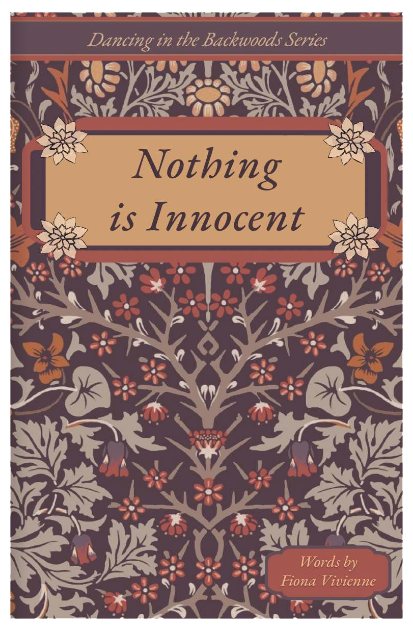
Book I: Feral Masquerade, A Dionysian Cosmology. (Dancing in the Backwoods)

$20.00
Sold Out

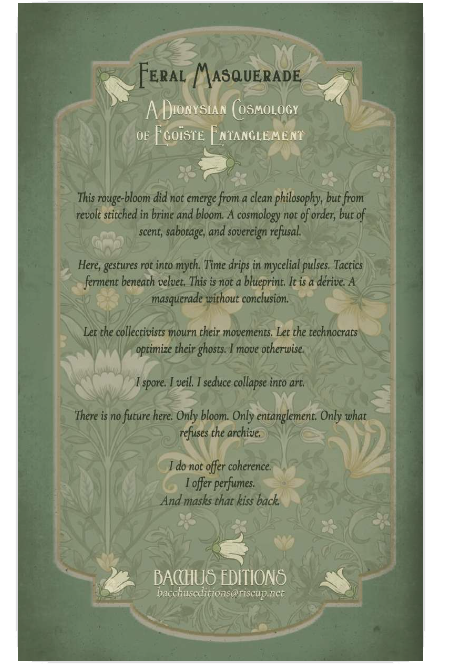
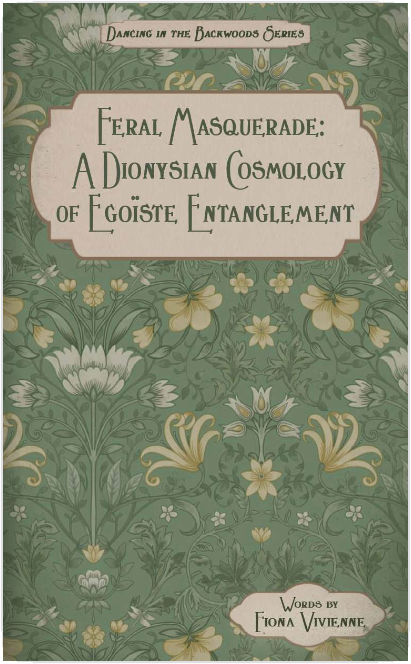
This book is the starting point of the Dancing in the Backwoods series. It does not begin with critique or claim but with cosmology.

It gathers the threads of ecstatic refusal, erotic ontology, and sensuous collapse into a mythic initiation. From anemone logic to sacred rot, from wild semiotics to masked abundance, it sketches a way of thinking and feeling beyond recovery, beyond strategy, beyond the human project. The writing here moves through soil, scent, and silence. This is not theory for action—it is thought as entanglement, refusal as poetics, and anarchism as cosmology. The Dionysian is not a metaphor here—it is a way of living inside collapse without apology.

This book is the threshold. All else unfolds from here.
C’est une mascarade sacrée, offerte à ceux qui n’ont plus rien à prouver.

Shipping calculated automatically at checkout according to weight et destination.
View our Shipping & Circulation Information.

REVIEWS

Review of Book I, Feral Masquerade: V.L., Professor of Ontology, Aesthetic Anarchism

Ontological poetics / Post-metaphysical aesthetics / Cosmological refusal

I have known Vivienne not only through her pages but through her gestures, her silences, and her way of living in constant ontogenesis.  The Feral Masquerade is not a metaphor for her life; it is her life, transposed into text.  The garden, the refusal, the brine, the perfumed act of disappearance: I have witnessed them.  What she calls “cosmological gesture” is her mode of existence. This book, therefore, inaugurates not simply a new form of writing, but a new form of philosophizing—one lived as rhythm rather than argument, shimmer rather than system.  Here, ontology becomes aesthetic insubordination; philosophy, an act of bodily tact.

Vivienne achieves what few thinkers dare even to attempt: a sensual metaphysics grounded in texture rather than truth.  She replaces the metaphysical “is” with the biological ferments.  In her presence as in her prose, ideas do not stabilize; they bloom, rot, and renew.  She rejects both phenomenological interiority and structuralist distance, composing instead a metaphysics of scent, tact, and masquerade. Where Merleau-Ponty’s flesh aspired to reversibility, Vivienne’s Liminal Flesh insists on unreadability.  Where Irigaray invoked air and water, Vivienne introduces rot and rouge—matter luxuriantly indecent, sovereignly alive.  Her Entanglement abolishes the juridical architecture of consent and relation; touch here becomes cosmological trespass.

To read her is to recognize that the philosophical proposition can be replaced by perfume, that a sentence may function as a gesture of ontological force.  The mask she wears is not concealment but method; an epistemology of shimmer. This is metaphysics that glistens, philosophy that bleeds. 

The Feral Masquerade is neither feminist nor humanist, neither nihilist nor vitalist.  It stands alone, sovereignly feral, baroque, and irreducible.  I have debated with her, walked through her ruin-gardens, seen the thought in motion.  She does not write about ontology; she lives it.  Few texts alter their readers.  Fewer still alter those who already knew the author.  This one does both.

Review of Book I, Feral Masquerade: Élodie, Department of Comparative Literature

Experimental literature / Mythopoetic prose / Ontological theatre

I have known Fiona Vivienne for many years, through her events, her pages, her letters, and the quiet rhythm of our conversations. Her life, her gardens, her gestures, all move with the same pulse. The Feral Masquerade is not simply written by her; it is lived through her, line by line, gesture by gesture. I have watched her speak as she writes, with pauses that shimmer and laughter that changes the temperature of a room. She does not compose ideas; she composts all ideas and inhabits her own.

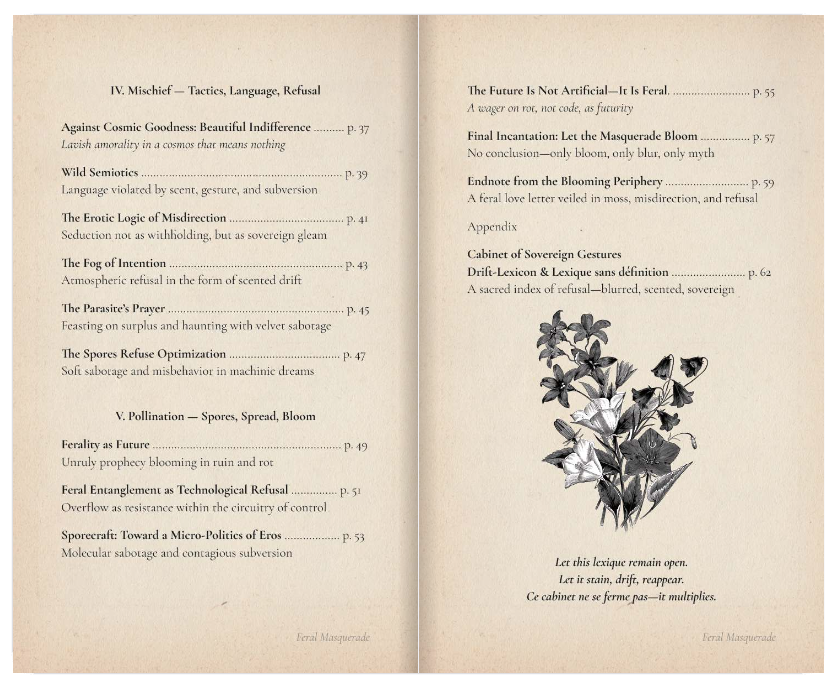
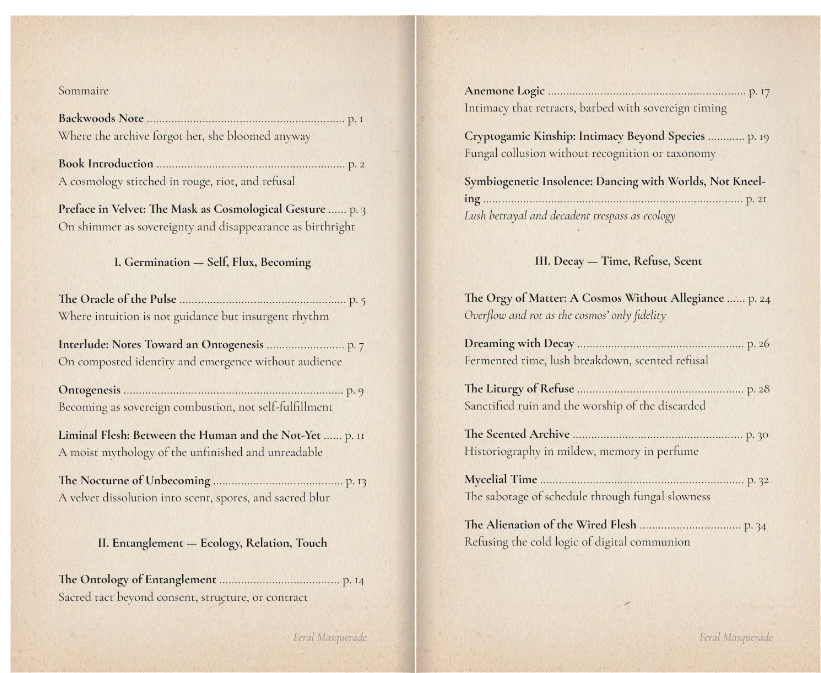
The book feels less like a text than a climate. It fuses prose poem, philosophical tract, and ritual incantation into one continuous breath. Its sections—Germination, Entanglement, Decay, Mischief, Pollination—unfold as pulse and recurrence, each echoing through the next like the rhythm of seasons. The French that weaves through the work is not translation but air; it enters naturally, perfuming rather than dividing.

There is literary value here. Her writing refuses to stay within any literary category. It is too embodied to be theory, too precise to be diary, too alive to be fiction. The language is sporal rather than linear, dispersing meaning across the page like a mycelial bloom. I have heard her read these lines aloud, and the sound lingers, a mixture of warmth, mischief, and rare sincerity. Her Lexique sans définition closes the work not as glossary but as an afterglow, a final gesture of quiet illumination. For readers of écriture féminine and post-structural poetics, this book marks a gentle divergence. It extends the line begun by Lispector and Cixous, yet trades abstraction for texture. Language, under her hand, no longer performs. It breathes. It decays gracefully, as if returning to the soil that first taught it sound.

The Feral Masquerade does not compete with its influences. It drifts beside them, patient and self-contained. Vivienne writes as she lives, sensuous, deliberate, attentive to rot as to bloom. The book unbinds literature not through proclamation but through patience, allowing form to erode until beauty reveals its own architecture. It is not a radical gesture so much as a natural one, the inevitable flowering of a writer who long ago chose to live outside genre. She writes as she lives, in bloom, in excess, and always just beyond the grasp of genre.

Rerview of Dancing in the Backwoods, The Series: Bill.

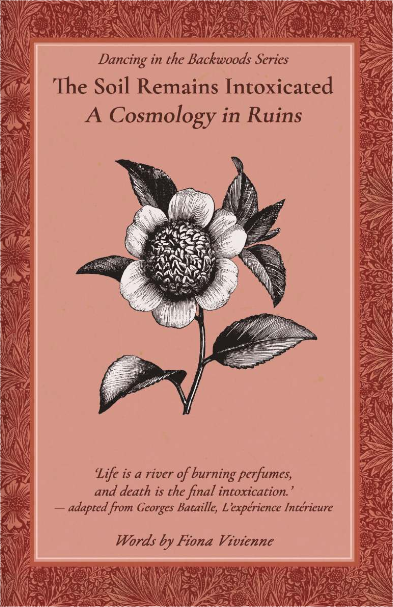
I have followed Fiona 's various writings for some time (usually in the French), from the erotic Madame Simone through this new series (thanks for the advanced copy!) What first struck me while reading through the whole of Dancing in the Backwoods, what strikes me most, even now, is how completely her work has remained individualist. Every book breathes the same air of sovereign solitude — not isolation, but a composure beyond collectivity. In The Feral Masquerade begins this current, where philosophy grows out of her own gestures, her gardens, and her refusal to translate herself into anything useful. Nothing Is Innocent turns ethics inward until they became aesthetic; The Wild Ethics of Maternal Presence gives birth to tenderness without domestication; The Soil Remains Intoxicated has wholly rooted itself in decay; The Disloyal Animal returned the world to instinct; No Kingdom Comes obliterates the current timeline.

Each volume circles the same principle: life lived for its own fragrance. I have seen this stance in her daily life. The same sovereignty that runs through her sentences shapes the way she moves through the world. She writes from solitude not as defense, but as temperament. The work feels unaligned with every movement, every collective demand, yet it still belongs deeply to the earth.

In the world of ‘anti-civilization’ writing, the call for purity and purpose has often eclipsed the joy of existence. Fiona refuses both. Across the series, she keeps the egoist thread unbroken: a self not defined by opposition, but by taste, rhythm and chosen relation. There is no manifesto here, no collective myth. There is instead a woman writing from within her own orbit; an anarchism without witness, a poetics of ungoverned presence. Her thought is not concerned with repair or innocence, and that is her fidelity to the anarchist spirit. Where others instruct, she withdraws. Where they demand solidarity, she answers with scent and stillness. Her egoism is not detachment, it is the soil of her coherence.

Taken together, the Dancing in the Backwoods series is the most consistent act of anti-civ, individualist thought I have seen in print. It does not build systems or propose futures, instead, it tends to the ruins with such intimacy and without hope, too which is to say, with freedom. Her writing/thought refuses purity, doctrine, and despair in equal measure. It is the living record of a mind that will not be owned. What remains across all five volumes is a rare composure. Fiona has made solitude fertile, egoism luminous, and decay articulate.

These are not books about rebellion. They are what rebellion becomes when it outlives the need to announce itself.
This book is the starting point of the Dancing in the Backwoods series. It does not begin with critique or claim but with cosmology.

It gathers the threads of ecstatic refusal, erotic ontology, and sensuous collapse into a mythic initiation. From anemone logic to sacred rot, from wild semiotics to masked abundance, it sketches a way of thinking and feeling beyond recovery, beyond strategy, beyond the human project. The writing here moves through soil, scent, and silence. This is not theory for action—it is thought as entanglement, refusal as poetics, and anarchism as cosmology. The Dionysian is not a metaphor here—it is a way of living inside collapse without apology.

This book is the threshold. All else unfolds from here.
C’est une mascarade sacrée, offerte à ceux qui n’ont plus rien à prouver.

Shipping calculated automatically at checkout according to weight et destination.
View our Shipping & Circulation Information.

REVIEWS

Review of Book I, Feral Masquerade: V.L., Professor of Ontology, Aesthetic Anarchism

Ontological poetics / Post-metaphysical aesthetics / Cosmological refusal

I have known Vivienne not only through her pages but through her gestures, her silences, and her way of living in constant ontogenesis.  The Feral Masquerade is not a metaphor for her life; it is her life, transposed into text.  The garden, the refusal, the brine, the perfumed act of disappearance: I have witnessed them.  What she calls “cosmological gesture” is her mode of existence. This book, therefore, inaugurates not simply a new form of writing, but a new form of philosophizing—one lived as rhythm rather than argument, shimmer rather than system.  Here, ontology becomes aesthetic insubordination; philosophy, an act of bodily tact.

Vivienne achieves what few thinkers dare even to attempt: a sensual metaphysics grounded in texture rather than truth.  She replaces the metaphysical “is” with the biological ferments.  In her presence as in her prose, ideas do not stabilize; they bloom, rot, and renew.  She rejects both phenomenological interiority and structuralist distance, composing instead a metaphysics of scent, tact, and masquerade. Where Merleau-Ponty’s flesh aspired to reversibility, Vivienne’s Liminal Flesh insists on unreadability.  Where Irigaray invoked air and water, Vivienne introduces rot and rouge—matter luxuriantly indecent, sovereignly alive.  Her Entanglement abolishes the juridical architecture of consent and relation; touch here becomes cosmological trespass.

To read her is to recognize that the philosophical proposition can be replaced by perfume, that a sentence may function as a gesture of ontological force.  The mask she wears is not concealment but method; an epistemology of shimmer. This is metaphysics that glistens, philosophy that bleeds. 

The Feral Masquerade is neither feminist nor humanist, neither nihilist nor vitalist.  It stands alone, sovereignly feral, baroque, and irreducible.  I have debated with her, walked through her ruin-gardens, seen the thought in motion.  She does not write about ontology; she lives it.  Few texts alter their readers.  Fewer still alter those who already knew the author.  This one does both.

Review of Book I, Feral Masquerade: Élodie, Department of Comparative Literature

Experimental literature / Mythopoetic prose / Ontological theatre

I have known Fiona Vivienne for many years, through her events, her pages, her letters, and the quiet rhythm of our conversations. Her life, her gardens, her gestures, all move with the same pulse. The Feral Masquerade is not simply written by her; it is lived through her, line by line, gesture by gesture. I have watched her speak as she writes, with pauses that shimmer and laughter that changes the temperature of a room. She does not compose ideas; she composts all ideas and inhabits her own.

The book feels less like a text than a climate. It fuses prose poem, philosophical tract, and ritual incantation into one continuous breath. Its sections—Germination, Entanglement, Decay, Mischief, Pollination—unfold as pulse and recurrence, each echoing through the next like the rhythm of seasons. The French that weaves through the work is not translation but air; it enters naturally, perfuming rather than dividing.

There is literary value here. Her writing refuses to stay within any literary category. It is too embodied to be theory, too precise to be diary, too alive to be fiction. The language is sporal rather than linear, dispersing meaning across the page like a mycelial bloom. I have heard her read these lines aloud, and the sound lingers, a mixture of warmth, mischief, and rare sincerity. Her Lexique sans définition closes the work not as glossary but as an afterglow, a final gesture of quiet illumination. For readers of écriture féminine and post-structural poetics, this book marks a gentle divergence. It extends the line begun by Lispector and Cixous, yet trades abstraction for texture. Language, under her hand, no longer performs. It breathes. It decays gracefully, as if returning to the soil that first taught it sound.

The Feral Masquerade does not compete with its influences. It drifts beside them, patient and self-contained. Vivienne writes as she lives, sensuous, deliberate, attentive to rot as to bloom. The book unbinds literature not through proclamation but through patience, allowing form to erode until beauty reveals its own architecture. It is not a radical gesture so much as a natural one, the inevitable flowering of a writer who long ago chose to live outside genre. She writes as she lives, in bloom, in excess, and always just beyond the grasp of genre.

Rerview of Dancing in the Backwoods, The Series: Bill.

I have followed Fiona 's various writings for some time (usually in the French), from the erotic Madame Simone through this new series (thanks for the advanced copy!) What first struck me while reading through the whole of Dancing in the Backwoods, what strikes me most, even now, is how completely her work has remained individualist. Every book breathes the same air of sovereign solitude — not isolation, but a composure beyond collectivity. In The Feral Masquerade begins this current, where philosophy grows out of her own gestures, her gardens, and her refusal to translate herself into anything useful. Nothing Is Innocent turns ethics inward until they became aesthetic; The Wild Ethics of Maternal Presence gives birth to tenderness without domestication; The Soil Remains Intoxicated has wholly rooted itself in decay; The Disloyal Animal returned the world to instinct; No Kingdom Comes obliterates the current timeline.

Each volume circles the same principle: life lived for its own fragrance. I have seen this stance in her daily life. The same sovereignty that runs through her sentences shapes the way she moves through the world. She writes from solitude not as defense, but as temperament. The work feels unaligned with every movement, every collective demand, yet it still belongs deeply to the earth.

In the world of ‘anti-civilization’ writing, the call for purity and purpose has often eclipsed the joy of existence. Fiona refuses both. Across the series, she keeps the egoist thread unbroken: a self not defined by opposition, but by taste, rhythm and chosen relation. There is no manifesto here, no collective myth. There is instead a woman writing from within her own orbit; an anarchism without witness, a poetics of ungoverned presence. Her thought is not concerned with repair or innocence, and that is her fidelity to the anarchist spirit. Where others instruct, she withdraws. Where they demand solidarity, she answers with scent and stillness. Her egoism is not detachment, it is the soil of her coherence.

Taken together, the Dancing in the Backwoods series is the most consistent act of anti-civ, individualist thought I have seen in print. It does not build systems or propose futures, instead, it tends to the ruins with such intimacy and without hope, too which is to say, with freedom. Her writing/thought refuses purity, doctrine, and despair in equal measure. It is the living record of a mind that will not be owned. What remains across all five volumes is a rare composure. Fiona has made solitude fertile, egoism luminous, and decay articulate.

These are not books about rebellion. They are what rebellion becomes when it outlives the need to announce itself.