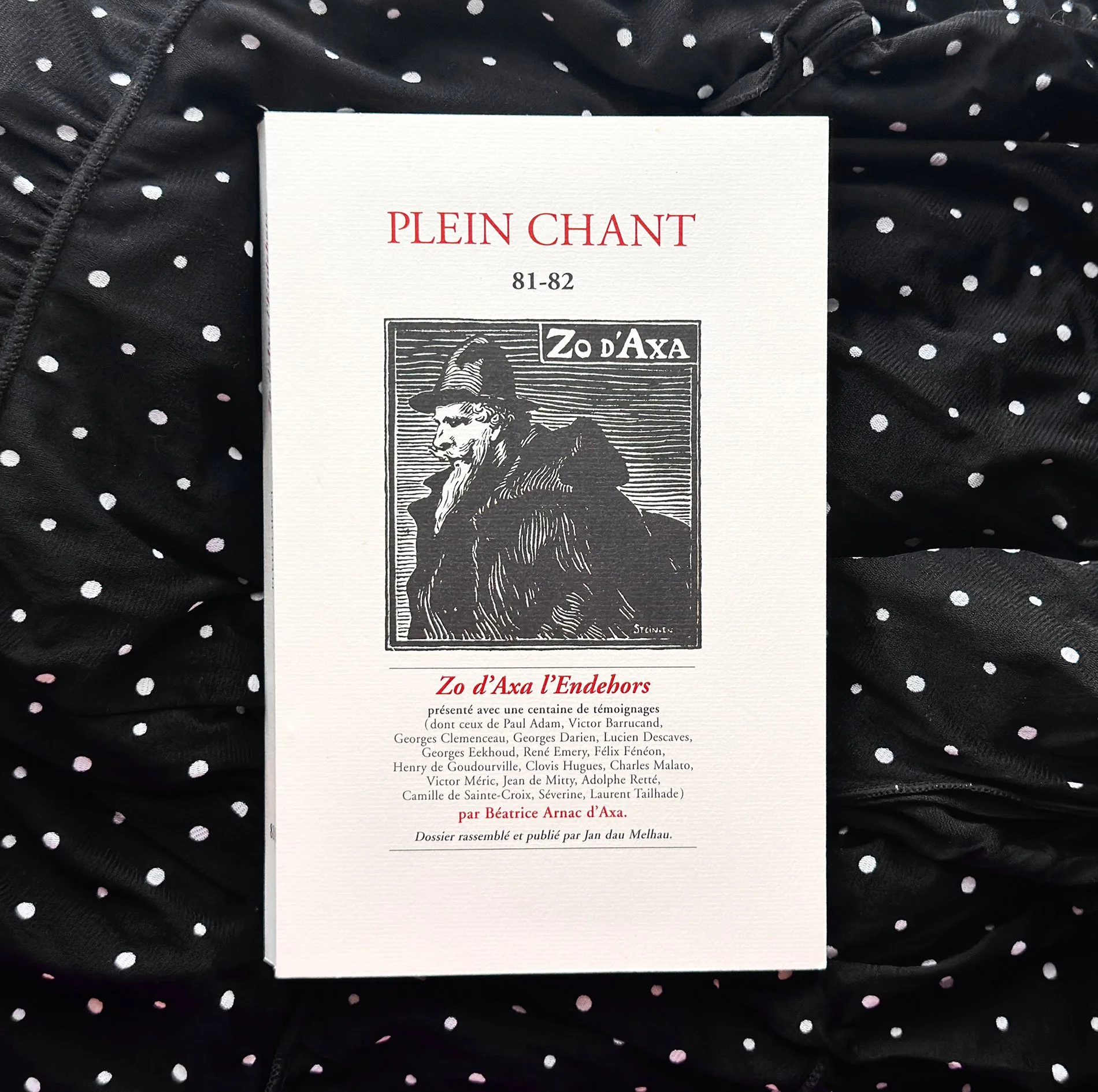
Bonjour friends, I have a lovely update on the Zo d’Axa archival work.
My correspondence with dear Jan dau Melhau has led to a new undertaking for Bacchus Editions as mentioned in a previous subscriber email. Jan is an Occitan writer, poet, and musician, and a longtime collaborator with the French literary review Plein Chant. I will be translating and publishing works from the Plein Chant catalog in English, et of course began with its double issue No. 81–82, Zo d’Axa l’Endehors. Jan assembled this book with Béatrice Arnac d’Axa, Daniel Roy, and others at Plein Chant. The translation is now nearly complete.
Many people know Zo d’Axa mainly through L’Endehors, La Feuille, his prosecutions and imprisonment, and his irreverent assaults upon political authority. For them, this volume offers a far fuller acquaintance. It brings together his writings, early poetry, correspondence, contemporary accounts, photographs, newspaper reproductions, et most notably, family recollections, all of it preserved et assembled by people who knew his history intimately. This volume has never appeared in English, and Béatrice’s recollections have never been translated at all.
The original French edition is quite possibly the most comprehensive portrait of Zo d’Axa ever assembled. Its pages reach well beyond the familiar episodes of his anarchist journalism, into the experiences, relationships, and contradictions of a man who was never particularly interested in making himself agreeable to anyone’s expectations.
Alongside the translation, I have been working through trunks of personal belongings et archival material from his granddaughter, Béatrice Arnac d’Axa, entrusted to me by Béatrice’s estate. The material has brought unexpected discoveries, et quite often an entire afternoon disappears into a single letter or photograph.
Of everything in the Plein Chant volume, though, it is Béatrice’s own contributions that illuminate...
I knew Béatrice personally, and adored her. She was passionate, opinionated, affectionate, hilarious, and sometimes, as Jan himself observed, an absolute pain in the ass. She could be gloriously impossible. I remember her force of character, her humor, and the remarkable ease with which she could move from tenderness to indignation. Translating her words has brought her voice back to me with such clarity.
Her opening chapter, “Germination,” begins with a declaration of love for her grandfather that is magnificent in its extravagance. She calls him “the only man I have loved with an incestuous but platonic love, the only man in my life…the one whose blood flows in my veins.”
Voilà. She wants to take his hand, enter his soul, follow the meanders of his existence, and gather its essence and perfume. She dreams of him, drinks Italian white wine with him in those dreams, and speaks of his beauty and tenderness with an admiration that is almost voluptuous.
I can imagine a few Anglo-Saxon eyebrows rising. Mais enfin, must every expression of ardor be subjected to the dreary inspection of propriety? Béatrice makes no apology for the intensity of her affection, and I see no reason to make one on her behalf. Nor do I intend to temper her language for English readers. She was an extravagant woman, and she wrote extravagantly. I would not dream of depriving her of it.
Having declared herself so magnificently, she then introduces us to a Zo d’Axa whom many anarchistes might scarcely recognize…
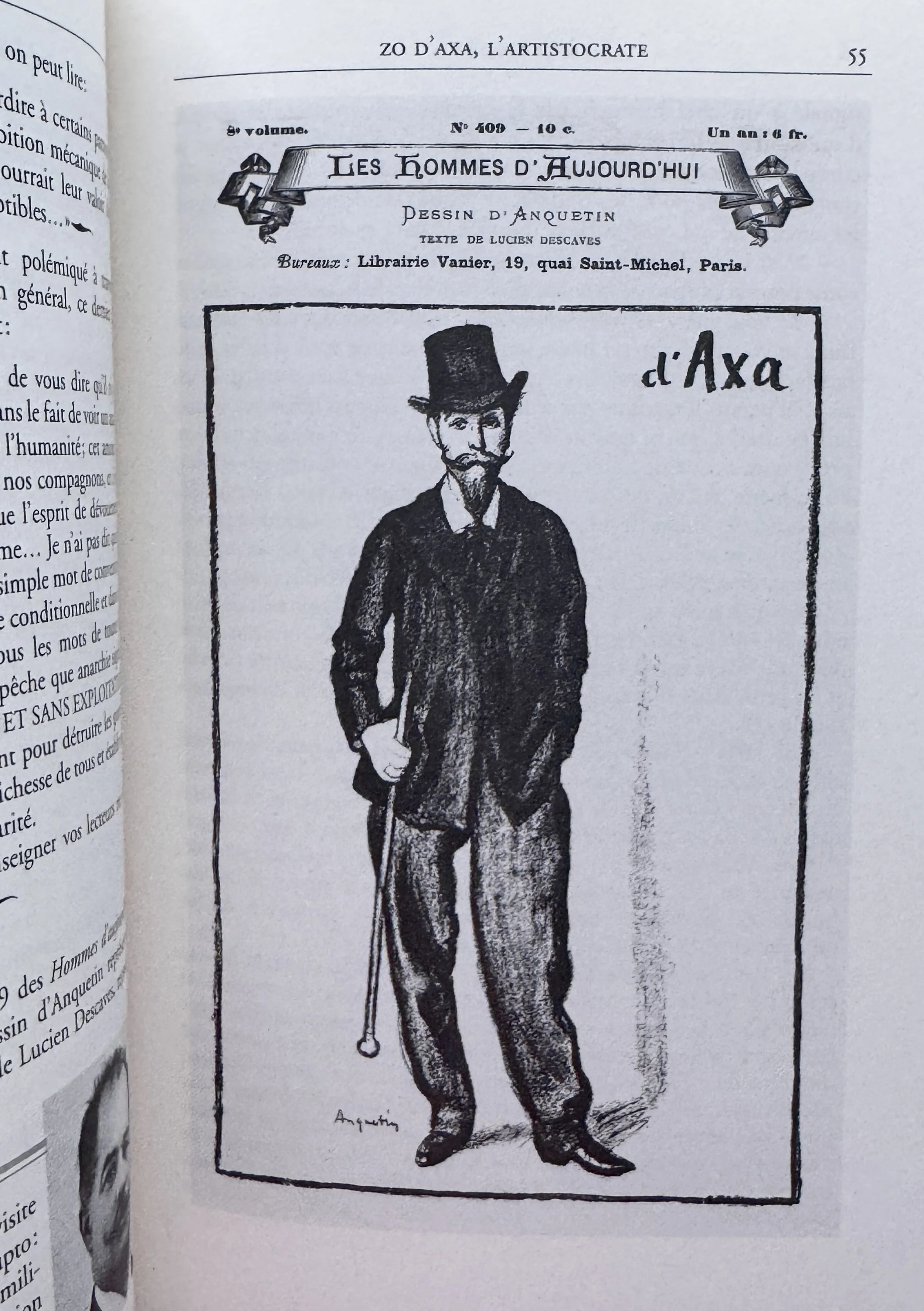
Before Zo d’Axa
Before the founder of L’Endehors, before the journalist who mocked politicians, judges, and respectable society, there is Alphonse Gallaud, a young royalist who enters military life at Saint-Cyr. A royalist, imagine. He quarrels with an officer, deserts the army, and flees France with the officer’s wife. Later, in Rome, he adopts the name Charles d’Aulga and moves among painters and poets, writing art criticism and attracting a quite ridiculous amount of admiration for his beauty. Béatrice, naturellement, takes great pleasure in recounting it.
His early writings, however, are what I suspect will most interest readers acquainted with his later individualisme.
At twenty-four, long before his anarchist journalism, he is already challenging the authority of critics who presume to determine what others ought to admire. He rejects the critic’s role as judge, the display of erudition, and the idea that beauty requires an authorized interpretation. He writes instead of his own sensations, the impressions a work produces in him, without attempting to impose them upon anyone else. He calls these writings his “impressions of art.”
Even antiquity receives no special indulgence. Confronted with the celebrated remains of ancient temples, he observes that a pebble rolling along the bottom of a stream is just as old. “Everything is the same age in nature.” He calls these pebbles “wandering stones,” and he is more moved by the ruins of a recent earthquake, where the traces of ordinary human lives remain, than by monuments whose importance has been established for centuries.
His political convictions had not yet become those of the anarchiste journalist we know, ~his youth is not a tidy story of ideological development. Yet his refusal to borrow his judgments from established authorities is already apparent. The man who would later refuse to submit himself to political orthodoxies was, at twenty-four, already perfectly capable of declining all authority.
And this is only the opening of the first chapter…
The English Edition and the Work of Plein Chant
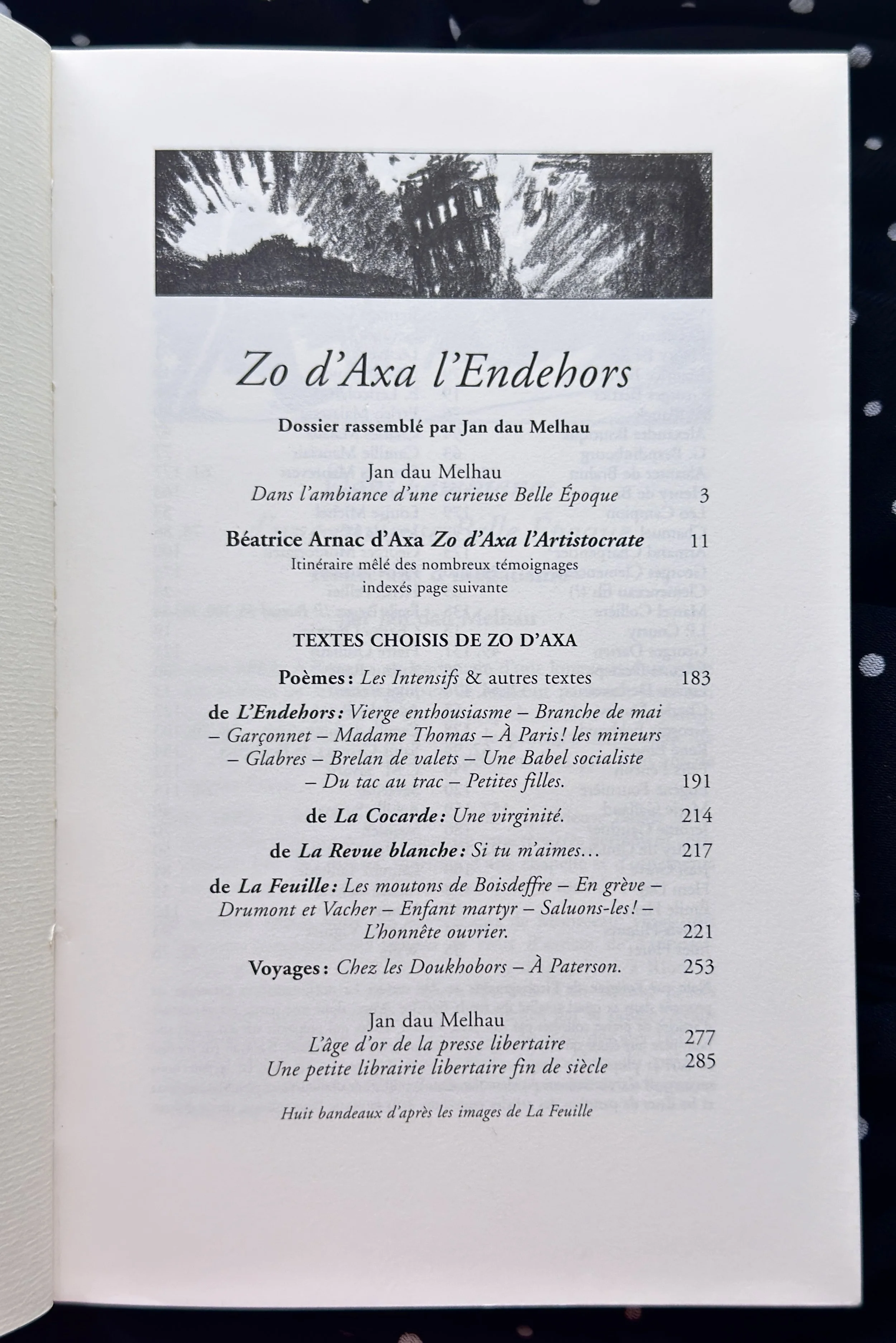
The chapters that follow take you into the founding of L’Endehors and the anarchistes, artists, et writers who gathered around it. They cover the prosecutions and imprisonments, the political scandals, the travels, and the stranger episodes of Zo’s life. His own writings appear alongside contemporary accounts and Béatrice’s family recollections, preserving details that English-language readers have never had the opportunity to encounter.
I know Béatrice’s voice so well, its little ironies, its tenderness, its occasional insolence, and translating her has been a particular joy. That delicious moment when affection gives way to provocation… oh, she is still very much herself. Not that I would dream of it, but I can almost hear what she would say if I dared to tidy up one of her sentences.
I want to give proper attention to the labor behind the original French edition. Jan dau Melhau devoted a great deal of work to assembling this dossier, with the assistance of Daniel Roy and others at Plein Chant. It brings together Béatrice’s writing, family recollections, historical documents, and Zo’s own words. The resulting double issue is a substantial historical and literary undertaking, assembled with a care that is evident throughout its pages.
It feels right that Bacchus Editions first English translation from the Plein Chant catalog should be this volume. The work of Jan, Béatrice, and their collaborators deserves a readership beyond France et I have very much wished for you all to have it, too. I am thrilled to be closing out this project. Béatrice’s account of her grandfather will at last be available to those who have known Zo d’Axa principally through fragments of his anarchiste writings.
Jan dau Melhau: Sous un regard
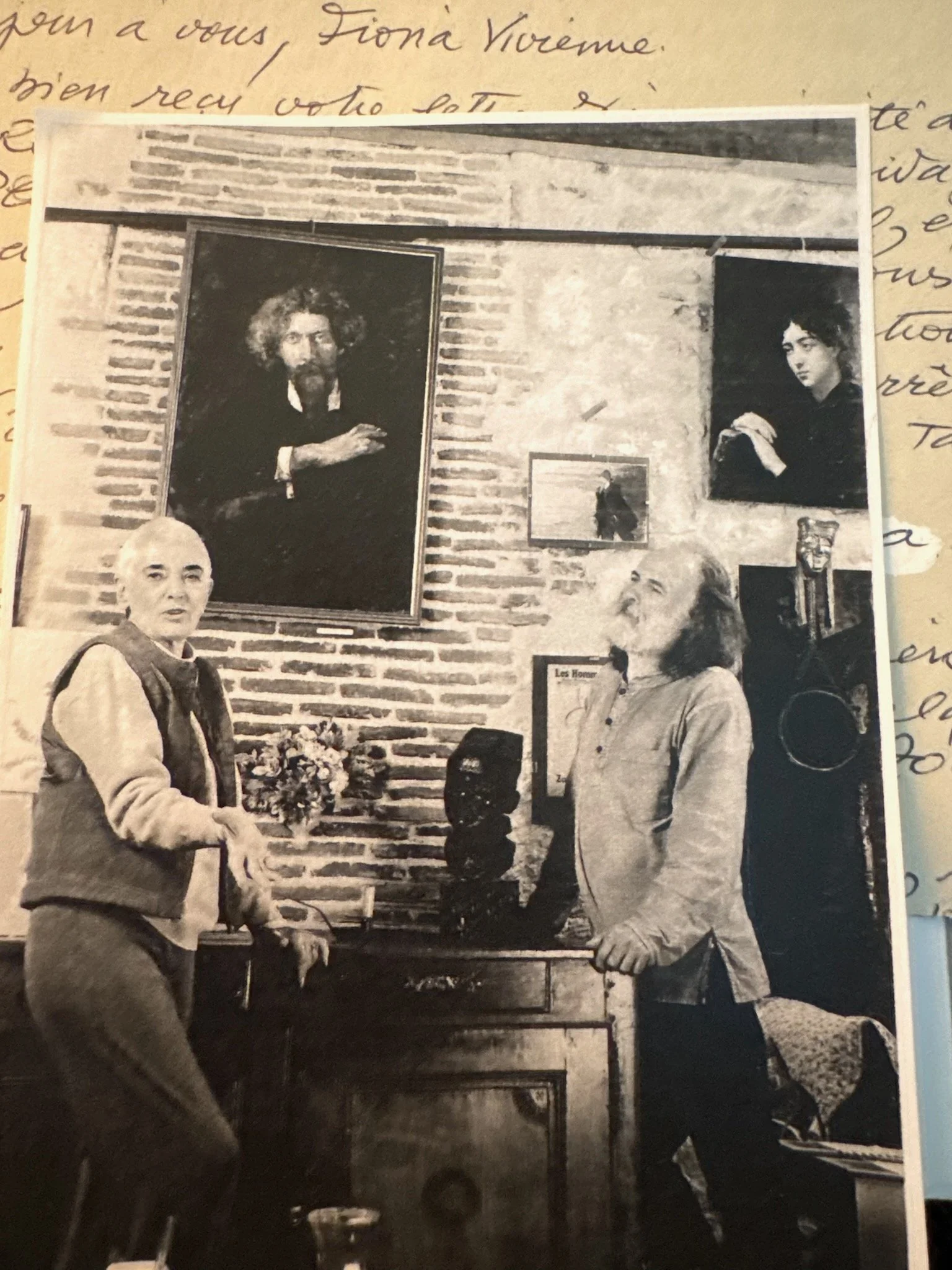
Jan dau Melhau et Béatrice Arnac d’Axa at her place. A fun aside, on her door in Le Bugue hung la fameuse plaque of illegalist- anarchiste (Alexandre) Marius Jacob :)
I have also completed the translation of Jan's own Sous un regard (Under a Gaze), written in December 2006. It is a particularly beautiful piece, addressed directly to Zo d’Axa as Jan contemplated one of the last photographs taken of him, shortly before his death in 1930.
Jan speaks to d’Axa as though he were sitting before him, as writer’s often do. He reflects upon freedom, individualism, and his own political generation, recalling 1968 et his little Occitan newspaper, La Fuelha. He has a few things to say about the rather poor attention given to Zo's anniversaries, too. It is affectionate, occasionally severe, et wonderfully personal. By the end, he seems almost to catch himself speaking for the man in the photograph, and allows silence to have the final word.
The translation is finished, et I am especially elated to be bringing Jan's own voice into English alongside the writings he has spent so much time preserving.
The archival material accompanying this work is equally fascinating. Jan's account of Jean Lécuyer and Zo d’Axa introduces correspondence from the 1890s, including Lécuyer's letters to Zo and his wife from prison, followed by Zo's own prison correspondences. Jan's editorial notes identify the anarchistes and other figures who appear in these letters as well, giving readers a much clearer sense of the people and circumstances surrounding them.
A Little More Zo
Bacchus Editions has already published Zo d’Axa and the Secret Door, the first volume in our Pocket Detonations series. It pairs d’Axa’s writing with original collages assembled from rare archival material, Plein Chant publications, et of course, the Arnac estate steamtruks. The pocket detonation includes the only known surviving photographs of his wife, discovered among the family belongings entrusted to me through Béatrice’s estate.
As the English edition of Plein Chant No. 81–82 approaches publication, Bacchus will keeping everything grouped on our Zo d’Axa page. You’ll find news of the translation, archival photographs, discoveries from the family material, and more about Zo d’Axa, and the people whose lives crossed his.

More very soon.
XO, Fíona Vivienne for Bacchus Editions