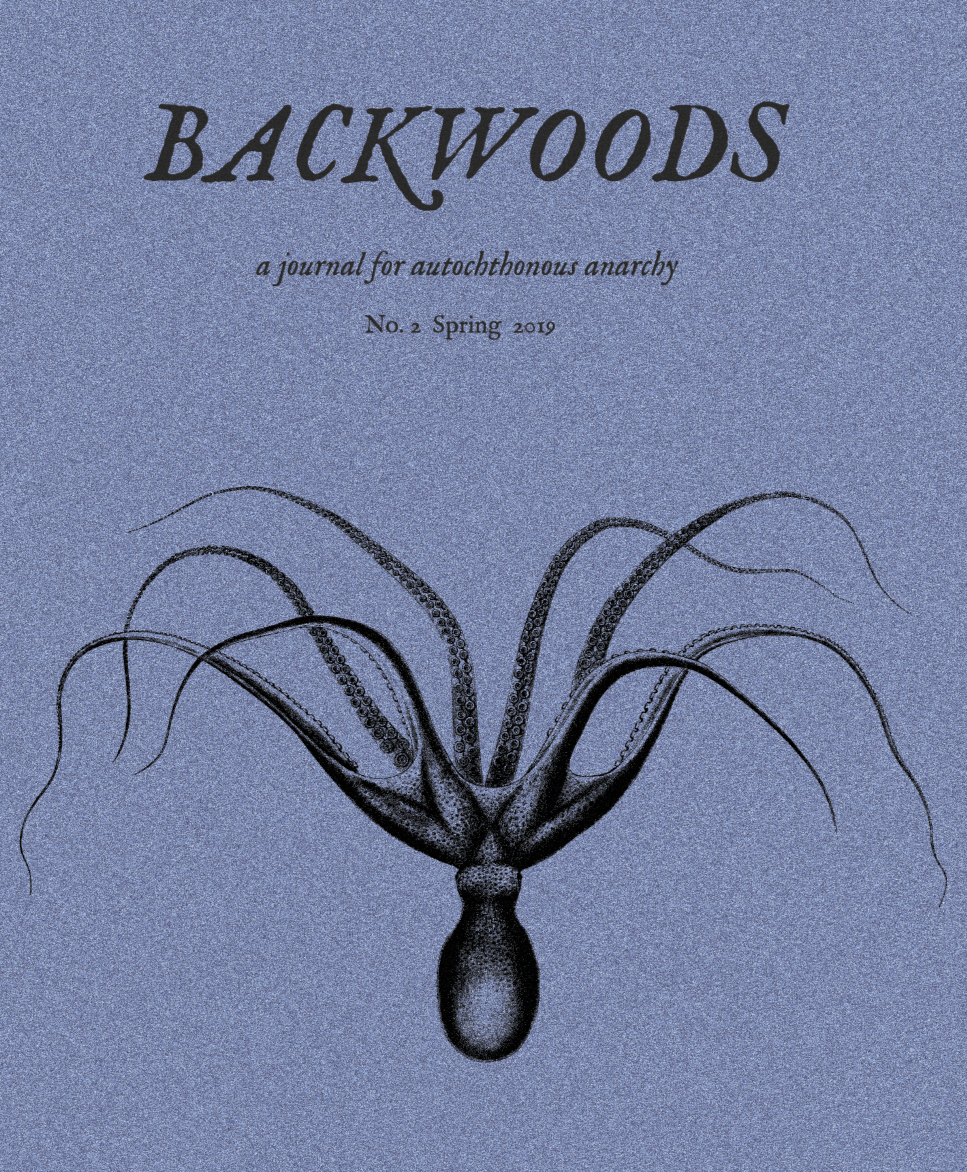
The second issue of Backwoods, Spring 2019, has come off our presses and is now in the Bacchus Editions bookshop!
If the first issue was the editors pitching their tent, the second is where they throw open the flap and invite everyone in to argue about where it’s pitched. The editorial says so outright. Having used No. 1 to stake out their own position, they now wanted difference, discussion, and no party line at all. Such a thing, they admit cheerfully, doesn’t exist even among the three of them. Trois têtes, zéro dogme. On vous adore. What follows is a journal quarrelling with its readers, its guests, its heroes, and now and then with itself, always with obvious affection…
The issue opens on its knees in a canyon. In “Tending the Goddess,” Tamarix names two ways civilization relates to wild land. Agriculture subdues it. The tidier “wilderness ethic,” beloved of conservationists, preserves it at a polite distance and visits it with pity, as tourists do. Both keep humans apart. Tamarix goes as a lover instead. The courtship begins in grief, and continues as an awkward, honest offering to one particular place: saliva, a carved spoon, a poem, jars of yarrow and mugwort seed, and a vow to protect the canyon from cattle that is kept quietly, outside the law. It ends with a communal invocation to the Goddess of Weeds, Wolves, and Women who Bleed. (Tu nous rappelles que le deuil est aussi une porte. Merci, mon cœur.)
Vincent Vulgare then reviews Dale Pendell’s The Great Bay in the form of Pendell’s own Pharmako books, treating the novel as a plant ally. It has its Taxonomy, its Effects, its Correspondences, and under How Taken: “read with coffee in the morning, possibly with tobacco.” “Or a Thousand Worlds” is homage and elegy at once, for Pendell died in 2018. It is also no mere tribute, since Vulgare parts ways with his ally over climate politics and the green-industrial schemes of the mainstream Left. In the end, Pendell’s post-collapse California answers the question of how people get by without Leviathan: by making a thousand worlds in place of the One. (Une critique qui se prend comme une plante : lentement, avec du café.)
At the heart of the issue sits Bellamy Fitzpatrick’s “What Does the World Desire?,” a seven-part genealogy of how the West came to believe the world is dead. Its boldest claim is that modern materialism is not the opposite of monotheism but its descendant. The line runs from the alphabet, through Plato’s Forms, Paul and Augustine, to Descartes’s animal-machines, with God removed at the end and only matter left. Against this, Fitzpatrick offers panpsychism, Gaia theory, and the old Indo-European root dhghem, ancestor of human, humus, humility, and autochthonous, the word that now graces the journal’s subtitle. The ethics that follows is no commandment, only a way of living well inside a world that is alive and wanting. (Le monde désire, et toi aussi, Bellamy. C’est pour ça qu’on te lit.)
Benjamin Weiss of Susquehanna Permaculture brings things down to the dirt with “Where the Wild Things Are(n’t).” He takes apart permaculture’s beloved zone map: it assumes a landowner with capital, it puts humans at the centre, and it neglects Zone 4, the semi-wild edge where all the essential resources we depend on actually enter our lives. Then comes his quiet bombshell. Since civilization now manages every biome on Earth, there is no wilderness left to draw on the map, and Zone 5 must become a destination rather than a starting point. Teheru’s poems grow in the margins throughout. (Merci d’avoir remis le sauvage au cœur du jardin. Et à Teheru, pour les vers qui poussent entre les lignes.)
Then comes the conversation everyone will be talking about. In “The Storyteller Who Ate the World,” Layla AbdelRahim argues that civilization is founded on predation, the choice to live by consuming others, and that our stories carry that premise into every school, church, and laboratory. Wild stories, she says, have no grammar for murder. Fitzpatrick presses her on what remains if one refuses both hunting and agriculture, offering his own move from veganism to hunting deer. She does not give an inch, and neither does his afterword. It’s printed unedited, unresolved, and all the better for it. (Chère Layla, merci de ne jamais céder. Deux esprits têtus à une même table : quel régal !)
And the letters! Twenty glorious pages of them. Jae Rodgers asks whether desertion is enough without attack. Queequeg doubts anarchism and permaculture belong together at all. goat asks bluntly about land, money, and the mini-feudal lords of land projects. Ola remembers how Norway’s back-to-the-landers ended up as organic certification. Apio Ludd, whose Vagabond Archive lives in our Reading Room (and gets an update this week!), asks how anyone without money finds a place to build a shack in the woods. rio goes to war over Japanese knotweed and gets as good as they gave. Editors Fitzpatrick, Fera Sylvain, and Thuggy Whiskers answer at length, candidly, and occasionally with their sleeves rolled up. À tous nos correspondants : continuez d’écrire, et de vous disputer !
The issue closes with a scavenged Backpage Rant from the late, great Lynn Margulis, whose Gaia theory has been quietly running beneath the whole issue. (Lynn, la Terre te remercie encore.)
What binds all this together is a single, stubborn question: how does one live as part of a living world, here and now, with whatever one actually has? Tamarix answers through grief and tending, Vulgare through imagination, Fitzpatrick through philosophy, Weiss through design, et AbdelRahim through the stories we tell our children. Then the letters arrive and drag every answer down to earth. Where is the land? Where is the money? Who gets to be free? Nobody wins, and that is precisely the pleasure of it.
✧ ˚ ⋆。 ✦ 🌲 ✧ 🌲 ⋆ ˚ ✧ 🌲 ✦ 。⋆ ✧
As before, we’re printing in small batches as orders arrive, so thank you, as always, for your patience with the print room. Enfin, the woods are getting crowded!
XO Yours,
Fíona