 Image 1 of 1
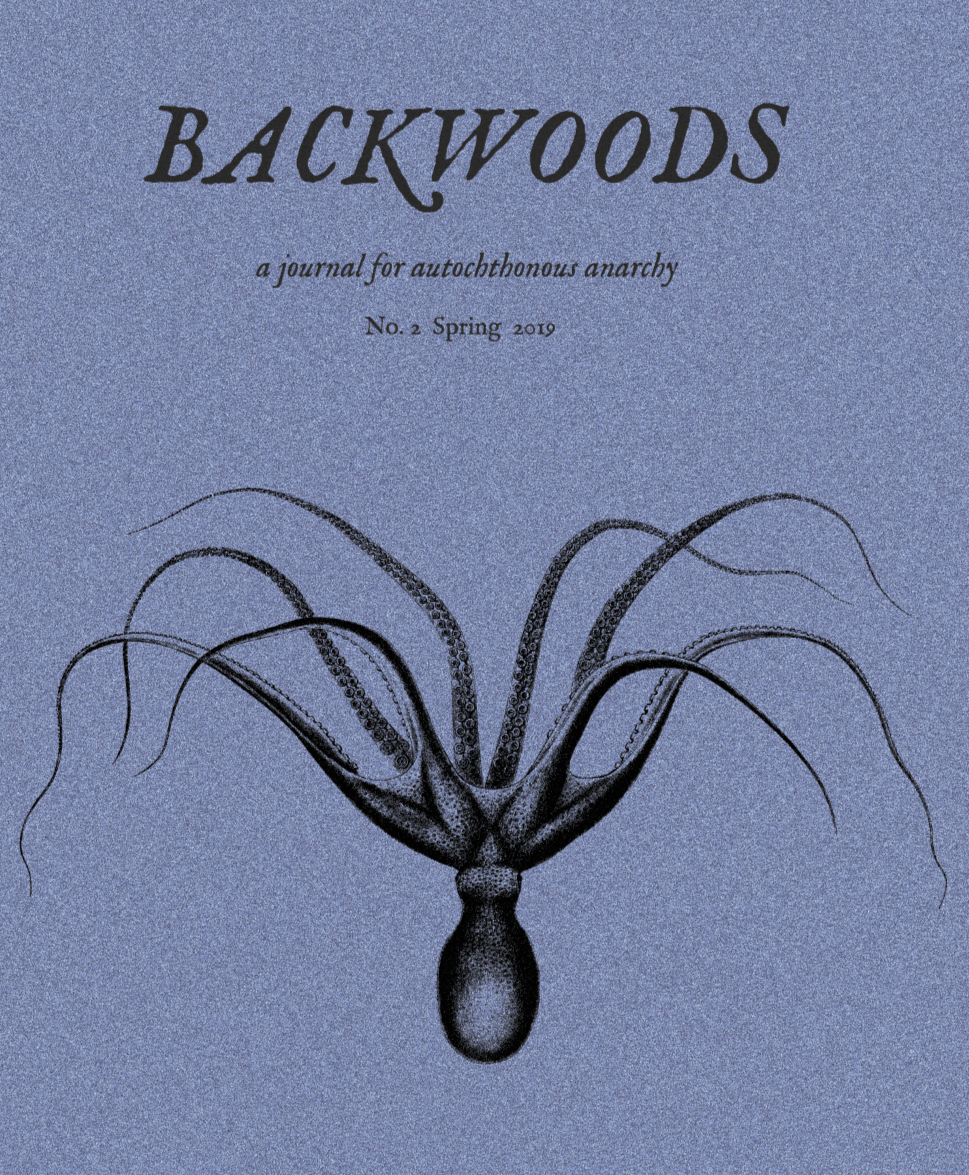
Backwoods A Journal of Anarchy & Wortcunning Issue No. 2 Spring 2019 | Bacchus Editions
$15.00
The second issue of Backwoods: A Journal of Anarchy & Wortcunning returns to print through Bacchus Editions, continuing the journal's exploration of anti-civilization anarchism, ecological relationships, permaculture, and the possibilities of living beyond industrial dependence. Where the inaugural issue established the journal's philosophical and practical terrain, No. 2 opens that terrain to disagreement. Its editors invite criticism, correspondence, and competing visions of anarchy, refusing the idea that a shared opposition to civilization requires a single doctrine or way of life.
In “Tending the Goddess,” Tamarix challenges both agricultural domination and the conservationist wilderness ethic, arguing that each keeps human beings apart from wild land. In their place, Tamarix proposes a relationship of intimacy, grief, reciprocity, and active tending, developed through an account of courtship with a particular canyon.
Vincent Vulgare's “Or a Thousand Worlds” revisits Dale Pendell's The Great Bay: Chronicles of the Collapse, adopting the unusual literary form of Pendell's own Pharmako books. Both homage and critique, the review explores the proliferation of communities and ways of living after industrial collapse, while questioning whether industrial green energy offers any meaningful departure from civilization's destructive arrangements.
In “What Does the World Desire?” Bellamy Fitzpatrick develops a philosophical argument that modern materialism is not simply the opposite of Abrahamic monotheism, but one of its descendants. Drawing upon panpsychism, Gaia theory, and the history of Western thought, he challenges the conception of the world as dead matter and considers an ethics grounded in participation within a living, experiencing Earth.
Benjamin Weiss, of Susquehanna Permaculture, reconsiders the conventional permaculture zone map in “Where the Wild Things Are(n't): Regenerating Zone 4.” Questioning its assumptions about land ownership, human centrality, and the management of wilderness, Weiss argues for the essential importance of the semi-wild interface between human habitation and the wider ecosystem. He proposes wilderness not as a fixed territory beyond human settlement, but as something to be regenerated. Poetry by Teheru accompanies the essay.
In “The Storyteller Who Ate the World,” Layla AbdelRahim, in conversation with Backwoods, develops her critique of civilization as a system founded upon predation. The exchange examines domestication, storytelling, education, and the reproduction of human domination, before turning toward a substantial disagreement with Fitzpatrick over hunting, agriculture, veganism, and the possibilities of subsistence.
The issue's extensive Letters section brings these arguments into direct conversation with readers. Correspondents including Jason Rodgers, Queequeg, goat, Ola, Joshua Myrvaagnes, Apio Ludd, and rio challenge the editors on desertion, insurrection, land access, permaculture, class, and ecological restoration. The editorial replies are candid and often contentious, reflecting the journal's commitment to disagreement as an essential part of its continuing inquiry.
The issue concludes with a Backpage Rant from Lynn Margulis, whose understanding of Gaia offers a fitting final provocation.
Throughout, Backwoods No. 2 returns to a question that cannot be resolved through critique alone: how might people inhabit the living world differently, with the land, resources, relationships, and possibilities actually available to them?
This Edition
Bacchus Editions is delighted to return the second issue of Backwoods Journal to circulation, preserving its original writings, illustrations, correspondence, and editorial character. As with No. 1, we have selected Rolland EnviroOpaque Offset, manufactured in Québec from 100% post-consumer recycled fibre. The paper is produced using biogas energy, processed chlorine-free, and carries FSC and Ancient Forest Friendly certifications. The original contents remain intact, with only the addition of the Bacchus Editions publishing credit. The first two issues are now available, with subsequent issues joining the collection as printing continues.
For the journal's history, editorial philosophy, and continuing work, visit Backwoods Journal at Bacchus Editions.
A Note on Printing & Shipping
Backwoods Journal is being printed in small, successive runs at Bacchus Editions. As we introduce the journal to a new readership, we are allowing production to follow demand rather than maintaining large quantities of stock.
Copies already on hand will ship within our usual fulfillment window. If an issue sells through its current print run, your order will be included in the next printing cycle. This may add a little time before your copy ships. All orders are fulfilled in the order they are received, and the journal will remain available to purchase as subsequent runs are completed.