Identity After Death & Chosen Family Workbook, Now in The Anarchist Death Project & Bookshop
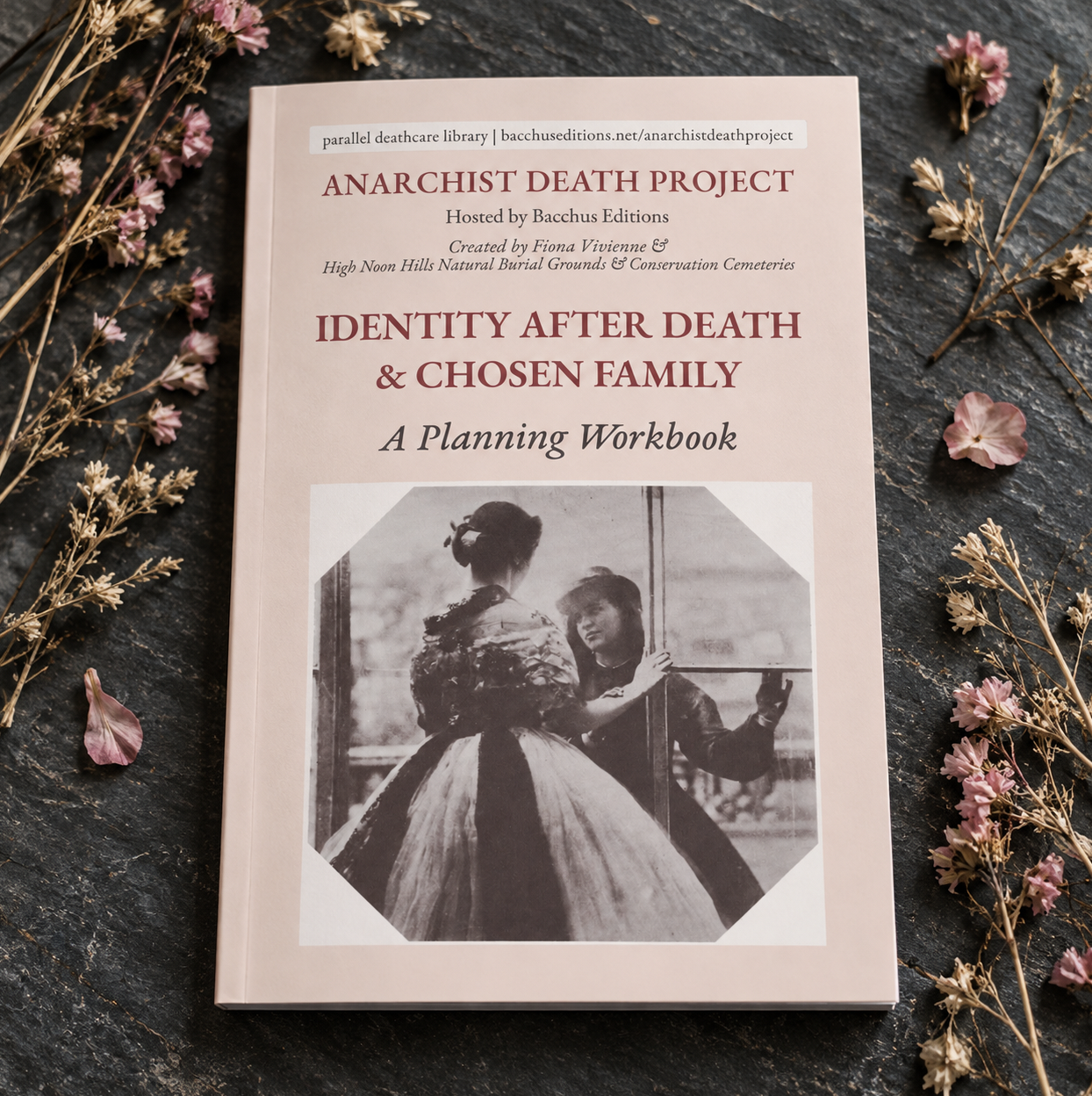
There is a particular cruelty in the assumption that the people entitled to make decisions about our bodies after death are necessarily the people who knew us, loved us, or understood anything about the lives we chose to live. For many people, the family recognized by law bears little resemblance to the family they have made for themselves. Lovers, companions, friends of thirty years, the people who have shared our kitchens, our beds, our catastrophes, our ordinary Tuesdays….
These are the people who know precisely what we would want. Yet when death arrives, their intimacy may count for absolutely nothing. A distant relative, someone from whom we have been estranged for decades, can suddenly possess an authority that the person who has slept beside us for twenty years does not.
Quelle absurdité ! And death, as I have written elsewhere, has the extremely unpleasant habit of delivering you straight into the hands of institutions et the state.
Identity After Death & Chosen Family: A Planning Workbook was created as part of the Anarchist Death Project to address this particular vulnerability. It is a practical, deeply personal workbook for those whose identities, relationships, and wishes may not be adequately protected by conventional next-of-kin arrangements. It asks questions that deserve to be answered while one is still very much alive…
Who do you trust to care for you body? Who should be contacted? Who should be kept away? How should your name, your identity, your relationships, and the life you actually lived be represented when you are no longer there to insist upon them yourself?
These questions carry particular urgency for queer and trans people, estranged families, unmarried partners, chosen families, and anyone whose intimate life exists beyond the tidy little categories preferred by the state. It is also for those that choose voluntary death or wish to disappear with no marker, et no memorial. Et the questions belong to all, of course, even the happiest family arrangements can become complicated when grief meets bureaucracy, and affection, however genuine, does not necessarily confer good judgment.
I (et everyone at Bacchus Editions) am particularly protective of those whose lives have already required them to defend the simple fact of who they are.
There are people who have spent years, sometimes their entire lives, establishing an existence beyond the authority of families who refused to recognize them. To imagine those same families reclaiming authority over their bodies, their names, their funerals, or the people permitted to mourn them is intolerable. As I wrote about cher Indigo Greene in How To Bury An Anarchist, et on mon darling Lily throughout the book: No one should have to spend a lifetime defending their identity only to have it surrendered to someone else's preferences upon death. Non, mes chers. Absolument pas.
The workbook offers a place to begin making those wishes explicit, documenting relationships, identifying trusted people, and preparing information that might otherwise be lost, disputed, or placed in the wrong hands. It is intended to accompany the more extensive legal and practical resources gathered within the Anarchist Death Project.
A workbook cannot, by itself, override the law. It can, however, make one's intentions considerably more difficult to misunderstand. And there is something equally important in the process of completing it. Beyond preparing for one's eventual death, it asks us to take a firmer stand for ourselves while living, to examine the relationships we have cultivated, the trust we have extended, and whether the people closest to us are truly the people in whose hands we would place our most intimate decisions.
These are questions worth sitting with, sometimes uncomfortably. Who knows us as we understand ourselves? Who can be trusted to honour that understanding when we are no longer present to defend it? The answers may reveal as much about the lives we are living as the deaths we are preparing for. Et voilà, sometimes the most difficult part of preparing for death is discovering what one has been unwilling to confront in life.
It is obscene, the ease with which authority can pass from the person who lived a life to someone who may have understood almost nothing of it. The body remains, the person can no longer object, and suddenly everyone has an opinion. Sometimes people who barely knew us acquire the most astonishing confidence about what we would have wanted. A lifetime of deliberate choices can be quietly rearranged by a signature, a funeral director's paperwork, the state, or the insistence of a relative who believes blood confers ownership of you. It does not. Et je n'en démordrai pas. I will argue that point until my own last dying breath.
I prefer to leave considerably fewer things to interpretation, et I hope you will too.
Because I believe nobody should be without this book, a printable edition will be available to everyone inside the Anarchist Death Project portal. For those who would like a physical copy, Bacchus Editions has also produced a beautiful edition, currently available for pre-order in the bookshop. The books are printed and bound in small batches, so please allow up to two weeks for printing and shipment.
I would especially love to see this workbook circulating through anarchist distros, queer community spaces, mutual aid networks, and among friends who care for one another beyond the boundaries of 'legal kinship. Print it, share it, put it into someone's hands. There are people who need these conversations and have never been given a place to begin them. And there are people who have been putting them off for years. Contemplating one's eventual absence is hardly everyone's idea of a delightful afternoon. But mes chers, there is a certain pleasure in putting one's affairs in order while still being gloriously alive to enjoy the consequences. Autant s'en occuper maintenant, while the decisions are still entirely our own to make.
One more thing, and this I mean quite personally…
If anyone needs help working through this workbook, or any of the planning documents and forms within the Anarchist Death Project, please reach out to me. I would be very happy to sit with you through the questions, help you understand what you are being asked, and work through whatever seems confusing or overwhelming. Some of these matters are complicated, particularly when family relationships, legal ‘authority,’ and personal wishes begin to collide.
As many of you know, alongside my publishing work, I run a natural burial ground et conservation easement, et have a private burial designation at home, so these questions occupy a very real part of my life. I know how bewildering deathcare arrangements can become, how much authority is assumed by people who have no business exercising it, and how quickly someone's wishes can disappear beneath the machinery of procedure. There are practical ways to prepare, et there are people willing to help you do so. I can certainly help anarchists understand the questions, organize your wishes, and find your footing.
I have spent much of my life protecting the freedom of my children to become exactly who they are, without requiring that their lives resemble mine. I cannot imagine loving someone and then presuming that love entitles me to overrule their wishes. The people entrusted with our bodies after death should be those capable of extending that same respect when it matters most. If someone has trusted you with the truth of their life, there is an extraordinary responsibility in being trusted with its ending. C'est une affaire de confiance, and that trust ought to be treated as something sacred to the individual who has given it. Unforunately, it happens over et over again.
So, to my fellow anarchists, to those who have spent their lives making their own arrangements outside of normative worlds, please know that I am available to you. Whether you need help understanding a form, sorting through your options, or simply someone willing to sit with you and take your wishes seriously, you are welcome to write to me. I would be delighted to help however I can. I love dearly, mes cher et I would very much like to see you properly cared for, on your own terms, right to the very end.
Ne cédez rien. Pas même à la mort.
XO , Fíona for Bacchus Editions