New release, with a review of: Wolfi Landstreicher’s Dancing Into Oblivion: Poetic Explorations of Dying, Bacchus Editions, 2026…
For decades, Wolfi Landstreicher’s writing and translation have moved through the international anarchist world carrying a particularly uncompromising form of individualist anarchism: an anarchy hostile to sacrifice, civilization, morality, fixed identity, the abstraction of “humanity,” et every future paradise demanding submission from the living present. Again and again there is the insistence upon the living individual as creator, upon desire and immediate experience, upon the wild, the ungovernable, the singular life that belongs to the one living it. Sans lendemain, perhaps, because the life being demanded is this one.
In Dancing Into Oblivion: Poetic Explorations of Dying, Wolfi carries this much further than an argument could. This is a book about dying written by someone who refuses to grant Death the metaphysical grandeur usually given to it, who takes away its crown, sa grande cérémonie, and asks what is actually there.
Across ninety pages of poèmes, death becomes dissolution, movement, appetite, decomposition, disappearance, laughter, eroticism, sorrow, earth, ocean, and oblivion. The self appears intensely and unapologetically as mine, yet never as something fixed or eternal. Wolfi's individual is a momentary constellation, a “specific flow of elements,” ravenous for experience precisely because it will end. Life becomes perpetual flux, bodies come together and fly apart, and the disappearance of the self returns its matter to a world already furiously creating itself.
This collection is distinctly Wolfi. His égoïsme does not produce a fantasy of individual immortality. It produces almost the opposite: an extraordinary willingness to disappear. And it produces pluriverses, des mondes dans les mondes, self-created and dissolving, colliding, flowing apart, and multiplying beyond the singular universe. Across the collection Wolfi is sometimes their creator, sometimes their inhabitant, and sometimes himself a “rainbow pluriverse,” until even the distinction begins to dissolve.
In “To Live As a God / To Die As a God,” the self-creator makes worlds for himself, lives among other self-creating gods, then imagines his eventual dispersal into forest, meadow, sea, wildflower, et bird and beast as the final creative act. In “Traces,” even literary posterity is suspect. Wolfi imagines the beauty of leaving almost nothing behind, then concedes a small trace for those he loves, hoping even that will disappear with time. In “Mine,” the matter becomes beautifully simple: when the bells finally toll, he can laugh because the life being relinquished has been his.
That little word, mine, à moi, contains a great deal of the anarchisme of this book.
There is no demand here that an individual justify a life before society, history, God, morality, posterity, usefulness, group, or the future. There is no celestial bureaucracy waiting to certify that one has lived correctly. Wolfi's answer is sensuous and ferociously earthly: the flesh breathes; the flesh creates spirit; the flesh desires, suffers, loves, eats, dances, ages, and eventually disintegrates. What follows belongs to the innumerable lives that make use of its matter, la chair rendue au monde. He burns the heavens to the ground and leaves no monument standing in their place.
The collection is filled instead with forests and oceans, wolves and wildcats, earthworms, fungi, vultures, stars, storms, moonlight, naked dancers, ruins, serpents, pirates, monsters, Dionysus, Eros and Thanatos. Civilization repeatedly appears as the confinement it is: paved and girded, mechanical, ordered… future-bound. Against this, Wolfi sets the god-beast, the outlaw, the vagabond, the wild one, the body under rain, the bare foot touching earth.
In one of my favourites, “Elder Child of Wildness,” the city has finally become distant ruins while crickets sing in the meadow. The elder anarchiste lies among wildflowers, smiling, soon to melt into the same wild dust from which crickets, flowers and god-beasts arise. Enfin la poussière, and even that is alive with appetite.
It would be easy to make such a book solemn. Wolfi absolutely refuses. There is grief here, sometimes immense sorrow that touches you deeply, a particularly intense feeling if you know him intimately. There are also poèmes that approach chosen death, exhaustion, and the desire for disappearance with absolute starkness, and no safety rails. At moments the distance between philosophical oblivion and the immediate desire to die simply vanishes. “Suicidal Splendor,” “Done,” and the darker passages of “Winter Solstice” go directly into that territory: death desired, death chosen, death encountered without apology or retreat into metaphor.
As some know, Wolfi has never had much interest in making dangerous ideas convenables for company.
And still, Empedocles leaps laughing into Etna! Gravity gets broken. Priests weep while hell unleashes enough cacophony to drown their sermons. Gods are slaughtered, angels misbehave, Satan acquires dancers, and elsewhere Wolfi shakes his hips through “the whole fuckin' thang” as death finds itself dragged into the same unruly carnival as sex, food, wine, love and poetry. Quelle fête.
Wolfi does not write from the safe philosophical distance of someone contemplating an abstraction called mortality. The poèmes keep returning to the body that is living now, the only place from which death can actually be encountered. His preoccupation with oblivion sharpens appetite. If there is no immortal soul to preserve, no historical destiny to serve, no promised future in which the present will finally be redeemed, then this brief, strange occurrence of being alive acquires an almost unbearable sensual density, une faim presque obscène.
Taste it. Devour it. Love extravagantly. Dance. Fuck in the storm. Wander into the forest. Make worlds. Destroy them all. Refuse the gray-faced machinery of mere survival, et know that none of it can be kept.
The book begins beneath the veil of dark ladies like myself, mes chères dames sombres, and Renée Vivien, to whom Wolfi dedicates the collection, invoking decadent beauty, siren songs, love and death. By its final stanzas the book has moved toward something nearing weightlessness. In “De L'Amour, de La Mort,” the dance of love fades into the dance of death. Then comes “An End,” a mischievous little farewell from an old god-beast who has dragged his bones through ice and fire and who, when the time comes, will make his departure an art.
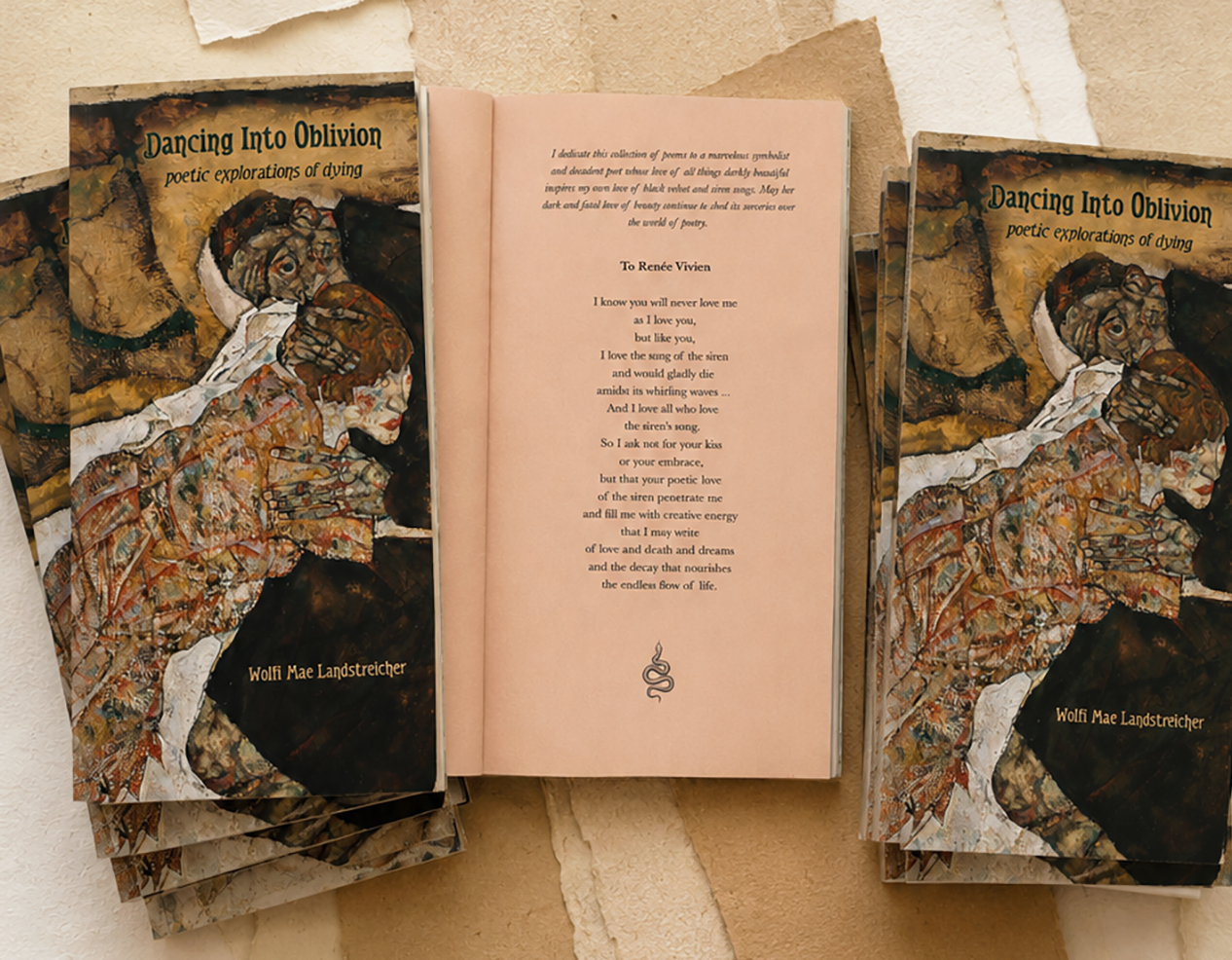
Bacchus Editions has made this physical limited edition worthy of the strange, familiar, beautiful creature Wolfi gave to us…
Dancing Into Oblivion is a slender 4.15 × 9 envelope sized book, an unusually tall, intimate format that feels like something carried in secret, un petit livre clandestin. The cover is built around the feverish corporeality of Egon Schiele, while inside the violence of the image falls away into warm salmon pages and restrained type. The poèmes have been given space. Shorter pieces gather toward the center of the page; longer poèmes take a more expansive form. Decoration is almost entirely absent, apart from the occasional tiny glyphs.
The poetry already contains more than enough wolves, oceans, blood, velvet, ruins, stars and monsters. It did not need us crowding the room! The result is one of the loveliest books to come out of the Bacchus atelier.
This limited first edition of Dancing Into Oblivion: Poetic Explorations of Dying is a beauty, pre-orders are now open, et it begins mailing the first week of September, alongside How to Bury an Anarchist, by moi, Fíona Vivienne.
These two books are being released together, as the new Anarchist Death Project goes live, as it seemed impossible to release them any other way. The books approach death from very different bodies, very different forms.. yet meet in the same unruly plane: death returned to the individual, stripped of obedience and institutional sanctity, brought back into the flesh, the earth, desire, disappearance, and the question of how one might make an ending one's own. They dance rather beautifully together.
For readers who have encountered Wolfi Landstreicher through his anarchiste essays, translations and decades of incendiary publishing, this book reveals another register of the same lifelong project. For those who know his poetry already, here is Wolfi wandering very far into its darkest land, jusqu'au fond.
For those who think they already know Wolfi... well. That was probably your first mistake, cher.
Come meet him… in disintegration, madness, et Oblivion.
~ FV