Le Bulletin de Vouziers, 1893. Adventures of An Anarchist
This curious little article appeared in Le Bulletin de Vouziers in 1893, shortly after Zo d'Axa's arrest at Jaffa and his forced return to France.
Part newspaper report, part comic sketch, it treats the affair less as a political event than as a picaresque adventure. The anonymous writer follows Zo from the streets of Jaffa to the deck of the Gironde, transforming diplomatic agreements, consular authority, prison transport, and international pursuit into material for farce.
This fascinates because it preserves something unmistakably Zo-like: the mixture of theatricality, scandal, humor, et self-invention that already surrounded him during his lifetime. Long before he became a historical figure, he was a character.
Most memorable of all is the image at its center: Zo d'Axa wandering through Jaffa in a green velvet suit, trailed by admiring street kids, before being "politely informed" by a French consul that he is under arrest.
It is also a reminder of how anarchists were being written about in the early 1890s (still?). Newspapers moved uneasily between alarm and amusement, fascination and ridicule. Still, in the middle of the exaggerations and jokes, something genuine slips through: a man who was resourceful enough to escape his guards, and equally incapable of resisting the temptation to appear at the window and watch the crowd that had gathered to stare at him. That isn’t a biographer inventing a personality, it’s a contemporary newspaper accidentally preserving one.
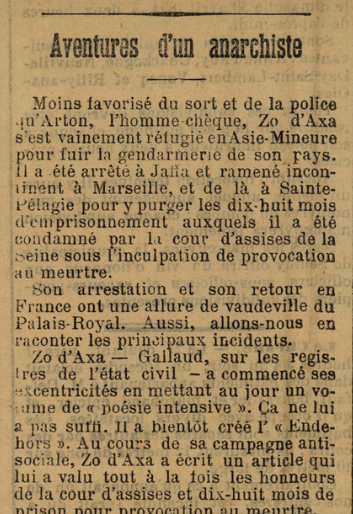
Le Bulletin de Vouziers, April 1893 ~ Adventures of an Anarchist
Translated by Fiona Vivienne
Less favored by fortune and by the police than Arton [1], the swindler, Zo d'Axa had vainly taken refuge in Asia Minor to escape the gendarmerie of his country. He was arrested at Jaffa and brought back, most inconveniently, to Marseille, and from there to Sainte-Pélagie to serve the eighteen months of imprisonment to which he had been sentenced by the Court of Assizes of the Seine on the charge of incitement to murder. His arrest and return to France have something of the character of a Palais-Royal vaudeville.
Let us therefore recount the principal incidents.
Zo d'Axa, Gallaud on the civil registers, began his eccentricities by bringing out a volume of "intensive poetry." That did not satisfy him. He soon created L'Endehors. During his anti-social campaign, Zo d'Axa wrote an article that earned him both the honors of the Court of Assizes and eighteen months in prison for incitement to murder.
The idea then came to him immediately to roam the world. He visited Italy, Austria, Turkey, and Asia Minor. He was strolling with perfect composure through the streets of Jaffa, followed by a dozen street boys whom his flamboyant costume, entirely of green velvet, filled with admiration, when a native gentleman of small stature came and stood before him and, with Levantine courtesy, said:
"Me. Consul. Wish speak you."
This language, which possessed scarcely anything French about it, charmed the former decadent poet, who hastened to follow his interlocutor. The latter immediately conducted him to a room in the consulate building, where he locked him up after saying, always politely: "You. Assassin. Arrested by virtue of capitulations dating from Francis the First."
The anarchist protested against the capitulations granted by Francis I [2].
But six janissaries appeared, weapons in hand, and having instructed him to continue his protest silently, Zo d'Axa judged it appropriate to keep quiet. He was then transferred beneath a sort of tent around which his guards kept watch. But a torrential downpour soon arrived, the janissaries decided to shelter in a neighboring house. Zo d'Axa took advantage of the opportunity to slip away in the middle of the night and take refuge in the English consulate.
There he was received without enthusiasm, but received nevertheless. He asked no more than that.
The following day, all Jaffa knew that a French prisoner, guilty of murder, had obtained asylum with the English consul. From then on, the idlers and the curious of the city came and stationed themselves routinely before the consulate. The anarchist, still whimsical despite events, could not resist the desire to place himself at the window and contemplate the crowd that was looking at him. Mocking and joker-like, he had been standing there for about five minutes when he suddenly felt himself seized by the head and dragged out of the place of asylum, that is to say into the street.
The janissaries [3] were taking their revenge by recovering, in an original though not especially legal manner, the prisoner of the previous day.
Zo d'Axa protested against this method of arrest, which the capitulations dating from Francis I could not possibly have foreseen. Useless efforts. He was bound, without a hat, having lost it during the balcony episode, led into a boat, and soon transported aboard the Gironde, returning from China and heading for Marseille.
The entire population of Jaffa attended the embarkation with curiosity.
Aboard the Gironde, he was lodged at the rear of the vessel, irons on his feet. The passengers came in succession to see the assassin, but prudently remained several meters away in order to avoid accidents. An Englishman dared address him:
"Whom have you murdered, miserable fellow?" he asked in a voice at once curious and indignant.
Zo d'Axa, eternally the gamin [4] of Paris, replied cynically: "I cut an old woman into thirteen pieces... That's what brought me bad luck!"
That reply remained, according to a well-known colorful expression, the finest day in the life of the director of L'Endehors.
Soon the passengers learned with horror that Zo d'Axa was not merely an assassin, but an anarchist as well. "Then he must be thrown into the sea!" said several people who, until then, had seemed somewhat interested in the fate of the unfortunate man.
The captain of the Gironde did not follow this rather unphilanthropic advice. Far from it. Despite the general indignation, he ordered the irons removed from Zo d'Axa's feet, and from that moment onward the anarchist was treated very comfortably.
The anarchist watched with boredom the arrival of the steamer at Marseille. At Marseille, he was detained in prison for three weeks. Then agents of Monsieur Goron came to fetch him and brought him to the prison of Sainte-Pélagie.
__
[1] Arton was a celebrated French fraudster associated with the Panama Canal scandals.
[2] The Capitulations were diplomatic agreements granting France certain legal privileges and jurisdictional rights within parts of the Ottoman Empire. French authorities relied upon these agreements to arrest and repatriate French citizens abroad. Zo d'Axa's protest is partly political and partly comic, treating a sixteenth-century treaty as the absurd instrument of his arrest.
[3] Janissaries were originally elite infantry of the Ottoman Empire. By Zo d'Axa's time the term was often used loosely in European writing for Ottoman guards, soldiers, or police attached to official authority.
[4] Gamin is a cultural type. gamin = Paris street boy, “urchin” of all things, and mischievous youth.