Translation: Zo d’Axa is Dead, Pierre Mualdes, 1930
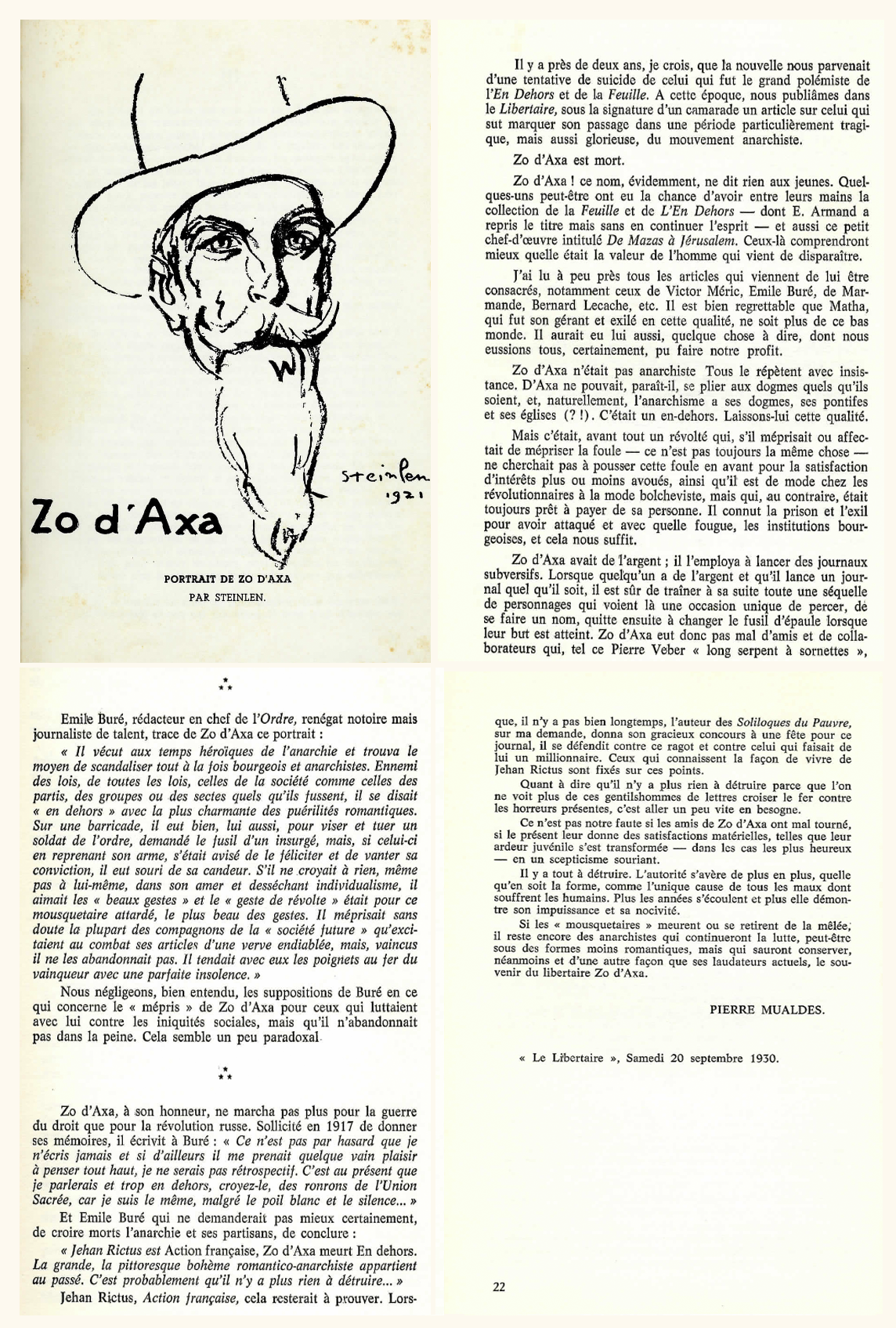
Zo d’Axa Is Dead.
Pierre Mualdes, 1930
Translated by Fiona Vivienne
Nearly two years ago, I believe, news reached us of a suicide attempt by the man who had been the great polemicist of L'En Dehors and La Feuille. At that time, we published in Le Libertaire, under the signature of a comrade, an article about the man who knew how to mark his passage through a period that was particularly tragic, but also glorious, in the anarchist movement.
Zo d'Axa is dead.
Zo d'Axa! That name, of course, means nothing to the young. A few, perhaps, have had the good fortune to hold in their hands the collections of La Feuille and L'En Dehors (a title later revived by E. Armand, though without continuing its spirit), and also that little masterpiece entitled From Mazas to Jerusalem. Those readers will better understand the worth of the man who has just disappeared.
I have read nearly all of the articles devoted to him, particularly those by Victor Méric, Émile Buré, Marmande, Bernard Lecache, etc. It is greatly regrettable that Matha, who was his manager and who went into exile in that capacity, is no longer among the living. He, too, would have had something to say, from which we all, certainly, might have profited.
Zo d'Axa was not an anarchist. Everyone keeps repeating it. D'Axa could not, it seems, submit himself to dogmas of any kind, and naturally anarchism has its dogmas, its pontiffs, and its churches (?!). He was an en dehors. Let us leave him that quality.
But he was, above all, a rebel who, though he despised, or affected to despise, the crowd, which is not always the same thing, did not seek to push that crowd forward for the satisfaction of interests more or less openly admitted, as has become fashionable among revolutionaries of the Bolshevik variety. On the contrary, he was always ready to pay the price himself. He knew prison and exile for having attacked, and with what fury, the bourgeois institutions. That is enough for us.
Zo d'Axa had money, and he used it to launch subversive newspapers. When someone has money and launches a newspaper of whatever kind, he is certain to drag behind him an entire retinue of characters who see in it a unique opportunity to break through, to make a name for themselves, only to switch allegiances once their objective has been achieved. Zo d'Axa therefore had quite a number of friends and collaborators who, like that Pierre Veber, that “long serpent of nonsense,” have nearly all succeeded in making a name and a position for themselves. What is the use of citing others?
Émile Buré, editor-in-chief of L'Ordre, a notorious renegade but a journalist of talent, sketches this portrait of Zo d'Axa:
“He lived during the heroic age of anarchy and found a way to scandalize both bourgeois and anarchists alike. An enemy of laws, of all laws, those of society as well as those of parties, groups, or sects of whatever kind, he called himself en dehors with the most charming of romantic childishnesses. Upon a barricade, he too would have borrowed an insurgent's rifle in order to aim at and kill a soldier of order; but if, upon taking back his weapon, the insurgent had thought to congratulate him and praise his convictions, he would have smiled at such candor. If he believed in nothing, not even in himself, within his bitter and withering individualism, he loved ‘beautiful gestures,’ and the ‘gesture of revolt’ was, for this belated musketeer, the most beautiful of all gestures. He undoubtedly despised most of the companions of the ‘future society,’ whom his articles of devilish verve stirred into combat; but once defeated, he did not abandon them. He extended his wrists beside theirs to the irons of the victor with perfect insolence.”
We neglect, of course, Buré's suppositions regarding the “contempt” Zo d'Axa supposedly felt toward those who fought alongside him against social injustices, whom he nevertheless did not abandon in adversity. That seems somewhat paradoxical.
To his credit, Zo d'Axa marched no more for the war of justice than for the Russian Revolution. Asked in 1917 to provide his memoirs, he wrote to Buré:
“It is not by chance that I never write, and if some slight vanity should seize me to think aloud, I would not be retrospective. I would speak of the present, and far too much outside, believe me, the purrings of the Sacred Union, for I am still the same man, despite the white hair and the silence...”
And Émile Buré, who would certainly ask nothing better than to believe anarchism and its partisans dead, concludes:
“Jehan Rictus is Action Française, Zo d'Axa dies En Dehors. The great, picturesque romantic-anarchist bohemia belongs to the past. It is probably because there is nothing left to destroy...”
Jehan Rictus, Action Française? That would still have to be proven. Not so very long ago, when, at my request, the author of The Soliloquies of the Poor graciously lent his support to a benefit for this newspaper, he defended himself against that rumor, and against another which made him out to be a millionaire. Those who know the manner in which Jehan Rictus lives are already settled on these points.
As for saying that there is nothing left to destroy because one no longer sees these literary gentlemen crossing swords against the horrors of the present, that is proceeding a little too hastily.
It is not our fault if the friends of Zo d'Axa turned out badly, if the present has given them material satisfactions such that their youthful ardor has been transformed, in the happiest cases, into a smiling skepticism.
There is everything left to destroy. Authority reveals itself more and more, whatever form it may take, as the sole cause of all the evils from which human beings suffer. The more the years pass, the more it demonstrates both its impotence and its harmfulness.
If the “musketeers” die or withdraw from the fray, there still remain anarchists who will continue the struggle, perhaps under forms less romantic, but who will nevertheless know how to preserve, and in a manner quite different from that of his current admirers, the memory of the libertarian Zo d’Axa.
~ Pierre Mualdes, Le Libertaire, September, 1930.
Add this to your cart to download the new Archive Discoveries translation!