Zo d’Axa is Dead, Pierre Mualdes, 1930.
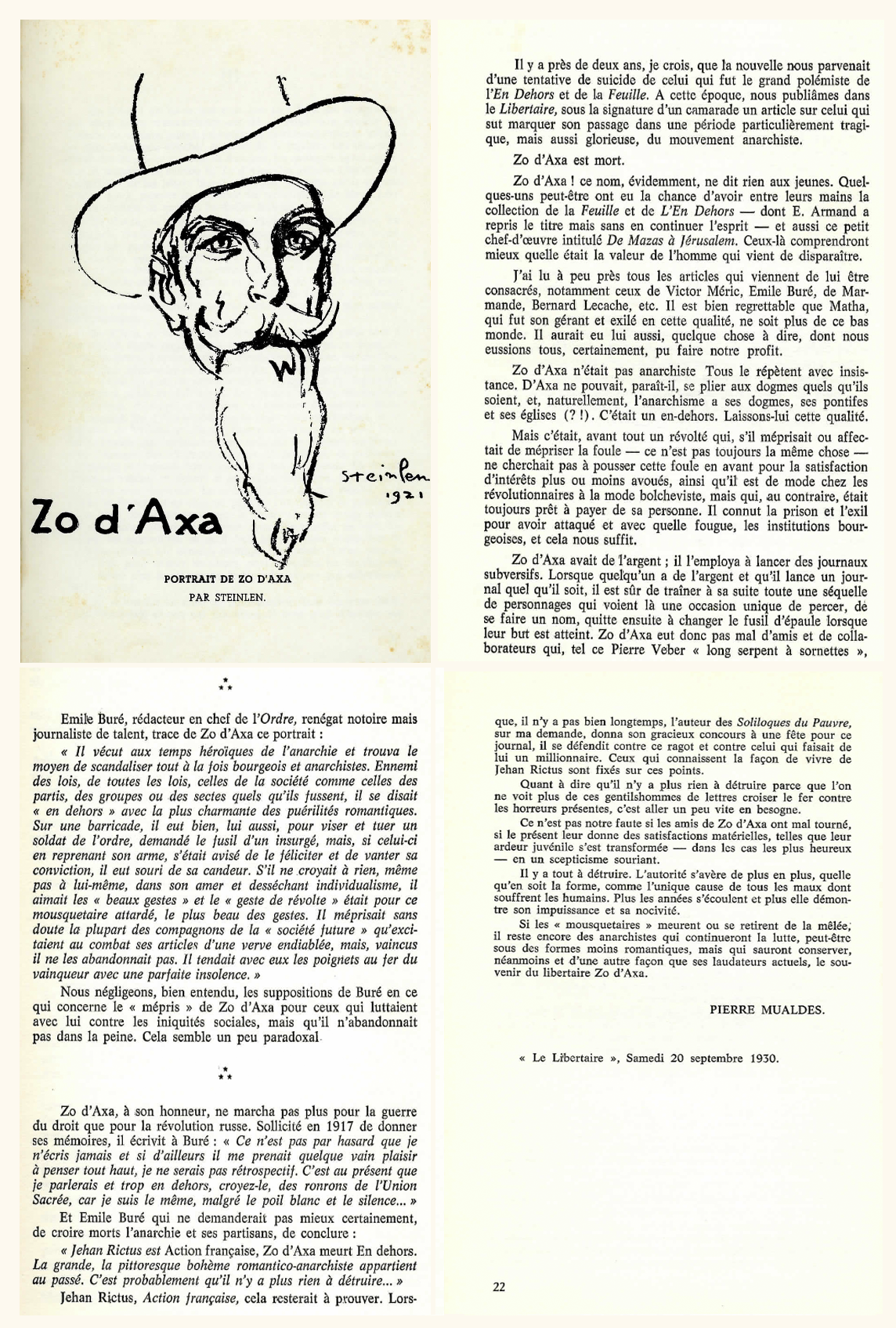
Zo d’Axa Is Dead!
While rifling through archives for three ongoing Bacchus projects, The Criminal Grace of Dancing: The Performing Body Through Nietzsche, Mallarmé, Artaud, and Genet (featuring Isadora Duncan, Valeska Gert, Mata Hari, Loïe Fuller, Béatrice Arnac, and Lavinia Schulz), Theatrical Shadows: Béatrice Arnac on Zo d'Axa ~ A Rare Familial Portrait of the Fin-de-Siècle Vagabond, and Zo d'Axa, Journalism, Vagabondage, Revolt, & Theatrical Insurrection, I stumbled across a small gem far too delicious not to share, naturellement….
Over in Archive Discoveries, in the Zo portal, you will find a writing by Pierre Mualdes, published in 1930, only months after Zo d'Axa's voluntary death. Part obituary, part argument, part defense, it wrestles with a question that has never quite gone away: who, exactly, was Zo d'Axa? Which is also to ask, perhaps, who remains en dehors today. Who still stands outside the camps, the orthodoxies, the collective banners, and the endless demand to belong? Qui donc? The question feels no less alive now than it did in 1930. Et pourtant...
Mualdes rejects the attempts, toujours the same attempts, to reduce him to a literary curiosity, a romantic eccentric, or a figure safely confined to the past. Instead, he presents a man of revolt, contradiction, insolence, and action. A man who refused dogma, distrusted crowds, fought authority, endured prison and exile, and remained stubbornly impossible to classify.
What struck me most while translating this piece is not simply how contemporary it feels, but how little the underlying pattern has changed. Nearly a century later, the landscape remains crowded with factions, causes, organizations, movements, and identities, each eager to gather people beneath a common banner. Even among anarchists, one can still observe the familiar pull toward camps, orthodoxies, and performances of belonging.
Against that backdrop, Mualdes's defense of the unruly individual, the one who remains obstinately en dehors, feels remarkably current, tout de même.
Mualdes refuses nostalgia. He does not mourn the passing of a vanished generation. Au contraire. He insists like some of us that there remains ‘everything left to destroy.’ The old ‘musketeers’ may die, retire, lose their appetite for the fight, or settle comfortably into the present, but others will arrive. D'autres viendront. There will always be singular figures who resist classification, refuse recruitment, and remain gloriously inconvenient to every camp that would claim them. The individuals who decline the comforts of belonging and continue, à leur manière, to keep the fire burning.
That, perhaps more than anything else, is what gives this article its enduring relevance. Je crois.
For the musketeers!
— Fíona