Translating
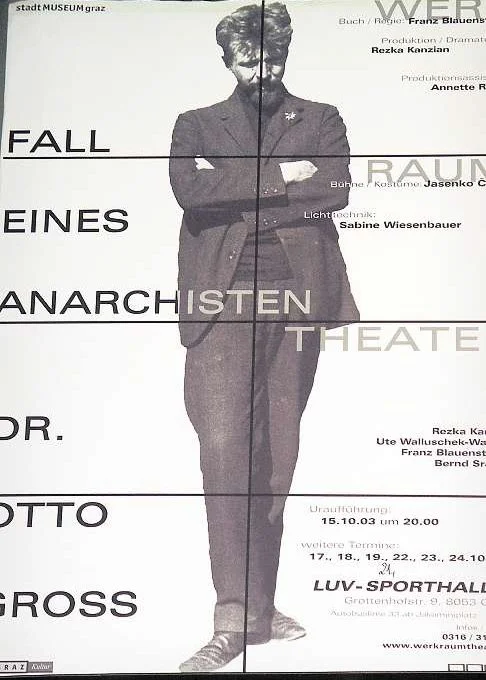
Otto Gross
He is widely cited, often invoked, and frequently placed at the margins of several traditions, yet rarely encountered in his own words. What circulates most readily are biographies, interpretations, and fragments selected to support particular readings of his life or influence. His writing itself remains dispersed across journals, archives, and partial collections, with only a small number of texts translated into English, and even fewer available in French. The result is a figure who appears familiar while remaining largely unread.
There are reasons for this. Gross did not produce a clean philosophical system, nor a stable body of work that could be easily gathered and presented, and, he has always been somewhat erased from at least psychoanalytic circles. His writings are embedded in early twentieth-century periodicals, written in a German that carries both the density of psychoanalytic discourse and the abruptness of polemic. His sentences often compress multiple lines of thought into a single structure, shifting between psychological observation, social critique, and personal address without marking transitions. He doesn’t pause to orient the reader, nor does he smooth contradictions into coherence. This usually creates a particular difficulty in translation, as English and French tend to require decisions about clarity, structure, and emphasis that redistribute the weight of the original.
Where translations do exist, they frequently emerge within academic contexts that prioritize readability and their own conceptual framing. This produces a version of Otto Gross that can be situated within various theories, but often at the cost of tone, cadence, intent, and the sharpness of his formulations. What reads in German as compressed, insistent, and at times deliberately unresolved can appear in translation as explanatory or systematized, altering the conditions under which the text is encountered.
Our engagement with Gross did not begin here. His presence has already been traced through earlier writings, fragments, and editorial work within our own projects, namely Distinctively Dionysian, not as an object of study but as a voice encountered directly, one that resists mediation when allowed to stand in its own life and language. Our earlier proximity made it crystal clear that, what is missing in the existing translations, was not simply availability, but the man and the texture of the writing itself.
The texts in this translation project are chosen precisely because they have not entered stable circulation in English or French. They allow for a return to Gross without anty reconstruction, without reliance on secondary framing, and without the need to position him within a predetermined intellectual lineage. They present him as he appears in his own writing: dense, abrupt, at times difficult, but unmistakably individual, and present.
To translate these texts is to work within that density. It requires attention to sentence structure, to rhythm, to the way argument and observation are held together without separation. It means resisting any impulse to clarify where Gross did not clarify, and to maintain the compression of his language without dispersing it into explanation. This is not a question of fidelity in the narrow sense, but of preserving the conditions under which the writing operates.
What emerges constantly is not a corrected version of Otto Gross, nor a more accessible one, but a closer one.
As the site expands, the translations will be shared here through excerpts, passages, and notes, and finally, when complete, in book form.