Translating
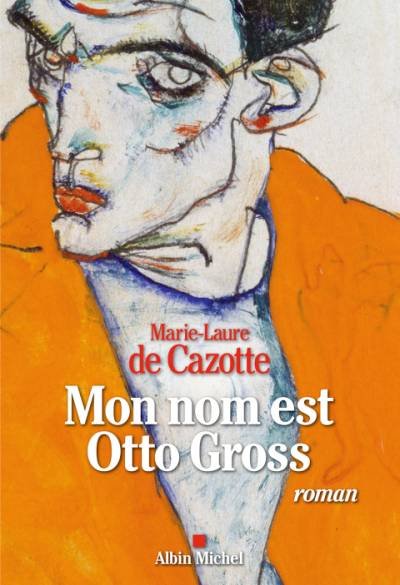
Marie-Laure de Cazotte - Mon Nom Est Otto Gross
My Name is Otto Gross
Mon nom est Otto Gross by Marie-Laure de Cazotte, published by Éditions Albin Michel, is a recent French novel centered on Otto Gross. It has not appeared in English. As mentioned on the main page, this translation began simply because those close wanted to read the book and could not. There are no English editions. This work begins there and will be shared here as it progresses.
Cazotte’s book is not a biography. It does not attempt to reconstruct Gross from the outside or organize his life into a complete account. It is written in the first person, speaking as him, and draws from well documented parts of his life while openly allowing for some invention and interpretation. Well researched invention and interpretation, we should say.
The novel follows recognizable moments: his movement through early psychoanalytic circles, his conflicts with Sigmund Freud and Carl Jung, his relationships, his legal and medical entanglements, and periods of confinement. These elements are not presented as a fixed historical record, they are arranged more as scenes, conversations, and interior passages that move between what is documented and what the author, a Gross researcher, imagined.
The structure is straightforward; chapters are set in specific places and years, all the real figures appear and interact. At the same time, the voice remains anchored in a first-person perspective that does not fully separate memory, interpretation, and invention. The result is a narrative that is legible as a story, but unstable in how it claims authority over what is being told.
Confinement plays a significant role in the book, but it doesn’t define its entire scope. The book moves between external situations and internal states, with shifts between clarity and disorientation that never settle into a single, reliable account of events. This position is stated openly by the author. The book is based on historical material—letters, journals, and known facts—but includes a substantial degree of fictional construction. It does not present itself as definitive. Again though, it is indeed well researched.
That tension is part of what drew us to it.
Otto Gross remains a figure who is often reduced, either to a footnote in psychoanalysis or to a simplified image of transgression. This book does something different. It does not clarify him at all. It places him inside a narrative that stays close to his instability without attempting to mend it, or resolve it.
Our interest in translating this work comes from that approach, as well as from its absence in English. There are many texts about Gross. There are very few that attempt to write as him, while still remaining tied to the historical record.
This translation is not presented as authoritative. It does not attempt to correct the original or define the figure it engages. It simply makes the text available, as it stands, for those who want to read it.
Updates, excerpts, and progress on the translation will be shared here as the work continues.

✶ · · ☾ · · ✶