Translating
Hélène Cixous
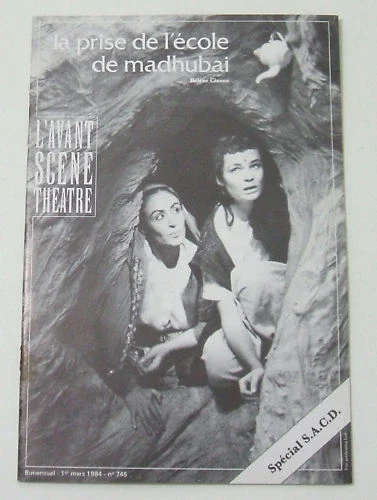
Portrait de Dora and La prise de l’école de Madhubaï brings together two plays by Hélène Cixous, written and staged between the 1970s and 1980s. These works didn’t follow the conventions of drama. In Cixous’ hands, théâtre is a place where language shifts, identities loosen, and what was usually fixed begins to move.
In Portrait de Dora, Cixous returned to the well-known psychoanalytic case from Sigmund Freud. But rather than retelling it, she unsettled it. ‘Dora’ was no longer held inside Freud’s interpretation. She spoke in fragments, in contradictions, in sudden turns that refused to settle into a single meaning. What mattered was not the case itself, but her refusal to be explained. Alongside her, another figure appears, drawn from Sanskrit theatre: Sakuntala. She was not treated as symbol or comparison. She remained at a distance, moving through the play as a kind of echo. Abandoned, misrecognized, returning through memory. Not the same story, but am eternal recurrence. Something that continued across time without being absorbed into it.
In La prise de l’école de Madhubaï, the setting shifted to a school. What unfolded there was less a narrative than a pressure. In the play, and much of her writings, language, knowledge, and identity are imposed through institutional forms. Voices emerge that do not fit what they were meant to become. The system attempts to organize, define, and produce coherence. Something resisted that did not resolve. The play is about that resistance.
Across both plays, psychoanalysis, myth, and education appear as different expressions of the same impulse: interpret, shape, contain. And in each case, something slips beyond that effort.
Cixous wrote over seventy books across fiction, essays, philosophy, and theatre. Only a small portion of her work exists in English. Much of it appears only as fragments, and excerpts in academic editions that are not only difficult to access, but translated without embodiment. Her theatre, in particular, has never fully circulated in a sustained or cohesive way. La prise de l’école de Madhubaï has been translated, but not encountered as part of her living body of work, and definitely not by one with affinity to the central ideas in each play.
Translating her to English is interesting. Her writing doesn’t behave like standard prose. It moves between voices, shifts tone without warning, and allows meaning to remain open rather than resolved. Sentences never aim to explain themselves, they simply carry forward, without signaling where they are going.
This is where translation becomes something more than conversion. French allows for a certain fluidity that English tends to resist. Tone, position, and subject can shift without being explicitly marked. English often asks for clarity, structure, and decisions that fix meanings in place. When translating Cixous, the challenge is not simply to understand what is being said, but to resist the English urge to stabilize it.
Translating her, then, is a matter of attention rather than correction. Following the movement of the sentence… allowing ambiguity to remain where it belongs… preserving rhythm, breath, and fracture without forcing coherence where none was intended. This kind of translation depends on a longer familiarity with her writing as a whole. Not just a single text, but a field of recurring gestures, images, and returns. It requires staying close without trying to resolve what resists resolution. There is a particular pleasure and challenge in this.
As the site expands, you’ll find translation notes, updates and more here on this dedicated page.
✶ · · ☾ · · ✶